

NMPA Approves Another Domestic Non-Invasive Glucose Monitor: LeapMed’s NeoGlu 01 Receives Class III Certification

Lepu Medical
Developer and Manufacturer of Cardiac Interventional Medical Devices and Pharmaceuticals
Lepu Medical recently announced that its self-developed non-invasive glucose meter, NeoGlu 01, has officially received approval for a Class III medical device registration certificate from the National Medical Products Administration (NMPA). According to the NMPA’s official website, this is the third domestically produced non-invasive glucose meter to gain approval, following those from Bobang Fangzhou and Jingce Medical.
Diabetes is a metabolic disorder characterized by hyperglycemia. Blood glucose testing is a critical approach for identifying individuals with potential diabetes and serves as a key method for adjusting treatment strategies and evaluating therapeutic efficacy. Traditional blood glucose meters (BGM) and continuous glucose monitoring (CGM) systems are invasive monitoring methods that heavily rely on patient compliance. Consequently, non-invasive and painless blood glucose monitoring technologies have become a focal point of research for professionals both domestically and internationally.
According to Lepu Medical’s announcement, this product combines optical and thermal methods to collect physiological and environmental signals correlated with blood glucose levels. Its artificial intelligence model automatically identifies the association between signal features and blood glucose levels, enabling synchronous multi-feature analysis to provide monitoring results.
In its semi-annual report, Lepu Medical stated that in addition to the first-generation non-invasive glucose meter NeoGlu, which has recently received approval, its second-generation continuous non-invasive glucose monitoring device, GluRing, is currently in the clinical stage and is expected to submit a registration application by the end of 2024. Furthermore, Lepu Medical has also laid out plans for CGM (Continuous Glucose Monitoring). The first-generation product, NeoGlu Comfort, has completed clinical trials and is preparing to submit a registration application, while the second-generation CGM product has already entered clinical trials.
A search on the NMPA official website using the keyword “non-invasive glucose meter” reveals that Bobang Fangzhou Medical’s non-invasive glucose meter has also been approved.In August 2019, the non-invasive glucose monitor jointly developed by Bobang Fangzhou and Tsinghua University received China’s first Class III medical device registration certificate approved by the NMPA.
To date, Bobang Fangzhou’s products have been updated to the third generation. These products are primarily used for daily blood glucose management in patients with diabetes and can also be employed for self-monitoring by individuals with impaired glucose regulation (including impaired glucose tolerance and impaired fasting glucose).
Jingce Medical’s combination glucose meter, which received NMPA approval in April this year, is also a non-invasive glucose meter.The product consists of a non-invasive blood glucose monitoring module, an invasive blood glucose monitoring module, a metabolic heat probe, an ambient temperature and humidity monitoring module, and a display screen. It is suitable for daily self-monitoring of blood glucose in patients with type 2 diabetes.
It should be noted that while the three products have achieved innovations in monitoring methods, their indications for use have been strictly limited.The NMPA approval pages for all three products indicate that,"This product is not for use in medical institutions, is not intended for individuals under 18 years of age, is not for the screening or diagnosis of diabetes, and the estimated results shall not serve as a basis for adjusting therapeutic medications."
The approval pages for Lepu Medical and Bobang Fangzhou also show, this product is suitable for daily self-management of blood glucose in patients with type 2 diabetes who are not treated with insulin. It can serve as a supplement to existing fingerstick blood glucose testing but cannot replace other blood glucose monitoring methods. Patients still need to regularly perform fingerstick blood sampling to measure blood glucose levels.
Currently, apart from Lepu Medical’s newly approved product, the other two products have already been launched and are available for sale.
Based on different technical approaches, the mainstream technologies for non-invasive blood glucose monitoring include optical and non-optical methods.
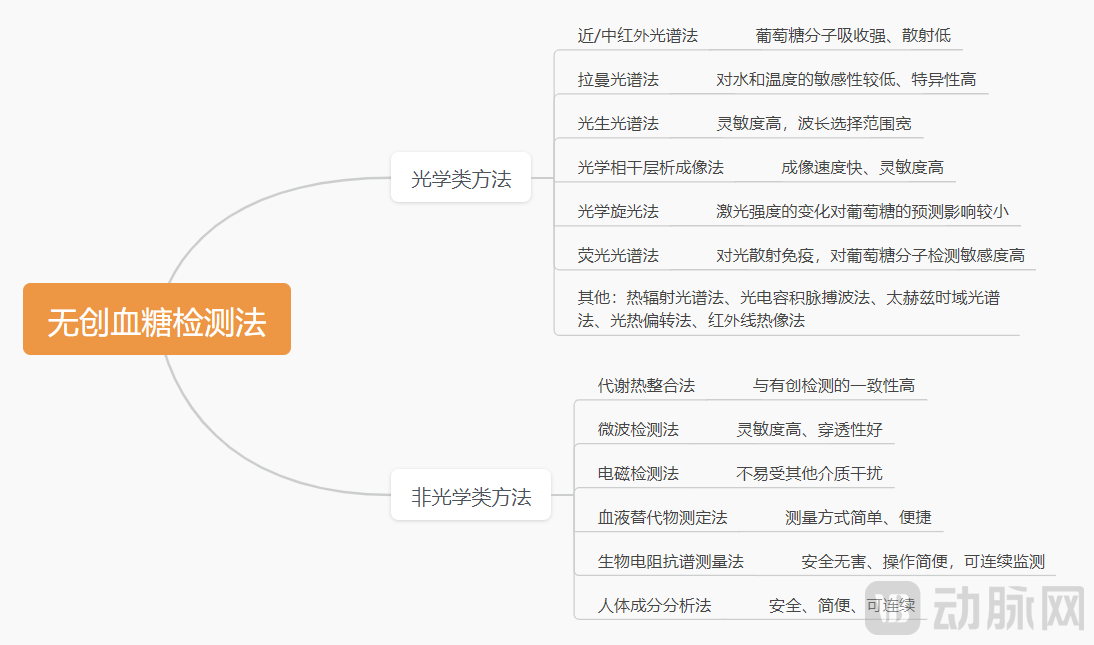
Optical detection methods use light as an information carrier, focusing a beam of light onto the human body. By leveraging the close correlation between blood glucose concentration and parameters such as transmitted light intensity, phase, polarization angle, frequency, and the scattering coefficient of tissue in the target area, these methods indirectly calculate blood glucose levels by extracting changes in these signals. Depending on the wavelength of the light wave and the underlying mechanism of action, optical detection methods can be further categorized into various types.
Non-optical methods primarily derive blood glucose concentration by measuring heat, glucose phase, or electrical properties within the human body, or indirectly estimate blood glucose levels by measuring glucose-related substances or physical characteristics in the body.Lepu Medical did not disclose the principles or detection methods of its approved products. Bobang Fangzhou and Jingce Medical, on the other hand, are based on the metabolic heat integration method.
The metabolic heat integration method is based on the principle that, when a person is at rest, the energy generated by human metabolism is primarily dissipated to the external environment in the form of heat. At this time, the heat produced by metabolism is related to blood glucose levels and blood oxygen content, while blood oxygen content is associated with blood oxygen saturation and blood flow velocity. However, Jingce Medical’s products collect sublingual temperature, whereas Bobang Fangzhou’s products collect fingertip temperature.
However, the metabolic heat integration method is based on the assumption of an absolute equilibrium between heat production and heat dissipation in the body. It faces significant challenges due to the complex coupling of multiple sensors and parameters, and it is highly susceptible to ambient temperature fluctuations. For instance, during the extended period following a meal, human heat production exceeds heat dissipation. This deviation from the underlying principle of the metabolic heat integration method leads to reduced accuracy in postprandial blood glucose measurements.
Based on this, Jingce Medical’s approach involves using its proprietary probes with a resolution of up to 0.01°C to capture minute metabolic heat differentials where postprandial heat production exceeds heat dissipation, thereby calculating user blood glucose levels. The calculation results are then corrected by comparing them with environmental parameters and personalized calibration data, thus overcoming the challenge of significant postprandial errors.
In addition to the metabolic heat integration method adopted by Chinese companies, numerous players in the global non-invasive blood glucose monitoring field have conducted relentless explorations along various technical routes.
Apple Inc., which has attracted significant attention, adopts Raman spectroscopy.Raman spectroscopy determines the molecular structure of substances based on the frequency difference between Raman scattering and Rayleigh scattering generated when laser light interacts with the sample, thereby enabling the compositional analysis of different materials.
The advantage of this approach lies in the weak Raman scattering of water, making it suitable for detecting aqueous solutions of biological samples; furthermore, Raman scattering spectral peaks are sharp and distinct, facilitating analysis. However, this method has significant drawbacks: the Raman scattering signal of glucose is weak and susceptible to interference, and the overall system equipment is expensive and bulky.
Not long ago, Bloomberg reported that Apple has made new moves in the field of blood glucose monitoring. The company has selected a group of employees to test its blood glucose app.
Apple has long been strategizing in the field of non-invasive glucose monitoring. In 2010, under Steve Jobs’ leadership, Apple acquired RareLight, a company specializing in non-invasive glucose monitoring. In 2015, Apple’s Core Devices Group (CDG), its advanced exploration division, took over the non-invasive glucose monitoring project and invested heavily in proof-of-concept development.
Another tech giant, Google, employs a blood surrogate assay.This technical approach involves sampling bodily fluids such as sweat, tears, saliva, and interstitial fluid, and performing chemical analysis on the biomarkers they contain to determine blood glucose levels. This technology requires companies to master the biochemical composition of these bodily fluids and their relationship with blood chemistry, while also upgrading sensors and algorithms to eliminate interference from environmental factors and individual physiological differences. Due to the significant challenges in research and development, Google’s product was ultimately abandoned.
It is important to note that obtaining regulatory approval does not guarantee a smooth path to market success. For instance, Cygnus Medical’s GlucoWatch, C8 MediSensors’ optical glucose monitor, and the Israeli company Cnoga’s TensorTip CoG, a glucose meter based on hemoglobin tissue color imaging technology, all received marketing authorization. However, due to multiple issues such as insufficient monitoring accuracy, inconvenient usability, and unstable signal acquisition, they failed to gain significant market acceptance and were ultimately withdrawn from the market.
As of now,The application of non-invasive glucose meters is limited by factors such as their large size, high usage costs, and low accuracy.
In response, new technologies and methods are continuously emerging in the market to address these issues. For instance, Bobang Fangzhou’s solution requires no consumables beyond the hardware device; Jingce Medical’s products are undergoing continuous iteration, with its second-generation device resembling a digital voice recorder and compatible with smartphones, thereby enhancing convenience.
There have also been some advances in monitoring accuracy. In June 2024, HAGAR released clinical study data comparing its non-invasive continuous glucose monitor, GWave, with traditional CGM devices. The data showed that 97% of GWave readings matched those of traditional CGMs; two separate GWave devices yielded consistent results; and the mean absolute relative difference (MARD) for GWave was 6.7%.
The 10th Edition of the IDF Diabetes Atlas shows that China has the highest number of adult diabetes patients in the world, reaching 140 million. Awareness of daily blood glucose monitoring is not yet widespread, indicating substantial potential for market growth. With continuous optimization and innovation by tech giants and startups focused on glucose monitoring, the non-invasive glucose monitoring market is poised for rapid development. Amidst intense competition among various stakeholders, patients are undoubtedly the biggest beneficiaries.