

Billion-Dollar Medical Device Rebounds as MASH Drug Approvals Drive Demand for Transient Elastography
In 2024, a blockbuster medical device was propelled into the spotlight by drug development for metabolic dysfunction-associated steatohepatitis (MASH).
Transient elastography (TE) is an indispensable technology in clinical trials for MASH therapeutics. Liver transient elastography devices enable non-invasive, quantitative diagnosis of liver fibrosis and hepatic steatosis, facilitating patient screening, scientific and precise stratification, and assessment of the clinical efficacy of MASH drugs in clinical trials.
In 2024, the field of metabolic dysfunction-associated steatohepatitis (MASH) witnessed significant advancements with the global approval and market launch of Rezdiffra, the first innovative therapy specifically indicated for MASH. The drug’s prescribing information recommends the use of transient elastography for assessment. Furthermore, numerous pivotal MASH drug pipelines are under development worldwide, with more than ten therapies for NASH expected to gain approval over the next 10–15 years. This year alone, MASH-related transactions exceeded $2 billion. The application of GLP-1 receptor agonists and small nucleic acid therapeutics in MASH treatment has also attracted considerable attention.
The research and development and clinical application of MASH drugs will significantly boost market demand for transient liver elastography devices, further expanding the market for this major medical device category.
The market for transient liver elastography devices is dominated by two companies: Echosens and Hisky. Financial reports released by Furi Pharmaceutical, the parent company of Echosens, show that sales revenue from liver fibrosis diagnostic instruments reached RMB 420 million in the first half of 2024. Hisky has completed multiple rounds of financing amounting to hundreds of millions of yuan, with its global installed base exceeding 3,000 units.
Liver Transient Elastography Devices Have Been on the Market for Over Two Decades: How Did They Become a Blockbuster Product in the Medical Device Industry? How Will the Surge in MASH Drugs Impact the Market Size of This Product?
TE is a product used for diagnosing liver fibrosis and fatty liver disease. Liver fibrosis refers to the excessive deposition of fibrous connective tissue in the liver resulting from various forms of chronic liver injury, and it represents a common pathway progressing toward cirrhosis. The early stages of liver fibrosis are reversible; therefore, early identification and timely therapeutic intervention can effectively slow the progression of liver disease and improve prognosis. Recent studies have indicated that fatty liver disease may also progress in a non-linear, "skip" manner. Multiple studies have confirmed this possibility, with one retrospective data analysis showing that 16% of hepatocellular carcinoma cases originated from simple non-alcoholic fatty liver disease.
As liver fibrosis progresses, liver stiffness gradually increases. A healthy liver feels soft to the touch, whereas a fibrotic liver feels firm like the tip of the nose, and a cirrhotic liver feels hard like the forehead. The fundamental principle of transient elastography is based on the propagation of shear waves in solid tissues: the higher the stiffness, the faster the wave propagation speed. This mechanism is used to stage liver fibrosis.
However, early-stage hepatic fibrosis is difficult to diagnose accurately and non-invasively. Hepatic fibrosis caused by most chronic liver diseases, and even early-stage cirrhosis, lacks specific symptoms, signs, or abnormalities in routine blood biochemical markers; therefore, it is not easily detected in a timely manner without liver histopathological examination.
The breakthrough of TE technology lies in providing a precise, non-invasive diagnostic method for liver fibrosis, thereby reducing the need for invasive biopsies in hospitals.Transient Elastography (TE) is a non-invasive quantitative diagnostic method. It utilizes a specialized probe to generate shear waves at a fixed frequency through mechanical vibration, while simultaneously emitting high-frequency ultrasound signals to track the propagation velocity of these shear waves within the liver. By integrating histological models of liver tissue, TE provides a quantitative Liver Stiffness Measurement (LSM) to assess the degree of fibrosis. Ultrasound propagation in the human body undergoes attenuation due to absorption, scattering, and reflection. In fatty liver disease, the accumulation of lipid droplets within hepatocytes significantly enhances ultrasound scattering. The severity of hepatic steatosis correlates positively with the extent of ultrasound scattering and the degree of acoustic attenuation.
TE simultaneously tracks the energy attenuation of ultrasound signals as they propagate through liver tissue, providing a quantitative assessment of fatty liver disease via the Ultrasound Attenuation Parameter (UAP) to evaluate the degree of hepatic steatosis.
Simply put, TE devices simultaneously measure liver stiffness measurement (LSM) and controlled attenuation parameter (CAP), which reflect the degree of liver fibrosis and hepatic steatosis, respectively.
The most frequently asked question during the market promotion of TE products is the difference between TE and ultrasound.
Industry experts stated: “Ultrasound is a non-invasive qualitative examination method, whereas TE (Transient Elastography) is a non-invasive quantitative detection method. Ultrasound generates images of internal human structures by transmitting high-frequency sound waves via an ultrasound probe and receiving the reflected signals. In the diagnosis of liver fibrosis, the degree of fibrosis is assessed based on parameters such as liver size, edge bluntness, parenchymal coarseness, surface nodularity, size of periarterial lymph nodes, portal vein blood flow velocity, and spleen size. In the diagnosis of fatty liver disease, changes in the reflection and refraction of sound waves occur when they encounter tissues of varying densities, thereby enabling the determination of fatty liver presence. For patients with fatty liver, acoustic reflection is enhanced due to fat accumulation, resulting in hyperechoic (bright) imaging.”
The specificity and sensitivity of ultrasonography vary considerably, being more susceptible to factors such as equipment, anatomical site, and the operator’s skill and experience. In contrast to conventional ultrasound, transient elastography provides more objective and quantitative results.
Transient elastography can be understood as a more technically challenging form of ultrasound technology. The primary technical barrier lies in data quantification, which requires the generation of safe and stable shear waves and the accurate calculation of their propagation velocity. Human tissues have a limited tolerance for external forces; within safety limits, the amplitude of shear waves is very small, their propagation is slow and broad, and they attenuate rapidly.
Precisely because of the aforementioned characteristics of shear waves in the human body, platforms for detecting shear waves require an optimal shear wave source, the highest possible detection rate, the widest possible field of view, and highly focused detection energy. This imposes stringent requirements on vibration control, ultrasonic transducers, and the measurement of shear wave propagation velocity.
Industry insiders stated, “Achieving precise and accurate detection involves numerous technologies. Among these, the accumulation of massive raw data and algorithmic analytical capabilities are the guarantees of product detection accuracy and precision.”
As the number of participants increases, patents serve as a critical moat. This patent moat effectively safeguards a company’s core technologies and restricts competitor entry, enabling it to maintain a unique competitive advantage in the transient elastography market while securing market share and profitability. For instance, Hisky successfully broke the monopoly held by foreign technologies and rapidly captured market share through its core patented technologies.
According to data from YH Research, global revenue in the elastography market reached USD 2.39 billion in 2023 and is projected to grow at a compound annual growth rate (CAGR) of 5.9% in the coming years, with the market size expected to exceed USD 3.579 billion by 2030.
In terms of market landscape, FibroScan, launched by Echosens, a subsidiary of Forui Shares, dominates the overseas market. In the Chinese market, Hisky's products lead in installation volume and hold a significant market share.
Echosens was co-founded in 2001 by Dr. Laurent Sandrin, a French national, along with other partners. The company previously received investments from Cathay Capital and OrbiMed. In 2016, Furuishare acquired Echosens for €20 million, making it a wholly-owned subsidiary.
FibroScan’s core competitiveness lies in its widespread adoption across more than 100 countries and regions worldwide, as well as its inclusion in clinical practice guidelines for liver disease by numerous authoritative organizations—including the World Health Organization (WHO), the European Association for the Study of the Liver (EASL), the Asian Pacific Association for the Study of the Liver (APASL), and the American Association for the Study of Liver Diseases (AASLD)—which officially recommend it as a device for liver stiffness measurement.
In China, Hisky was established in 2010 and launched FibroTouch, a transient elastography product based on technology from Tsinghua University’s laboratory. The global installed base has exceeded 3,000 units. Meanwhile, Hisky has obtained overseas market certifications from the U.S. FDA, the EU CE, Japan’s PMDA, Australia’s TGA, South Korea’s KFDA, and Russia’s RZN, with its products sold to more than 60 countries and regions worldwide.
As attention on the transient elastography (TE) market continues to grow, new entrants such as Mindray Medical, Lepu Medical, and E-Lead Medical have joined the competition. Leveraging its technological expertise in ultrasound, Mindray Medical has launched its Hepatus series of transient elastography systems, which are now available in domestic, international, and North American markets. The startup E-Lead Technology has introduced the industry’s first handheld wireless liver stiffness meter, a product that distinguishes itself from the cart-based transient elastography devices currently on the market through its portability and compact design.
In the TE market, core competitiveness is primarily reflected in the following aspects: First, physicians focus on whether the device demonstrates consistency with liver biopsy and whether comparative studies against liver biopsy have been conducted. Second, clinical expert endorsement is a key indicator, specifically whether the product has gained widespread recognition among clinical experts. These metrics are often influenced by subtle product differences, such as variations in frequency and algorithms.
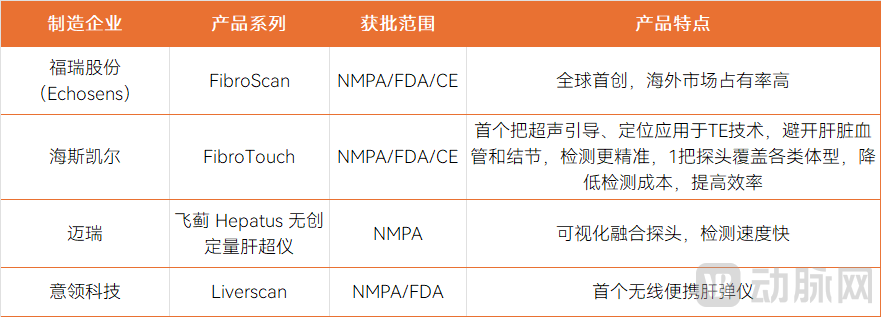
Major TE Products in the Domestic Market
With the market launch of MASH medications, the transient elastography (TE) market is poised for further expansion. Future growth in the TE market will be driven by three key factors:
The primary growth driver is the approval of MASH drugs, which will boost demand for TE testing.The pathogenesis of MASH is complex, effective assessment methods are lacking, and the U.S. FDA has stringent requirements for clinical endpoints. Furthermore, drug mechanisms may be too indirect, monotherapy demonstrates suboptimal efficacy, and the incidence of adverse effects is high. For a long time, there has been a lack of definitive therapeutic options for MASH.
In 2024, this field finally achieved a breakthrough. Rezdiffra, developed by Madrigal Pharmaceuticals, received U.S. FDA approval for marketing on March 14, becoming the first MASH drug to gain such approval in 40 years. According to Madrigal Pharmaceuticals’ financial report for the second quarter of 2024, sales of Rezdiffra reached $14.6 million in its first quarter on the market, exceeding expectations. Meanwhile, more than ten new MASH drugs are approaching launch.
TE devices play a pivotal role in the application of MASH therapeutics, facilitating early identification of MASH patients and evaluating drug efficacy through TE’s quantitative capabilities. Given the large population of patients in China with diabetes or obesity complicated by fatty liver, the increase in MASH drug research and approvals will significantly drive up the demand for TE-based diagnostics.
Seizing the new opportunities presented by MASH therapeutics, major global players are actively preparing. Forui Medical has established collaborations with multiple large international pharmaceutical companies, leveraging FibroScan for initial patient screening and clinical efficacy assessment in MASH drug development, thereby cementing FibroScan’s position as the gold standard in the diagnosis of MAFLD/MASH worldwide.
According to experts, Hisky has developed a device capable of quantitatively detecting metabolic dysfunction-associated steatohepatitis (MASH). Multiple hospitals have participated in the validation of this feature, positioning it as potentially the first device to enable direct quantitative detection of MASH.
The second-largest driver of market growth is the expanding population of patients with fatty liver disease.Currently, TE technology is primarily applied in hepatology and infectious disease departments. With the development of MASH therapeutics, endocrinology departments will also begin to adopt TE technology. In the past, TE technology mainly targeted patients with liver fibrosis caused by viral hepatitis. As the national action to eliminate hepatitis advances, along with the widespread adoption of vaccines and the implementation of mother-to-child transmission prevention measures, the number of new viral hepatitis cases is gradually declining, leading to a gradual contraction of the existing market for TE.
However, the market for fatty liver disease is gradually expanding. Simple steatosis can progress through four stages: developing into metabolic dysfunction-associated steatohepatitis (MASH), hepatic fibrosis, and cirrhosis, which may ultimately lead to hepatocellular carcinoma. Recent studies, however, indicate that fatty liver disease can also follow a skip-pattern progression. Multiple studies have confirmed this possibility; a retrospective data analysis showed that 16% of hepatocellular carcinoma cases originated from simple non-alcoholic fatty liver disease.
With the prevalence of obesity and type 2 diabetes mellitus (T2DM), the global prevalence and incidence of non-alcoholic fatty liver disease are continuously rising, with the situation being particularly severe in China. According to data from the Chinese Consensus on the Clinical Diagnosis and Treatment of Liver Cirrhosis, although accurate figures for the number of patients with metabolic dysfunction-associated fatty liver disease (MAFLD) in China are lacking, it is projected that the number of MAFLD patients in China will increase from approximately 244 million in 2016 to about 315 million by 2030, including approximately 750,000 new cases of MAFLD-related decompensated liver cirrhosis. As a country traditionally burdened with a high prevalence of liver diseases, China faces a grim outlook.
The third major growth driver is the rising demand in the health checkup market.. In the health checkup market, national regulations prohibit mandatory hepatitis B testing for school enrollment and employment. Health checkup centers can use TE devices to help clients detect liver fibrosis and fatty liver disease at an earlier stage.
Two decades since its inception, TE technology is experiencing a resurgence following the approval of MASH therapeutics. This development is expected to drive up diagnostic and treatment demand, unlocking an entirely new incremental market. As a billion-dollar single-product category, TE is poised for leapfrog growth.
Reference Article:
[Consensus] Expert Consensus on the Diagnosis of Liver Fibrosis Using Transient Elastography (2018 Updated Edition)—Chinese Journal of Hepatology
[Consensus] Consensus on the Diagnosis and Treatment of Liver Fibrosis (2019)
Can Fatty Liver, a Condition Affecting Many People, Progress to Liver Cancer? It’s True! — The Second Affiliated Hospital of Zhejiang University School of Medicine