

Evommune Secures $115M Series C Financing to Advance Clinical Development of EVO756 and EVO301 for Autoimmune Inflammatory Diseases

Evommune
Biological New Drug Developer
On October 31 local time, Evommune, a pharmaceutical company focused on developing treatments for immune-mediated inflammatory diseases, announced the completion of a $115 million (approximately RMB 819 million) Series C financing round. The funds will support the clinical development of its lead program, the MRGPRX2 inhibitor EVO756, and its IL-18-targeted fusion protein program, EVO301. Evommune expects to announce data from multiple Phase 2 trials of these therapies in patients with chronic urticaria and atopic dermatitis in 2025 and 2026.
This funding round was co-led by RA Capital Management and Sectoral Asset Management, with participation from B Capital, Marshall Wace, Avego Bioscience Capital, Longwood Fund, RTW Investments, ADAR1 Capital Management, NEXTBio Capital, Beiersdorf Venture Capital, FemHealth Ventures, Allostery Investments LP, Pivotal bioVenture Partners, EQT Life Sciences, Andera Partners, Amplitude Ventures, SymBiosis, Verition Fund Management, and others.
The story of Evommune begins in 2020. That year, Luis Peña, a seasoned pharmaceutical executive, sold the dermatology drug development company he founded to Eli Lilly for $1.1 billion. Just one week after leaving Dermira, Luis Peña established Evommune, focusing on the development of therapies for immune-mediated inflammatory diseases.
In its founding year, November 2020, Evommune announced the completion of a $12.5 million seed financing round. In September 2021, April 2023, and July 2023, the company subsequently completed its Series A, Series B, and Series B+ financing rounds, raising $83 million, $50 million, and $7.5 million, respectively. Including this Series C financing round, Evommune has raised a cumulative total of $268 million (approximately RMB 1.909 billion) over a four-year period (from November 2020 to November 2024).
Why Does Evommune Frequently Garner Recognition from Investment Institutions? The Answer May Lie in Its Pipeline PortfolioAccording to Evommune’s official website, the company currently has seven specialized pipelines in development, targeting indications such as urticaria, atopic dermatitis, and inflammatory bowel disease. These are all chronic autoimmune conditions that currently lack curative treatments and affect large patient populations. The proceeds from this financing round will be allocated to the clinical development of the EVO756 and EVO301 pipelines.
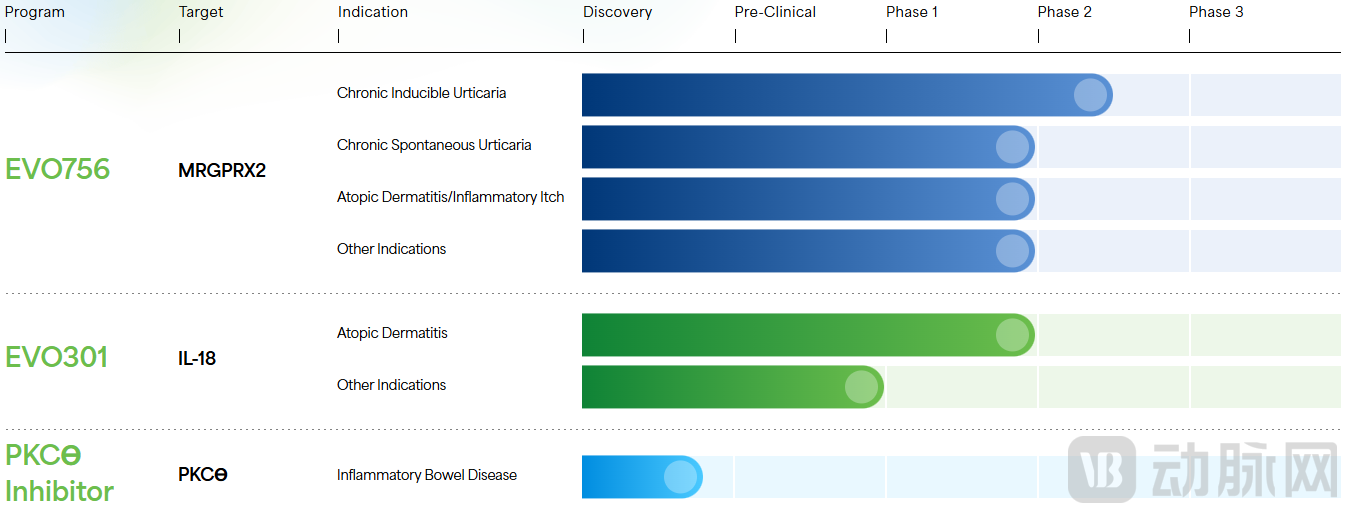
Evommune’s Pipeline Portfolio, Image Source: Evommune Official Website
EVO756 is a potent, highly selective small-molecule antagonist of MRGPRX2. MRGPRX2 is most abundantly expressed on mast cells, which are the primary effector cells driving various inflammatory diseases. By blocking MRGPRX2 and inhibiting mast cell granule release, EVO756 holds promise as a targeted, safe, and effective therapy for multiple mast cell-mediated disorders. In July this year, Evommune announced positive proof-of-concept clinical data for EVO756. All doses of EVO756 demonstrated favorable safety and tolerability profiles, supporting once-daily oral administration. The company will present the full trial results at scientific conferences in the fourth quarter of 2024.
EVO301 is a long-acting, serum albumin-binding IL-18BP fusion protein injectable therapy. IL-18 is a pro-inflammatory cytokine of the IL-1 family that drives innate and adaptive immune processes associated with infection, inflammation, and autoimmunity. IL-18BP is a naturally occurring inhibitor of IL-18. By neutralizing the IL-18 signaling pathway, EVO301 treats various inflammatory and autoimmune diseases. Evommune plans to initiate Phase 2 clinical trials of EVO301 in patients with atopic dermatitis in the first half of 2025 and expects to obtain preliminary data from these trials in 2026.
Since the beginning of this year, the autoimmune disease sector has been exceptionally active, with frequent blockbuster deals highlighting its remarkable fervor.In addition to Evommune, multiple domestic and international companies with a presence in the autoimmune disease sector, including Zedman Pharma, Zhikang Hongyi, Anlixirong, Navigator, AltruBio, Candid, Cartesian, and Jade Biosciences, have all completed financing rounds this year.
Notably, in April this year, Vertex acquired Alpine at $65 per share, representing a nearly 80% premium, for a total consideration of approximately $4.9 billion (approximately RMB 35.454 billion), thereby expanding its footprint in the autoimmune disease sector and marking the largest acquisition in the field to date this year.In addition, major pharmaceutical companies such as AbbVie, Johnson & Johnson, Roche, Merck & Co., Sanofi, Novartis, Biogen, and Otsuka Pharmaceutical have also prioritized strategic investments in this field in recent years.
Meanwhile, in the domestic market, local companies are also making rapid strides.According to statistics from R&D Ke, among nearly 80 “active players” in new drug development listed on the A-share and H-share markets, 43 companies have entered the autoimmune disease sector. Particularly in therapeutic areas such as atopic dermatitis, psoriasis, rheumatoid arthritis, and systemic lupus erythematosus, some domestic pharmaceutical companies have achieved preliminary R&D successes. In the field of psoriasis, multiple drug candidates have reached Phase III clinical trials, with leading companies including Jiangsu Hengrui Medicine, Akeso, Quanxin Biotech, and 3SBio.
Currently, multiple domestically developed autoimmune drugs have been approved for marketing in China, marking the formal entry of Chinese-made autoimmune therapeutics into a phase of rapid expansion. In the past two months alone, three innovative domestic autoimmune drugs have successfully received marketing approval. Among them, Secukinumab Injection—the first fully human IL-17A-targeted drug in China and Chongqing’s first Class 1 biological innovative drug—has been approved for marketing, achieving a breakthrough from “zero” in Chongqing’s track of innovative biological products.
Pharmaceutical companies worldwide are deeply engaged in the autoimmune disease sector, with frequent milestone achievements and M&A transactions; the underlying reasons are easy to understand.
Autoimmune diseases encompass a wide variety of conditions, affecting a large patient population and leaving substantial unmet clinical needs. This sector continues to offer new growth potential for the pharmaceutical industry, fostering the development of new blockbuster drugs and even future “blockbuster champions.” According to Frost & Sullivan projections, the global market for autoimmune disease therapeutics is expected to reach $176 billion by 2030, with a compound annual growth rate (CAGR) of 3.6% from 2022 to 2030. Notably, China’s market size is projected to approach $25 billion by 2030, representing a tenfold increase compared to 2020, making it a significant source of incremental growth in the global autoimmune drug market. On the other hand, for multinational corporations (MNCs) facing patent cliffs and growth crises, the autoimmune sector undoubtedly represents a fertile ground worth cultivating intensively.
Humira, the previous “blockbuster drug” in autoimmune diseases, sustained AbbVie’s performance for over a decade. Who will claim the title of the next autoimmune “blockbuster drug”? Will a Chinese pharmaceutical company emerge as the contender? Only time will tell.
References:
1. Yaozhi, “China’s Domestic Autoimmune Disease Sector Has ‘Exploded’”
2. VBInsight, “$1.125 Billion! Otsuka Pharmaceutical Completes Acquisition of Autoimmune Drug Company”