

Bringing Sci-Fi to Life: SCHOTT AG Showcases Cutting-Edge Specialty Glass Innovations at CIIE’s Inaugural Advanced Materials Zone

Schott AG
Factory for manufacturing optical glass
Shanghai, October 29, 2024 — SCHOTT AG, an internationally leading manufacturer of specialty materials, has been invited to exhibit in the newly established New Materials Zone for the first time. The company will participate in the China International Import Expo (CIIE) for the seventh consecutive year from November 5 to 10 (Booth 5C-04, New Materials Zone, Hall 3).
As a “glass giant” with 140 years of illustrious history in the field of specialty glass, Schott will showcase innovative products across various sectors. Among them, products making their debut cover niche areas such as chip manufacturing, augmented reality, electric vehicles, and life sciences, featuring many “technological marvels” once seen only in science fiction films. Examples include glass microarrays no larger than a fingernail yet capable of holding 132 biological samples; glass optical fibers that empower surgical robots with “keen vision”; optical waveguides that eliminate the “sense of boundary” between the digital and physical worlds; and specialty glass solutions paving the way for next-generation advanced semiconductor packaging.
As a multinational high-tech specialty materials company that has participated in the China International Import Expo (CIIE) for seven consecutive years, SCHOTT is a successful exemplar of realizing the CIIE’s mission to “transform exhibitors into investors and products into commodities.” China is one of SCHOTT Group’s key markets. Over the past five years, SCHOTT’s total investment in China has exceeded €170 million, and it will continue to drive the development of Chinese high-tech enterprises through its specialty materials.
Dr. Frank Heinricht, CEO of Schott AG, stated that the China International Import Expo (CIIE) has generated significant brand impact for Schott. In previous years, Schott leveraged the CIIE platform to announce various investments in sectors such as healthcare and home appliances. Building on the success of prior editions, Schott announced the establishment of a new “Advanced Glass Solutions for Semiconductor Packaging” division 50 days before the opening of this year’s CIIE. The company has also set up a dedicated expert team in Suzhou to provide customized solutions for partners in China’s semiconductor industry.
Encountering the Future at the CIIE: Specialty Materials Weave Science Fiction and Reality Together
R&D of new materials is a critical foundational segment at the upstream end of the industrial chain, and Schott’s products continue to push the frontiers of technology. Commenting on Schott’s exhibition lineup for this year, Chen Wei, General Manager of Schott China, stated, “Glass is a material that is both ancient and modern. At this CIIE, Schott will showcase more specialty glass applications ‘from the future,’ aiming to unlock the boundless imagination of audiences and the market regarding glass.”
Featured products include:
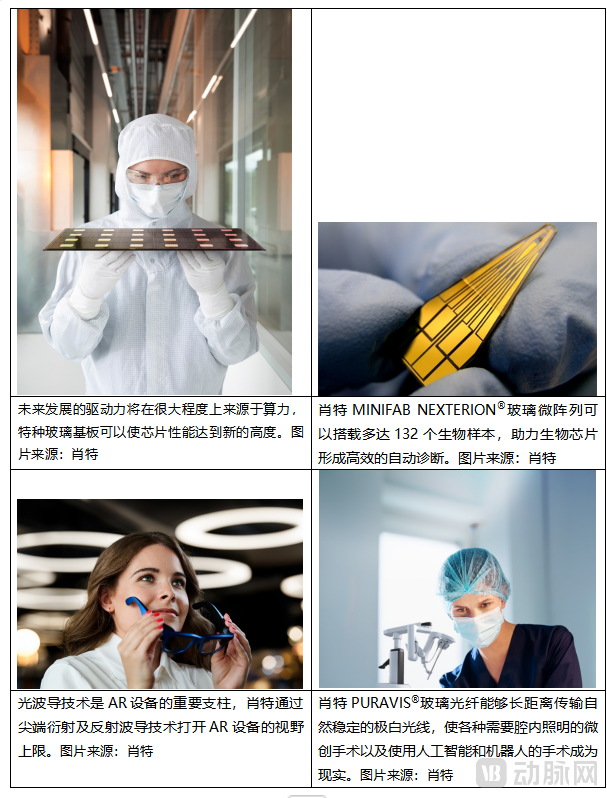
● A Biochip Lab at Your Fingertips——Schott MINIFAB NEXTERION®These miniaturized glass substrates, designed for research, diagnostics, and other life science applications, enable laboratory analyses to be automated with greater efficiency than ever before. Ready-to-use biochips incorporating SCHOTT glass can generate diagnostic information from a single blood sample, facilitating automated blood typing and antibody analysis. Red blood cells and antibodies are “printed” onto glass microarrays; each microarray is as small as a fingernail and as thin as a human hair, yet capable of accommodating up to 132 samples. In the near future, such miniature biochips will be able to identify diseases such as HIV or hepatitis B without delay, and rapidly and effectively match blood types between donors and recipients without requiring physician intervention.
● Empowering Surgical Robots with “Keen Vision”—In a sense, the history of progress in modern medicine is the history of transforming light energy into clinical insights. The world’s first new-generation apochromatic optical microscope adopted Schott’s optical glass technology, laying the foundation for microbiology. Today, Schott PURAVIS®Glass optical fibers can transmit natural, bright, and extremely white light while maintaining stable light transmission over long distances, making various minimally invasive surgeries requiring intracavitary illumination, as well as AI- and robotics-assisted medical procedures, a reality. Robotic surgeries often need to be performed over long distances, where light from remote sources must reach the patient without compromising performance. In the future, doctors will also be able to leverage optical fibers to better utilize light beyond the visible spectrum, such as infrared, near-infrared, and short-wave infrared, for deep observation of microscopic phenomena beneath the surface of human tissues, thereby enabling tissue identification and characterization, for instance, in cancer margin detection.
● Pioneering the “Chip” Future: Specialty Glass Becomes the Breakthrough for Next-Generation Chips——The driving force for future development will largely stem from computing power, and specialty glass products can help the chip industry reach new heights. As Moore’s Law approaches its bottleneck, major chip designers, manufacturers, and packaging firms are striving to identify new materials better suited for high-density packaging and interconnects, so as to enhance the computational speed and efficiency of integrated circuits. After extensive technical validation, leading companies in the industry have unanimously chosen specialty glass as one of the most promising new materials for next-generation substrates. Danning, Director of Operations and R&D at Schott Semiconductor, revealed that Schott has been engaging in close discussions with leading semiconductor enterprises to support the industry in developing solutions based on specialty glass and advanced materials, thereby enabling next-generation innovative products. Meanwhile, Schott’s high-quality flexible light guides and other solutions have already been deployed in state-of-the-art lithography machines within the chip industry, helping these highly complex systems achieve the most stringent precision requirements. Today, Schott’s specialty glass plays a role in the manufacturing process of nearly all chips.
● Eliminate "boundaries" to seamlessly integrate the digital world with the real world——Augmented reality (AR) technology can integrate virtual content into real-world visuals in real time, thereby enhancing users’ perception of their physical environment. Optical waveguide technology is a critical pillar of AR devices. Leveraging cutting-edge diffractive and reflective waveguide technologies, Schott helps leading industry partners in China and around the world push the boundaries of AR device capabilities, minimize obstruction of the natural field of view, and virtually eliminate the “sense of boundary” associated with wearable AR devices. Schott’s optical waveguides are fabricated from ultra-high-quality optical glass, which improves lens transparency and color neutrality, making virtual images appear more realistic and accelerating the adoption of AR devices by end consumers.
Exhibits Significantly Expanded, Showcasing Specialized Glass Applications Across Various Fields
In addition to the exhibits mentioned above, this year’s attendees will also see a wider array of exciting products in the fields of pharmaceuticals, mobility, and consumer electronics, as well as the return of Schott’s star exhibits from previous China International Import Expos (CIIE).
In the pharmaceutical sector, Schott will make its debut of SCHOTT TOPPAC® for cryogenic drugs®Freeze: A primary pharmaceutical packaging solution that maintains stable performance even at -100°C. From drug filling to patient administration, an increasing number of medications require low-temperature freezing conditions to ensure stability throughout the supply chain. mRNA-based therapies, viral vectors (AAV), cell and gene therapies, chemotherapeutic agents, and many other cryogenically stored drugs impose stringent requirements on drug packaging and delivery. Schott will also premiere its packaging and administration solutions for GLP-1 antidiabetic drugs, including cartridges compatible with pen injectors that enable self-administration and multiple dosing, providing highly chemically stable and safe containers for the storage and delivery of peptide-based therapeutics.
In the mobility sector, a series of products targeting electric vehicle (EV) applications are also being showcased for the first time this year. These include Schott’s new glass-ceramic powders, which excel in high-temperature resistance and enhancing overall battery stability; Schott CompRite™ electric compressor terminals, which extend the service life of electric compressors and withstand extreme pressure, temperature, and high voltage; glass-to-metal seal (GTMS) battery connectors suitable for liquid immersion cooling systems; and next-generation battery pack solutions that improve the performance of EV batteries.
Schott ZERO, the “blockbuster” product that made its debut at last year’s China International Import Expo and is used in the primary mirror of the European Extremely Large Telescope®The glass-ceramic mirror blanks have been successfully manufactured, with the final batch shipped. Leveraging the platform of the China International Import Expo (CIIE), SCHOTT has deeply engaged in China’s astronomical sector, contributing to frontier scientific research through projects such as the Guo Shoujing Telescope and the Mozi Wide Field Survey Telescope.
Schott CERAN®®As a long-standing participant at the China International Import Expo (CIIE) in the home appliance sector, glass-ceramic cooktop panels leverage innovation to make cooking more aesthetically pleasing, safer, and more sustainable, redefining modern kitchen aesthetics. Schott®UTG ultra-thin glass offers exceptional flexibility and an extremely small bending radius, unlocking new design possibilities for foldable smartphones. Schott’s ceramic laser phosphor converters provide stable, bright light sources, making them the ideal choice for high-brightness lighting equipment such as projectors and searchlights.
Upholding a Sustainable Development Strategy: Committed to Low-Carbon Specialty Glass Melting Technology
As a pioneer in the development of green glass, SCHOTT is committed to achieving climate-neutral glass manufacturing technology by 2030. The company is pursuing this goal through four key areas of action: technological transformation of glass melting furnaces, improving energy efficiency, adopting 100% green electricity, and compensating for residual emissions through participation in climate protection projects. In terms of the circular economy, SCHOTT has also successfully launched multiple pilot projects with industry partners in the pharmaceutical sector, including a vial recycling project with Sanofi and a medical packaging tray recycling project with Takeda Pharmaceutical Company.
International rating agency EcoVadis awarded Schott the Gold Medal for Sustainable Development Management in 2023. In 2024, Schott received the Sustainability Champion Award in the Supply Chain category in recognition of its proactive efforts in sustainability. Also this year, Schott became the first company from the specialty glass industry to officially join the China ESG Alliance, working with industry partners to co-create a sustainable future.
Currently, SCHOTT has achieved industrial-scale testing of glass production using 100% hydrogen, successfully manufacturing optical glass that meets extremely stringent quality requirements at its German facility. The company’s Chinese plant has also fully transitioned to operating on 100% green electricity. This year, SCHOTT R&D has launched several lighthouse projects, a key milestone being the development of an electrically powered, low-carbon furnace for pharmaceutical glass in Bavaria, Germany, which will reduce greenhouse gas emissions from the glass melting process by 80%. The furnace is scheduled to be officially ignited in 2026. Achieving a permanent energy transition will require further extensive testing as well as a stable and competitive local supply of green energy, including green electricity and green hydrogen. This transformation in glass melting technology will help SCHOTT take another significant step toward its strategic goal of achieving climate-neutral glass production by 2030.
Drive Innovation – Take Responsibility – Co-create
SCHOTT is a manufacturer of high-tech materials such as specialty glass. The company’s three core values are driving innovation, taking responsibility, and co-creating. Its founder, Otto Schott, was the inventor of specialty glass and a pioneer in the entire glass industry. For nearly 140 years, SCHOTT’s #glasslovers have upheld a spirit of pioneering and boundless passion, continuously exploring new markets and fields. With offices in more than 30 countries and regions, SCHOTT serves as a high-tech partner in cutting-edge sectors including healthcare, home appliances, consumer electronics, semiconductors, data communications, optics, industry, energy, automotive, astronomy, and aerospace. In fiscal year 2023, the company’s 17,100 employees generated total sales of €2.9 billion. SCHOTT AG is part of the Carl Zeiss Foundation, one of Germany’s oldest foundations, which uses dividends from SCHOTT to promote science and technology. As a foundation-owned company, SCHOTT bears special responsibility toward its employees, society, and the environment. The company is committed to reducing carbon emissions and achieving climate neutrality by 2030.