

Zimmer Biomet Secures Exclusive U.S. Distribution Rights to NeuroOne's OneRF Ablation System with $3 Million Upfront Payment

NeuroOne Medical Technologies
Developer of High-Definition, Minimally Invasive Thin-Film Electrodes
On November 4, Zimmer Biomet reached a new agreement with NeuroOne Medical Technologies to secure exclusive distribution rights for the OneRF Ablation System, with an upfront payment of $3 million (approximately RMB 21.33 million).
NeuroOne, founded in 2009, is an innovative company dedicated to providing minimally invasive, high-definition electroencephalography (EEG), brain stimulation technologies, and ablation therapies to patients suffering from epilepsy, Parkinson’s disease, dystonia, chronic pain resulting from failed back surgery, and other related neurological disorders. To date, NeuroOne has received FDA approval for three products, including the OneRF Ablation System.
Zimmer Biomet is one of the global “big three” in orthopedics, with core businesses including knee implants, hip implants, and fracture management products. Since spinning off from its parent company, Bristol-Myers Squibb, to become an independent entity in 2001, Zimmer Biomet has completed more than 20 mergers and acquisitions over the past two decades. Notably, in 2016, Zimmer Biomet acquired a renowned orthopedic surgical robotics company for $1.32 billion and developed the ROSA ONE Brain platform based on its products.
In August 2022, Zimmer Biomet acquired distribution rights for NeuroOne’s Evo electrode product, given its synergies with the ROSA ONE Brain platform, and was required to pay NeuroOne a $2 million upfront payment as well as subsequent milestone payments.
Building on this partnership, the two parties recently updated their cooperation agreement to reaffirm their collaboration regarding NeuroOne’s OneRF Ablation System. Commenting on the renewed partnership, NeuroOne stated, “This collaboration will enable NeuroOne to leverage Zimmer Biomet’s leadership in robotics and its extensive distribution network, thereby facilitating broader distribution of the OneRF Ablation System in the United States.”
Zimmer Biomet President Brian Hatcher stated, “We are pleased to expand our partnership with NeuroOne and look forward to launching the OneRF Ablation System in the market as soon as possible.”
The World’s First FDA 510(k)-Cleared Stereoelectroencephalography-Guided Radiofrequency Ablation System for the Brain
In December 2023, the OneRF Ablation System received FDA 510(k) clearance, becoming the world’s first stereoelectroencephalography (sEEG)-guided radiofrequency ablation system for the brain to obtain FDA 510(k) clearance. This approval marks a significant step forward for radiofrequency ablation systems in the neurology and neurosurgery markets.
The system primarily consists of two components: the NeuroOne stereoelectroencephalography (sEEG) electrodes (FDA-approved) and a compatible radiofrequency generator with temperature control. During operation, the implanted sEEG electrodes record brain activity and guide the connection to the radiofrequency generator for ablation. Throughout the ablation process, spatial temperature is synchronously monitored and maintained to ensure precise thermal control. The system allows clinicians to set both temperature and duration parameters.
The standout feature of the OneRF ablation system is that its sEEG electrodes serve both diagnostic and therapeutic functions, enabling not only monitoring of brain activity but also ablation of epileptogenic foci. This design offers a safer and more cost-effective treatment option for clinical practice. Furthermore, NeuroOne’s sEEG electrodes provide detection capabilities comparable to those of cortical electrodes, yet they are less invasive as their implantation does not require craniotomy.
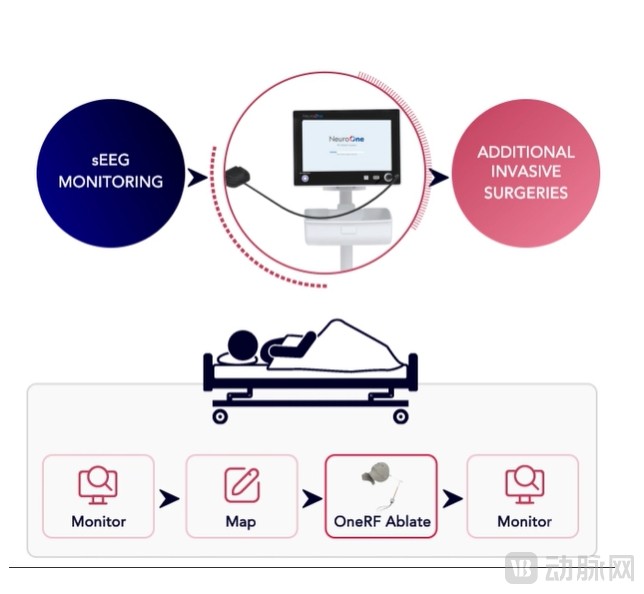
Image source: NeuroOne official website
NeuroOne stated in a report that neurosurgeons at University Hospitals Cleveland Medical Center performed ablations using six different electrodes over a two-day period. Furthermore, sEEG electrodes provided significant assistance in identifying the patient’s focal epileptic zone.
Meanwhile, the report noted that during the two-month follow-up period, the patient remained seizure-free and self-reported improvements in mood and memory. Dave Rosa, CEO of NeuroOne, stated, “The uniqueness of this case lies in its extension beyond the ablation ranges documented in clinical literature. We are pleased that, with the assistance of this system, clinicians safely performed 44 ablation procedures and achieved positive outcomes.”
Electrophysiology Sector: Chinese Innovation Rises with Strength
Notably, Chinese companies have also emerged in the field combining brain science with radiofrequency ablation.
For example, since its establishment in 2017, Nuoer Medical has been dedicated to and continuously expanding its presence in key global brain science technology fields, particularly stereoelectroencephalography (SEEG) technology. The company has developed a range of innovative medical devices required for the precise diagnosis and treatment of functional neurological disorders, including drug-resistant epilepsy, as well as for brain science research. As of 2022, Nuoer Medical had successfully developed the first generation of 3.0T MRI-compatible stereoelectroencephalography electrodes, which were undergoing clinical trials at seven clinical centers across China. Additionally, its deep brain therapeutic SEEG electrodes with radiofrequency ablation capabilities had completed core patent arrangements and prototype design.
Beyond neurosurgery, the most prominent application areas for radiofrequency ablation include renal denervation (RDN) and cardiac electrophysiology. Currently, three RDN products have received approval from the National Medical Products Administration (NMPA): Medtronic’s renal artery radiofrequency ablation system, Xinmai Medical’s renal artery radiofrequency ablation system, and Nuowei Ye’s radiofrequency ablation system.
Xinmai Medical’s renal artery ablation system is the world’s first radiofrequency ablation device capable of mapping renal nerves. It not only provides precise ablation targets for renal sympathetic denervation but also offers effective intraoperative and postoperative feedback to assess immediate procedural efficacy.
The standout feature of Meili Weiye’s renal artery radiofrequency ablation system lies in its single-use mesh-type renal artery radiofrequency ablation catheter, which features six electrodes arranged in a spiral pattern to effectively enhance ablation efficiency. The basket-like design also ensures that blood flow is not obstructed during ablation. This represents an innovative design unique worldwide.
In the field of cardiac electrophysiology, radiofrequency ablation remains the mainstream technology, with numerous companies both domestically and internationally having established their presence. Leading foreign companies include Johnson & Johnson and Abbott, while domestic players primarily comprise MicroPort EP, Huitai Medical, and Jinjiang Electronics.
Among them, Johnson & Johnson’s QDOT Radiofrequency Ablation Catheter is a temperature-controlled, autonomous feedback radiofrequency catheter designed for high-power, short-duration ablation. According to clinical study data released by Johnson & Johnson in 2023, the use of this product not only significantly improved ablation speed and efficacy, but also resulted in an adverse event rate of only 3.6%, an atrial tachycardia recurrence-free rate of 82.1%, and a repeat ablation-free rate of 92.1%.
Abbott has recently achieved new progress in the cardiac radiofrequency ablation sector, with its self-developed next-generation single-use magnetoelectric positioning pressure-sensing radiofrequency ablation catheter receiving approval from the National Medical Products Administration (NMPA). This product is the first and only pressure-monitoring ablation catheter featuring a flexible laser-etched tip, offering excellent safety, stability, and ablation efficiency.
Finally, it is worth highlighting that pulsed field ablation (PFA) has emerged as a highly anticipated technology in the field of cardiac electrophysiology in recent years. As of October 2024, four PFA products have received approval from China’s National Medical Products Administration (NMPA), originating from Jinjiang Electronics, Deno Electrophysiology, Boston Scientific, and Medtronic. Furthermore, more than 30 additional PFA products are currently under development in the global market.
Similar to the radiofrequency ablation sector, Chinese enterprises are actively present in this space. This signifies that in these high-value, high-barrier niche sectors, China’s innovative forces are now capable of competing on the same stage as global medical device giants.