

Can 'Finance + Ecosystem' Be the Solution to Breaking the Vicious Cycle in Healthcare Venture Capital?
March 2024,Beijing’s RMB 20 Billion Pharmaceutical and Health Industry Investment Fund Officially Established in Changping, with future investments to be prioritized in niche sectors such as innovative drugs, innovative medical devices, cell and gene therapy, and digital health. Previously, Beijing had proposed the formation of a trillion-yuan pharmaceutical and healthcare industry cluster by 2025; with the launch of this significant fund, this vision is drawing ever closer.
In fact, it is not just Beijing; across China, investment in the pharmaceutical and healthcare sectors has been substantial over the past one to two years, with parent funds valued at tens or even hundreds of billions of yuan emerging in large numbers. According to statistics from Zero2IPO Research,The scale of government-guided funds in China grew to nearly RMB 13 trillion in 2023, with state-owned limited partners (LPs) accounting for over 70% of total capital commitments.This means that government-guided funds are becoming the primary source of liquidity for the entire capital market, and as a key focus area, the pharmaceutical and healthcare sector has naturally attracted a substantial influx of capital.
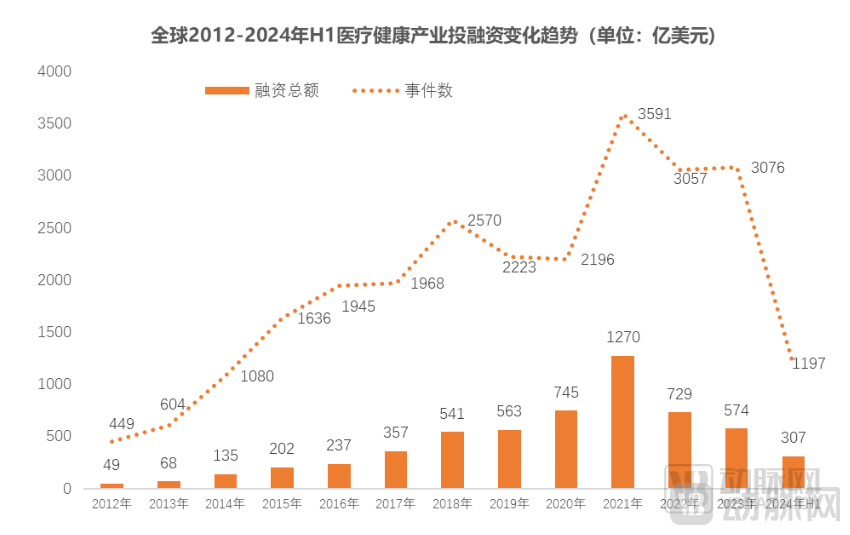 Figure 1. Trends in Investment and Financing in the Healthcare Industry from 2012 to H1 2024 (Data Source: VCBeat)
Unlike the fervor surrounding government guidance funds, the pharmaceutical and healthcare sector is currently somewhat subdued. According to a financing and investment report by VCBeat, China’s healthcare sector completed 415 financing deals in the first half of 2024, with total funding amounting to approximately USD 4.8 billion. Compared to the same period in 2023, the number of deals and total funding volume decreased by 32.3% and 12.2%, respectively. The secondary market has been even more dismal; as of September 2024, fewer than 20 healthcare companies had successfully gone public this year, representing a decline of over 60%.
On one side, government guidance funds continue to pour in; on the other, the venture capital market is shrinking significantly. Amid this increasingly fragmented industry landscape, a question is growing louder:What Kind of Healthcare Funds Can Break Free from Cutthroat Competition and Rise Against the Tide in the Industry’s Slow Cycle?
Overnight Riches Are a Thing of the Past; The Industry Now Requires Greater Patience
In 2021, the healthcare venture capital market experienced a historic surge, with 3,591 financing deals and a total funding amount of $127 billion, both setting all-time highs. During this period of favorable conditions, it was not uncommon for healthcare companies to complete two or even three rounds of financing within a single year. Moreover, stories of rapid wealth creation, with companies achieving successful IPOs just three years after establishment, continued to unfold.
However, such scenes are now rarely seen.The core reason is that investment logic has undergone significant changes: investors are generally abandoning the blind pursuit of industry hotspots and instead returning to focus on the intrinsic value of projects.This assessment is divided into three key dimensions: first, the project's innovativeness, specifically its potential to become a "first-in-class" therapy; second, its market commercialization capability, particularly whether it has a clear monetization timeline; and finally, its growth potential, namely the likelihood of evolving into one of the top three medical enterprises in China or even a global leader.
In fact, the establishment of these criteria stems from subtle shifts in industry demands. Taking innovation as an example, addressing current unmet clinical needs, adhering to the market logic of domestic substitution and cost reduction with efficiency enhancement, and even aspiring to become industry unicorns that compete head-on with global leaders—all require robust innovation as their foundation. Innovation has clearly become a key component in demonstrating the competitiveness of today’s healthcare enterprises.
Moreover, monetization capability has become particularly crucial in the current landscape. Since 2023, IPO channels have significantly narrowed, with “financial due diligence” emerging as a key variable; the entire A-share market has imposed clear requirements on profitability and net profit scale. This shift is primarily driven by the market’s ongoing demonstration that only healthcare companies capable of generating sustainable internal cash flow can survive in the future era of stock-based competition.
Of course, as the investment profile evolves, new demands are being placed on investment institutions. In this regard, Wang Ying, General Manager of Changfa Zhan, stated in an interview, “The market inevitably experiences cycles of cooling and heating; therefore, a winter period is not necessarily detrimental. It actually represents an evolution of the industrial ecosystem, during which industry bubbles will gradually be cleared out, and social resources will be reallocated and utilized more efficiently.”Therefore, in a more rational market environment, higher standards are imposed on the professional competence of investment institutions. They must possess strong insights into specific sectors and industry cycle dynamics, while also demonstrating the capacity to support portfolio companies through industry cycles and foster their long-term growth.。”
This means that current investment institutions can no longer limit themselves to the role of mere capital providers; instead, they must engage more deeply in the industry, providing continuous and precise value-added support to genuinely accompany enterprises throughout their growth journey.
“What does a typical model of ‘Finance + Ecosystem’ look like?”
Amidst the market winter and industry bubble, investment institutions have faced significant challenges over the past one to two years. On one hand, fundraising has become increasingly difficult; on the other, high-quality projects are hard to find. Moreover, most existing portfolio companies face difficulties in achieving exits. As a result, cash flow has emerged as a major issue, with survival challenges now widespread among investment firms.
Even so, a group of steadfast investors continues to support corporate growth, with Changfa Development Group standing out as a typical representative. It is reported thatTo date, the Changfa Development Group’s fund-of-funds system has partnered with 44 market-oriented investment funds, directly or indirectly invested in over 1,100 projects, facilitated the listing of 39 companies on secondary markets, and is currently advancing the IPO processes of more than 30 companies.Fund-of-funds and direct investment businesses are both flourishing.
For a young fund that has been in existence for less than 10 years, achieving such results must mean it has done some things right.
First, from a financial perspective. As of now, the government-backed investment funds within the Changping Technology Industry Fund-of-Funds cluster include three early- to mid-stage fund-of-funds (Changping Micro, Small, and Medium Enterprises Mass Entrepreneurship and Innovation Development Fund, Beijing Industrial Integration and Innovation Fund, and Changping SME Growth Investment Fund), one industrial guidance fund (Changping Industrial Development Fund-of-Funds), and two mid- to late-stage fund-of-funds (Changping Life Valley Pharmaceutical and Health Industry Fund-of-Funds and Changping Advanced Energy Industry Fund-of-Funds).With a total committed capital of nearly RMB 10 billion, it has established a fund network covering the full investment lifecycle, including early-to-mid stage, growth stage, and mature stage.。
In addition to building a fund-of-funds industrial cluster, Changfa Zhan Group also focuses on direct investment. In 2020, Changfa Zhan Group officially established the Zhiheng Direct Investment Fund, which primarily targets early- and growth-stage projects in the pharmaceutical and healthcare industry—focusing on biopharmaceuticals, medical devices, and healthcare services—as well as the broader TMT sector, with an emphasis on information technology, advanced manufacturing, and energy technology. To date, the Zhiheng No. 1 Direct Investment Fund has invested in nearly 20 companies, including star projects such as Pins Medical, Huahui Anjian, Tupai Medical, and Yanming Bio. Among the 42 direct investment projects deployed by Changfa Zhan Group through its own capital, special purpose vehicles (SPVs), and other means—including those under Zhiheng Direct Investment—Aibo Medical, InnoCare Pharma, and BeiGene have successfully gone public. Currently, Changfa Zhan Group is preparing to launch its second healthcare-focused direct investment fund, aiming to further strengthen its investment roadmap across the pharmaceutical and healthcare industry chain.
In response, Wang Ying, General Manager of Changfazhan, stated in an interview, “A fund of funds essentially serves as a “telescope,” helping us map out the industrial landscape to better gain insights into industry development trends. In contrast, direct investment is more like a “microscope,” enabling us to intuitively understand the on-the-ground realities of frontline industries and thereby build deeper trust with industry stakeholders.。”
Having discussed finance, we now turn our focus to ecosystem development. In fact, as a wholly state-owned investment platform of Changping District, Changfa Group established from its inception the guiding objective of fully promoting the development of core industries in Changping. For instance, in terms of specialized fields, it has continuously aligned with the district’s industrial layout and has now anchored its strategy onPharmaceuticals & Healthcare, Advanced Energy, Advanced ManufacturingThree Major Key Industrial Sectors. Additionally, in terms of ecosystem development, leveraging Changping’s favorable business environment, industrial policies, and related industrial supporting facilities, Changfa Group has currently established a framework centered on “Asset Management, Fintech, and Industrial Services"An industrial ecosystem centered on three core business segments."
Specifically, based on the growth needs of portfolio companies at different stages, Changfa Development Group has built a multi-layered post-investment value-added service system centered on industrial services, financial services, scenario implementation, and ecosystem integration. This system not only coordinates various policy resources and regional industrial resources to help enterprises connect with markets, talent, and technology, but also matches their financing needs at each stage through its fund system and cooperative financial institutions.
Furthermore, grounded in the fundamental logic of the pharmaceutical industry, Changfa Development has established multiple specialized service platforms, including the International Center for Precision Medicine Innovation and Acceleration, the International Medical Device CMO Platform, the Shared Platform for Instrumentation, Equipment, and Testing Services, the M+ Medical & Aesthetic Innovation Center, and the Synthetic Biology Manufacturing Translation and Acceleration Center. These platforms enable the company to provide portfolio companies with comprehensive, end-to-end services spanning the entire lifecycle from 0 to 1, 1 to 10, and 10 to 100.
In this regard, Xie Sijin, Senior Vice President of Changfa Zhan Co., Ltd. and Chairman of Changke Jin Company, stated, “The principle of ‘30% investment, 70% management’ runs through the entire investment lifecycle of a fund, making management capability critically important. In fact, management encompasses two aspects: post-investment management and post-investment empowerment. Currently, post-investment empowerment is becoming increasingly important and has become a key area where major institutions are competing to establish their presence.”The same holds true for Chang Development Group. On one hand, we are continuously expanding our fund size; on the other, we are steadily strengthening our ecosystem development and continually enriching our toolkit to provide more valuable, targeted services to our portfolio companies.。”
It is evident that Changfa Development Group has deeply integrated investment with its ecosystem, which not only enhances its market competitiveness but also establishes the sustainability of its investment operations.
Where Is the Next Growth Opportunity?
Currently, the healthcare industry is at a new inflection point, and during this critical period,Challenges to Survival Coexist with Significant Future Growth Opportunities。
Take innovative technologies as an example: frontier fields such as synthetic biology, brain-computer interfaces (BCI), and artificial intelligence (AI) are unlocking greater possibilities and accelerating their march toward commercialization. In terms of exit strategies, business development (BD) and mergers and acquisitions (M&A) are thriving, making IPOs no longer the sole option. Finally, at the market level, “global expansion” has become a key industry keyword, with related strategic layouts and infrastructure entering a new phase.
Faced with these new trends, investment institutions are currently in urgent need of answering two key questions:First, how to uncover innovative potential, that is, whether one can truly understand and discern the market value behind innovative technologies; second, how to incubate and unleash innovative potential, that is, how to better empower innovation by integrating finance with the industrial ecosystem, thereby accelerating its path to market and ultimately enabling its clinical application.。
To find the answer,“2024 Changping Pharmaceutical and Health Financial Investment Innovation Forum (CHIF)”The timing of the event is particularly apt. It is reported that the conference will be held onNovember 22Officially launched in Changping, Beijing, the event has invited over 20 distinguished guests from the medical and health ecosystem—including government officials, academicians and scientists, clinical experts, top-tier investors, and corporate leaders—as well as hundreds of high-level industry professionals. Through keynote speeches and roundtable discussions, participants will jointly explore value investment and value creation in the future pharmaceutical and healthcare industries.
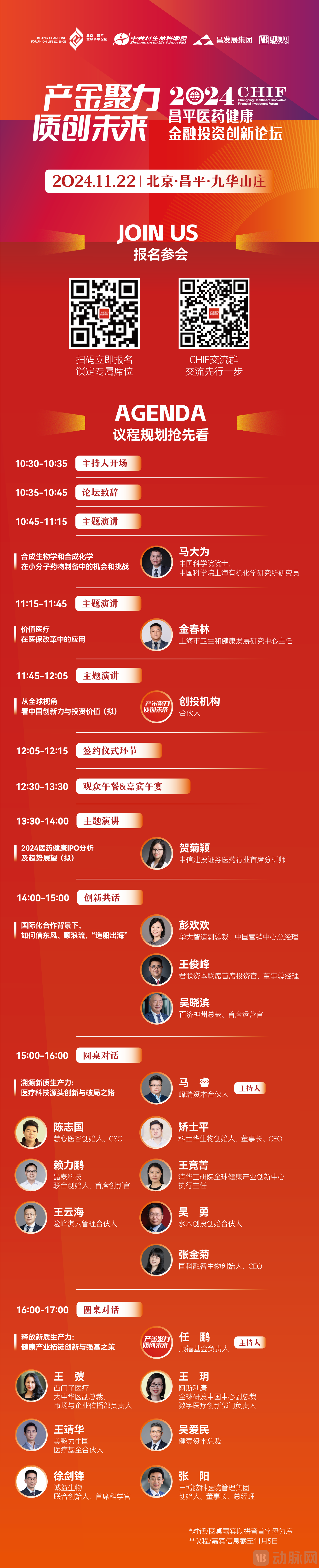
Figure 2. Conference Agenda
Specifically, in terms of value investment, the focus is primarily on anchoring to certain frontier innovation sectors and intensively exploring the underlying market logic. To this end, the conference has specially invitedAcademician of the Chinese Academy of Sciences, Ma DaweiA deep dive into the new concept of “new quality productive forces.” Additionally, the conference will feature a specially curated roundtable forum titled “Tracing the Origins of New Quality Productive Forces: The Path to Source Innovation and Breakthroughs in Medical Technology,” which will comprehensively explore the origins and cultivation of medical innovation from the perspectives of scientists, heads of research institutions, founders, and investors. It is reported that the signing ceremony for the cooperation of the “Life Valley Pharmaceutical and Health Industry Investment Fund” will also take place concurrently at the conference, where major strategic partnerships will be formally finalized.
Furthermore, in terms of value creation, the focus is primarily on building an industrial ecosystem and expanding into overseas markets. Taking ecosystem development as an example, the conference not only curated themed keynote speeches and roundtable forums to first explain the underlying logic from a theoretical perspective, but also leveraged relevant platform channels to facilitate effective ecosystem connectivity.
Finally, in the “Going Global” segment, the conference has specially established an “Innovation Dialogue” section, and has currently invitedPeng Huanhuan, Vice President of MGI Tech; Wang Junfeng, Co-Chief Investment Officer of Legend Capital; Wu Xiaobin, President and Chief Operating Officer of BeiGeneThree panelists engaged in an in-depth discussion on the topic, “Leveraging Favorable Conditions and Navigating Global Currents to Expand Overseas Amidst International Cooperation,” distilling a strategic “methodology” for global expansion to propel more Chinese healthcare enterprises and institutions onto the international stage.
In fact, the "Changping Medical and Health Financial Investment Innovation Forum (CHIF)" has been successfully held twice. Over the past two editions, the conference has witnessed subtle changes in the pharmaceutical industry while fostering collaboration across industries and between industries and their ecosystems. Standing at a new inflection point of industry transformation, the third "Changping Medical and Health Financial Investment Innovation Forum (CHIF)" is poised to launch. It aims to uncover greater possibilities within the sector, facilitate more significant strategic partnerships, and open up new growth curves for the entire medical and health industry.

Scan the QR code to register for the conference.