

MMI Files for IPO Following $110M Funding Round for World’s Smallest Wristed Surgical Robot

MMI
Microsurgical Instrument Researcher
Currently, medical imaging technology has advanced rapidly, providing clearer and more detailed visualization during surgical procedures. However, the fundamental methods and techniques of microsurgery have not undergone corresponding major innovations. During surgery, doctors still face challenges when handling minute structures and performing delicate maneuvers.
Specifically, surgical precision may be limited by the dexterity of the human hand and affected by physiological and idiopathic tremors. Poor ergonomics and operational fatigue during lengthy procedures can also compromise surgical outcomes. Furthermore, while surgical instruments are standardized, surgical approaches and specific maneuvers are personalized for each patient; thus, instruments require greater versatility to perform complex tasks in hard-to-reach anatomical regions and within extremely small blood vessels. In addition, due to the steep learning curve and the considerable difficulty of performing anastomoses in fine vessels, there is a scarcity of highly skilled clinicians capable of executing such procedures.
To address the aforementioned pain points, Medical Microinstruments, Inc. (MMI) has entered the market. Headquartered in Pisa, Tuscany, Italy, the company specializes in developing innovative devices for minimally invasive surgery. Founded in 2015, MMI is dedicated to enhancing the precision and controllability of minimally invasive surgical procedures through robotic technology.
1Solving Complex Challenges in Vascular and Lymphatic Anastomosis
MMI employs over 245 staff members across multiple countries. Its leadership team possesses extensive industry experience in the research and development, mergers and acquisitions, market expansion, and physician training related to medical device innovation, particularly in the field of surgical robotics.
Mark Toland is the Chief Executive Officer of MMI. Prior to joining the company, he served as President and CEO of Corindus, leading it to become a leader in the vascular robotics industry with the only system approved for coronary, peripheral, and neurovascular indications. Corindus was subsequently acquired by Siemens Healthineers for $1.1 billion, marking the fifth-largest medical technology acquisition of 2019. Before joining Corindus, Mark held the position of Senior Vice President at Boston Scientific, where he led the U.S. commercial cardiovascular business, which generated approximately $4 billion in revenue. Additionally, he serves on the boards of directors of Moon Surgical, Cardiologs (a cardiovascular AI company acquired by Philips in 2021), and Amplitude Vascular Systems (an intravascular lithotripsy company).
Jeff LaConte, Vice President of Marketing and Business Development, joined the company in April 2023 to oversee global marketing and innovation strategy. Previously, he led the global robotics, digital surgery, and augmented reality businesses for DePuy Synthes, Johnson & Johnson’s orthopedics division. He and his team were responsible for the development, branding, market launch, and business strategy of the VELYS Robotic-Assisted Solution, rapidly establishing it as one of the fastest-growing robotic technologies in the history of orthopedics. Prior to his role at DePuy Synthes, Jeff held senior leadership positions across multiple Johnson & Johnson business units, including Ethicon, J&J Vision Care, and J&J Surgical Vision, where he gained extensive experience in direct-to-consumer and patient-level brand strategy.
Bob Mullins, Vice President of Clinical Excellence and Global Training, leads medical and professional education initiatives to support a broad community of healthcare professionals. Prior to joining the company, Bob spent over 30 years at Boston Scientific, where he led sales for the Peripheral Intervention business and most recently served as Director of Medical Affairs and Global Education for WATCHMAN. He and his team spearheaded comprehensive professional education and training programs for more than 2,500 new device users.
The MMI core team believes that expanding treatment options for patients further requires enabling more surgeons to practice microsurgery and supermicrosurgery in open soft-tissue procedures. A critical component of this effort is helping surgeons enhance their precision when operating on ultrafine blood vessels and nerves.
Currently, the number of surgeons able to receive training in these techniques is limited. Moreover, many microsurgical procedures are technically demanding and have a steep learning curve, requiring surgeons to possess exceptional hand-eye coordination and fine motor skills. This level of proficiency demands prolonged, repetitive training and clinical practice, and cannot be achieved overnight. Against the backdrop of widespread shortages in medical resources, robot-assisted technology represents a crucial breakthrough solution.
Following this line of thought, MMI’s innovation path is clear: developing miniaturized articulated instruments to assist surgeons in repairing tiny, delicate anatomical structures. The company first focused on creating the world’s smallest wristed instruments and then built a customized robotic platform capable of delivering precise movements—the Symani Surgical System. Designed for microsurgical techniques in open soft-tissue surgery, the system can be applied to microvascular repair, lymphatic repair, and peripheral nerve repair, addressing clinical scenarios such as breast cancer, lymphedema, head and neck cancer, and trauma.
2Featuring the World's Smallest Wrist-Worn Tool
The Symani Surgical System is a pioneering robotic platform designed to deliver enhanced precision in surgical manipulation,Sutures ranging from 8-0 to 12-0 can be used even in the smallest blood vessels. It integrates the world’s smallest wristed instruments and is equipped with tremor filtration and motion scaling technologies to address the complexities of microsurgery and supermicrosurgery.
Symani consists of a portable cart equipped with macro-positioners and micro-manipulators, enabling surgical instruments to smoothly access the operative field. Its ergonomically designed surgeon console provides comfortable support for surgeons during prolonged procedures.The patented Nano Wrist tool, attached to the micromanipulator, is the world’s smallest wristed instrument, featuring seven degrees of freedom, flexibility, vibration-dampening technology, and motion scaling from 7x to 20x., enabling surgeons to precisely manipulate and suture delicate anatomical structures. MMI’s product portfolio includes multifunctional needle holders and dilators, available in two different size ranges to address microvascular and supermicrovascular procedures. The system leverages teleoperation technology to mimic natural surgical movements, converting the surgeon’s larger hand motions into highly precise mechanical actions.
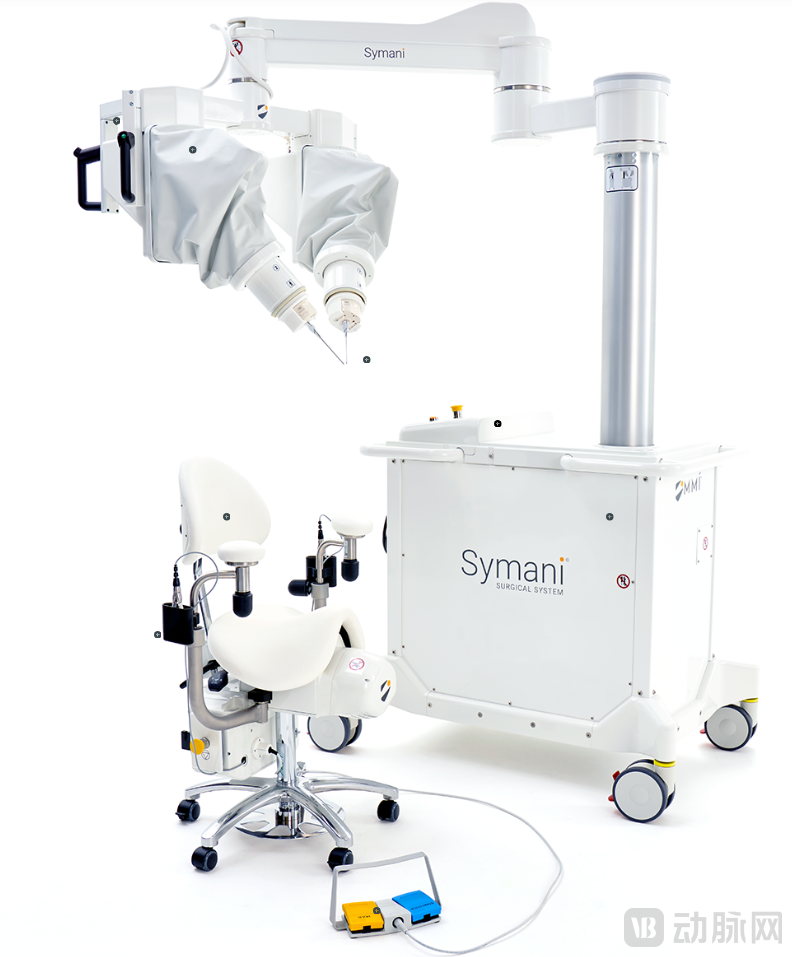
Symani Surgical System
“By precisely placing needles and sutures, this system reduces the risk of vascular trauma and occlusive thrombosis, thereby improving surgical success rates while decreasing adverse events, the need for reintervention, and flap failure rates, thus offering a more minimally invasive treatment option. ‘Previously, the smallest blood vessels and nerves that surgeons could suture had to be at least 1.0 mm in diameter; now, however, lymphatic vessels as small as 0.3 mm or even 0.2 mm in diameter can be sutured. MMI’s surgical robot overcomes the movement limitations of the human hand, enabling operations with precision down to one-tenth of a millimeter,’ commented PD Dr. Khaled Dastagir from Hannover Medical School in Germany.”
The Symani System enhances surgeons’ microsurgical capabilities, enabling them to perform more challenging supermicrosurgical procedures, such as perforator flap surgery and lymphatic surgery. “When it comes to breast cancer, one complication that concerns me is lymphedema caused by lymph node dissection. Currently, very few surgeons are able to operate freely on vessels as small as 0.3 millimeters in diameter, which corresponds to the average size of lymphatic vessels. The Symani Surgical System not only overcomes technical barriers but also provides solutions for conditions previously considered untreatable,” explained Professor JP Hong.
In terms of imaging system compatibility, Symani is designed to be compatible with traditional optical microscopes, hybrid microscopes, and 3D surgical microscopes. This ensures that the system can be seamlessly integrated into existing operating room setups when using preferred imaging technologies. Furthermore, Symani has a smaller footprint than most robotic systems currently on the market, making it easy to install in operating rooms worldwide.
On October 30, 2024, MMI announced that its Symani Surgical System was named one of TIME Magazine’s Best Inventions of 2024.In April this year, the FDA granted Symani De Novo classification, making it the only commercialized platform available in the United States for reconstructive microsurgery.A few weeks later, the system completed its first clinical case at Pennsylvania Hospital of the University of Pennsylvania Health System in Philadelphia. These successful limb reconstruction microsurgery procedures marked the first time such surgeries had been performed in the United States, ushering in a new era of microsurgery.
Currently, the Symani Surgical System has received regulatory approval in 35 countries and has been utilized in over 1,000 clinical cases worldwide.
Meanwhile, MMI has also garnered significant favor from investors. In February 2024, MMI announced the completion of its $110 million (approximately RMB 780 million) Series C financing round. The round was led by Fidelity Management & Research Company, with participation from Andera Partners, BioStar, Deerfield Management, Fountain Healthcare Partners, Panakès Partners, RA Capital, Sambatech, and Wellington Partners. According to data disclosed by Crunchbase, MMI has completed three financing rounds to date, raising a total of over $200 million (approximately RMB 1.42 billion).
3Domestic Companies Accelerate Their Strategic Layout
Microsurgical procedures typically require delicate manipulation at the microscopic scale, thereby imposing extremely stringent requirements on microsurgical robots in terms of mechanical structure design and motion control algorithms. For instance, the robotic arm must achieve sub-millimeter-level motion accuracy with stable repeatability, which places exceptionally high demands on the machining precision of mechanical components, sensor accuracy, and control system fidelity.
Furthermore, microsurgical robots must possess exceptional capabilities in micro-force sensing and control. During microsurgical procedures, surgeons need to apply minute forces when manipulating tissues with surgical instruments, as excessive force may damage fragile tissues. Therefore, the system must be able to monitor the interaction forces between surgical instruments and tissues in real time and achieve precise force control through its control system. In addition, the development of microsurgical robots imposes extremely high requirements on companies’ biomechanical modeling and visual system technologies, resulting in very high barriers to entry in this industry. Nevertheless, many innovative domestic enterprises have already entered the market and achieved significant breakthroughs.

Introduction to Microsurgical Robotic Systems from Domestic Enterprises
Currently, the "Dishi Weifeng" ophthalmic surgical robot, independently developed by Hangzhou Dishi Medical Biotechnology Co., Ltd., has officially launched its multi-center registrational clinical trial. Reportedly, "Dishi Weifeng" is the first ophthalmic surgical robot product in China to enter the multi-center registrational clinical trial phase. The successful completion of the initial cohort enrollment marks another significant milestone for "Dishi Weifeng," following its achievement of performing Asia’s first robot-assisted ophthalmic surgery. It is poised to become the first ophthalmic surgical robot approved for market launch in China.
Antai Weijing has built the world’s first robotic platform focused on small-scale, precision surgeries, and has successfully achieved tremor-free operation throughout the entire surgical process, marking a series of advancements in the field of microsurgical robotics. Currently, its products have completed type testing and are capable of micron-level single-step movements, fully meeting the high-precision operational requirements of microsurgery.
As a Chinese developer of ophthalmic surgical robots, Xianwei Medical’s core technologies stem from the commercialization of scientific and technological achievements at Beihang University. The company’s ophthalmic surgical robot has been iterated to its third generation, boasting robust technical specifications that are on par with advanced international standards. In addition, companies such as Fuyi Medical are also accelerating their market deployment.
Fact.MR predicts that the global microsurgical robotics market size will reach US$ 1.1714 billion in 2024. From 2024 to 2034, the compound annual growth rate (CAGR) of microsurgical robotics sales is projected to be 7.3%. Demand for microsurgical robots is expected to reach US$ 2.3738 billion by 2034. By 2034, the East Asian microsurgical robotics industry will grow at a CAGR of 8.7%. China has emerged as the dominant force, accounting for 44.1% of the East Asian microsurgical robotics market share by 2034.