

Arc-Shaped Electric Laryngoscope Developed by Peking University Third Hospital Team Targets $5 Billion Market to Address Intubation Challenges
During the COVID-19 pandemic, endotracheal intubation for patients with dyspnea was a task that frontline doctors performed repeatedly multiple times each day. During the intubation procedure, a laryngoscope is used to retract the tongue and soft tissues within the oral cavity, and to lift the epiglottis, thereby exposing the glottis to facilitate intubation.
Peking University Third Hospital(hereinafter referred to as Peking University Third Hospital)Department of AnesthesiologyProfessor Guo Xiangyang's TeamofYao YouxiuAssociate Chief PhysicianHe is also a busy member of the anti-epidemic team. During frequent daily procedures, he observed that even with the assistance of video laryngoscopy, the glottis could not be fully exposed in approximately 30% of patients. Repeated intubation attempts not only cause bleeding of the laryngeal mucosa, leading to pain and other discomforts, but also increase the risk of laryngospasm and asphyxia. Furthermore, in emergency rescue situations, the inability to perform rapid and accurate endotracheal intubation can directly threaten the patient’s life.
Furthermore, traditional laryngoscopes are not single-use devices; after use, they are prone to contact with patients' body fluids and secretions, which increased the risk of cross-infection for healthcare workers during procedures amid the COVID-19 pandemic.
Based on this, Dr. Yao Youxiu’s team, drawing on clinical experience, designed aCurved Electric Laryngoscope, with the aim of addressing the clinical difficulties associated with traditional laryngoscopes.
Overcoming the Pain Point of Difficult Intubation, Filling a Clinical Gap
The advent of the laryngoscope dates back to the late 19th century. The most traditional laryngoscope was simply a rigid reflector with an integrated light source, allowing physicians to directly visualize the laryngeal structures without inserting their fingers into the patient’s mouth. Compared with conventional flashlight illumination, laryngoscopes with built-in light sources provide more stable brightness, thereby enhancing safety during intubation and laryngeal procedures.
Subsequently, with advancements in video technology, video laryngoscopes were introduced into clinical practice. By transmitting images of the larynx to a screen via a camera, they enable physicians to perform procedures without direct contact with the patient, offering superior clarity and stability compared to traditional laryngoscopes. Building on this foundation, the introduction of functional lenses—such as anti-fog, high-definition, and motorized controllable lenses—has further enhanced the convenience and safety of these procedures.
However, current laryngoscopes still fail to address the difficulty of intubation in 30% of patients.. The main reason is that the current market'sFixed laryngoscope curvature and fixed camera position, it demonstrates poor adaptability to anatomical variations among different patients. For patients with limited head and neck mobility, as well as those with a high glottis or neck stiffness, intubation failure is highly likely to occur.
Globally, no patented product has yet emerged to address this clinical challenge. There is an urgent clinical need for an adjustable video laryngoscope, a gap that Dr. Yao Youxiu’s team is currently working to fill.
Retractable, visualizable, and with adjustable field of view, poised to become the third-generation video laryngoscope
The curved electric laryngoscope developed by Dr. Yao Youxiu’s team offers three major advantages:Retractable, visualized, and adjustable field of view.
First, it is scalable. The team adoptsScrew StructureDesign that converts the rotational motion of a conventional motor into linear motion, thereby driving the lens to move along the axial direction of the laryngoscope. This structure provides precise control and smooth movement, enabling the laryngoscope, after being inserted deep into the patient’s throat, toAutomatic elongation of 2–3 cm。
It is reported that this technology is a pioneering innovation by the team. For patients with a high laryngeal position and a deep tracheal inlet, the viewing angle and length of traditional laryngoscopes may be insufficient to directly visualize the glottis, making accurate placement of the endotracheal tube difficult. With the curved motorized laryngoscope, however, physicians can adjust the position of the lens as needed, allowing it to pass over the epiglottis and move closer to or farther from the target area. This telescoping motion provides greater operational flexibility for physicians when managing difficult airways or when a clearer view is required.
Next is glottic visualization. The team referenced the design approach of flexible endoscopes during development,Combining rigid and flexible endoscopes.Rigid endoscopes provide excellent support and a wide field of view, while flexible endoscopes can access hard-to-reach areas. Through this combination, physicians can more easily visualize the glottis and safely and conveniently perform intubation, even in cases where traditional laryngoscopy fails to achieve adequate exposure.
Finally, a broader field of view. The side of the curved electric laryngoscope featuresSlide Rail Design, enabling smoother and more precise angle adjustment, allowing physicians toAdjust the angle of the laryngoscope by 180°, to achieve optimal visualization. It is worth noting that telescopic extension and angular adjustment are two independent functions that do not interfere with each other. This means that angular adjustment can be performed simultaneously with lens extension, enabling physicians to locate the target area more rapidly and accurately.
Additionally, the distal end of the curved electric laryngoscopeUse of disposable consumables: use and discard, no need for re-sterilization.This not only conserves medical resources but also avoids the risk of cross-infection.
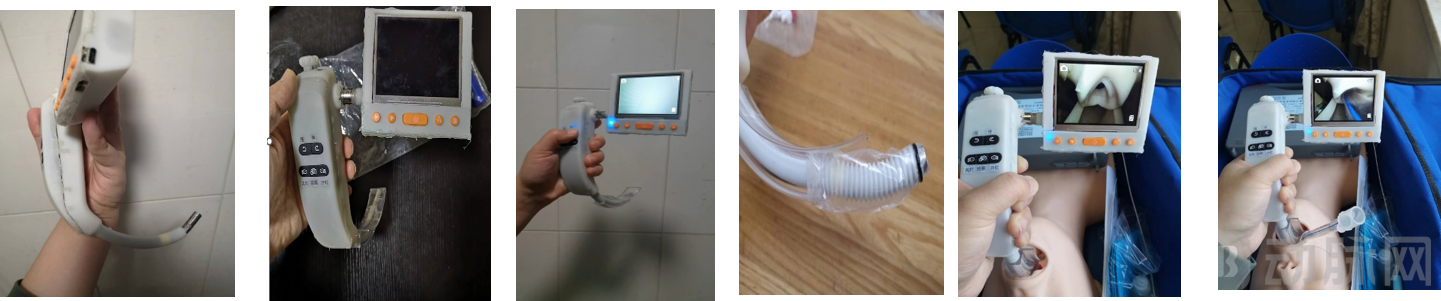
Curved Electric Laryngoscope Product Image
In 2022, the first-phase prototype was manufactured and validated using human body models, achieving a breakthrough from scratch. In 2024, the second-phase prototype was completed, with upgrades in appearance, waterproofing, weight, and other aspects.Simulation trials have been completed, meeting the criteria for translation to clinical practice, and patent certifications have been obtained in both China and the United States.
Yao Youxiu stated, “If successfully commercialized, the curved video laryngoscope is expected to gradually replace conventional laryngoscopes and existing video laryngoscopes, emerging as the third-generation video laryngoscope.”
Research Progress Is Internationally Leading; Seeking Partners
As the global population ages, the number of patients requiring endotracheal intubation and laryngeal surgery is steadily increasing. Statistics indicate that in China, there are an estimated 20 million general anesthesia surgeries, 500,000 cases of cardiac arrest, and over 1 million pre-hospital emergency patients annually, for which a laryngoscope is an indispensable tool.
Amid intensifying market demand, teams in various overseas countries are also conducting research on visual laryngoscopes with telescopic and angle-adjustable features.
According to research by Yao Youxiu’s team, currently only a handheld robotic system developed by a U.S. team—Spiro Robotics—shares a similar design concept with the curved electric laryngoscope; however, it has not yet received regulatory approval and is at a development stage comparable to that of Yao Youxiu’s team. In terms of cost-effectiveness, the Spiro Robotics handheld robotic system is projected to be priced as high as $15,000, with disposable components costing $350 each, whereas the disposables for the curved electric laryngoscope are expected to be priced at just RMB 50, significantly alleviating the financial burden on patients.
The curved electric laryngoscope project has continuously received support from the Innovation and Translation Fund of Peking University Third Hospital, won the Second Prize in the 7th Innovation and Translation Competition of Peking University Third Hospital, and achieved the First Prize in the Capital Medical Innovation and Translation Competition organized by the Beijing Medical Association.Successfully Selected for Beijing’s 2024 Excellent Promotion Planand advanced to the next level. With the strong support and leadership of hospital administrators at all levels, as well as Dr. Guo Xiangyang, Director of the Department of Anesthesiology, and Mr. Wang Jun, Party Secretary of the department,Dr. Yao Youxiu’s team is actively seeking partners, including enterprises and investors,to facilitate the early commercialization and clinical adoption of curved video laryngoscopes. In the future, we hope that domestically produced laryngoscopes can truly transition from imitation and substitution to becoming industry leaders.
Dr. Yao Youxiu’s team is currently seeking partners, including enterprises and investors. If you are interested in the curved electric laryngoscope, please contact us.