

SynBioLily Files IPO Prospectus: Powering Synthetic Biology Innovation with AI-Driven One-Stop CRO Platform and World’s Largest Biosynthesis Pathway Database
In 2010, the first synthetic cell, “Synthia,” was created, bringing the disruptive technological potential of synthetic biology into the global spotlight. In the decades since 2010, synthetic biology has gradually converged with global industries in a historic alignment, serving as a key technological pillar that has propelled the biomanufacturing sector to the forefront of worldwide scientific and industrial competition.
Currently, biomanufacturing is regarded as having the potential to lead the “Fourth Industrial Revolution,” becoming a focal point of competition among nations worldwide. China has also listed biomanufacturing as a strategic emerging industry for priority development, serving as one of the key means to enhance new-quality productive forces. Particular emphasis is placed on focusing on fields such as light-industry fermentation, pharmaceuticals, chemicals, agriculture, and food, to establish a technological system for the creation of core microbial strains and key enzymes in biomanufacturing.
However, to achieve a breakthrough, the bio-manufacturing industry, with its market size reaching the trillion-yuan level, still requires further upgrading. Technological capabilities and cost are merely one aspect of the many challenges faced during this upgrade process. The key to transitioning from traditional bio-manufacturing to realizing new quality productive forces lies in developing a portfolio of original, market-leading products, as only such innovations can truly demonstrate the value of technology. In the synthetic biology capital market, product selection has long been a central topic and a significant challenge. This difficulty intersects with a new bottleneck in the bio-manufacturing industry: how to design reactions, enzymes, and pathways based on vast amounts of biosynthetic data.
In the biopharmaceutical sector, Contract Research Organizations (CROs) specializing in R&D and manufacturing outsourcing have joined forces to break through industry bottlenecks. How, then, does synthetic biology fare? Wuhan SynBioLily Biotechnology Co., Ltd. (SynBioLily, hereinafter referred to as “SynBioLily”), an emerging enterprise dedicated to its mission of “making no raw material difficult to produce,” has answered this question. The company operates as a one-stop customized R&D platform for synthetic biology, driven by source innovation in artificial intelligence. Its team has developed the world’s largest database of synthetic biology reactions and pathways, along with a globally leading, one-stop, data-driven system for the rational design of synthetic pathways.
Creating Biosynthetic Pathways for Over 99% of Molecules
Dr. Hu Qiannan, Chief Scientist at SynBioLily, pointed out that the field of synthetic biology is currently facing a significant challenge. Globally, there are approximately 200 million different chemicals, yet only tens of thousands of molecules have a research foundation for biosynthesis; more than 99% of the remaining molecules lack established biosynthetic pathways. This situation highlights a critical bottleneck that the industry urgently needs to overcome.
Hu Qiannan’s personal research experience is closely aligned with this field. During his graduate studies around the year 2000, his supervisor introduced him to the vast array of compounds existing worldwide and guided him in exploring how to synthesize these compounds and identify underlying patterns. Since then, he has dedicated more than two decades to the industry, focusing on developing low-cost, high-efficiency, and environmentally friendly methods for producing various substances. He observed that, despite the long-term efforts of many talented researchers globally, the challenge of establishing biosynthetic pathways for over 99% of molecules remains inadequately addressed.
The impact of this unmet need has also subtly permeated from the research sector to the industry sector. Hu Qiannan’s team conducted an in-depth analysis of the actual needs of industry players and found that different customer groups have their own unique areas of focus.
Production- and manufacturing-oriented enterprises are more inclined to directly acquire mature, readily implementable projects. These companies aim to rapidly achieve technology transfer to enhance production efficiency and market competitiveness.
Among enterprises with R&D capabilities, particularly listed companies, there is often a demand for technological upgrades. These companies aim to achieve cost reduction and efficiency improvement by introducing synthetic biology techniques, such as novel reaction steps, into their existing production processes, thereby lowering costs, optimizing production pathways, or reducing environmental pollution.
Furthermore, some companies are seeking a second growth curve, aiming to expand their business scope by introducing new projects and achieve sustainable development. These enterprises also have an urgent demand for synthetic biology technologies and look forward to driving industrial upgrading through technological innovation.
In addition to the aforementioned types of enterprises, another customer segment comprises research institutions and the R&D departments of leading companies. This group encounters challenges that are difficult to address using traditional methods during the process of technology maturation, thereby necessitating the adoption of new technical approaches to break through bottlenecks.
To address these industry pain points, Hu Qiannan’s team decided to leverage emerging technologies, such as big data and artificial intelligence, to empower the industry and overcome this critical challenge. Thus, SynBioLily was established. From its inception, the company has adhered to its core mission: to provide downstream clients with one-stop customized R&D services in synthetic biology. It not only meets the needs of production- and manufacturing-oriented enterprises for mature projects but also assists companies with R&D capabilities in technological upgrades and helps those seeking a second growth curve introduce new projects. Meanwhile, it provides technical support to research institutions and the R&D departments of leading enterprises, resolving technical challenges and offering robust assurance for their R&D efforts.
AI-Powered: RxnFinder Database’s “World’s Largest” and “World’s First”
Given the lengthy synthetic biology industry chain and the current lack of efficient computational design tools and big data services within the sector, SynBioLily has leveraged its technological expertise to initially focus on building capabilities in computational design and big data services. Hu Qiannan has specialized in the field of computation since his graduate studies. During model construction, he observed that relevant data was fragmented and lacked systematic organization, leading him to recognize the critical importance of addressing this issue. While at Kyoto University in Japan, he noted that research on biosynthetic pathways enjoyed high global citation rates despite limited data sources, prompting him to further enhance data infrastructure in this field.
To build the RxnFinder database, the team spent over a decade and recruited more than 100 part-time students to participate. Currently, the database leads in terms of literature coverage.
RxnFinder is designed to help researchers address diverse scientific challenges, such as queries related to biosynthetic reactions, enzymes, pathways, strains, and literature; enzyme discovery technologies based on molecular structure transformation and deep learning; pathway design based on reaction combinations and strain metabolic networks; and strategies for developing high-value-added products from given compound precursors and constructing new molecular libraries.
At the data level, the RxnFinder database currently includes over 670,000 biosynthesis literature articles, more than 100,000 biosynthetic pathways, and over 300,000 biosynthetic reactions. Users can query relevant reaction information by entering molecule names, (sub)structures, or reaction types, with each reaction linked to its original literature source. Leveraging this extensive foundational data, the SynBioLily team has established the world’s largest strain–product relationship database and the world’s largest biosynthetic pathway database.
To bring these data to life and maximize their potential, SynBioLily has also developed multi-dimensional information search and integration tools. The strain-product relationship database supports queries on the relationships between strains and target compounds based on specific target compounds or strains, providing strain phylogenetic trees and molecular lists. When querying biosynthetic pathways, users need only input the target compound to retrieve its biosynthetic pathway, with the interface displaying visualized results of relevant literature and pathways.
Meanwhile, the RxnFinder database has also developed multidimensional bioinformatics tools for biosynthesis to meet demands such as online interactive biosynthetic pathway design, mining of biosynthetic potential for compounds, and preferred biosynthetic design (the SciFinder of the biosynthesis field). At the operational level, inputting a target molecule allows substructure algorithms to calculate possible precursor compounds and generate a similarity-ranked list.
Notably, SynBioLily has established the world’s first reaction similarity search method, which enables the retrieval of experimentally validated reference reactions based on inputted designed reactions. Additionally, it has developed the world’s first rational strain selection tool, which supports the rational selection of microbial strains and pathway design based on metabolic network calculations for different target compounds, yielding a list of candidate strains and corresponding biosynthetic pathways.
Furthermore, the introduction of AI has provided substantial support to SynBioLily’s intelligent manufacturing platform, leveraging the extensive data accumulated by the company in its early stages. Building on this data foundation, SynBioLily utilizes AI to enhance decision-making efficiency and precision, marking an inevitable direction for its future development.
The company is currently intensifying its efforts to strengthen its AI division, focusing primarily on two areas: first, enzyme discovery and matching. By leveraging deep learning algorithms, SynBioLily has successfully established correlations between molecular structures and enzyme sequence features, enabling precise and efficient enzyme screening. While this process might take traditional laboratories up to three years, SynBioLily can complete it within 29 days, significantly enhancing R&D efficiency. Second, in terms of synthetic pathway innovation, SynBioLily utilizes AI to create entirely novel synthetic pathways.
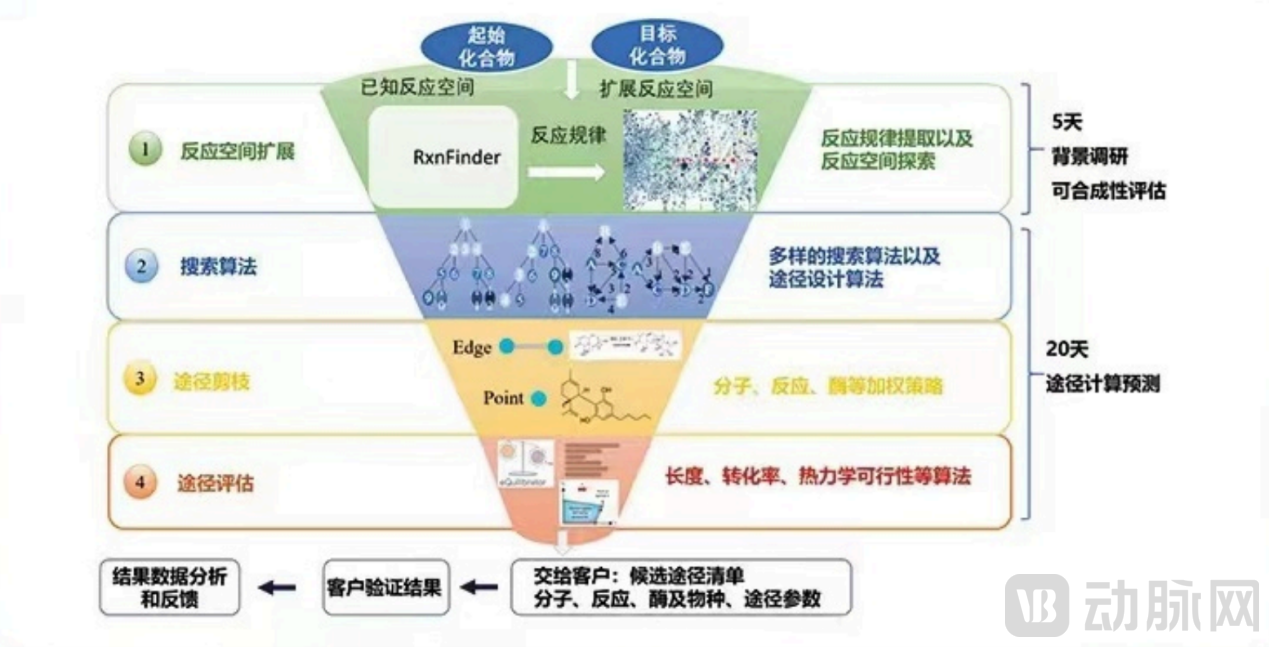
The AI model predicts relevant pathway lists and literature based on the target compound specified by the client, or based on both the starting compound and the target compound.
One-Stop CRO Services: Integrating Source Innovation with Industrialization
While building the RxnFinder database, SynBioLily also continues to identify new opportunities for business expansion.
A notable phenomenon in synthetic biology and related industries is that even when companies build specialized databases for their partners, they often still struggle to fully meet customer needs. The reason is that many new entrants lack practical experience in synthetic biology; what they desire is a complete pathway from theory to practice.
To this end, SynBioLily has decided to further expand its service capabilities. Similar to the multi-stage outsourcing services provided by WuXi AppTec in the pharmaceutical sector, SynBioLily aims to help customers in the field of biosynthesis address various challenges from R&D to production through one-stop services, thereby accelerating R&D efficiency and industrialization in the industry.
Initially, SynBioLily’s strategy focused on collaborating with industry leaders, concentrating on the research, development, and production of cosmetic ingredients, and launching a range of ingredient products exemplified by its “White Plus Black” series. However, in practice, the company found that leading enterprises preferred mature industrial processes and were not eager to invest in newly developed products. Meanwhile, downstream customers placed greater emphasis on ingredients that could be directly incorporated into formulations, facilitating rapid private-label product launches.
Guided by this insight, SynBioLily has further refined its strategy, extending its business chain to integrate the research and development, production, and manufacturing of cosmetic ingredients. Its subsidiary platform, LifeGenius, exemplifies this strategic shift. As a globally leading AI-driven design software for synthetic biology, LifeGenius provides practitioners with proprietary enzyme design algorithms and innovative source-level design services for reactions and pathways. It offers informatics-based CRO (Contract Research Organization) technical services in synthetic biology, supporting applications such as biomanufacturing, metabolic engineering, biosynthesis, biomaterials development, biomass utilization, high-value-added product development, toxin degradation, environmental pollution remediation, agricultural industrialization, industrial green transformation, as well as carbon peaking and carbon neutrality initiatives.
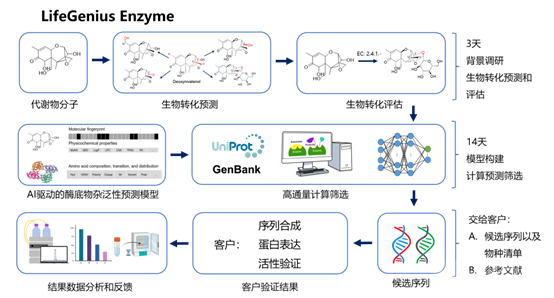
SynBioLily Intelligent Enzyme Discovery Platform
Hu Qiannan emphasized that although synthetic biology holds immense potential, the synthesis of many molecules still faces challenges. In particular, certain unique molecular structures or fragments lack global precedents, thereby imposing higher demands on computational and design capabilities. Some reaction steps suffer from low efficiency, necessitating the use of artificial intelligence to identify breakthrough solutions. To this end, SynBioLily secured financing in 2024 through its 80%-owned AI subsidiary, which is dedicated to addressing these design challenges.
Hu Qiannan further pointed out that different industries, such as agriculture, cosmetics, food, and pharmaceuticals, face distinct pain points during the R&D process. SynBioLily’s platform offers advantages including strong versatility, high R&D efficiency, and one-stop solutions, enabling it to provide differentiated solutions tailored to these industries.
It is worth noting that the SynBioLily team has engaged in in-depth discussions with multiple investment institutions. After evaluating the company’s projects, these investors concluded that the project possesses exceptional uniqueness within the industry and represents a scarce resource. Although there are overseas companies offering customized services in the field of synthetic biology, they fall short in terms of source innovation and the commercialization of industrial products. In contrast, SynBioLily’s one-stop platform and its focus on source innovation are unparalleled in the industry.
Currently, SynBioLily has established partnerships with multiple listed companies and leading industry players, and is working to enhance their R&D and production capabilities. Recently, SynBioLily announced a strategic collaboration with Magfutei Biotechnology (Shanghai) Co., Ltd. (“Magfutei Biotech”). Leveraging their respective deep expertise in enzyme technology research and application, both parties will jointly promote the development of synthetic biology and deliver more efficient customized enzyme solutions to customers.