

Toumai Surgical Robot Completes First Commercial Procedure in Europe, Marking Milestone for Chinese Medical Robotics

MedBot
Surgical Robot Developer
Recently, the Toumai four-arm laparoscopic surgical robot, under Shanghai Microport Medbot (Group) Co., Ltd., successfully performed an adrenalectomy combined with cholecystectomy through a single incision at Italy’s largest public hospital.
This marks the first commercial clinical surgery performed by a domestically produced laparoscopic surgical robot in developed countries across Europe and North America, signifying a new breakthrough for the Toumai robot in expanding into high-end markets in these regions.
The Toumai surgical robot, independently developed by MicroPort MedBot Group, received NMPA approval for market launch in January 2022. In September 2023, it obtained multi-specialty registration certification, enabling its use in endoscopic surgeries across urology, general surgery, thoracic surgery, and gynecology. In May 2024, the Toumai robot received EU CE marking, becoming the first Chinese-made laparoscopic surgical robot to enter the European market.
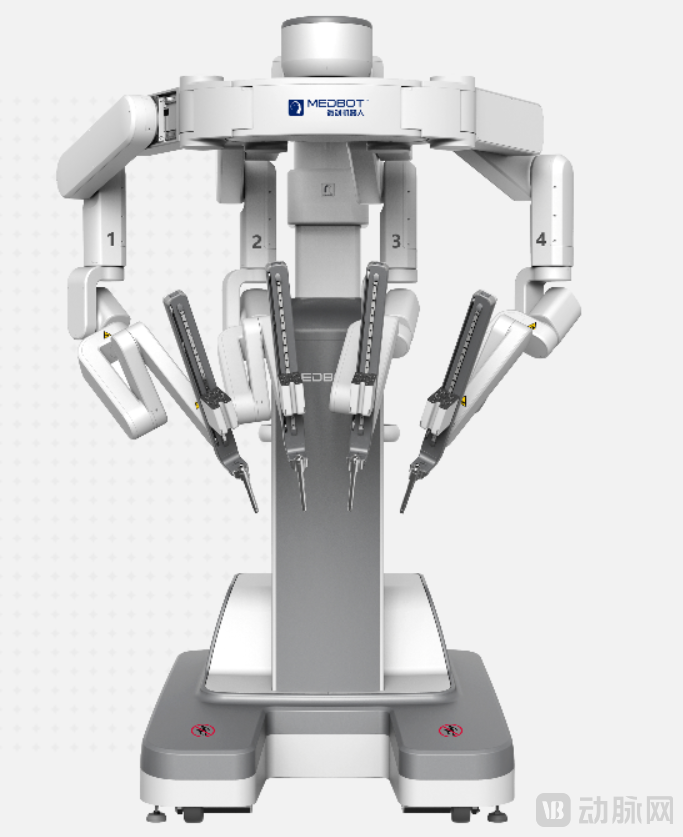
Image source: MedBot official website
Endoscopes extend the surgeon’s line of sight into the patient’s body, while robotic arms mimic the surgeon’s hands to hold and maneuver the endoscope and surgical instruments. Endoscopic surgical robots are currently the most widely used type of surgical robot, offering significant advantages over traditional laparoscopic surgery in terms of precise manipulation, tremor elimination, improved surgeon ergonomics, and reduced surgical trauma for patients.
The following two advantages of the Toumai surgical robot are particularly prominent:
Pioneered the launch of force feedback-related features.When performing surgery with a laparoscopic surgical robot, surgeons lose natural haptic perception and can only estimate force visually. The integration of force feedback technology enhances not only the realism of the procedure but, more importantly, effectively improves surgical efficiency.
The primary technical approach for achieving force sensing in laparoscopic surgical robots is through the integration of encapsulated force sensors. The key technical challenges lie in ensuring high precision and reliability, while also achieving miniaturization and integration, as well as adapting to the surgical environment. The Toumai robotic system features the world’s first haptic feedback component for laparoscopic surgical robots—Force Feedback.
Exploration of 5G Remote Surgery Capabilities.Remote surgery demands ultra-low communication latency and highly stable data transmission, as any delay or connection interruption could lead to imprecise surgical maneuvers or even compromise patient safety. The procedure requires the transmission of large volumes of real-time imaging and sensor data; high-resolution image transmission and real-time haptic feedback are critical to ensuring surgical precision and safety. In clinical applications, the Toumai robotic system has successfully completed over 250 cases of 5G-enabled ultra-remote surgeries, achieving a 100% success rate. The longest surgical distance exceeded 12,000 kilometers, with a cumulative data transmission distance surpassing 400,000 kilometers.1
In July 2024, the real-time fused fluorescence 3D electronic thoracoabdominal endoscope, designed for use with the Toumai surgical robot, officially received market approval, spearheading the accelerated independent innovation and development of domestically produced laparoscopic surgical robots.
As minimally invasive surgery gradually replaces traditional open procedures, laparoscopic surgical robots have become new assistants for surgeons, leveraging their advantages in precision and stability. In this market, Intuitive Surgical’s da Vinci Surgical System is the leader. Currently, Intuitive Surgical primarily sells the fourth-generation product in China—the imported and domestically produced versions of the da Vinci Xi.
On March 15, 2024, Intuitive Surgical announced that its next-generation multi-arm robotic system, the da Vinci 5, had received FDA 510(k) clearance. The da Vinci 5 also introduces haptic feedback technology, enabling certain instruments to measure the subtle forces exerted on tissues during surgery, thereby assisting surgeons in force application and reducing tissue trauma.
Furthermore, the da Vinci 5 is equipped with state-of-the-art 3D display and image processing technologies, boasting computational power more than 10,000 times that of the da Vinci Xi, thereby delivering superior data processing capabilities.
In terms of product functionality and performance, domestically produced laparoscopic surgical robots still lag behind the da Vinci Surgical System to some extent.The gaps are specifically reflected in three aspects: fewer types of supporting surgical instruments, imaging performance that still needs improvement, and a narrower range of covered indications.However, domestic brands such as Jingfeng Medical, Sizherui, Shurui Medical, and Weijing Medical are in a stage of rapid product iteration and are striving to catch up.
For instance, with regard to the haptic feedback technology mentioned earlier, the da Vinci 5 system has not yet been approved for market launch in China. Consequently, the Toumai surgical robot remains the only laparoscopic surgical robot with haptic feedback capabilities approved for use in China.
Furthermore, Weijing Medical’s laparoscopic surgical robot also adopts a highly precise master-slave haptic feedback control system, addressing the issue of operational accuracy. The four-arm laparoscopic surgical robot from Weijing Medical is expected to obtain regulatory approval by the end of 2024.
Meanwhile,Domestic brands are also continuously expanding surgical indications.In February 2024, Shurui Medical’s single-port laparoscopic surgical system received NMPA approval, adding gynecological indications to its existing urological applications.
On October 30, 2024, Edge Medical’s single-port laparoscopic surgical robot received approval from the National Medical Products Administration (NMPA), expanding its indications from gynecology to urology, gastrointestinal surgery, and hepatobiliary surgery. By November 15, it had surpassed 500 clinical procedures, with applications spanning multiple specialties including gynecology, urology, general surgery, thoracic surgery, breast surgery, and head and neck surgery.
In addition,Domestic EnterprisesRuilong Surgery and Hedong Medical are developing modular surgical robots and split-bed surgical robots,In terms of structural design, it has formed a clearly differentiated product compared to integrated surgical robots represented by the da Vinci system.
Currently, laparoscopic surgical robots are experiencing the best market opportunities in history. The downgrading of the management category for configuration certificates and the increase in planned quotas have led to a substantial rise in installations. Since entering the Chinese market in 2006, the da Vinci Surgical System has long dominated the sector. It was not until 2021, with the rapid development of domestic surgical robots, that da Vinci’s monopoly was broken.
According to MedBot’s 2024 semi-annual report, the Toumai laparoscopic surgical robot achieved seven commercial installations in the first half of the year, bringing the cumulative number of commercial installations in China to 20. In addition, overseas orders exceeded 10 units.
Jingfeng Medical (MP1000) and Sizherui Medical (Kangduo Robot) have not publicly disclosed specific installation figures. According to incomplete statistics compiled by VCBeat based on public tender data from the China Government Procurement Network and other publicly available sources, the cumulative number of winning bids for the Kangduo laparoscopic robot stood at 14 units as of September 2024, while Jingfeng Medical’s MP1000 had secured 11 winning bids. (These figures are based solely on publicly available data and do not represent total installations.)
In contrast, according to data from Intuitive Surgical’s earnings conference calls for the first and second quarters of 2024, the number of da Vinci surgical systems installed in China decreased year over year. In the first half of 2024, 24 da Vinci surgical systems were installed in China, compared with 34 during the same period in 2023, representing a year-over-year decline of nearly 30%.In addition to being affected by delays in equipment tendering and procurement, the rise of domestic enterprises cannot be overlooked.。
In response to these competitive pressures, da Vinci is also adopting a multi-dimensional approach.On the one hand, lowering the selling price of the domestically produced version of da Vinci,For instance, the price range for the da Vinci IS4000 CN version dropped from RMB 19 million to RMB 13 million, with the lowest winning bid price being halved compared to the imported version;On the other hand, accelerate localization development, with the establishment and commissioning of Intuitive Fosun’s headquarters and industrialization base, the da Vinci system is gradually achieving localization of its components, thereby further controlling costs.
Furthermore, the da Vinci 5 boasts superior computing power and an enhanced digital experience, further widening the gap between it and competing products. Its future launch in China could significantly reshape the competitive landscape of the Chinese market, placing considerable pressure on domestic brands.
Reference Article:
1. China-made laparoscopic surgical robot completes first commercial clinical case in developed countries, marking another milestone for Toumai® in expanding into high-end European and American markets! — MedBot