Chinese Biotechs Flood the NewCo Arena as T-Cell Engager Pipeline Deals Surge
As the year draws to a close, the fervor surrounding NewCo transactions remains undiminished.
Since 2024, NewCo transactions have become the most critical capital maneuver for domestic biotech firms. These deals, which combine elements of business development (BD) and financing, have spurred biotechs holding early-stage innovative drug assets to actively pursue such opportunities. Admittedly, NewCo transactions have offered a new lifeline to China’s biotech sector. However, even this potent remedy is not suitable for every biotech company.
From publicly disclosed cases, we can already discern certain inherent patterns in NewCo transactions. Just as ADC drug pipelines have become the primary targets in the era of business development (BD), participants in NewCo deals also exhibit distinct preferences. Underlying these trends is a profound transformation in the global landscape of innovative pharmaceuticals, highlighting the unique value demonstrated by China’s innovation ecosystem within this context.
The Sector Heated Up by NewCo Transactions
If BD is akin to sourcing from the domestic innovative drug market, NewCo transactions are more like overseas investment institutions stockpiling for MNCs.
VCBeat’s ongoing tracking of NewCo transactions has revealed a clear preference among top-tier overseas investment institutions for innovative drug assets in China. Among these, T-cell engagers represent one of the pipeline categories that best align with their expectations. Since 2024, Chinese biotech companies have announced four NewCo deals, all involving investigational T-cell engager therapies.It can be said that the NewCo transaction has ignited interest in the niche sector of T-cell engager therapies.
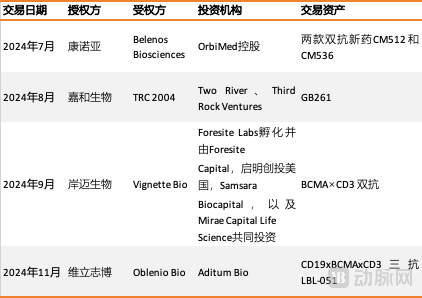
Selected NewCo Transactions Since 2024 Data Source: Artery Orange Database
Based on the disclosed details of NewCo transactions, overseas investment institutions have shown strong interest in acquiring T-cell engancer drug pipelines. Both very early-stage assets and relatively mature, high-cost pipelines may become targets for NewCo deals.
On one hand, overseas investment institutions are willing to assume greater R&D risks for T-cell engager pipelines.Among the four NewCo transactions involving T-cell engager pipelines that have occurred this year, Keymed Biosciences’ CM536 and Lellithera’s LBL-051 are both still in the preclinical research stage. Previously, industry practitioners analyzed on VCBeat that, from the perspective of balancing risk and return, investment institutions tend to select pipeline assets at or around Phase I clinical trials as targets for NewCo structures. The two transactions completed by Keymed Biosciences and Lellithera have clearly broken away from this conventional framework.
On July 9, Conmeda and Belenos Biosciences announced that they had reached an agreement on exclusive license agreements for two bispecific antibody drugs, CM512 and CM536, granting Belenos Biotech the global rights for research, development, registration, production, and commercialization outside of Greater China. Although the corresponding targets were not disclosed, industry insiders widely speculate that both CM512 and CM536 are derived from Conmeda’s nTCE bispecific antibody platform. Indeed, Conmeda has previously demonstrated strong performance in the T-cell engager field, with leading clinical progress in multiple drug candidates within its pipeline, including CD20/CD3, BCMA/CD3, and GPC3/CD3.
In a coincidental development, on November 7, Weili Zhibo and the venture capital firm Aditum Bio announced the establishment of a new drug development company, Oblenio Bio, based on Weili Zhibo’s globally first-in-class CD19 x BCMA x CD3 trispecific T-cell engager antibody, LBL-051, and entered into an exclusive option and license agreement. Reportedly, LBL-051 is a novel trispecific T-cell engager developed using Weili Zhibo’s independently owned and proprietary technology platform, LeadsBody™. By simultaneously targeting CD19 and BCMA, LBL-051 holds the promise of eliminating a broader range of pathogenic B cells in various antibody-mediated autoimmune diseases, thereby eliciting more potent and durable therapeutic effects.
Both new drug pipelines have garnered favor from investment firms even before key clinical trial data were available, underscoring the urgent demand among investors and the multinational corporations (MNCs) they serve for high-quality T-cell engager assets.
On the other hand, overseas investment institutions are also willing to offer higher upfront payments to acquire relatively mature T-cell engager pipeline assets.In August, Genor Biopharma announced that it had entered into a license agreement and an equity agreement with TRC 2004. Under the license agreement, Genor Biopharma has agreed to grant the licensee an exclusive global license (excluding Mainland China, Hong Kong, Macau, and Taiwan) to develop, use, manufacture, commercialize, and otherwise exploit GB261. In consideration, Genor Biopharma will receive a certain equity stake in TRC 2004, an upfront payment of tens of millions of U.S. dollars, milestone payments of up to $443 million, and tiered royalties ranging from single-digit to double-digit percentages of net sales.
GB261 is one of Genor Biopharma’s core assets. As a novel, differentiated CD20/CD3 bispecific T-cell engager, GB261 binds to CD3 with low affinity while retaining Fc function. Previously, Genor Biopharma successfully completed a Phase I/II multicenter study of GB261 in B-cell non-Hodgkin lymphoma (B-NHL), including diffuse large B-cell lymphoma (DLBCL) and follicular lymphoma (FL), in China and Australia. The results demonstrated that GB261 has superior safety and efficacy.
The following month, I-Mab Biopharma announced that it had entered into a license agreement with Vignette Bio regarding EMB-06, I-Mab’s BCMA-targeting T-cell engager molecule. Under the terms of the agreement, I-Mab granted Vignette exclusive rights to develop and commercialize EMB-06 outside of Greater China (including mainland China, Hong Kong, Macau, and Taiwan), while I-Mab retained the rights to EMB-06 within Greater China.
As consideration, Mabwell will receive a total upfront payment of $60 million in the form of cash and Vignette equity, and will be entitled to receive up to $575 million in development, regulatory approval, and commercialization milestone payments, as well as revenue sharing based on net sales. It is understood that EMB-06 is the first T-cell engager (TCE) molecule developed under Mabwell’s T-cell engagement platform and the third project from Mabwell to have received clinical trial approval.
As evidenced by the transaction consideration, the upfront payments made by investment institutions for GB261 and EMB-06, two relatively mature T-cell engager assets, were substantial. In comparison to NewCo deals completed during the investment and financing boom around 2021, the upfront payments in these two transactions did not decline.
Whether in target selection or pricing, T-cell engager assets have become highly sought-after in NewCo transactions.
Old Trees Sprout New Branches
In fact, T-cell engager drugs are not a new concept.In the early years, T-cell engagers and cell therapies were jointly regarded as new hopes for the treatment of malignant tumors.
So-called T-cell engagers are essentially bispecific antibody drugs characterized by a simple structure that lacks an Fc fragment. They consist of two single-chain antibodies linked by a short peptide chain, retaining only two antigen-binding sites to exert their function. One side of these single-chain antibodies recognizes tumor-associated antigens, such as CD19, CD33, and BCMA, while the other side specifically recognizes CD3, a component of the T-cell receptor complex.
The underlying logic of T-cell engagers is connection.T cells and tumor target cells, leading to T cell activation, therebyKilling tumor target cells.However, for a long period, the application of T-cell engagers was confined to the treatment of specific hematologic malignancies. Breakthroughs in indications were difficult to achieve, resulting in very limited clinical and commercial value. T-cell engagers were once considered an obsolete technology, with some companies that had early involvement in this drug development area even discontinuing their related pipelines.
The currently popular NewCo transactions are essentially a precursor to MNCs acquiring new pipelines. Behind the hot targets of NewCo deals lies also a shift in the R&D focus of MNCs.With the launch of Amgen’s new small cell lung cancer drug, Imdelltra, the value of T-cell engagers is being reevaluated. In fact, driven by breakthroughs across multiple indications and particularly by the confirmed therapeutic potential in autoimmune diseases, T-cell engagers are once again stepping into the spotlight, becoming a fiercely contested battleground for multinational corporations (MNCs).
First, in recent years, with breakthroughs in novel drugs targeting star antigens such as CD3/CD20, CD3/CD19, and CD3/BCMA, T-cell engagers have expanded into multiple key indications for hematologic malignancies.As one of the most fiercely contested target combinations, CD3/CD20 bispecific antibodies offer new therapeutic strategies for hematologic malignancies such as non-Hodgkin lymphoma (NHL). Currently, three CD3/CD20 bispecific antibodies have been approved for marketing. Among them, AbbVie’s pcoritamab has been approved for the treatment of patients with relapsed/refractory (R/R) diffuse large B-cell lymphoma (DLBCL) and follicular lymphoma (FL); Roche’s glofitamab has been approved for the treatment of patients with R/R DLBCL; and Roche’s mosunetuzumab has been approved for the treatment of patients with R/R FL.
As the first globally approved CD3/CD19 bispecific antibody, Amgen’s Blinatumomab demonstrated strong commercial potential immediately after its launch. From 2021 to 2023, Blinatumomab achieved sales of $472 million, $583 million, and $861 million, respectively. It is understood that Blinatumomab has been approved for the treatment of adult and pediatric patients with relapsed or refractory B-cell precursor acute lymphoblastic leukemia (R/R BCP-ALL), as well as adult and pediatric patients with BCP-ALL who are in their first or second complete remission but have minimal residual disease (MRD) levels ≥0.1%. The drug has also entered the Chinese market.
Furthermore, T-cell engager therapies targeting BCMA, a star target in multiple myeloma, have also reached the market. Currently, two CD3/BCMA bispecific antibodies have been approved globally: Teclistamab (developed by Johnson & Johnson/Genmab) and Elranatamab (developed by Pfizer). Both have received FDA approval for the treatment of patients with relapsed or refractory (R/R) multiple myeloma (MM).
Second, with the optimization of technical details such as target screening and tumor microenvironment modulation, T-cell engager drugs are beginning to show promise in solid tumors.Historically, the development of T-cell engager therapies for solid tumor indications has faced numerous technical bottlenecks. Target antigens in solid tumors are often also expressed on tissues in healthy organs, which can readily lead to fatal immune-mediated organ damage and organ failure; thus, the safety profile of T-cell engagers requires improvement. Furthermore, within the tumor microenvironment of solid tumors, the number of T cells available to exert therapeutic effects may be insufficient or subject to multiple inhibitory mechanisms, resulting in uncertain efficacy of T-cell engagers against specific targets.
Nowadays, with the approval of Amgen’s new drug tarlatamab (CD3/DLL3) for marketing in the United States, and given that T-cell engagers targeting CD3 in combination with tumor-specific highly expressed antigens such as CLDN18.2, EGFR, and HER2 have demonstrated promising results in early-stage clinical trials, T-cell engager therapies are beginning to secure indications for solid tumors. This breakthrough from hematologic malignancies to solid tumors has led more multinational corporations (MNCs) to recognize the clinical significance and commercial value of T-cell engager drugs.
Last, and most importantly, recent studies have confirmed that T-cell engagers can be used for certain autoimmune disease indications, which are currently the hottest area of competition among multinational corporations (MNCs).Studies have shown that B-cell depletion therapy may emerge as a potential treatment for certain B-cell-mediated autoimmune indications, such as systemic lupus erythematosus, rheumatoid arthritis, and multiple sclerosis.
B-cell depletion therapy refers to the use of antibody drugs that target B-cell surface antigens, such as CD20 and CD19. This approach mediates B-cell lysis through antibody-dependent cellular cytotoxicity (ADCC) or complement-dependent cytotoxicity (CDC), or induces B-cell apoptosis by targeting cytokines essential for B-cell survival, such as B-cell activating factor (BAFF), thereby achieving B-cell depletion. Previously, Amgen released preliminary data on blinatumomab, a CD3/CD19 bispecific antibody, in six patients with refractory rheumatoid arthritis (RA). The study demonstrated that blinatumomab effectively cleared B cells from the body, thereby reducing the production of pathogenic antibodies. All patients experienced a rapid decline in clinical disease activity, improvement in synovial lesions, and reduced levels of autoantibodies.
Some media outlets have pointed out that, in reality, many multinational corporations (MNCs) are seeking T-cell engager drugs with the aim of building a more robust pipeline in the field of autoimmune diseases.T-cell engagers: A Revitalized Class Facing Fierce Competition
The Track Is Crowded with Chinese Pharmaceutical Companies
Currently, among the more than 120 T-cell engager drugs that have entered clinical trials globally, VCBeat has found that nearly half of these clinical-stage T-cell engagers are being developed with participation or leadership from Chinese pharmaceutical companies. In addition to the several biotech firms mentioned earlier that have already completed transactions,In the development of T-cell engagers targeting CD19/CD3, CD20/CD3, CD3/CLDN-18.2, and CD3/DLL3, Chinese biotech companies are at the forefront of global new drug R&D.。
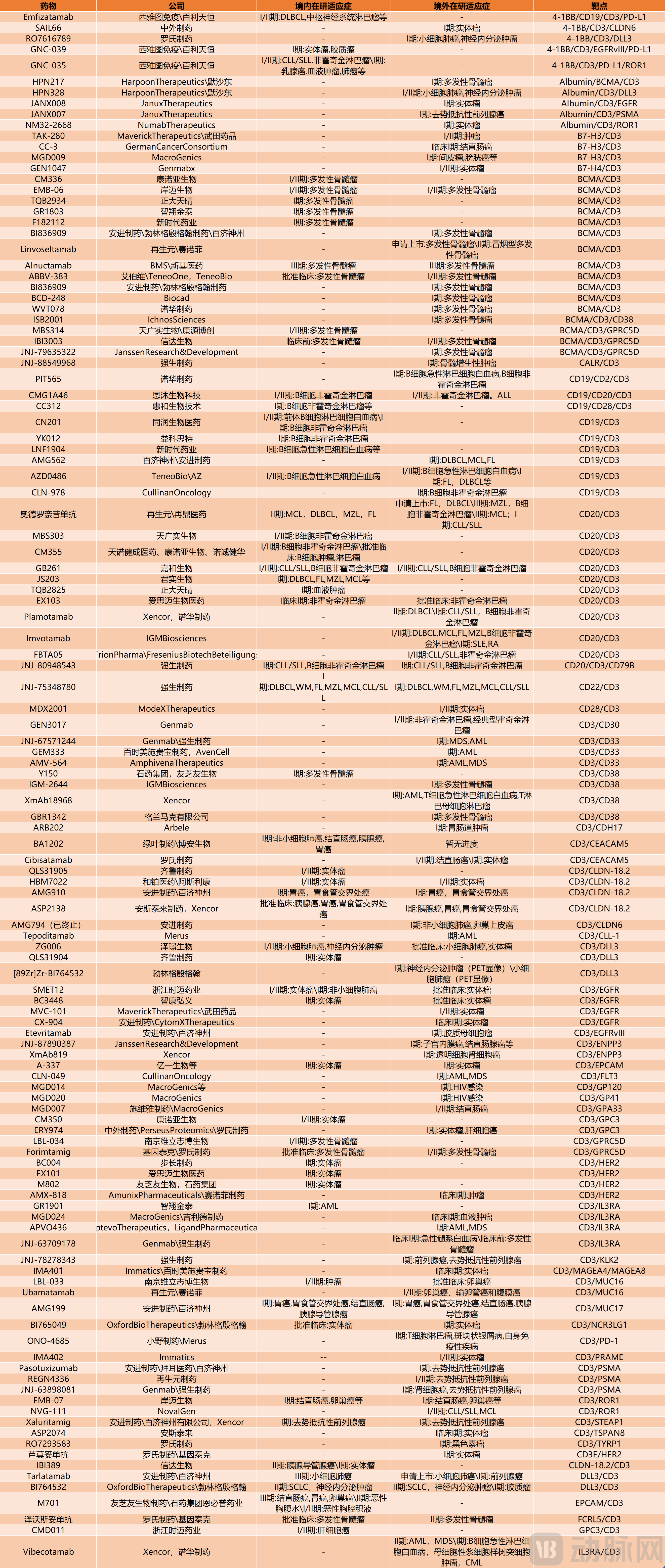
Among these, Tongrun Biologics’ CD19/CD3 pipeline candidate CN201 was acquired by Merck & Co. in August, with an upfront payment of $700 million and up to $600 million in milestone payments contingent on subsequent development and regulatory approval progress. According to the NextPharma database by PharmaCube, at the time the transaction was announced, this deal ranked second globally and first in China in terms of upfront payment for a single asset. The reason this low-profile biotech company was able to secure such a striking deal lies not only in CN201’s fortunate alignment with the wave of autoimmune drug development but, more importantly, in the fact that it is the only domestic pipeline in its class to have advanced to the clinical stage and generated clinical data, placing its clinical progress among the global leaders.
Furthermore, TianGuangShi Biologics, with its CD20/CD3 pipeline; Harbour BioMed, with its CD3/CLDN18.2 pipeline; and Qilu Pharmaceutical, with its CD3/DLL3 pipeline, are all at the global forefront in the development of their respective targets.
In December 2022, MBS303, a CD20/CD3 bispecific antibody independently developed by TianGuangShi Biologics, received implicit approval for clinical trials. It will proceed to Phase 1/2 clinical trials for the treatment of relapsed/refractory CD20-positive B-cell non-Hodgkin lymphoma (B-NHL), ranking second in development progress only to odronextamab, which is jointly developed by Regeneron and Zai Lab. In April 2022, Harbour BioMed granted AstraZeneca the global rights for the development and commercialization of HBM7022, a CLDN18.2/CD3 bispecific antibody, receiving an upfront payment of $25 million. Currently, HBM7022 is undergoing global Phase I/II clinical trials for solid tumors, making it the fastest-advancing drug in its class worldwide.
On the other hand, it is worth noting that the development of innovative tri-specific T-cell engagers is becoming a unique advantage for Chinese biotech companies in this niche sector.In October 2024, the news that GSK had acquired CMG1A46, a CD19/CD20/CD3 trispecific antibody developed by Enmab Therapeutics, for a sky-high price sparked significant industry attention. Under the agreement, Enmab Therapeutics will receive an upfront payment of $300 million (approximately RMB 2.139 billion) and milestone payments totaling $550 million, while GSK will obtain full global rights to CMG1A46, with a subsequent focus on exploring the drug’s potential in B cell-driven autoimmune diseases. This deal has made Enmab Therapeutics the second Chinese biotech company to achieve sudden prominence through a T-cell engager-related transaction, following Tongrun Biopharma.
According to VCBeat, TianGuangShi Bio/Conyuan Bochuang’s BCMA/CD3/GPRC5D-targeted pipeline MBS314 and Innovent Biologics’ BCMA/CD3/GPRC5D pipeline IBI3003 are conducting Phase I/II clinical trials for multiple myeloma domestically and internationally, respectively, representing the fastest progress among comparable drugs. Meanwhile, Zelixir Pharma’s CD3×DLL3×DLL3-targeted pipeline ZG006 is undergoing Phase I/II clinical trials in China for small cell lung cancer and other solid tumors, and has already received approval to conduct clinical trials in the United States, also marking the fastest global progress among its peers.
The NewCo transaction has once again placed T-cell engager therapeutics in the spotlight for investment firms and multinational corporations (MNCs). In this therapeutic area, where Chinese biotech companies hold a distinct advantage, we anticipate more landmark deals that will effectively drive the development of novel drugs.
China’s innovative drug ecosystem is undergoing profound transformation. The NewCo model has emerged as a novel approach for innovative pharmaceutical companies to address challenges in fundraising and business development (BD), optimizing the alignment between innovative drug assets and capital by integrating asset transactions with equity deals. However, the industry remains in an exploratory phase, with many uncertain about implementation strategies and timing. To address this, VCBeat, in partnership with Niukou Capital, will host the “China NewCo Summit” in Shanghai on December 6. Through practical presentations, discussions, and resource networking, the summit aims to help executives of innovative pharmaceutical companies and relevant stakeholders grasp the essentials of the NewCo model while facilitating valuable connections. To register and access the agenda, please scan the QR code below to contact our staff.