

Chengdu-Based Biotech ConnoMed Inks $626M NewCo Deal for BCMA/CD3 Bispecific Antibody CM336

Keymed Biosciences
Innovative Biopharmaceutical Developer

Platina Medicines Ltd
--
On November 17, Keymed Biosciences’ wholly-owned subsidiary, Kang Nuoya Biomedical Technology (Chengdu) Co., Ltd., entered into an exclusive license agreement with Platina Medicines Ltd (PML). Under the license agreement, Keymed Biosciences granted PML an exclusive license to develop, manufacture, and commercialize the candidate drug CM336 globally (excluding Mainland China, Hong Kong, Macau, and Taiwan).This marks Keymed Biosciences’ second NewCo overseas venture in 2024, following its $185 million deal with Belenos Biosciences in July.
Keymed Biosciences will receive an upfront payment and near-term payments totaling $16 million,Additionally, a minority equity stake in Ouro Medicines (the parent company of PML, holding 100% of PML’s equity) was obtained as part of the consideration.Upon the achievement of certain clinical, regulatory, and commercial milestones, Keymed Biosciences is eligible to receive additional payments of up to $610 million and is entitled to receive tiered royalties on net sales.(Note: The total transaction amount was $626 million, equivalent to approximately RMB 4.527 billion.)
Keymed Biosciences shall be responsible for providing assistance to facilitate the transfer of technology and know-how. Unless otherwise agreed, PML shall bear all costs associated with the development activities of CM336 in the Licensed Territory. PML and Keymed Biosciences shall enter into a clinical supply agreement, pursuant to which PML shall procure clinical supplies of the CM336 drug product from Keymed Biosciences.
It is reported that CM336 is a BCMA/CD3 bispecific antibody independently developed by Keymed Biosciences. Its clinical trial was approved by the National Medical Products Administration in 2021 for the treatment of relapsed or refractory multiple myeloma (R/RMM).
According to the company’s official website, Keymed Biosciences has established a dual pipeline focused on “autoimmune and chronic diseases + oncology.” It currently boasts 11 candidate drugs in clinical development or at the stage of filing for clinical trials, including one antibody-drug conjugate (ADC) product. The autoimmune pipeline comprises five products under development, including its core asset spartalizumab (CM310), CM326, and CM338, with R&D progress ranking among the leading domestic peers in the same class. The oncology pipeline includes six products under development, such as CMG901, CM313, and CM355.
CM336, a BCMA/CD3 bispecific antibody developed based on Keymed Biosciences’ proprietary nTCE bispecific platform, is expanding overseas through the NewCo model.CM336 specifically binds to BCMA-positive target cells and CD3-positive T cells, recruiting immune T cells to the vicinity of the target cells, activating T cells, and inducing T cell-mediated cytotoxicity against tumor cells (TDCC) to kill the target cells.
Keymed Biosciences is continuously advancing a multicenter, open-label Phase I/II clinical study to evaluate CM336 injection for the treatment of patients with relapsed or refractory multiple myeloma.Furthermore, based on the clinical efficacy observed in the multiple myeloma indication, Keymed Biosciences believes that CM336 has the potential to become a novel therapeutic option for autoimmune diseases by eliminating plasma cells that secrete pathogenic antibodies.
Meanwhile,Keymed Biosciences Has Products Approved for Market Launch in China in the Autoimmune Disease FieldOn September 12, Keymed Biosciences’ self-developed Class 1 innovative drug, Kangyueda® (spesolimab injection), was officially approved for marketing by the National Medical Products Administration for the treatment of moderate-to-severe atopic dermatitis in adults, becomingThe First IL-4Rα Antibody Drug Approved for Marketing in China and the Second Globally。
The 52-week study results demonstrated that long-term treatment with spikizumab in adult patients with moderate-to-severe atopic dermatitis yields sustained clinical benefits with a favorable safety profile. The EASI-75 response rates were 92.5% and 88.7%, respectively; the EASI-90 response rates were 77.1% and 65.6%, respectively; and the rates of achieving an IGA score of 0 or 1 with a reduction of ≥2 points from baseline were 67.3% and 64.2%, respectively, indicating potent and sustained improvement in skin lesions. Furthermore, the treatment provided rapid and sustained relief from pruritus: the response rates for a reduction of ≥4 points in the weekly mean daily PP-NRS score from baseline were 67.3% and 60.5%, respectively, and the change in daily PP-NRS score from baseline on Day 1 of treatment was significantly superior to that of placebo.
Furthermore, the National Medical Products Administration (NMPA) has accepted the marketing authorization applications for spucibart in the treatment of chronic rhinosinusitis with nasal polyps (CRSwNP) and seasonal allergic rhinitis, with the CRSwNP indication included in the priority review and approval program. Clinical trials for pediatric and adolescent atopic dermatitis, prurigo nodularis, asthma, and chronic obstructive pulmonary disease are currently in Phase III or pivotal Phase II/III stages.
In the field of oncology, the most rapidly advancing asset is the lead ADC pipeline CMG901/AZD0901, for which a global exclusive licensing agreement was reached with AstraZeneca in 2023.AstraZeneca is responsible for the global research and development, manufacturing, and commercialization of CMG901. In the publicly disclosed Phase I data, the confirmed objective response rate (ORR) was 35% and the confirmed disease control rate (DCR) was 70% among 89 evaluable subjects with Claudin 18.2-high gastric cancer or gastroesophageal junction adenocarcinoma across three dose cohorts. A confirmed ORR of 48% was observed in the 2.2 mg/kg dose cohort.The median progression-free survival (mPFS) was 4.8 months, and the median overall survival (mOS) was 11.8 months in all 93 subjects with Claudin 18.2-high gastric cancer or gastroesophageal junction adenocarcinoma.
Currently, nearly half of Keymed Biosciences’ 11 drug candidates in development have been out-licensed to partners including AstraZeneca, InnoCare Pharma, and CSPC Pharmaceutical Group, among other renowned domestic and international pharmaceutical companies. This has enabled the company to generate revenue for consecutive years and achieve profitability despite not yet having any commercialized products.
For example, in 2021, Keymed Biosciences achieved total revenue of RMB 110 million, of which RMB 70 million was the upfront payment from CSPC Pharmaceutical Group for domestic rights to the autoimmune product CM310, and RMB 40 million came from collaboration income with InnoCare Pharma regarding the oncology product CM355. In the first half of 2022, Keymed Biosciences again recorded total revenue of RMB 100 million, driven by the upfront payment previously made by CSPC Pharmaceutical Group for the introduction of the autoimmune product CM326. Meanwhile, the company achieved a net profit attributable to shareholders of RMB 5.454 million, turning a profit compared to the loss in the same period of the previous year.
In March 2021, CSPC Pharmaceutical Group invested RMB 170 million to acquire the domestic rights from Keymed Biosciences for CM310 in the treatment of respiratory diseases such as moderate-to-severe asthma and chronic obstructive pulmonary disease (COPD). In November of the same year, the two companies further strengthened their partnership, with Keymed Biosciences granting CSPC Pharmaceutical Group the Chinese rights (excluding Hong Kong, Macau, and Taiwan) for CM326 in the treatment of respiratory diseases such as moderate-to-severe asthma and COPD. In return, CSPC paid an upfront payment of RMB 100 million and agreed to pay development milestone payments of up to RMB 100 million based on development progress.
In 2023, Keymed Biosciences reached a peak in business development (BD) collaborations. In February, it granted AstraZeneca exclusive global development rights for CMG901, securing a total transaction value of up to $1.2 billion, including a $63 million upfront payment and up to $1.125 billion in potential additional payments. Consequently, Keymed Biosciences achieved total revenues of RMB 327 million in 2023, representing a substantial year-on-year increase of 227%. The primary revenue source was the upfront payment from the licensing of its oncology investigational product, CMG901, to AstraZeneca. Net profit attributable to shareholders amounted to RMB 47 million, marking a sevenfold year-on-year increase.
According to its 2024 interim business report, Keymed Biosciences currently holds approximately RMB 2.6 billion in cash, time deposits, and short-term wealth management products. Its revenue for the first half of the year amounted to around RMB 55 million, primarily derived from milestone payments related to the licensing collaboration for CMG901. Notably, the sustainable internal funding and robust cash flow generated through business development (BD) of its innovative pipeline have provided Keymed with the financial confidence to further invest in research and development. In the first half of 2024, the company’s R&D expenses increased by 33% year-on-year, reaching approximately RMB 330 million.
Meanwhile, Keymed Biosciences entered a new phase of commercial development in 2024 with the approval and market launch of its first drug, CM310 (sipucibart). To support this milestone, the company’s production facility in Chengdu has reached a total capacity of 18,600 liters, and it has gradually built a commercialization team comprising more than 190 members.
The NewCo model represents a more sophisticated approach to innovative drug asset transactions, integrating asset deals with equity transactions—effectively combining business development (BD) with financing. Historically, overseas funds were the primary drivers seeking NewCo partners in the Chinese market; however, an increasing number of Chinese pharmaceutical companies are now proactively initiating NewCo arrangements. A growing number of Chinese innovative drug developers are pursuing various pathways to globalize their products, with more than half of these companies expressing willingness to consider the NewCo model.
In China, the surge in NewCo transactions has been largely driven by Hengrui Medicine’s high-profile entry into this model. In May 2024, after Hengrui Medicine licensed its GLP-1 product portfolio to its overseas subsidiary, Hercules, other innovative pharmaceutical companies such as Keymed Biosciences, Genor Biopharma, BioMab Therapeutics, and Elpiscience Biopharmaceuticals rapidly completed their own NewCo deals. In these transactions, Chinese biotech firms typically license the ex-Greater China rights of one pipeline asset to a newly established overseas entity (the “NewCo”) as consideration, thereby receiving upfront payments, milestone payments, and other benefits from the business development (BD) deal, along with an equity stake in the NewCo.
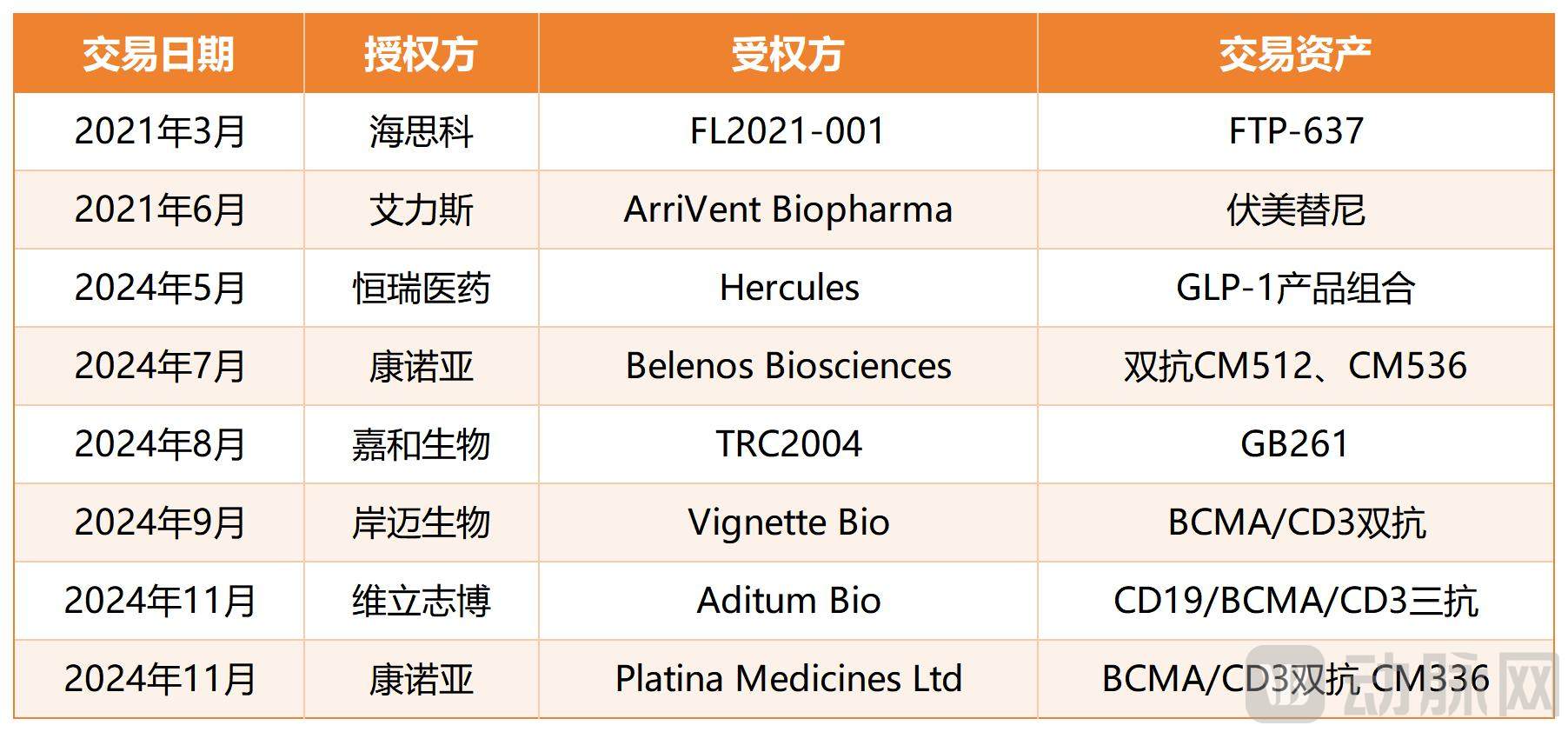
NewCos Involving Domestic Biotechs (VCBeat Orange Database)
Unlike conventional spin-offs, NewCos exhibit a strong overseas orientation, primarily operating in the U.S. market. In existing cases, although licensed Chinese innovative drug pipelines serve as core assets, the NewCo is structured as a purely American entity. It typically features a Caucasian management team, completes financing or goes public in the U.S. market, and operates independently, with the ultimate goal of being acquired by a multinational corporation (MNC) to facilitate an exit for early-stage shareholders.
Notably, when domestic biotech companies spin off overseas rights to relatively early-stage pipelines in NewCo transactions, this does not conflict with the domestic launch of their products. In BD (business development) deals, MNCs (multinational corporations) often prefer mature pipelines that have already entered Phase II or III clinical trials and are expected to reach the market within two years.Under the NewCo model, biotech companies retain global rights to their core pipelines in Phase II or III clinical trials, while also securing substantial upfront and milestone payments comparable to those in business development (BD) deals, thereby supporting the continued development of their domestic R&D pipelines.
Meanwhile, establishing new companies through capital investment to expand overseas ensures that a significant proportion of overseas equity is retained even after products enter the commercialization phase. At its core, the prosperity of NewCos reflects the increasingly important supporting role played by China’s innovative drug assets. The next critical task is to generate high-quality clinical data and bring these NewCo overseas assets to the attention of multinational corporations (MNCs).
References:
VBInsight “$1.35 Billion: This Chinese Pharma Company Sold Two Bispecific Antibodies in a Single Deal”
VCBeat: “Behind the Surge in Popularity of the NewCo Model: Who Has Entered the Arena, and Who Is Watching from the Sidelines?”