

Domestic DSA Manufacturers Challenge GE, Philips, and Siemens in High-End Medical Imaging Market
There is a high-end niche product in medical imaging that remains monopolized by three giants—General Electric (GE), Philips, and Siemens. This product is the DSA system (Digital Subtraction Angiography), which stands as one of the most advanced devices currently available for both diagnosis and treatment.
How Staggering Are the Data? According to data from Med-Engine Study Society, in 2023, Philips, Siemens, and GE collectively accounted for nearly 90% of the market share, while domestic brands combined held approximately 10%, underscoring the absolute dominance of these three companies in the industry.
In other words, for every 10 DSA units sold in the Chinese market, only one is from a domestic brand. This stands in stark contrast to the strong rise of domestic brands in recent years in medical imaging fields such as DR, CT, and MR.
It is important to recognize that DSA equipment is an essential “weapon” for interventional diagnosis and treatment in areas such as coronary angiography, stent implantation, neurovascular diseases, peripheral vascular diseases, and tumors across various systems. It holds particular significance in the narrative of domestic substitution of medical devices in China.
What exactly are the “roadblocks” hindering the domestic DSA equipment sector? Where do the industry barriers lie? And how are Chinese brands breaking through?
Different medical device products face distinct barrier challenges.
For instance, in the field of medical imaging equipment, the core of Digital Radiography (DR) systems is the imaging chain, which includes key components such as high-voltage generators, X-ray tubes, detectors, gantries, and software processing workstations. As China’s imaging chain industry started relatively late and has long relied on imports, there remains a significant quality gap between some domestically produced core components and their imported counterparts, making it challenging for Chinese medical imaging companies to compete in certain high-end markets.
“Once the localization rate of these key components increases, the overall localization of the product will accelerate rapidly,” Tian Wei, Marketing Director at Vmai Medical, told VCBeat. “In recent years, domestically produced DR systems have benefited from the development of China’s domestic imaging chain industry, with their market share continuously expanding to approximately 80%.”
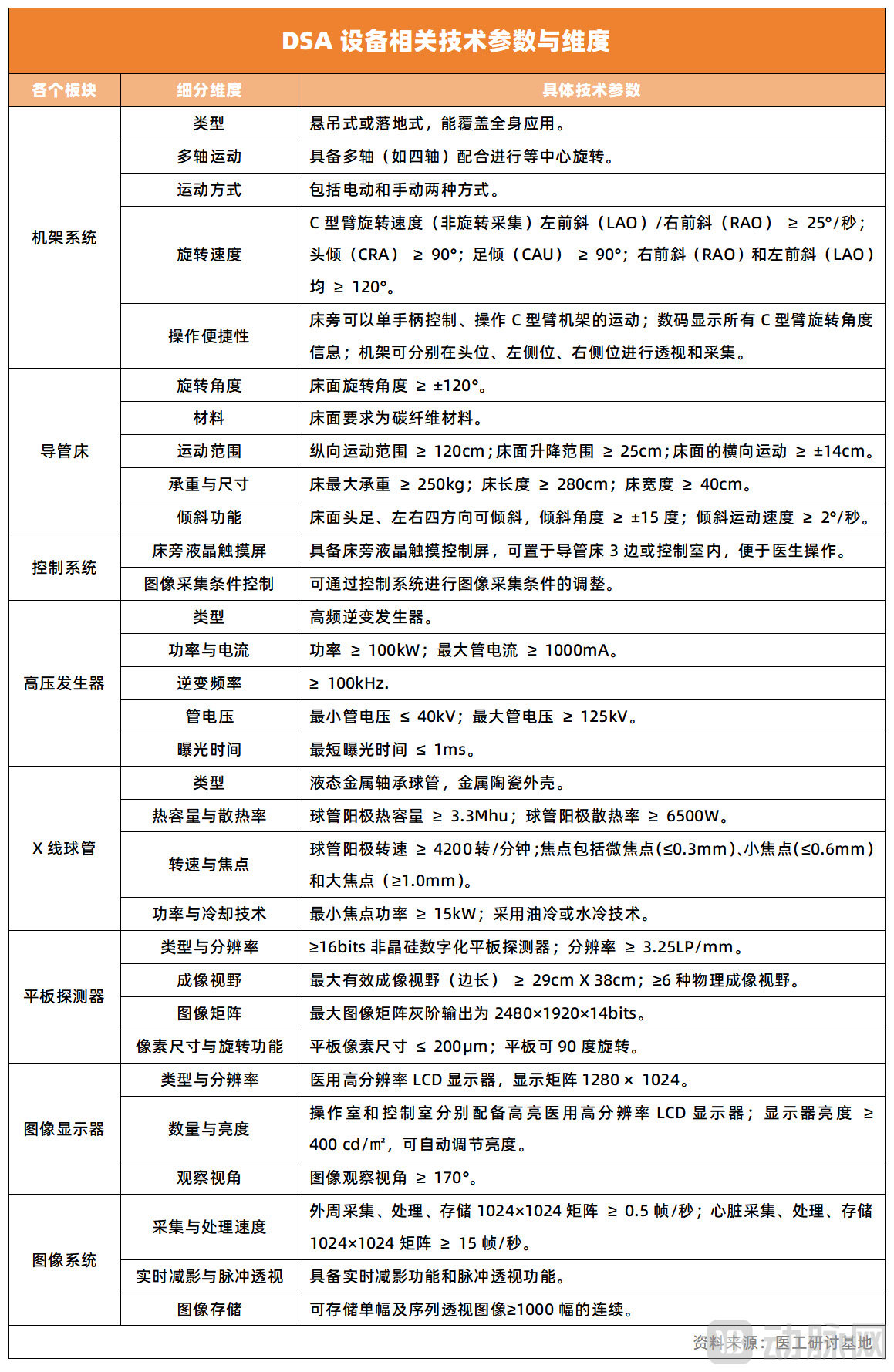
Unlike DR and other products, DSA equipment not only places particular importance on the imaging chain but also rigorously tests the real-world clinical effectiveness of the product.
The reason is that, unlike other medical imaging devices, which fall under the category of diagnostic equipment, DSA systems are more geared toward surgical treatment. AndThe diversity of surgical procedures, coupled with the need for real-time and efficient image processing, has increased the complexity of DSA equipment and imposed stringent requirements on its intraoperative stability.
VCBeat Graphics
Therefore, for companies entering the market, a deep understanding of clinical practice and accumulated experience constitute another core factor determining their ability to break through in the DSA equipment sector.
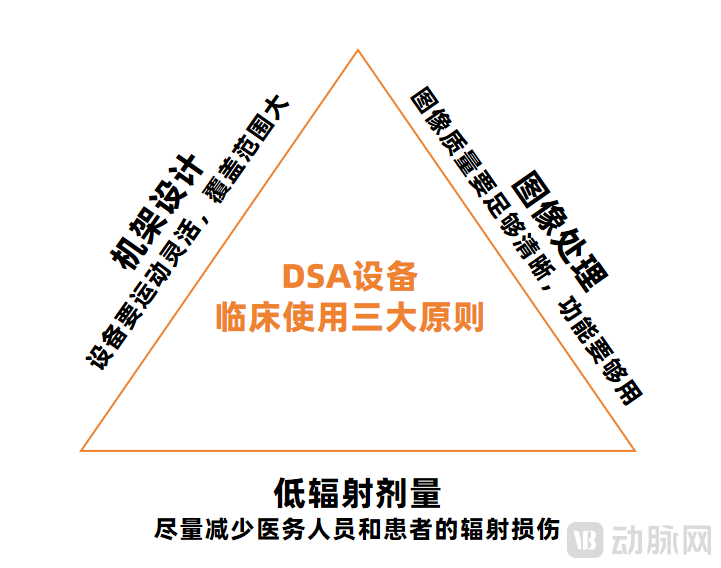
“DSA is the gold standard for diagnosing coronary heart disease and is highly effective in the diagnosis and treatment of vascular diseases, particularly cerebrovascular conditions such as cerebral infarction and cerebral hemorrhage.” A cardiologist at a tertiary hospital in Chongqing told VCBeat, “When selecting DSA equipment, we generally prioritize three principles.First, the equipment must offer flexible maneuverability and extensive coverage; second, it must deliver sufficiently clear image quality with adequate functionality; third, it should minimize radiation exposure to both medical personnel and patients.”
VCBeat Graphic
From these three dimensions, major brands have been making concerted efforts to continuously accelerate the iterative upgrades of DSA equipment.
For instance, Siemens Healthineers achieved several breakthroughs with its “New Feitian” 6D angiography system, launched at the China Medical Equipment Fair (CMEF 2024), across the first two dimensions. In terms of coverage, this DSA device provides 330° comprehensive, blind-spot-free coverage, thereby meeting the clinical application needs of all interventional specialties. Regarding image quality and functionality, the system leverages 6D imaging to capture information on complex, multi-vessel structures within complete arteriovenous malformation (AVM) niduses, displaying them in different colors to help physicians clearly assess arterial and venous blood flow dynamics.
In the latter dimension, Philips launched the digital UNIQ FD20 angiography system, which employs the DoseWise intelligent dose management system to reduce radiation doses, thereby minimizing the risk of prolonged radiation exposure for medical staff.
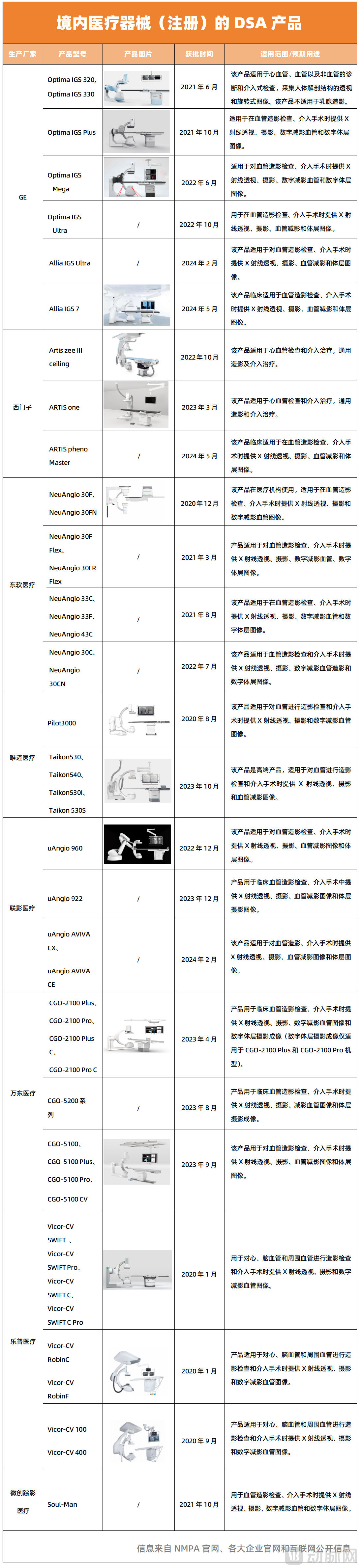
It is precisely by continuously conducting R&D centered on clinical needs that DSA equipment from foreign medical device giants has secured a firm foothold in the market and achieved absolute leadership in sales volume. A review of the NMPA website reveals that 22 models of DSA equipment have already been approved as imported medical devices (registered).
However, the result of long-term monopoly is that the overall price of DSA equipment remains at a high level.VCBeat has learned that the price of most DSA (Digital Subtraction Angiography) equipment exceeds RMB 4 million, with some imported models priced at over RMB 10 million per unit.
Faced with high prices, only tertiary hospitals with strong purchasing power can afford to procure DSA equipment, resulting in a low penetration rate of DSA devices in China. According to incomplete statistics, the annual sales volume of DSA equipment nationwide reached approximately 1,300 units by 2024. Among these, the number of specialized devices in primary care institutions is significantly lower than that in medical institutions in top-tier cities.
A formidable challenge is that, with the intensifying aging of China’s population, demand for digital subtraction angiography (DSA) equipment in medical institutions will only continue to grow. From this perspective, improving the penetration rate of DSA equipment is an urgent issue that needs to be addressed.
A transformation is underway.On November 3, 2021, the National Health Commission issued the “Notice on the Work Plan for Enhancing the Comprehensive Capabilities of County Hospitals under the ‘Thousand Counties Project’ (2021–2025),” which explicitly calls for improving hardware facilities at county-level hospitals to strengthen their capacity for emergency and critical care, as well as their treatment capabilities for specialized conditions such as cancer, neurological disorders, and cardiovascular diseases. The plan also supports the establishment of minimally invasive interventional centers to carry out interventional diagnosis and treatment in fields including oncology, peripheral vascular disease, and neurology.
Amid increased investment in primary healthcare, digital subtraction angiography (DSA) equipment has seen rapid adoption in secondary hospitals, including county-level hospitals. Meanwhile, the Chinese government has frequently introduced policies to accelerate the domestic substitution of high-end medical devices, providing significant support for Chinese brands as they gradually advance into the high-end DSA market.
What strategies are domestic brands adopting to break through, and what achievements have they made so far?
“Although the market share of domestic brands for DSA equipment remains relatively low, it has actually been on an upward trend in recent years,” industry insiders revealed. “The procurement volume of DSA equipment continues to increase, with purchasing medical institutions gradually expanding from tertiary hospitals to secondary hospitals. Over a longer time horizon, the change in market share for imported brands is quite evident, declining from approximately 95% in 2018 to around 89% in 2023.”
During this process, domestic brands have gradually captured market share from Japanese brands, primarily targeting primary healthcare institutions.
For instance, as one of the earliest companies in China to establish a presence in the digital subtraction angiography (DSA) sector, Wandong Medical, a subsidiary of Midea Healthcare, has developed a unique empowerment program for interventional medicine departments at primary-care hospitals. Specifically, to address the critical shortages of equipment, technical expertise, and skilled personnel that hinder interventional procedures at these facilities, Wandong Medical has extended its integrated support model—combining technology transfer with talent development and known as the “One-Stop Comprehensive Interventional Solution”—to county-level hospitals. By positioning itself as a “partner” to these primary-care institutions, the company not only helps elevate their clinical diagnostic and treatment capabilities but also expands sales of its product portfolio.
For instance, Vmai Medical has launched the Aurora DSA, a universal digital subtraction angiography (DSA) system. This product offers three key advantages: First, it features a floor-mounted seven-axis design that utilizes multi-axis linkage technology, providing extensive coverage, wide angulation, and enhanced operational flexibility. Second, it delivers low-dose, high-definition imaging; while capturing ultra-high-definition 16-bit images, the system intelligently calculates exposure parameters to automatically minimize radiation exposure to medical staff. Third, it comes fully equipped with premium configurations, including a liquid metal X-ray tube, a large-screen display, an intelligent floating catheterization table, rotational DSA, and 3D-DSA capabilities.
Having achieved breakthroughs in primary healthcare, domestic brands are also advancing into the high-end medical equipment sector.However, it is important to distinguish between high-end and mid-to-low-end products. So-called high-end DSA (Digital Subtraction Angiography) systems are primarily superior to previous generations in terms of the imaging chain, application software configuration, and their ability to address practical clinical challenges.
In other words, high-end DSA equipment can better and more effectively meet the three major principles mentioned above.
Taking the imaging chain as an example, the flat-panel detector is the most critical core component of DSA equipment. Its performance directly affects X-ray imaging quality and determines the clarity of blood vessels and various therapeutic devices during surgery. In the early stages of the industry, DSA equipment utilized image intensifiers. After 2000, amorphous silicon flat-panel detectors began to become mainstream. Currently, the direction of DSA detector research and development focuses on achieving lower radiation doses, reduced noise, and higher frame rates.
“We initially launched a series of products in primary healthcare institutions to establish a foothold. After building a solid customer base, we continued to advance into the high-end equipment sector,” said Tian Wei, Marketing Director at Weimai Medical.
For example, Weimai Medical has launched the high-end DSA system—Taikon. This product is the first in the industry to feature the We-Aimage imaging platform, which integrates AI algorithms for high-definition imaging. The platform enables independent pixel-by-pixel processing and functional differentiation and recognition of similar signals, thereby enhancing the detectability of minute lesions.
With the continuous advancement of medical technology, angiography systems are constantly iterating and evolving in response to clinical needs, becoming increasingly intelligent.. One pathway for high-end products is to adopt the “DSA + enabling technologies” approach. For example, empowered by 5G and AI, the industry has seen the emergence of vehicle-mounted mobile catheterization laboratories, which can be deployed flexibly like mobile CT scanners, thereby addressing the uneven distribution of medical resources.
For example, Vimai Medical has launched the Weiyi Robot DSA, a one-stop interventional diagnosis and treatment system that combines a high-end vascular interventional robot with digital subtraction angiography (DSA) to eliminate radiation injury. This product integrates Vimai Medical’s globally leading vascular interventional robot with a high-end X-ray angiography system, organically combining imaging data with interventional procedural data to enhance surgical efficiency and effectively reduce the operator’s radiation exposure. Furthermore, the Weiyi Robot DSA features a deep integration of vision and operation that mimics and surpasses human manual capabilities, offering advantages such as operational flexibility, high safety, and zero radiation.
Another innovative enterprise, Neusoft Medical, has launched the NeuAngio 30C “Hanwu” in the high-end DSA sector. It is reported that this device features a patented trackless seven-axis ceiling-mounted gantry, an intelligent ultra-high-end imaging chain, three major IDM intelligent platforms, and comprehensive clinical solutions covering cardiology, neurology, oncology, peripheral vascular interventions, and other fields.
For high-end products, adapting to the ever-changing clinical needs and enabling a wider range of application scenarios is also a viable path.For instance, as surgeries in cardiac surgery, neurosurgery, oncology, orthopedic trauma, major vascular surgery, gastroenterology, and urology and gynecology/obstetrics increasingly require the assistance of interventional devices,The concept of hybrid operating rooms (equipped not only with DSA, surgical lights, operating tables, and ceiling-mounted service columns, but also with ultrasound, CT, and MRI equipment) is becoming increasingly widespread.To meet the demands of hybrid operating rooms, major brands have successively launched DSA systems tailored for such environments.
For example, Neusoft Medical has launched a high-end multimodal one-stop imaging system that integrates CT and DSA. This product incorporates Neusoft Medical’s ultra-high-end wide-bore 512-slice panoramic multimodal CT, combining diagnostic imaging with interventional therapy to enhance surgical efficiency. Meanwhile, the integrated diagnosis and treatment platform effectively reduces potential risks associated with patient transfer, enables seamless switching between CT and DSA, and provides precise therapeutic support for hybrid surgeries in neurology, oncology, cardiology, pulmonology, and other fields.
Certainly, in addition to the companies mentioned above, domestic brands such as Lepu Medical and United Imaging Healthcare are also making continuous inroads in the field of Digital Subtraction Angiography (DSA). For instance, United Imaging Healthcare has essentially completed its strategic layout in image-guided therapy, encompassing ceiling-mounted DSA systems, hybrid operating rooms, and percutaneous puncture surgical robots.
Going forward, as relevant brands continuously optimize and iterate their DSA product lines, the pace of domestic substitution will continue to accelerate.
There is still significant room for growth in the DSA industry.
According to Eshare Medical Device Hub, the volume of aortic interventional procedures in China is projected to reach 67,000 cases in 2024, while peripheral vascular interventional procedures are expected to reach 205,000 cases. Additionally, China performs over one million coronary interventions annually, ranking first globally and indicating substantial market demand. The continued growth in interventional procedure volumes will drive an increase in angiographic examinations, with the market size estimated to reach RMB 9.52 billion in 2024.
In the face of vast growth opportunities, in what directions will DSA evolve? In response, Academician Ge Junbo proposed a vision of inclusive accessibility for the future of DSA at an industry conference. He noted that high-end DSA systems have historically been expensive and complex to operate, limiting the ability of county-level hospitals to perform minimally invasive interventional procedures. Consequently, there remains significant unmet clinical demand among the general population in grassroots communities.Therefore, developing DSA systems better suited to China’s primary healthcare market will benefit a broader population.
Meanwhile, amid the wave of “domestic substitution,” imported brands such as GE and Siemens are also comprehensively accelerating their localization strategies, thereby continuously improving the cost-effectiveness of DSA equipment.
VCBeat Graphic
It is worth noting that, like other high-end medical device industries,The rapid development of DSA equipment is bound to drive the growth of the entire supply chain.Taking dynamic flat-panel detectors as an example, the industry currently predominantly employs amorphous silicon, while some digital subtraction angiography (DSA) systems utilize monocrystalline silicon (CMOS). Regardless of whether amorphous or monocrystalline silicon is used, a cohort of innovative enterprises has begun to emerge in China.
For instance, in the field of monocrystalline silicon (CMOS), SenseMicro, a solid-state imaging detector supplier backed by Matrix Partners China, has taken the lead in undertaking a key project under the Ministry of Science and Technology’s 14th Five-Year Plan. The project focuses on developing low-dose, high-resolution, large-area CMOS flat-panel detectors for use in DSA systems, thereby advancing the localization of high-end Digital Subtraction Angiography (DSA) equipment.
Additionally,“DSA+ Empowerment Technology” will continue to be strengthened.For instance, artificial intelligence has become a valuable assistant to physicians in areas such as image interpretation, clinical decision support, and treatment efficacy prediction leveraging big data. Furthermore, virtual reality and voice-controlled C-arm maneuvering are expected to enable doctors to focus more intently on the surgical procedure itself or on preoperative rehearsal in the future.
It is crucial to recognize that, as therapeutic devices, Digital Subtraction Angiography (DSA) systems differ from diagnostic imaging equipment such as MR and CT scanners in that they directly impact patient safety. Consequently, domestic brands require more time for accumulation and clinical validation in this field. After all, international giants represented by GE, Philips, and Siemens have also undergone decades of development to achieve their current success.
A journey of a thousand miles begins with a single step. With strong state support for the relevant industry, a mature ecosystem is taking shape, spanning talent development to clinical research. Domestic brands are poised to break the import monopoly on DSA equipment and ultimately emerge as global leaders.