

Nanjing-based Biosion Secures $940M Global Licensing Deal for Anti-TSLP Antibodies BSI-045B and BSI-502, Gaining 19.9% Equity Stake in Aclaris Therapeutics

Aclaris Therapeutics
Biopharmaceutical Manufacturer
On November 18, Biosion announced that it had entered into an exclusive global licensing agreement (excluding Greater China) with Aclaris Therapeutics (NASDAQ: ACRS) for BSI-045B and BSI-502.Aclaris Therapeutics will be responsible for the novel anti-TSLP monoclonal antibody BSI-045B and the novel anti-TSLP/IL-4R bispecific antibody BSI-502.Global development and commercialization rights, excluding the Greater China region.
Biosion will receive over $40 million in cash payments as an upfront payment, and will assume a portion of the development costs and drug product material expenses, whileBiosion will also acquire a 19.9% equity stake in Aclaris TherapeuticsIn addition, Biosion is also eligible to receive over $900 million in development and sales milestone payments, as well as single-digit tiered royalties on sales.(Note: The total transaction amount exceeds $940 million, equivalent to approximately RMB 6.805 billion)
On the same day as the transaction, Aclaris announced a private placement of $80 million, issuing 35,555,555 shares of common stock at a purchase price of $2.25 per share, for total proceeds of approximately $80 million.
Founded in 2017, Biosion leverages its proprietary core technology platforms—the H³ Antibody Discovery Platform, the SynTracer® High-Throughput Antibody Internalization Screening Platform, and the Flexibody® Bispecific Antibody Platform—to develop highly differentiated innovative drugs that address unmet medical needs worldwide. Through a flexible “Discover–Develop–Partner” model, Biosion has established ten global collaboration projects, seven of which have entered clinical stages, covering monoclonal antibodies, bispecific antibodies, and antibody-drug conjugates (ADCs). Biosion maintains operational entities in the United States, China, and Australia.
BSI-045B (TQC2731) is the most advanced drug candidate in Biosion’s innovative pipeline. In 2017, a collaborative development agreement was signed with Chia Tai Tianqing, granting it the rights to develop and commercialize the product in the Greater China region.
Previously, BSI-045B completed a study in the United States involving 22 participantsPatients with Moderate-to-Severe Atopic Dermatitisa Phase 2a, single-arm, proof-of-concept clinical trial. The trial demonstrated that the drug molecule’s excellent data in terms of pharmacodynamics, safety, and efficacy support its potential as a first-in-class therapy. Chia Tai Tianqing is also advancing multiple Phase 2 clinical studies of BSI-045B in China, includingSevere Asthma, Chronic Rhinosinusitis with Nasal Polyps, to explore the potential of this drug molecule in additional indications.
Another pipeline candidate, BSI-502, is a humanized bispecific antibody targeting TSLP and IL-4R. It blocks signal transduction through the upstream TSLP receptor and activation of the downstream IL-4R, thereby inhibiting this major pro-inflammatory pathway. In this target space, Innovent Biologics’ anti-IL-4Rα/TSLP bispecific antibody IBI3002 has entered Phase I clinical trials, with an indication focus on mild-to-moderate asthma.
In 2024, GSK acquired Aiolos for $1.4 billion, gaining access to its core asset, AIO-001—a potential best-in-class, long-acting monoclonal antibody targeting thymic stromal lymphopoietin (TSLP). AIO-001 was developed by Hengrui Medicine, which sold the exclusive global development and commercialization rights outside Greater China to Aiolos in August 2023. The deal included an upfront payment of only $21.5 million, with potential milestone payments exceeding $1 billion.
TSLP is a pleiotropic cytokine produced in response to pro-inflammatory stimuli, such as pulmonary allergens, viruses, and other pathogens. By activating antigen-presenting cells, it acts on T cells, B cells, dendritic cells, mast cells, eosinophils, tumor cells, and others. Positioned at the apex of the inflammatory cascade, TSLP plays a critical role in various immune responses. Blocking the TSLP signaling pathway is a validated mechanism of action, and current global R&D efforts are largely focused on autoimmune diseases.
In December 2021, Tezspire (tezepelumab), the world’s first anti-TSLP monoclonal antibody developed collaboratively by Amgen and AstraZeneca, was approved for marketing in the United States. It is indicated as add-on maintenance treatment for severe asthma in adults and adolescents aged 12 years and older, and represents the first biologic capable of sustainably and significantly reducing exacerbations across a broad population of patients with severe asthma.According to Amgen’s annual report, Tezspire achieved sales of $174 million in 2022 and continued to gain market traction, with sales reaching $567 million in 2023. Sales are projected to reach $2 billion by 2026.
The key reason for its strong market appeal is that Tezspire is the only biologic in the treatment of severe asthma without restrictions based on phenotypes (such as allergic status) or biomarkers (such as eosinophil count). Tezspire acts across multiple inflammatory pathways, targeting various inflammatory mechanisms that contribute to asthma symptoms and disease exacerbation. By acting at an early upstream point in the inflammatory cascade, Tezspire may be suitable for a broad population of patients with severe, uncontrolled asthma, regardless of patient phenotype or T2 biomarker status.
With pioneering precedents already in place, TSLP antibody therapies have initially expanded their indications within the autoimmune field: ezspire’s current pipeline includesAtopic Dermatitis, Chronic Rhinosinusitis with Nasal Polyps, Eosinophilic Esophagitis, Chronic Obstructive Pulmonary Disease, Chronic Spontaneous Urticaria. According to Frost & Sullivan data, in 2019, there were 19.7 million and 190 million patients with atopic dermatitis in China and globally, respectively, with a prevalence rate of up to 20% among children and adolescents. It is projected that by 2030, the number of patients in China and globally will reach 81.7 million and 750 million, respectively, with approximately 30% being moderate-to-severe cases.If successful in this indication, the atopic dermatitis drug market will become another major potential market for TSLP monoclonal antibody drugs.
Led by Amgen and AstraZeneca, competition in the TSLP-targeted drug space has intensified, with numerous Chinese companies entering the field. As the second TSLP monoclonal antibody to enter clinical trials abroad, Biosion’s BSI-045B has the potential to become a first-in-class therapy for this indication.
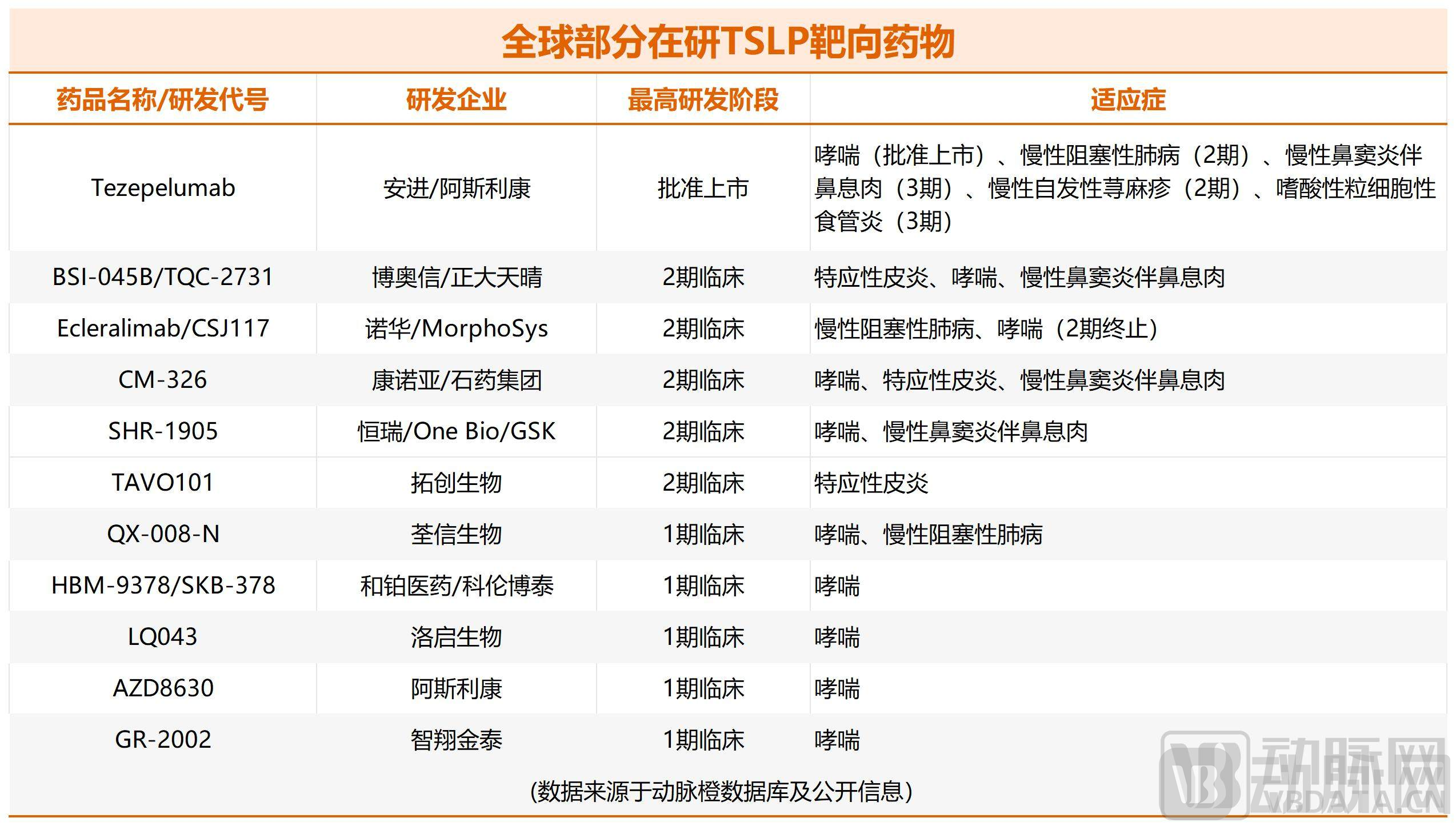
Global Pipeline of TSLP-Targeting Drugs in Development – Chart by VCBeat
References:
VCBeat: “From Autoimmunity to Alopecia: Could the Multifunctional TSLP Be the Next Universal Target?”