

The $5 Billion Deal Ignites Radiopharmaceutical Boom: The Golden Era of Theranostics Arrives

BoomRay
Developer of Tumor Therapeutics
Nuclear Medicine Enters Its "Golden Age"
In May this year, Novartis, the “king of radiopharmaceuticals,” invested nearly $5 billion in radioligand therapies (RLTs) and macrocyclic peptides, reigniting the radiopharmaceutical boom.
Unlike previous diagnostic radiopharmaceutical products, the current surge in the radiopharmaceutical sector is driven by the rise of therapeutic radiopharmaceuticals. Data shows that as of July 4, 2024, 88 novel radiopharmaceuticals had been approved for marketing worldwide, with only 18 indicated for therapeutic use. Correspondingly, according to MEDraysintell, the global radiopharmaceutical market size was approximately USD 7 billion in 2022, with therapeutic radiopharmaceuticals accounting for only 20%. However, there is an industry consensus that therapeutic radiopharmaceuticals will drive high growth in the global radiopharmaceutical market over the next five years.
Why has the development landscape of diagnostic and therapeutic radiopharmaceuticals shifted? How can we drive the integrated development of diagnosis and therapy in the radiopharmaceutical sector? Against this backdrop, we conducted an exclusive interview with BoomRay and its backer, Sunshine Ronghui Capital, to explore the emerging changes in the radiopharmaceutical field.
BoomRay is an innovative pharmaceutical company focused on the precision diagnosis and treatment of cancer. It has multiple research and development projects for diagnostic and therapeutic radiopharmaceuticals, and has established a proprietary technology platform for drug innovation and development translation.
Theranostics Advantages Become Evident, Radiopharmaceuticals Poised for Explosive Growth
For a long period, radiopharmaceutical products were primarily used in the diagnostic field. However, in recent years, with the emergence of several key radiopharmaceuticals for therapeutic applications, their clinical status has gradually improved, driving rapid growth in the global radiopharmaceutical market. It is expected that the market will continue to expand rapidly as more therapeutic agents gain regulatory approval.
Shi Shenghao, Managing Partner at Sunshine Capital, stated that from the perspective of drug development logic—progressing from chemical drugs to small-molecule targeted therapies, then to immunotherapies and antibody-drug conjugates (ADCs)—cancer treatment is trending toward greater precision. As a precise form of radiotherapy, radiopharmaceuticals present significant industry opportunities.
According toHead of the Pharmaceutical GroupLi Bingfeng introduced that RDC is a novel therapeutic approach combining the properties of targeted drugs and radionuclides. It can be loaded with different radionuclides to achieve dual functions of diagnosis and therapy. For instance, when loaded with diagnostic radionuclides, radiopharmaceuticals can be used for imaging and diagnosing lesion areas; when loaded with therapeutic radionuclides, they can be used for treatment, particularly for cancer therapy.
This also brings another major advantage of radiopharmaceuticals: controllable drug development risk. By using diagnostic radionuclides to observe the drug metabolism and pharmacokinetics (DMPK) of a drug in the human body, it is possible to evaluate its distribution, metabolism, and excretion processes in vivo, thereby helping to reduce the risks associated with drug developability.
Moreover, RDCs specifically recognize and bind to diseased cells via targeting moieties (such as antibodies or small-molecule ligands), thereby achieving precise drug delivery. Since radionuclides do not require direct contact with the cells, the linker of the RDC does not need to be cleaved during its mechanism of action, which further enhances the stability and safety of the radiopharmaceutical in vivo.
In summary, as a theranostic technological approach, radiopharmaceuticals demonstrate significant advantages in drug development risk control, precision therapy, stability, and safety.
“The commercial success of Novartis’ Pluvicto marks the dawn of the first year for the commercialization of therapeutic radiopharmaceuticals, and capital markets are sure to respond accordingly. As the industry continues to mature, the field of radiopharmaceuticals is poised for explosive growth, leveraging the unique advantages of integrated theranostics,” said Li Bingfeng.
The core team possesses extensive experience in product development and research.
As the clinical demand for early diagnosis and precision treatment of cancer and other diseases continues to grow, radiopharmaceuticals are playing a pivotal role in healthcare due to their integrated theranostic capabilities, offering broad prospects for development.
However, the radiopharmaceutical industry also faces certain challenges. According to Qin Mingbo, Head of Financing at BoomRay, the penetration rate of nuclear medicine diagnosis and treatment in China is lower than that in mature markets such as the United States, indicating a substantial unmet therapeutic need. Meanwhile, the current radiopharmaceutical sector is grappling with issues including target homogenization, shortages of raw material supplies, reliance on imported radionuclides, and stringent regulatory oversight.
In an environment where opportunities and challenges coexist, BoomRay has steadily committed itself to the development of the radiopharmaceutical sector. Established in 2019 as a joint venture between WuXi AppTec and the Peking University Institute of Molecular Engineering (Suzhou), the company secured pre-Series A investment from WuXi AppTec in 2020, obtained technology and project licenses from Peking University, and built its core translational team. In 2021, BoomRay completed the formation of its core management and R&D teams and initiated Investigational New Drug (IND) studies for multiple projects. In 2022, the company closed its Series A financing round, raising nearly RMB 300 million, which provided strong financial support for its R&D efforts and strategic layout.
BoomRay’s core team comprises multiple experts with extensive experience. Among them, Dr. Shan Bo, Chief Executive Officer, has over 20 years of experience in innovative drug research and development and manufacturing across Europe, the United States, and China. As former Chief Scientific Officer at Antengene Corporation, he built a differentiated pipeline of innovative drugs and led the team in completing multiple Investigational New Drug (IND) and New Drug Application (NDA) filings.
Liu Zhibo, Chief Scientific Officer and Professor at the College of Chemistry and Molecular Engineering, Peking University, is a recipient of the National Science Fund for Distinguished Young Scholars. Addressing the bottlenecks in the development of novel radiopharmaceuticals and China’s long-standing reliance on imported medical isotopes and radiopharmaceuticals, Liu Zhibo’s team is dedicated to applied basic research in radio-pharmaceutical chemistry. They have achieved significant breakthroughs in key scientific issues, including the structure-activity relationships of radiopharmaceuticals, radionuclide-driven in vivo chemistry, and their health effects. In May this year, Nature published the team’s research paper titled “Covalent Targeted Radioligands Potentiate Radionuclide Therapy,” marking the first paper in the field of radionuclide therapy published by Nature in nearly 50 years.
Leveraging its robust R&D team and multi-faceted capital support, BoomRay is dedicated to identifying innovative targets and developing radiopharmaceutical products with high specificity and efficacy. Meanwhile, the company has established collaborative partnerships with multiple hospitals and research institutions to optimize product design and enhance clinical applicability and effectiveness. “We have conducted clinical research and applications in collaboration with several hospitals. The aim is to understand clinical needs through communication with clinicians, thereby optimizing product design and improving clinical applicability and effectiveness,” said Qin Mingbo.
Furthermore, BoomRay has established a research and development center in Suzhou, obtaining both a Radiation Safety License and an Laboratory Animal License, thereby possessing independent R&D and manufacturing capabilities. In terms of radionuclide supply, the company has established long-term collaborations with multiple suppliers to ensure a stable supply of radionuclides.
Multiple FIC/BIC radiopharmaceuticals in development, covering the entire spectrum of diagnosis and therapy
According to Qin Mingbo, BoomRay is guided by clinical needs, leverages its core R&D technologies, focuses on precision diagnosis and treatment of cancer, and has built a diversified product pipeline. Currently, the company owns global rights to three clinical-stage projects, with multiple new drug candidates poised to enter clinical trials.
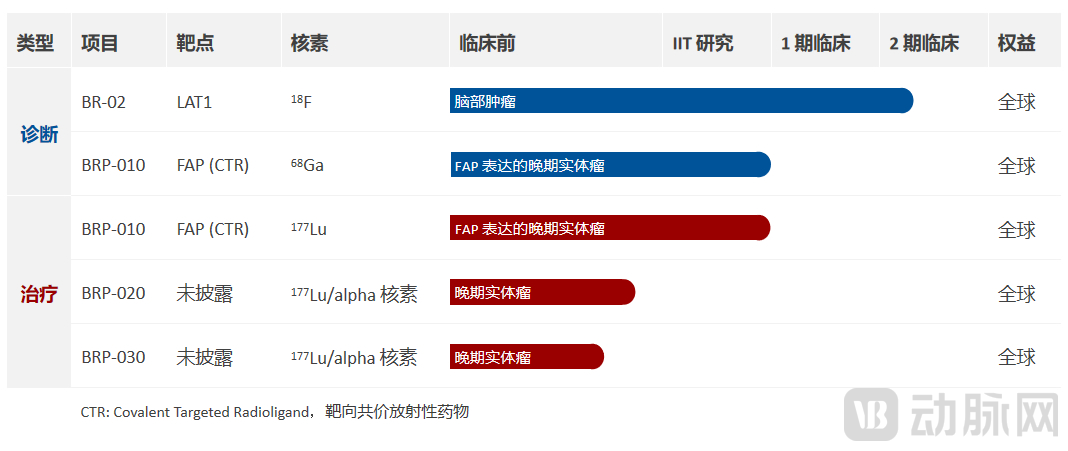 Product Pipeline
BR-02 is an amino acid-based PET tracer for brain tumors, specifically the [¹⁸F]BF₃-BPA injection, used as a positron emission tomography (PET) tracer for the diagnosis of primary and metastatic brain tumors. It is the first Class 1 new drug of its kind to file for clinical trials in China, and BoomRay holds global independent intellectual property rights to this molecule. In 2023, the amino acid-based brain tumor PET tracer [¹⁸F]BF₃-BPA injection (BR-02), developed by BoomRay, received clinical trial approval in both China and the United States. As a novel amino acid analog, BR-02 is expected to address the limitations of other PET tracers in the diagnosis and assessment of brain tumors. It aims to play a significant role in various clinical scenarios, including the diagnosis of primary and metastatic brain tumors, evaluation of treatment efficacy, differentiation of tumor progression, and identification of post-treatment inflammatory or false-positive lesions.
BRP-010 is a theranostic project targeting covalent radiopharmaceuticals (CTR-FAP). Its principle involves utilizing SuFEx “latent warheads” to achieve covalent binding of the ligand to the target protein without compromising affinity, thereby irreversibly modifying the target protein with radionuclide-carrying chelators. This approach enhances tumor uptake and retention of the radioligand, overcoming the longstanding challenge of balancing safety and efficacy in conventional radiopharmaceuticals. CTR-FAP is the world’s first covalent radiopharmaceutical product to enter clinical trials. The company is currently actively advancing its development.
Furthermore, BoomRay’s R&D pipeline features multiple first-in-class (FIC) radionuclide conjugate drugs, encompassing diagnostic and therapeutic products for various indications, including advanced-stage cancers.
What Are the Key Elements of an Outstanding Radiopharmaceutical Company?
BoomRay’s rapid growth has been driven not only by its experienced core team and differentiated pipeline strategy, but also by the capital support behind it.
It is understood that Sunshine Huihui Capital has adhered to an industry research-driven investment strategy, combining top-down and bottom-up approaches, and has been focusing on the field of radiopharmaceuticals since 2021.
Regarding how to select a high-quality radiopharmaceutical company, Li Bingfeng believes there are several key criteria. First, in terms of the team, it is essential not only to possess expertise in nuclear medicine, technical reserves, and original research capabilities, as well as an understanding of the development logic for both cold kits and hot radiopharmaceuticals, but also to have experience in clinical drug development and manufacturing, with the ability to address radionuclide supply and production challenges.
Secondly, the technology platform must possess originality and differentiation. Radiopharmaceuticals need to rapidly reach and accumulate in tumors after administration while minimizing effects on other tissues; therefore, controlling and optimizing the therapeutic window is critical. Simply applying design logic from other industries to molecular design in radiopharmaceuticals may result in suboptimal therapeutic outcomes. A differentiated technology platform can effectively narrow the therapeutic window, providing a significant advantage for the company in developing competitive products.
Meanwhile, given that radiopharmaceuticals represent a relatively cutting-edge field, it is essential to maintain a robust risk-balancing mindset in product pipeline development, effectively striking a balance between first-in-class and best-in-class targets.
In addition, synergy and integration capabilities across the industry chain are equally critical; companies must possess both radionuclide production capabilities and the ability to effectively integrate with clinical practice. “Close collaboration with leading nuclear medicine physicians is of great significance for product development, identification of clinical needs, dose optimization, and refinement of clinical guidelines. Meanwhile, the ability to coordinate industry resources will have a substantial impact on product approval, regulatory submissions, and commercialization,” stated Li Bingfeng.
Finally, an international perspective and business development (BD) capabilities are also highly valued. Currently, many domestic products suffer from serious homogenization, and future market competition is expected to be intense. Moreover, there remains a generational gap compared with advancements in developed countries. To develop a robust portfolio of high-value clinical nuclear medicines, it is essential to possess internationally leading technological features and development strategies. This will not only provide competitive products for the domestic market but also lay a solid foundation for future license-out opportunities, thereby enhancing pipeline value.
The investment in BoomRay is precisely based on these considerations. Li Bingfeng believes that Mr. Liu Zhibo, the founder of BoomRay, is a leading figure in China’s radiopharmaceutical sector. The company’s team has accumulated extensive experience not only in early-stage R&D and manufacturing of radiopharmaceuticals, but also in international vision and business development (BD).
What is even more commendable is that the company demonstrates significant global foresight in target selection, drug design, and pipeline portfolio strategy. Its core therapeutic pipeline ranks among the international first tier and holds Best-in-Class (BIC) potential, while the company places strong emphasis on balancing overall pipeline risk. Furthermore, the company collaborates with multiple clinical hospitals in China to accelerate the clinical translation of its products.
It can be said that BoomRay is a relatively rare radiopharmaceutical company with source innovation capabilities in integrated diagnosis and therapy.
Looking ahead, the field of radiopharmaceuticals will move toward greater precision and personalization, with theranostics becoming a key focus of research and development. As technology advances, the development of new targets and novel radionuclides will increase, further expanding the scope of therapeutic applications. “The evolution of a new model—from its emergence and early development to maturity and widespread acceptance—represents the formation of a new industrial chain, during which certain directional trends will inevitably emerge,” said Li Bingfeng.
Based on this, in addition to BoomRay, Sunshine Ronghui Capital is also actively monitoring other companies in the radiopharmaceutical industry chain. In the future, it will focus on companies with technological barriers, including incremental markets across the upstream and downstream of the entire industry chain, as well as areas subject to critical supply chain bottlenecks.
Novartis’s strong sales performance for Pluvicto has broadened market expectations for therapeutic radiopharmaceuticals. With advancements in radionuclide raw material production and technological capabilities, the issuance of R&D technical guidelines, and regulatory policy drivers, China’s radiopharmaceutical market is poised to enter a new phase, propelled by the combined forces of industry and capital. Therapeutic radiopharmaceuticals are also set to reach a peak in development.