

LAEKNA Announces HK$230 Million Fundraising to Advance LAE102 and ActRII-Targeted Pipeline
Laekna Therapeutics
Innovative Drug Developer
Strike while the iron is hot.
On November 21, Laekna Therapeutics announced that it had entered into a placing agreement with the exclusive placing agent to place 17.636 million placing shares to no fewer than six placees at a price of HK$13.36 per share. The placing price per share represents a discount of approximately 15.01% to the closing price of HK$15.72 per share on November 20, and the placing shares are equivalent to approximately 4.33% of the enlarged issued share capital after issuance.
Assuming full placement, Laekna Therapeutics will receive net proceeds of approximately HK$230 million, which are expected to be fully utilized by December 31, 2026, to accelerate the research and development of LAE102 (an ActRIIA monoclonal antibody) and other drug assets targeting the ActRII receptor.
The day before, Laekna Therapeutics announced the signing of a clinical collaboration agreement with Eli Lilly and Company to support and accelerate the global clinical development of LAE102 for the treatment of obesity. Eli Lilly will be responsible for conducting and funding a Phase I study in the United States. Meanwhile, Laekna Therapeutics will retain global rights to LAE102. Following this announcement, Laekna’s stock price surged by 48.3%, closing at HK$15.72 per share, with a total market capitalization of HK$6.132 billion, marking its highest level since January of this year.
This also marks the second time this year that Laekna Therapeutics’ stock price has risen due to collaborations with multinational corporations (MNCs).
In June, Novo Nordisk presented research findings on a “Human Tissue-Engineered Muscle Function Research Platform” at the 84th American Diabetes Association (ADA) Scientific Sessions in 2024, with Laekna Therapeutics listed among the poster collaborators. This move was once regarded as a signal of potential future collaboration between Novo Nordisk and Laekna Therapeutics. In the same month, Laekna Therapeutics announced that the first subject had been dosed in its Phase I clinical trial of LAE102 in China. Its stock price surged by more than 12%, closing at HK$5.58, with trading volume reaching HK$4.4912 million.
As biotech companies flocked to the GLP-1 space riding the wave of semaglutide, Laekna Therapeutics carved out a distinct path by targeting fat loss with muscle preservation, swiftly entering the metabolic disease arena. In the first half of this year, LAE102 received Investigational New Drug (IND) approvals from both the U.S. FDA and China’s CDE for the treatment of obesity.
As early as the 2023 STAT Breakthrough Summit, a large-scale clinical trial on semaglutide indicated that approximately 40% of the weight lost by participants was lean body mass, primarily composed of muscle. Muscle loss increases the risk of cardiovascular disease, osteoporosis, and other conditions in the general population; among the elderly, it further elevates the risk of mortality.
LAE102 is a monoclonal antibody independently developed by Laekna Therapeutics that targets ActRIIA, a receptor playing a critical role in muscle regeneration and adipose metabolism. Blocking the Activin-ActRII pathway can promote muscle regeneration and reduce fat. In preclinical models, LAE102 has demonstrated effects of increasing muscle mass and reducing fat. When used in combination with GLP-1 receptor agonists, LAE102 further reduces fat and significantly mitigates muscle loss associated with GLP-1 receptor agonist therapy, positioning LAE102 as a high-quality candidate for weight management.
This Phase I clinical trial is a randomized, double-blind, placebo-controlled, single- and multiple-ascending dose study designed to evaluate the safety, tolerability, and pharmacokinetics of LAE102 injection in healthy adult subjects and overweight/obese subjects via intravenous (IV) infusion and subcutaneous (SC) injection.
As of September 30, more than half of the intravenous infusion cohort had completed dosing, with early signs of target engagement and expected changes in PD biomarkers observed in the low-dose group. An announcement on October 16 indicated that Laekna Therapeutics had initiated the subcutaneous (SC) portion of its Single Ascending Dose (SAD) study, with completion of the SAD study anticipated by the end of 2024.
To maximize the therapeutic potential of targeting ActRII receptors, Laekna Therapeutics has established a new drug development platform centered on the ActRII pathway. Its pipeline also includes independently developed candidates: LAE103 (an ActRIIB-specific antibody) and LAE123 (a dual-target inhibitor against ActRIIA/IIB).
Currently, LAE103 has initiated IND-enabling studies; LAE123 is planned to advance to the PCC stage by the end of 2024. The multiple ActRII antibody pipelines not only increase the flexibility to target various combinations of ActRII receptors but also hold the potential to expand into other disease indications.
As early as 2017, Lv Xiangyang, founder of Laekna Therapeutics, led the laboratory in initiating its first project—early-stage research on ActRII-related targets. At that time, the weight-loss drug sector had not yet gained momentum, and the primary development focus for ActRII-related targets was oncology. According to Gelonghui, Lv Xiangyang has nearly two decades of R&D experience at multinational pharmaceutical companies and is one of the co-inventors of bimagrumab (an ActRII monoclonal antibody), an FDA Breakthrough Therapy designated drug being developed for potential indications in fat loss and muscle preservation.
In 2016, Novartis announced that bimagrumab had failed to meet the primary endpoint in a Phase IIb/III clinical trial for the treatment of sporadic inclusion body myositis, leading to the termination of its clinical development. Bimagrumab was subsequently licensed to Versanis. After five years of hardship, a study published in JAMA Network in 2021 demonstrated the efficacy and safety of bimagrumab in improving body composition and glycemic control in adults with overweight or obesity and type 2 diabetes, thereby reviving this pipeline. This culminated in July 2023, when Eli Lilly acquired Versanis in an all-cash deal worth $1.925 billion, securing this next-generation asset for fat loss and muscle preservation.
Bimagrumab has preliminarily demonstrated its efficacy in increasing muscle mass and reducing fat in Phase 2 trials, showing superior outcomes in weight loss and glycemic control with stable muscle mass compared to placebo: participants in the treatment group experienced a reduction in total body fat (-20.5% vs. -0.5%), an increase in lean body mass (+3.6% vs. -0.8%), a decrease in waist circumference (-9 cm vs. +0.5 cm), and a reduction in body weight (-6.5% vs. -0.8%). Furthermore, no weight regain was observed in patients within 12 weeks after discontinuation of treatment.
In terms of safety, the most commonly reported adverse events in the bimagrumab group were mild diarrhea (41% vs. 11%) and muscle spasms (41% vs. 3%); the incidence of diarrhea was highest after the first dose and gradually decreased thereafter. Currently, patient enrollment has been completed for the Phase IIb BELIEVE study evaluating bimagrumab in combination with semaglutide for the treatment of obesity, with top-line data expected to be released in the second half of 2024.
Eli Lilly’s significant investment in Bimagrumab underscores its confidence in the ActRII target, with bets on next-generation weight-loss drugs becoming the central theme of its recent mergers and acquisitions. As a former member of the Bimagrumab development team, Lü Xiangyang, and Laekna Therapeutics’ ActRII pipeline may therefore be more likely to enter Eli Lilly’s radar as potential acquisition targets.
Furthermore, Eli Lilly’s direct execution of a Phase I study of LAE102 in the United States underscores Laekna Therapeutics’ confidence and the high level of trust between the two parties. Under the leadership of Lu Xiangyang, the Laekna Therapeutics team possesses not only LAE102 but also years of in-depth R&D experience targeting ActRII, along with a multi-indication, multi-pipeline new drug development platform focused on ActRII. This also points to greater potential for broader collaboration between Laekna Therapeutics and multinational corporations (MNCs) in the future.
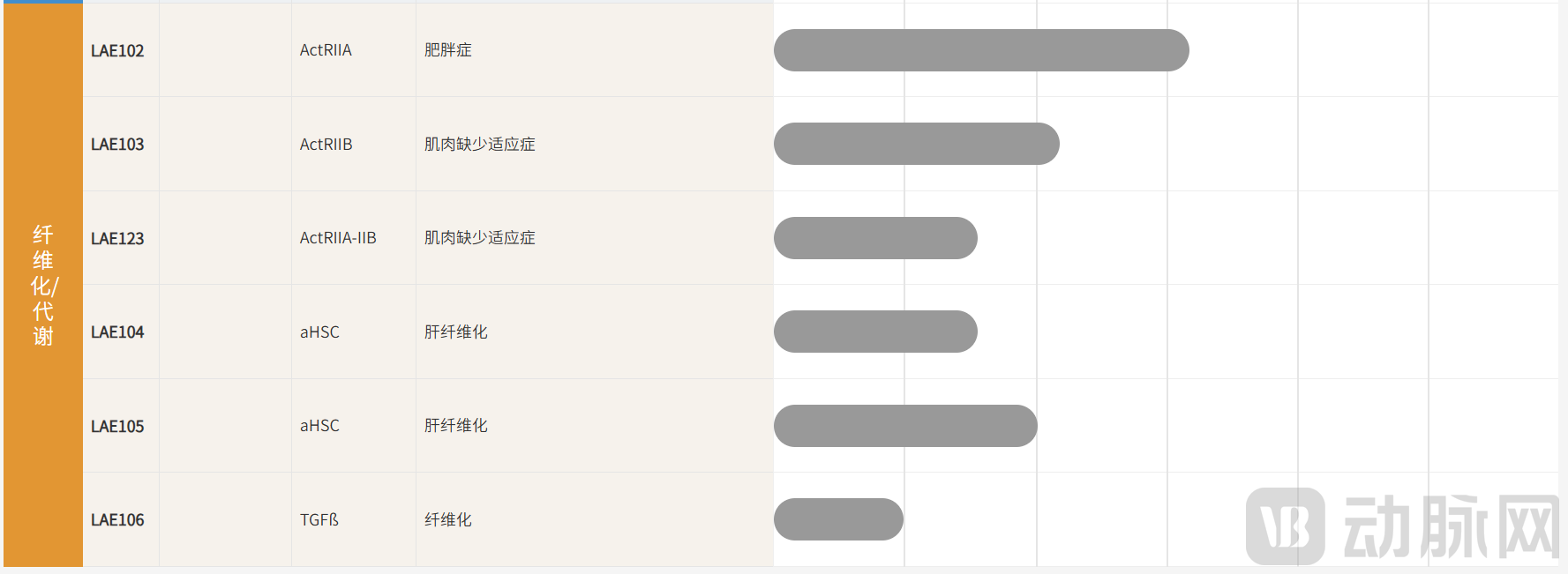
Laekna Therapeutics’ Pipeline Layout in Fibrosis and Metabolism
In March this year, Merck & Co.’s “first-in-class” therapy Sotatercept (brand name: Winrevair) received FDA approval for the treatment of pulmonary arterial hypertension (PAH). Sotatercept is an ActRIIB-Fc fusion protein and the world’s first biologic agent approved for PAH treatment. It restores the balance between pro-proliferative and anti-proliferative signaling pathways associated with remodeling of the pulmonary arterial wall and right ventricle, thereby inhibiting cell proliferation, reversing vascular remodeling, and improving vascular patency, fundamentally transforming the therapeutic landscape for PAH.
Globally, only two drugs targeting ActRII have been approved for marketing. Early investigational indications primarily focused on hematologic disorders, pulmonary arterial hypertension, and cancer, encompassing both fusion proteins and antibodies. The other marketed drug is Luspatercept, an ActRIIB-Fc fusion protein from BMS, which is the world’s first erythroid maturation agent indicated for the treatment of thalassemia and was approved in China in 2022.
The ActRII target, which has delivered disruptive therapies across multiple indications, is poised to yield the next generation of fat-loss and muscle-preserving weight-loss drugs. At the very least, clinical data for bimagrumab have raised expectations to their peak.
Globally, LAE102 is the first ActRIIA-specific antibody to enter clinical development for the treatment of obesity.