

Junshi Biosciences Inks $1.03 Billion Deal to License Two Bispecific Fusion Proteins for Oncology in Greater China
Junshi Biosciences
Innovative Drug Developer
On November 20, Junshi Biosciences announced that it had entered into a License Agreement with an undisclosed licensor, obtaining exclusive license and sublicense rights to develop, manufacture, use, import, export, sell, and otherwise commercialize two dual-target fusion proteins within the Greater China region (including mainland China, the Hong Kong Special Administrative Region, the Macao Special Administrative Region, and Taiwan).
The subject of this transaction comprises two dual-target fusion proteins, primarily intended for the treatment of malignant tumors.Licensed Product 1 is currently in Phase I clinical trials overseas. Junshi Biosciences has submitted an application for its Phase I clinical trial in China to the National Medical Products Administration, and Junshi Biosciences holds a right of first refusal for Licensed Product 1 outside the Greater China region.
Licensed Product 2 is in the preclinical research stage. In addition to holding exclusive license and sublicense rights to develop, manufacture, use, import, export, sell, and otherwise commercialize Licensed Product 2 within the Greater China Region, Junshi Biosciences will share with the Licensor all rights and interests in the global development, manufacture, use, import, export, sale, and other commercialization of Licensed Product 2 on a 50:50 equity basis.
Upon execution of the license agreement, Junshi Biosciences will pay the licensor an upfront payment of USD 1.5 million, followed by cumulative milestone payments not exceeding RMB 740 million based on the research and development progress and sales performance of the licensed products, as well as potential royalties calculated at a single-digit percentage of the annual net sales of the licensed products in the Greater China region. (Note: The total transaction value is approximately RMB 750 million.)
With the launch of toripalimab injection, the first domestically produced PD-1 inhibitor to successfully expand overseas, Junshi Biosciences has sustained rapid growth in its overseas market presence in recent years. In 2021, it received approval from the National Medical Products Administration (NMPA) for the treatment of advanced nasopharyngeal carcinoma, becoming the world’s first immune checkpoint inhibitor approved for this indication. Over the past three years, toripalimab has been sequentially approved as the first drug for nasopharyngeal carcinoma in the United States, Europe, India, Jordan, Hong Kong (China), and the United Kingdom. In the UK, toripalimab has also been approved as the sole first-line treatment for advanced or metastatic esophageal squamous cell carcinoma, regardless of PD-L1 expression status.
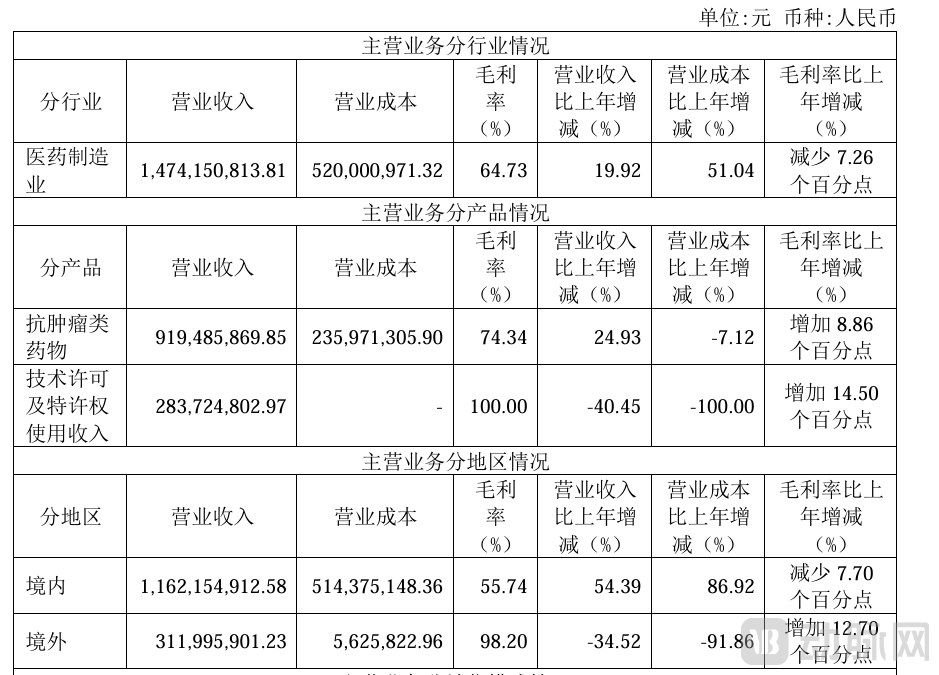 Junshi Biosciences 2023 Annual Report
In terms of performance, Junshi Biosciences is expected to achieve operating revenue of approximately RMB 1.474 billion in 2023, representing a year-on-year increase of 19.92%; of this, domestic revenue amounted to approximately RMB 1.162 billion, and overseas revenue to approximately RMB 312 million. Junshi Biosciences explained that the increase in drug sales revenue during the period was primarily attributable to the enhancement of the company’s commercialization capabilities, with sales in the domestic market gradually entering a positive cycle.
As of the end of the reporting period, Junshi Biosciences had three commercialized products: toripalimab injection (brand name: Tuoyi), adalimumab injection (brand name: Junmaikang), and vudremidevir hydrobromide tablets (brand name: Mindewei), a small-molecule anti-COVID-19 drug.
In China, toripalimab has been approved for seven indications, six of which are included in the National Reimbursement Drug List (NRDL). The indication for Mindewei (VV116) in the treatment of adult patients with mild to moderate COVID-19 has been included in the official NRDL for the first time. All eight approved indications for Junmaikang (adalimumab biosimilar) remain included in the NRDL.
From a regional perspective, domestic revenue is primarily derived from drug sales, while overseas revenue mainly consists of technology licensing and royalty income. This aligns with Junshi Biosciences’ globalization strategy, which leverages licensing collaborations with overseas pharmaceutical companies to establish commercialization and industrialization pathways. For example, in the United States and Canada, Junshi Biosciences entered into a development and commercialization partnership with Coherus BioSciences for toripalimab injection before submitting its first Biologics License Application (BLA) to the U.S. Food and Drug Administration (FDA).
Under the terms of the agreement, Junshi Biosciences and Coherus will jointly develop toripalimab, with Coherus responsible for all commercial activities in the United States and Canada. Junshi Biosciences is eligible to receive upfront payments, optional program execution fees, and milestone payments totaling up to $1.11 billion. In addition, Junshi Biosciences will grant Coherus options for JS006 (an anti-TIGIT monoclonal antibody) and JS018-1 (a next-generation engineered IL-2 cytokine drug), as well as rights of first negotiation for two early-stage checkpoint inhibitor antibody drugs.
This collaboration mirrors the license-in deal announced today, except that Junshi Biosciences has shifted from the role of licensor to licensee, thereby strengthening its clinical and preclinical pipeline. Furthermore, as the accessibility of its approved products and indications improves following their inclusion in the National Reimbursement Drug List, Junshi Biosciences’ enhanced commercial revenue-generating capacity provides greater confidence and support for the expansion and efficiency of its R&D layout.
Since its establishment, Junshi Biosciences has developed more than 50 drug candidates in its pipeline, with nearly 30 undergoing clinical trials and over 20 in preclinical development. Meanwhile, the company is accelerating its global integration: its San Francisco laboratory conducts initial high-throughput antibody screening, followed by humanization, selection, and optimization; its Maryland laboratory leverages a membrane receptor proteome library and eukaryotic cell-based functional assay platforms to screen for new targets and evaluate and select antibody candidates.
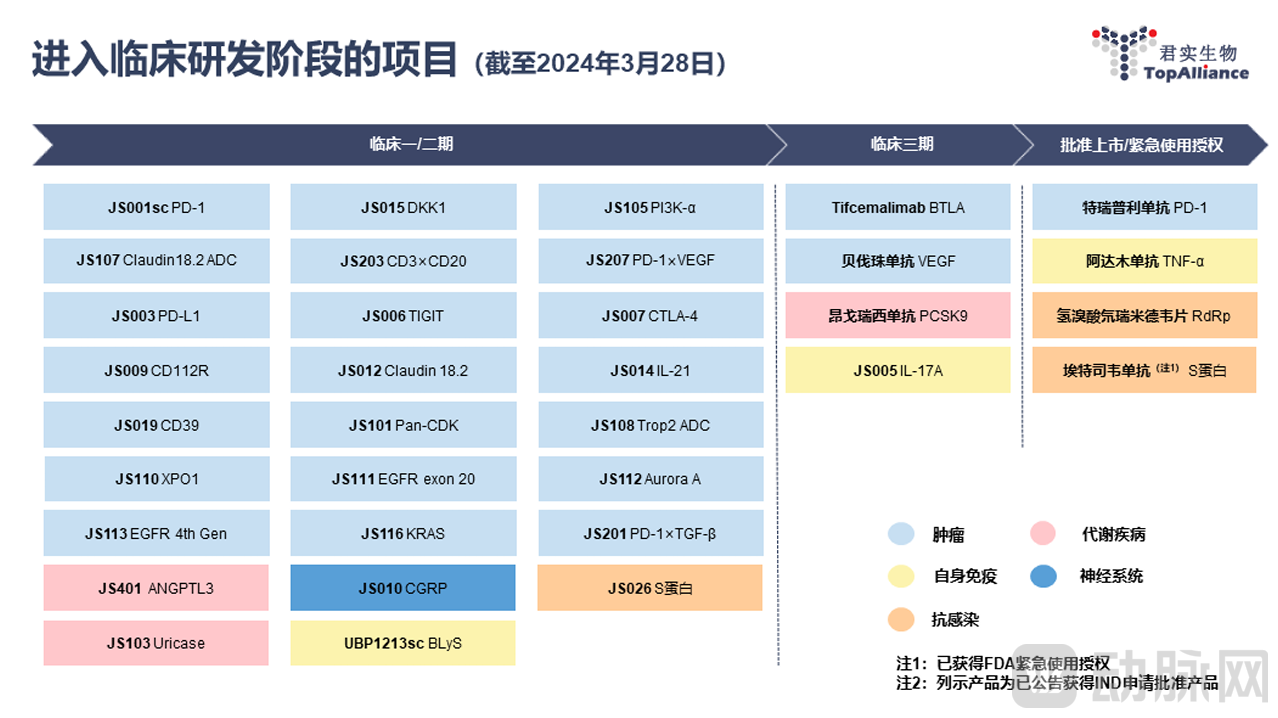 Junshi Biosciences 2023 Annual Report
In this transaction, Junshi Biosciences was granted an exemption from disclosing information regarding the counterparty and the subject matter of the transaction; however, it was noted that the license agreement shall be governed by the laws of California, United States, and U.S. federal law. Notably, the license agreement includes a restrictive clause on rights protection: if the licensor grants to any third party the rights under its intellectual property or the sublicense rights obtained from the Company to develop, commercialize, manufacture, use, sell, import, or export the licensed products outside the Greater China Region, the licensor may be required to pay the Company an amount equal to the lower of 20% of the sublicense income or USD 200 million.
This is not the first time Junshi Biosciences has expanded its fusion protein pipeline through acquisitions.
On June 24, 2019, Junshi Biosciences entered into a share purchase agreement with Anwita Biosciences to subscribe for 2,990,162 shares of its Series A preferred stock (representing approximately 20% of the outstanding shares) for a cash consideration of USD 10 million. Concurrently, the two parties executed a license agreement for the development and commercialization of Anwita’s innovative IL-21 fusion protein, AWT008, in the Greater China region (including mainland China, Taiwan, Macau, and Hong Kong). Upon technology transfer, Junshi Biosciences will make an upfront cash payment of USD 2 million, followed by contingent milestone payments totaling up to USD 64.5 million.
In March 2021, the two parties signed the “Series B Preferred Stock Subscription Agreement” again, under which Junshi Biosciences invested approximately US$6.5 million to subscribe for 423,212 shares of Series B preferred stock issued by Anwita. Upon completion of this subscription, Junshi Biosciences held a total of 19.53% equity interest in Anwita.
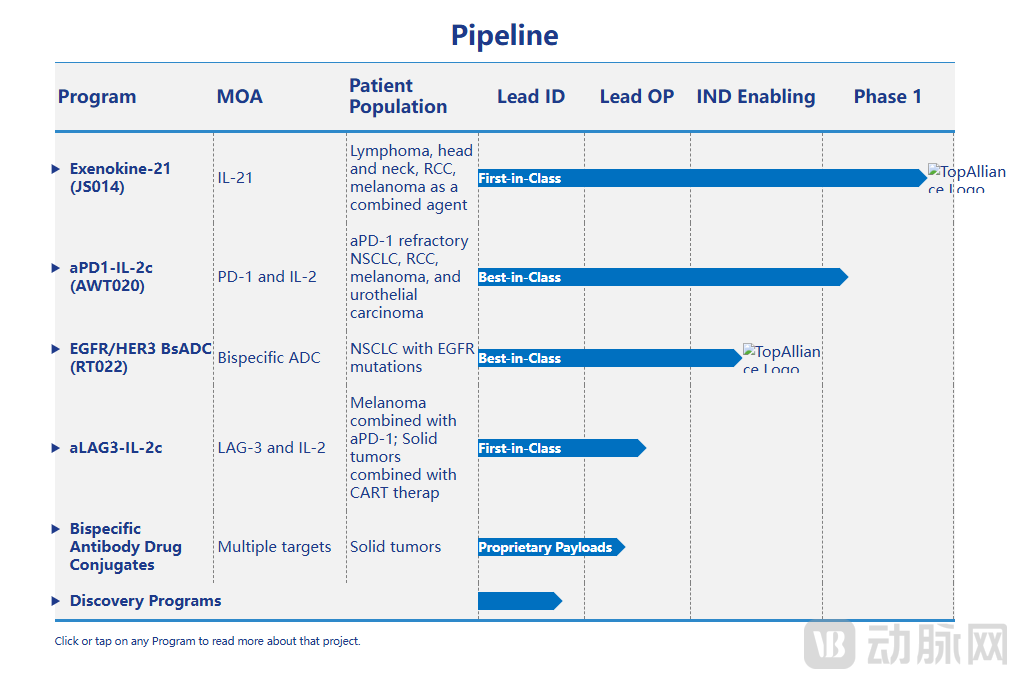 Anwita's Pipeline in Development
In August 2021, Junshi Biosciences’ IL-21 fusion protein JS014 (Exenokine-21) received clinical trial approval, becoming the first IL-21 fusion protein in China. According to the PatSnap New Drug Database, JS014 is currently undergoing Phase I clinical trials both domestically and internationally, with Anwita, the original developer, serving as the sponsor for the overseas clinical trials.
References:
National Business Daily: “Junshi Biosciences 2023 Earnings Forecast: Revenue Increased by Approximately 6.02% Year-on-Year, Net Loss Decreased by Approximately 5.78% Year-on-Year”