

Shanghai Jiao Tong University Licenses Three siRNA-Based Ocular Therapeutics Patents Led by Professor Zhang Chuan for Over RMB 1.2 Million Plus Equity

SJTU
Shanghai Jiao Tong University, located in Shanghai, China’s economic and financial hub, is a comprehensive national key university directly under the Ministry of Education. With a distinctive strength in science and engineering, it encompasses nine major academic disciplines: science, engineering, medicine, economics, management, humanities, law, and others. It is among the first seven universities included in the “211 Project” and the first nine designated for priority construction under the “985 Project.” The university has been selected for several national initiatives, including the “Peak Plan,” the “111 Plan,” the “2011 Plan,” the “Excellent Doctor Education and Training Plan,” the “Excellent Legal Talent Education and Training Plan,” the “Excellent Engineer Education and Training Plan,” and the “Excellent Agricultural and Forestry Talent Education and Training Plan.” It is also a prominent member of the “C9 League,” Universitas 21, and the Academic Alliance of the 21st Century.As of December 2017, the university comprised 29 schools/departments directly under its administration, 24 research institutes, 13 affiliated hospitals, two affiliated medical research institutes, 12 directly affiliated units, and six directly affiliated enterprises. It enrolled 16,221 full-time undergraduate students (domestic) and 30,895 graduate students (domestic), including 14,532 full-time master’s candidates and 7,236 full-time doctoral candidates. Additionally, there were 2,722 international degree-seeking students.
Recently,Shanghai Jiao Tong University has issued an announcement proposing to license the following three invention patents—“Nucleic Acid-Drug Conjugates, Drug Delivery Systems, and Their Preparation Methods and Applications,” “A Pharmaceutical Composition for Inhibiting NFKBIZ Gene Expression and Its Application,” and “A Pharmaceutical Composition for Inhibiting TGFBI Gene Expression and Its Application”—to the inventors for implementation. The transaction price is set at a total of RMB 1.2 million plus the cash value equivalent to a 1% equity stake.
The principal inventor of these three patents is Professor Zhang Chuan, a researcher at the School of Chemistry and Chemical Engineering, Shanghai Jiao Tong University, and a recipient of the National Science Fund for Distinguished Young Scholars. Professor Zhang’s research interests encompass modification and assembly technologies for nucleic acid molecules, the development of novel nucleic acid therapeutics and delivery systems, and innovative applications of nucleic acid drugs in disease treatment. Notably, Professor Zhang is currently leading a project titled “Nucleic Acid Drug Delivery Systems” under the National Science Fund for Distinguished Young Scholars of the National Natural Science Foundation of China.
Focused on siRNA Drug Development, Targeting the Treatment of Ocular Diseases
According to the patent specification, the outcomes of this translation bring new hope for the treatment of eye diseases. The patents target ocular surface diseases and corneal dystrophies, respectively, with both leveraging the cutting-edge technology of small interfering RNA (siRNA).
As the core effector molecules of RNA interference (RNAi) technology, small interfering RNAs (siRNAs) induce specific degradation of target gene mRNA in vivo through double-stranded RNA (dsRNA), thereby leading to gene silencing at varying levels and holding great potential for disease treatment. Compared with small-molecule drugs, siRNAs offer advantages such as a broad range of targets, low propensity for drug resistance, long-lasting effects, and ease of synthesis and production. In contrast to antibodies, which face challenges including high costs, potential systemic toxicity, and the development of anti-drug antibodies, siRNAs provide greater durability and safety. Furthermore, owing to their higher probability of successful drug development and more time-efficient and convenient research, development, and manufacturing processes, siRNA therapeutics have garnered increasing attention in recent years.
On the one hand,Professor Zhang Chuan’s Team Treats Ocular Surface Diseases by Inhibiting NFKBIZ Gene ExpressionThis pharmaceutical composition is a conjugate formed by a targeting ligand molecule and a nucleic acid molecule with gene regulatory functions. It can precisely target eye tissue-specific proteins, significantly improving the efficiency of nucleic acid molecules entering ocular surface cells, thereby efficiently downregulating the expression of the NFKBIZ gene.
The team demonstrated through mouse experiments that after 14 days of treatment, both the CsA eye drop group and the PBA6‑siNFKBIZ pharmaceutical composition group showed significant improvements in ocular damage. In the CsA administration group, the murine ocular score decreased from 11 to approximately 6, and the phenol red thread tear test result increased from 2.1 mm to approximately 4.5 mm. In the PBA6‑siNFKBIZ pharmaceutical composition group, the sodium fluorescein staining score decreased from 11 to approximately 4, and the phenol red thread wetting length increased from 2.6 mm to approximately 5.6 mm. The animal study results indicate that the PBA6‑siNFKBIZ pharmaceutical composition group exhibited more pronounced therapeutic effects on dry eye in mice compared to the control group and the CsA eye drop group.
On the other hand,To treat corneal dystrophy, Professor Zhang Chuan’s team has provided a pharmaceutical composition that inhibits TGFBI gene expression.This composition utilizes targeting ligand molecules to target ocular tissue-specific proteins, thereby enhancing the efficiency of nucleic acid molecule entry into ocular surface cells and effectively downregulating TGFBI gene expression, which in turn efficiently inhibits TGFBIp expression at the protein level.
Furthermore, the team validated in animal models of TGFBI-associated corneal dystrophy that the PBA6‑siTGFBI pharmaceutical composition exhibits favorable adhesion to the ocular surface, effectively enhances the ocular surface bioavailability of the siTGFBI gene therapy, and significantly suppresses TGFBI gene expression, thereby achieving the therapeutic goal for TGFBI-associated corneal dystrophy.
As one of the most sophisticated organs in the human body, the eye’s unique anatomical and physiological characteristics have established topical ocular administration as the mainstream route of drug delivery, with eye drops, ophthalmic ointments, and ophthalmic gels being the three primary dosage forms. However, these conventional formulations face challenges such as low bioavailability (with only 5%–10% of the dose reaching the target tissue) and poor patient compliance, which severely hinder effective drug delivery.
Therefore, in terms of drug delivery,The team has also developed a nucleic acid-drug conjugate based on phosphorothioate-modified nucleic acids, addressing numerous challenges in current drug conjugate delivery systems, such as the difficulty of simultaneously achieving biocompatibility, in vivo degradability, and low immunogenicity, as well as complex synthesis processes and difficulties in constructing multifunctional drug-loading systems.Specifically, by selecting diverse nucleic acid sequences, including functional nucleic acids, the team enabled these nucleic acid-drug conjugates to self-assemble into various forms of drug-loaded nanocarriers for drug delivery. Compared with existing technologies, this approach can be implemented via simple solid-phase synthesis and allows precise control over the grafting sites of drug molecules on the nucleic acid backbone as well as their assembly configurations.
Alnylam Leads the Way, with Domestic Products Already in Clinical Trials
With continuous breakthroughs in chemical modification and delivery technologies, the oligonucleotide drug industry is gradually overcoming bottlenecks and entering a phase of rapid development. According to data from Maximize Market Research, the siRNA therapeutics market is projected to surge from $12.7 billion currently to $39.2 billion by 2029, representing a compound annual growth rate (CAGR) of 25.3%.
As of now, six siRNA drugs have been approved for marketing worldwide, while according to statistics from the PatSnap New Drug Intelligence Database, at least 115 siRNA drugs are currently in clinical trials.
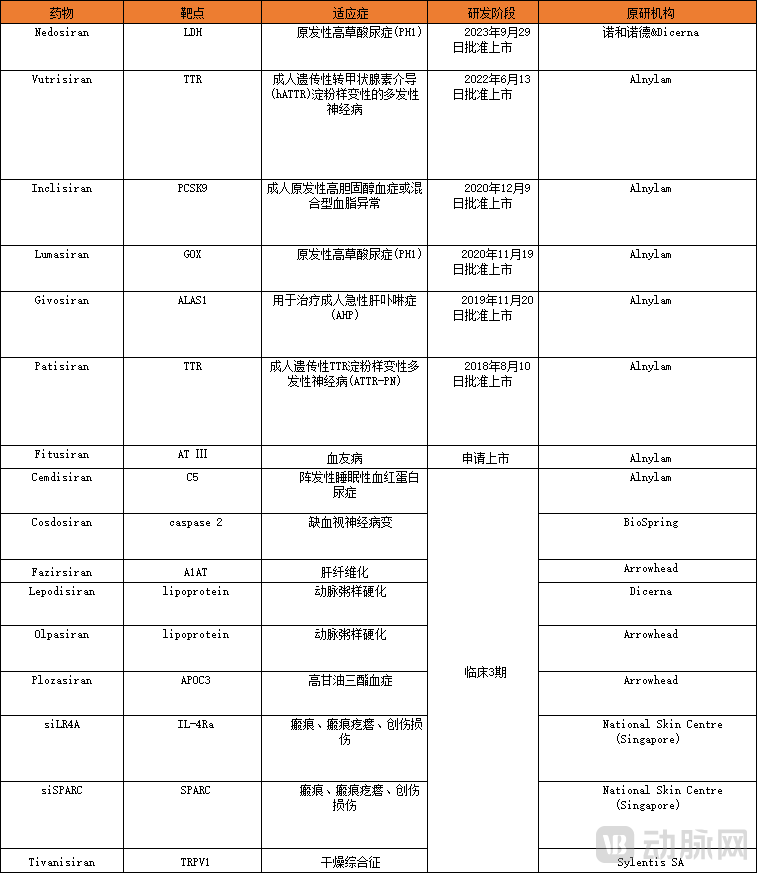
Figure: siRNA drugs in Phase III clinical trials, under marketing application, and approved for marketing
In the field of siRNA drug development, Alnylam has consistently maintained a leading position. Currently, among the six siRNA drugs approved globally, five were developed or co-developed by Alnylam.
From a technological roadmap perspective, Alnylam has gradually transitioned from the lipid nanoparticle (LNP) delivery technology used in its 2018 drug Onpattro (patisiran) to the GalNAc-siRNA conjugate delivery technology employed in its subsequent four drugs.
From the perspective of indications, the therapeutic scope of siRNA drugs is gradually expanding from rare diseases to common conditions. Among these, Alnylam is advancing a deep pipeline of RNAi-based innovative therapeutics across four key areas: genetic disorders, cardiometabolic diseases, infectious diseases, and central nervous system (CNS) and ocular diseases. Leveraging its RNAi therapeutic platform and drug development approach, Alnylam files 2–4 Investigational New Drug (IND) applications annually.
In China, although the foundation for nucleic acid drug R&D is relatively weak and the industrial chain is not yet fully developed, several representative companies have begun to emerge.. For example, Ribo Life Sciences is developing two siRNA drugs, SR061 and SR016, targeting acute non-arteritic anterior ischemic optic neuropathy (NAION) and hepatitis B, respectively. However, interim data from a pivotal clinical trial of SR061 showed that the efficacy results for the primary endpoint were insufficient to support continued enrollment. Nevertheless, the company still plans to complete the data analysis and design new clinical protocols based on the findings.
Furthermore, Sinobiologics announced in 2022 the initiation of Phase I clinical trials for its siRNA candidate drug, STP705. Leveraging peptide nanoparticle delivery technology, STP705 features dual-targeting inhibitory properties, simultaneously targeting TGF-β1 and COX-2. In addition to its application in medical aesthetics, STP705 is subject to dual Investigational New Drug (IND) filings in both China and the United States for indications including cholangiocarcinoma, non-melanoma skin cancer, and hypertrophic scars. It has also been designated as an orphan drug for the treatment of cholangiocarcinoma (CCA) and primary sclerosing cholangitis (PSC). The diverse therapeutic potential of STP705 lays a solid foundation for its broad future applications.