

Adcendo Secures $135M Series B Financing to Advance Global ADC Pipeline Featuring China-Originated Asset ADCE-T02

ADCendo
Developer of Novel Anti-Cancer Drugs

TCGX
Investment Institution in the Innovative Biotechnology Sector

TPG Life Sciences Innovations
Venture Capital Firm

OrbiMed
Healthcare Investment Institutions

Venrock
Venture Capital Firm

Surveyor Capital
Financial Services Company

Logos Capital
Investment Institutions in the Fields of Medical Research and Life Sciences

RA Capital
Life Sciences Venture Capital Firms

Novo Holdings
Venture Capital and Asset Management Firms

Pontifax
Israeli Venture Capital Firm

Dawn Biopharma
Early- to Mid-Stage Investment Firms
On November 25, 2024, local time in Copenhagen, Denmark, ADC drug development company Adcendo announced the successful completion of an oversubscribed Series B financing round totaling $135 million (approximately RMB 1 billion). The proceeds will be used to advance, broaden, and accelerate the development of the company’s portfolio of ADC products, including ADCE-T02 (TF ADC), ADCE-D01 (uPARAP ADC), ADC E-B05, and the A0401 project.
This financing round was led by TCGX, with participation from new investors TPG Life Sciences Innovations (LSI), Orbimed Advisors, Venrock Healthcare Capital Partners, Surveyor Capital (a Citadel company), and Logos Capital, as well as all existing investors, including RA Capital Management, Novo Holdings, Pontifax Venture Capital, and Dawn Biopharma (a platform controlled by KKR, HealthCap, Gilde Healthcare, and Ysios Capital).
Adcendo ApS was founded in 2017 by a team of scientists from the University of Copenhagen and Rigshospitalet, focusing on the development of antibody-drug conjugate (ADC) therapies for cancer. In 2021, Adcendo raised €51 million in Series A financing from investors including Novo Holdings, Ysios Capital, RA Capital Management, HealthCap, and Gilde Healthcare. According to Adcendo’s official press release, the company expanded its Series A round to €98 million to further strengthen the development of its ADC pipeline and advance the strategic development of its uPARAP program in soft tissue sarcomas and other mesenchymal cancers. To date, the company has raised over $200 million in funding.
Over $1 Billion Deal to Bring ADCs into China
One of Adcendo’s key pipeline assets, ADCE-T02 (TF ADC), was in-licensed from China in August 2024.
On August 20, 2024, Puzhong Discovery and ADCendo jointly announced that they had entered into a licensing agreement for ADCE-T02 (Puzhong Discovery’s internal code: AMT-754), a novel and highly differentiated antibody-drug conjugate (ADC) targeting tissue factor (Anti-TF). Under the agreement, ADCendo will obtain exclusive global rights to develop and commercialize the product outside of Greater China, while Puzhong Discovery will retain the rights to develop and commercialize it within Greater China.
Under the financial terms of the agreement, Puzhong Discovery will receive an upfront payment of tens of millions of US dollars. Upon achieving subsequent development, regulatory, and commercial milestones, it will be eligible for total milestone payments exceeding US$1 billion, as well as sales royalties ranging from high single-digit to low double-digit percentages based on global net sales (excluding the Greater China region).
ADCE-T02 is a novel, highly differentiated anti-TF ADC. Its unique antibody design mitigates impact on the coagulation cascade, while the T1000-exatecan linker-payload platform has been demonstrated to amplify the bystander effect, enhance linker stability, and hold potential for overcoming resistance mechanisms. These differentiated attributes are expected to translate into higher clinical response rates, longer duration of response, and improved safety, thereby offering a superior therapeutic window.
Tissue factor (TF), also known as coagulation factor III, is a transmembrane single-chain glycoprotein composed of 263 amino acid residues. Multiple studies have demonstrated positive TF expression in various solid tumors, including cervical cancer (100%), non-small cell lung cancer (34%–88%), endometrial cancer (14%–100%), and ovarian cancer (75%–100%). This high level of TF expression may contribute to tumor cell growth and survival, angiogenesis, and metastasis. Consequently, TF is considered a highly promising therapeutic target for cancer treatment.
Puzhong Discovery is capable of developing industry-leading ADC products, with its competitive advantage lying in its two technology platforms.
One of these is MabArray, an antibody platform designed to discover novel cell-surface anti-tumor targets for the development of First-in-Class therapeutics. As Puzhong Discovery’s core technology, the industrial-grade MabArray antibody chip platform leverages an ultra-high-density library containing hundreds of thousands of antibodies to enable high-resolution antigen screening that is unattainable with conventional methods. It facilitates the identification of challenging antigens—such as multi-pass transmembrane proteins, proteins with unique conformations, and glycoproteins—covering approximately 50% of human cell-surface membrane proteins (potential drug targets) in a single assay, thereby advancing cell-surface antigen recognition to new heights.
The second is the T moiety ADC (T1000) technology platform. This is a highly hydrophilic self-cleaving linker modification technology that can be used to develop next-generation, highly potent and stable ADC drugs. Benefiting from superior “hydrophobic shielding effects” and stability, this new technology significantly enhances the therapeutic efficacy of ADCs compared with existing ones, prolongs drug action duration, and overcomes multidrug resistance in tumors. More importantly, it does not increase toxic side effects, thereby further widening the therapeutic window of current ADC drugs.
The combination of MabArray and T1000 has generated significant synergistic effects, enabling Puzhong Discovery to construct an ADC “atlas.” This atlas holds promise for treating malignancies with high unmet medical needs, such as small cell lung cancer, colorectal cancer, pancreatic cancer, and renal cancer, thereby achieving higher and more durable responses.
According to ADCendo, ADCE-T02, based on two major platforms, has currently been submitted for clinical trial approval in Australia and is expected to file an Investigational New Drug (IND) application in the United States in the near future.
Originating from a Chinese Technology Platform, the First-in-Line IND Application Approved
It is worth noting that Adcendo’s lead candidate, ADCE-D01—an antibody-drug conjugate (ADC) targeting the uPARAP receptor—also has deep ties to China. In 2023, Adcendo entered into a collaboration with DualityBiologics on its ADC technology platform, securing a license for DualityBiologics’ proprietary “DITAC” tumor ADC platform to support its uPARAP-targeting ADC program for the treatment of mesenchymal tumors. Four months later, the two parties expanded the scope of their collaboration, granting Adcendo options to develop ADCs based on the DITAC platform against two specified innovative targets.
Duality Biologics is also deeply committed to the innovative R&D of antibody-drug conjugates (ADCs), having developed multiple independently owned ADC technology platforms, including DITAC, DIMAC, and DISAC. Among these, the DITAC (Duality Immune Toxin Antibody Conjugate) platform offers significant advantages over currently leading international ADC technologies, including more precise tumor-targeted drug release, superior efficacy, enhanced safety, and a wider therapeutic window. Leveraging the DITAC platform, Duality Biologics has developed nearly 10 cutting-edge ADC drug candidates, with three projects having entered the Investigational New Drug (IND) stage. Notably, its first ADC product completed the entire process from project initiation to IND approval in just 13 months, demonstrating highly efficient execution capabilities.
uPARAP, the target of ADCE-D01, is a cell surface receptor highly expressed in various interstitial cancers, including soft tissue sarcoma, osteosarcoma, gastrointestinal stromal tumors (GIST), and malignant gliomas such as glioblastoma. ADCendo’s uPARAP-targeting antibody-drug conjugate (ADC) has demonstrated potent antitumor activity against glioblastoma multiforme (GBM) in preclinical models and exhibited cytotoxicity against GBM cancer cells in vitro. These data suggest that uPARAP-targeting ADCs may represent a potential novel therapeutic option for patients with GBM.
According to the latest news, in October 2024, the U.S. Food and Drug Administration (FDA) approved the Investigational New Drug (IND) application for the Phase I/II study of ADCE-D01 in patients with metastatic and/or unresectable soft tissue sarcoma (STS) (the ADCElerate-01 trial). ADCElerate-01 is a first-in-human, Phase I/II, multicenter, open-label, dose-escalation and expansion study evaluating ADCE-D01 as monotherapy in patients with metastatic and/or unresectable STS. The primary objective of the study is to assess the safety and tolerability of ADCE-D01 to determine the maximum tolerated dose and the recommended Phase II dose and schedule for ADCE-D01 monotherapy. Secondary objectives include characterizing pharmacokinetics and evaluating the preliminary efficacy of ADCE-D01. Patient enrollment will take place in the United States and Europe, with plans to submit an application via the Clinical Trials Information System (CTIS) in the European Union in the coming months.
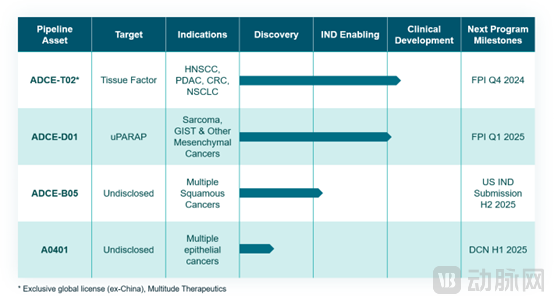
ADCendo Pipeline
Domestic ADCs Are Being “Snapped Up”
Since 2024, next-generation antibody-drug conjugates (ADCs) from Chinese pharmaceutical companies have frequently been licensed out or involved in collaborations with overseas pharmaceutical firms. Notable among these transactions are major acquisitions, such as Genmab’s $1.8 billion acquisition of Bio-Thera Solutions.
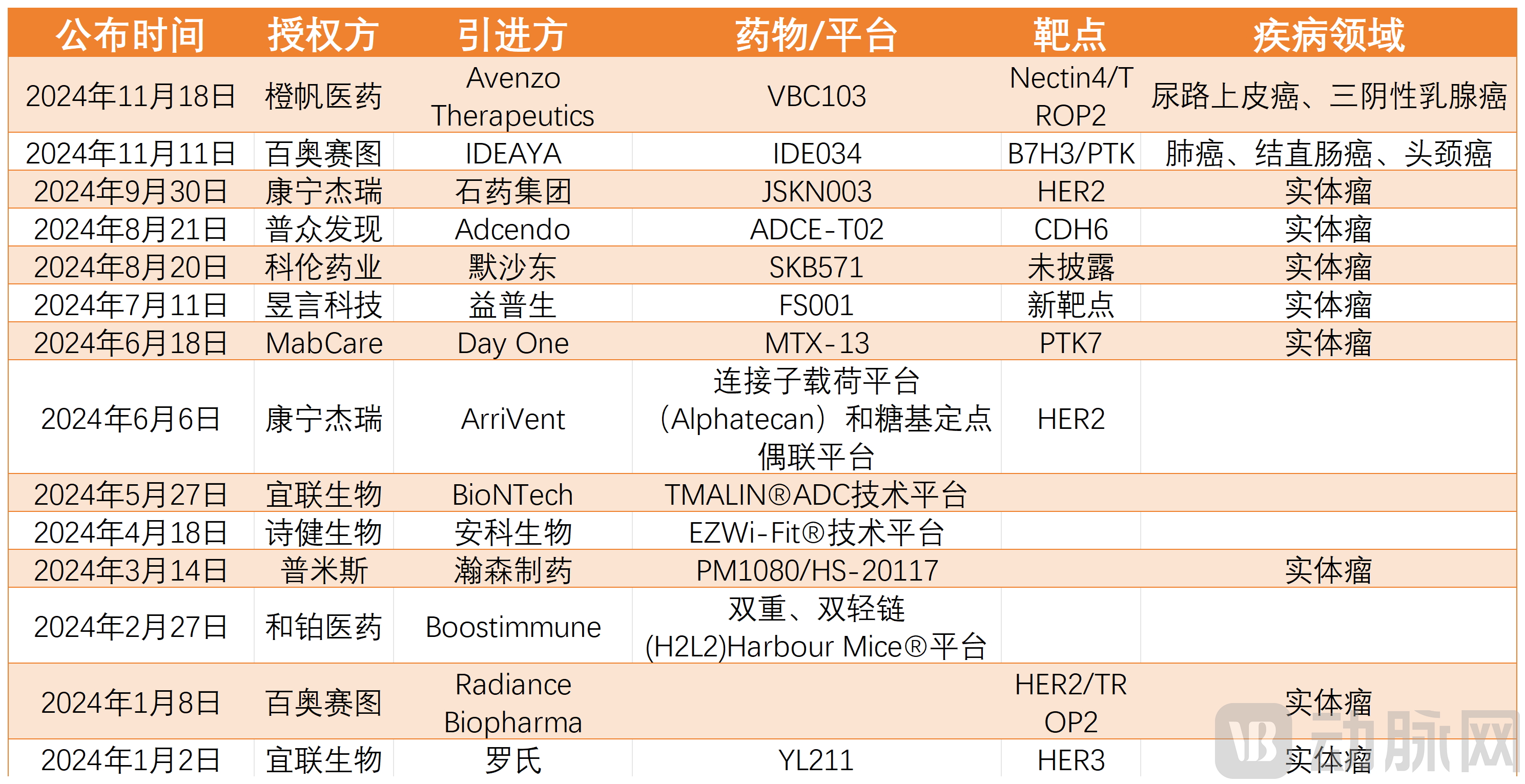
Some Domestic ADC Collaborations in 2024, Chart by VCBeat
In January, Roche licensed in YL211, a c-MET-targeting antibody-drug conjugate (ADC) from Elevation Biopharma, for over $1 billion, marking a strong start for Chinese-made ADCs’ successive global expansions in 2024. Shortly thereafter, Radiance Biopharma acquired the global rights to Biocytogen’s first-in-class HER2/TROP2 bispecific ADC. In March, Biocytogen entered into a collaboration with ABL Bio, which boasts advanced platforms for cancer immunotherapies and central nervous system disease treatments, to jointly develop novel bispecific ADC drugs.
By May, Yilian Biologics once again made a high-profile appearance, securing a new strategic collaboration with BioNTech valued at over $1.8 billion. Under this agreement, BioNTech obtained exclusive options and corresponding global exclusive licenses to develop antibody-drug conjugate (ADC) products targeting specific selected frontier innovative targets, leveraging Yilian Biologics’ TMALIN® ADC technology platform.
The new generation of domestically produced antibody-drug conjugates (ADCs) has gained favor because the popular target HER2 is highly competitive, making re-entry an unwise choice. Companies such as Alphamab Oncology, which have chosen to focus on HER2, are upgrading their technologies to highlight the differentiated advantages of their pipelines. This also explains why collaborations involving ADC technology platforms are just as vigorous as those centered on drug pipelines.
Furthermore, bispecific antibody-drug conjugate (ADC) pipelines have become a key focus in the global expansion of ADCs due to their scarcity and potential.
Bispecific antibody-drug conjugates (BsADCs) leverage the synergistic effects of two distinct targets to more precisely target tumor cells. Theoretically, this approach can further enhance tumor selectivity and internalization rates, improve responses in patients with low target expression and tumor heterogeneity, expand the clinical application of ADC drugs, and achieve a “1+1>2” effect. Consequently, many companies shifted their strategic focus toward differentiated BsADC development in 2024 to explore opportunities for overtaking competitors. Companies such as Orange Sail Pharma, Biocytogen, and Kelun Pharmaceutical have all advanced their BsADC candidates into international markets.
Overall, the frequent acquisitions of domestically produced ADCs by overseas pharmaceutical companies are driven by two main factors: on one hand, multinational corporations (MNCs) face the risk of declining sales as their core products’ patents expire, creating an urgent need for new product pipelines; on the other hand, there remains a substantial unmet clinical demand in oncology. As Chinese pharmaceutical companies continue to enhance their internal R&D capabilities, their technological platforms and candidate drug portfolios are becoming increasingly robust, offering greater potential to bring new therapeutic possibilities to patients.