

CGM Prices Plummet Below ¥100 in Fierce Market Competition

MicroTech Medical
Developer of Medical Device Products for Diabetes Management

Ottai
Provider of Medical-Grade Smart Wearable Devices and Digital Chronic Disease Management Solutions

Sibionics
Medical Device R&D and Manufacturing Company

Sinocare
Rapid Detection of Chronic Disease: Product R&D, Production, and Sales
If products could speak, Abbott’s FreeStyle Libre 2 continuous glucose monitor (CGM) would certainly be left speechless.
In late October, Abbott launched the FreeStyle Libre 2 continuous glucose monitor (CGM) in the Chinese market, priced at 475 yuan per sensor. It was greeted by both long-awaiting patients and competitors igniting a price war.
When the FreeStyle Libre 2 was launched at a price of 475 yuan, a number of CGM devices had already entered the Chinese market at prices below 100 yuan.
According to the survey, on the official flagship stores of various CGM manufacturers on the Tmall platform, if multiple CGM products are purchased at once, the unit price of CGM can be as low as 96 yuan to 123 yuan, which is a significant decrease compared to the average selling price of 400-600 yuan in 2021 and 200-300 yuan in 2023.
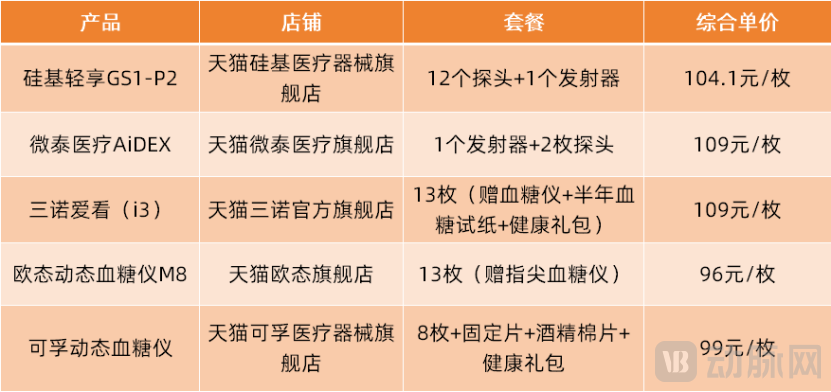
(Some products require contacting customer service to claim coupons; prices as of November 25)
For example, the Ottai CGM product launched in May this year is priced at 119 yuan per sensor on its official flagship store; however, purchasing 13 sensors at once includes a free fingerstick blood glucose meter, reducing the per-sensor price to as low as 96 yuan.
For another example, MicroTech Medical’s first-generation CGM product, AiDEX, is priced at RMB 218 for one transmitter plus two sensors, whereas the per-sensor price drops to just RMB 99 when purchasing six sensors in a single transaction.
How intense has the price war among CGM manufacturers become? Beyond pricing, what new innovations have CGM manufacturers introduced in their products?
Major Price Cuts in CGM, but Companies Adopt Different Pricing Strategies
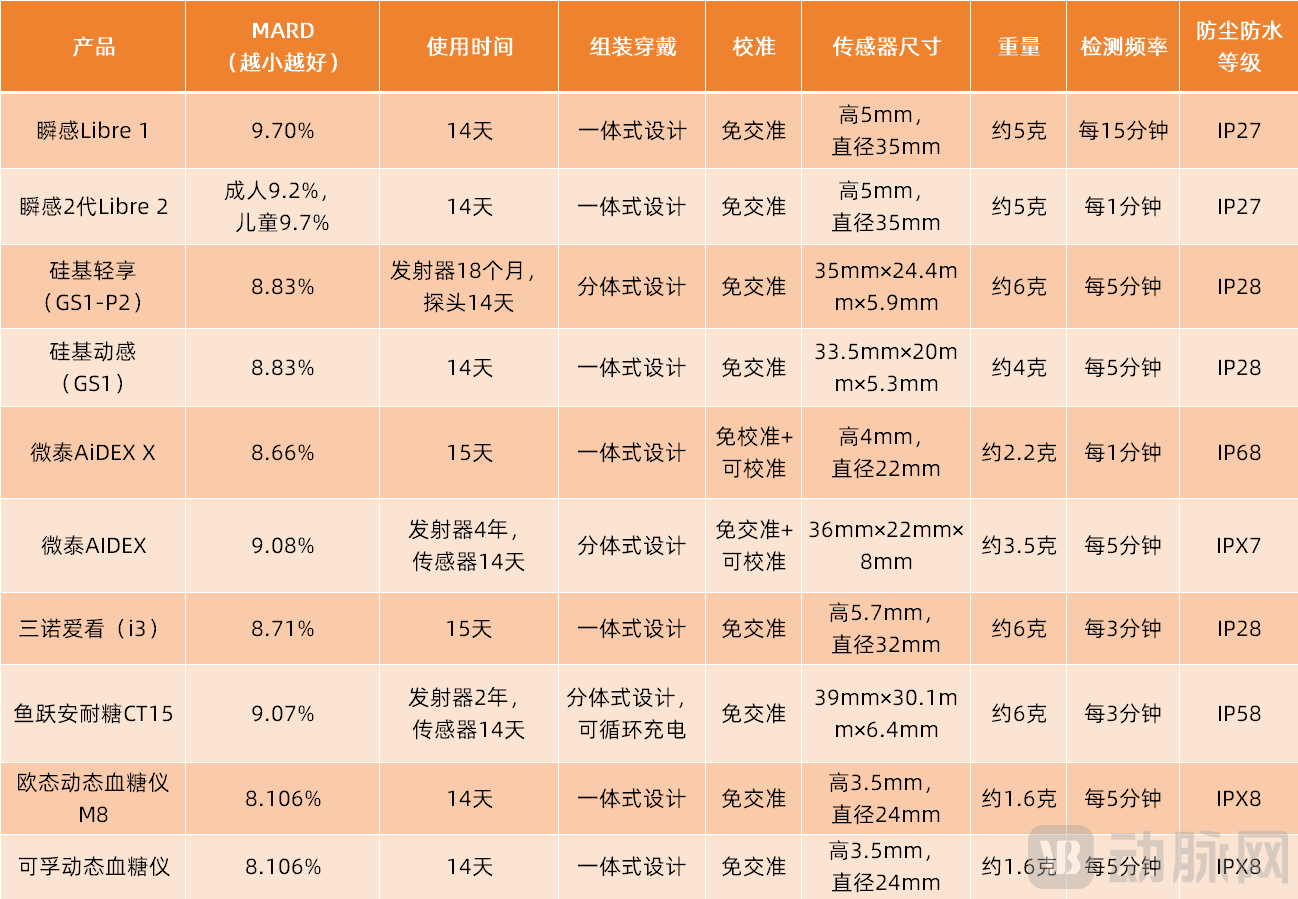
(Performance Parameters of Mainstream CGM Products in the Market, Compiled by VCBeat)
1. Launch of next-generation products, price reduction for previous-generation products. For example, in April 2024, MicroTech Medical released its latest generation continuous glucose monitor, the AiDEX X. This product features an integrated design combining the sensor and applicator, enabling immediate use upon opening, reducing application steps, and lowering operational complexity. In contrast, the previous generation employed a separate design for the sterile-packaged sensor-applicator and the transmitter, requiring patients (users) to manually assemble the two components.
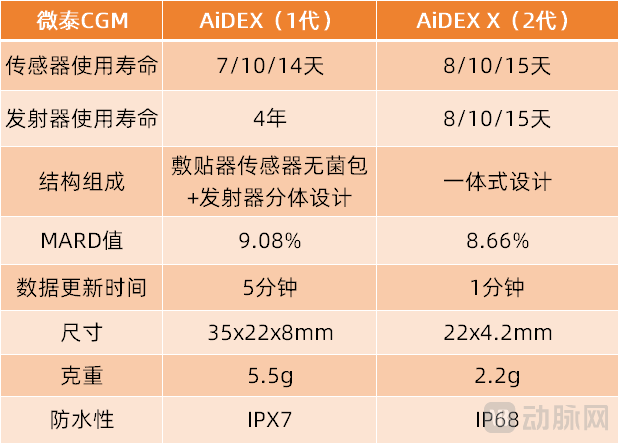
It should be noted that for split-design CGM products, the transmitter can be reused within its service life (1–4 years), with only the sensor requiring replacement each time. In contrast, integrated designs require replacement of both the transmitter and the sensor at each change. Based on this, split-design CGMs are considered to offer greater cost advantages.
Compared to its predecessor, the MicroTech AiDEX X features a more compact size, greater measurement accuracy, higher sampling frequency, and an improved water resistance rating.
Research has found that after the high-end AiDEX X was launched, MicroTech Medical reduced the price of its first-generation product, AiDEX, to create a pricing portfolio that caters to users with different needs. Specifically, the high-end AiDEX X targets users who prioritize experience and product performance, while the previous-generation AiDEX serves those who are more price-sensitive.
Second, as all-in-one CGM products achieved strong sales, companies launched split-type CGM systems with lower usage costs, meeting user expectations.For example, Sibionics generated over RMB 100 million in revenue in 2022 through its CGM product, Sibio GS1, and achieved sales exceeding RMB 67 million during the 2023 Double 11 shopping festival, representing a year-on-year increase of 110%. By April 2024, the number of Sibio GS1 users had surpassed one million.
Sibionics Dynamic is an all-in-one, calibration-free continuous glucose monitoring (CGM) device. With a Mean Absolute Relative Difference (MARD) of 8.83% and weighing only 4 grams, it has garnered widespread favor and recognition among users. However, many users frequently leave comments at the end of its WeChat official account articles, such as, “The product is great, just a bit expensive,” or “High accuracy; it would be perfect if it were more affordable.”
Perhaps in response to user demand, Sibionics launched its Sibio Lite product in late April 2024. On November 25, at the official Sibionics flagship store on Tmall, a bundle consisting of one transmitter and two sensors was priced at RMB 259 after applying a coupon obtained by contacting customer service (with a limited-time bonus of reinforcement stickers). For a six-box pack of sensors, the post-coupon price came to RMB 119.8 per sensor. This offers a significant cost advantage compared to Sibionics’ Sibio Dynamic model, which costs RMB 289 per sensor after coupons. (Note: Coupon amounts may vary depending on big data recommendations and purchase frequency.)
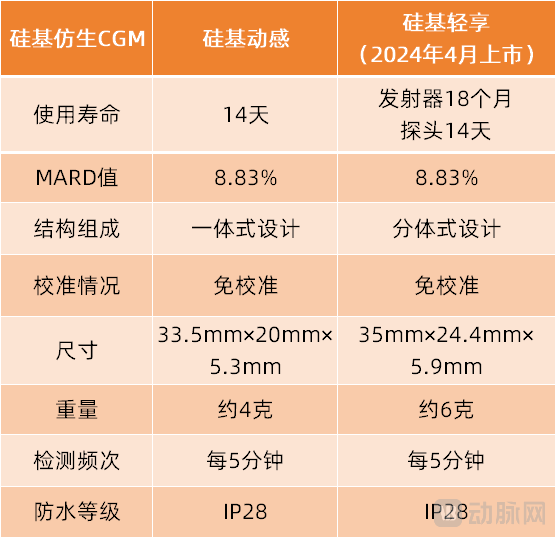
In terms of product performance, the Sibionics Lite weighs approximately 6 grams, which is heavier than the 4-gram Sibionics Dynamic; its volume is also slightly larger than that of the Sibionics Dynamic. However, the Sibionics Lite shares the same MARD value, detection frequency, and dust/water resistance rating as the Sibionics Dynamic. This enables price-sensitive users to access high-quality, accurate continuous glucose monitoring services.
Third, launch new products and penetrate the market with a Xiaomi-style pricing strategy.. For example, the all-in-one continuous glucose monitoring (CGM) product launched by Ottai in May 2024 brought CGM products into the sub-100-yuan price range upon its market debut. Currently, the unit price is 119 yuan per sensor; if 13 sensors are purchased at once, the price drops to as low as 96 yuan per sensor, and a fingerstick blood glucose meter is included free of charge.
Why has Ottai adopted such a pricing strategy? After all, many all-in-one CGM devices on the market are priced above 200 yuan.
“Ottai is a company invested in by Xiaomi Group. Similar to the pricing strategy for everyday consumer goods, Ottai does not aim to generate high gross profits from individual products. Instead, it determines product prices through a reverse-calculation approach based on supply chain costs, after ensuring a reasonable net profit margin. This strategy allows the company to maintain sufficient profits for operations and innovative development, while also keeping the financial burden on diabetes patients manageable.”
Additionally, Ottai has adopted another approach: by comprehensively considering the actual monthly expenditures of diabetic patients—such as costs for insulin, medications, and monitoring (CGM, BGM)—Ottai aims to ensure that spending on monitoring does not account for an excessive proportion of the total, particularly in the absence of insurance coverage. Based on survey data regarding the payment proportions across different aspects of diabetes care, Ottai reverse-engineered the price to establish its pricing strategy. Taking both approaches into consideration, Ottai has priced its all-in-one CGM product in the range of hundreds of yuan.
On the day of Ottai CGM’s launch, the headline on Ottai’s official WeChat account read: “Offering Heartfelt Prices to Deliver Quality Products for the Masses.” At that moment, Lei Jun’s philosophy—“Technology should no longer be aloof but serve the people”—was once again embodied, and it was a company previously invested in by Xiaomi Group that brought this philosophy to life.
Not only does it offer a price advantage, but this CGM developed by the Oxford University team under Ottai also delivers impressive performance specifications. The device features a 14-day wear duration, requires no calibration, boasts a MARD value of 8.106%, and weighs merely 1.6 grams. In comparative analysis, the Ottai CGM demonstrates significant advantages in accuracy, weight, and size.
Beyond Ottai, Sinocare’s all-in-one CGM product, Sinocare iCan, has also gradually dropped to the hundred-yuan price range. During the official Tmall promotional period, purchasing 13 units of Sinocare iCan in a single transaction brings the per-unit price down to as low as RMB 109, and includes a free blood glucose meter, six months’ supply of blood glucose test strips, and a health gift package.
It is reported that Sinocare Aikan is a calibration-free, all-in-one continuous glucose monitoring (CGM) system. It can be used for 15 days, generates a blood glucose reading every three minutes, and has a mean absolute relative difference (MARD) of 8.71%. Leveraging Sinocare’s brand strength, distribution channels, and pricing advantages, Sinocare Aikan achieved omnichannel sales exceeding 300,000 units during the June 18 Shopping Festival in 2024, and surpassed 400,000 units during the Double 11 Shopping Festival in 2024, representing a growth rate of over 400%.
As CGM prices have dropped significantly, market penetration has also risen rapidly. According to the “2024 Continuous Glucose Monitoring (CGM) Market Insights” released by JD Health in October 2024, CGM sales growth remained above 22% from 2021 to 2024, reaching 44% in 2024. The market share of CGMs also climbed from 17% in 2021 to nearly 25% in 2024.
As price wars intensify, more patients are expected to adopt CGM, driving further market penetration and growth.
Beyond engaging in price wars, domestic CGM manufacturers are also continuously optimizing their products and services to provide diabetic patients with a better experience in blood glucose monitoring and management.
For example, Sibionics is continuously expanding the indications for its CGM product, Sibio. In November 2024, Sibio received approval for pediatric and adolescent indications, enabling continuous or periodic monitoring of interstitial fluid glucose levels in children and adolescents aged 3 to 17 years.
MicroTech Medical and Ottai are striving to make CGM products thinner, lighter, and imperceptible. MicroTech Medical’s innovatively launched AiDEX X continuous glucose monitor weighs only about 2.2 grams, with a thickness of 4 mm and a diameter of 22 mm; Ottai’s CGM product weighs only about 1.6 grams, with a height of 3.5 mm and a diameter of 24 mm. Both devices are extremely compact and lightweight, offering patients a more conforming, imperceptible, and comfortable wearing experience.
In addition, Ottai has integrated artificial intelligence technology into its CGM products. By introducing the “Xiao Ou AI” feature, Ottai provides users with a 24/7 intelligent health assistant that leverages AI to promptly address user inquiries and questions regarding blood glucose management.
As a pioneer in diabetes management, MicroTech Medical provides comprehensive, closed-loop care throughout the entire disease course and across all scenarios for patients with diabetes, leveraging products such as the AiDEX X, the Equil patch-type smart insulin pump, and the Jiantang Doctor blood glucose management system. Notably, its innovatively developed MicroTech hybrid closed-loop insulin pump is an “intelligent” system based on artificial intelligence technology that mimics physiological insulin secretion; it automatically adjusts insulin delivery based on the patient’s glucose levels under the control of core algorithms.
Sinocare has also launched its “4-in-1 Diabetes Management System” based on its product portfolio. This system integrates four core functions: blood glucose monitoring (BGM), continuous glucose monitoring (CGM), continuous subcutaneous insulin infusion, and a patient education platform. It provides comprehensive blood glucose management spanning both in-hospital and out-of-hospital settings, while enabling seamless interdisciplinary and inter-departmental integration, thereby advancing hospital-wide blood glucose management toward intelligence, precision, personalization, and real-time capability.
Notably, Sinocare has also launched the H3 model CGM product for use in medical institutions. With a clinical MARD value as low as 7.45% and an eight-day wear duration, this device enables healthcare professionals to comprehensively monitor patients’ glucose data, thereby facilitating the development of more precise and personalized treatment and management plans.
In terms of product features, domestically produced CGM systems have also developed direct connectivity with smartwatches, an innovation that Shenzhen Sibionics once leveraged to attract a large number of new users. One reason for this is that children with type 1 diabetes have a critical need for CGM, yet students are generally not permitted to carry mobile phones; therefore, smartwatches serve as an ideal complementary tool due to their high penetration rate and portability.
Following Sibionics, domestic CGM products such as MicroTech Medical’s AiDEX X, Sinocare’s Aikan continuous glucose monitor, and Ottai CGM have also introduced direct connectivity with smartwatches, facilitating blood glucose management for diabetic patients across various scenarios.
Moreover, these domestic CGM manufacturers have also launched customized smartwatches to provide a better service experience when paired with their CGM products. For instance, Sibionics released its customized smartwatch in June 2023, Ottai launched the Ottai Smartwatch in October 2024, and MicroTech Medical debuted its smartwatch in late October 2024.
From product performance, specifications, and user experience to comprehensive diabetes lifecycle management services, domestic CGM manufacturers are engaging in all-around intense competition.
Not only manufacturers, but JD Health has also participated in the promotion of CGM. For example, in September 2023, JD Health joined hands with Sibionics to launch a campaign offering dynamic glucose monitors for trial at just 1 cent. In September 2024, they collaborated again with Sibionics to carry out an experience campaign for dynamic blood glucose monitoring. Users who meet the conditions and pass the application review can pay 39 yuan to enjoy nurse home service and try on Sibionics' dynamic glucose monitor products.
JD Health also collaborates with other CGM manufacturers. For instance, in September 2024, JD Health partnered with MicroTech Medical to launch a Blood Glucose Care Initiative, introducing the “1-Cent Trial for Continuous Glucose Monitors” campaign: eligible diabetic patients can try on MicroTech Medical’s second-generation CGM product, AiDEX X, without a deposit by paying just one cent.
In addition, JD Health has partnered with Abbott to launch the FreeStyle Libre 2 glucose meter on its platform for the first time. JD Health stated that it not only provides users with high-quality sales and delivery services for CGM devices but also offers related education, consultation, and support services. Furthermore, for users unfamiliar with device usage, JD Health provides in-home nursing guidance and sensor insertion services by nurses, helping users better manage their blood glucose levels.
Currently, domestic CGM manufacturers are not only engaged in fierce competition in the Chinese market but are also expanding their competitive efforts into overseas markets.
In November 2024, MicroTech Medical showcased its LinX continuous glucose monitor (the overseas version of its CGM product), Equil patch insulin pump, blood glucose meter, and Pancares management system at the 56th MEDICA International Trade Fair & Conference. It is reported that MEDICA is one of the largest B2B trade fairs for the medical industry worldwide, with more than 5,800 exhibitors from 72 countries and 80,000 visitors participating in the event.
In addition, MicroTech Medical held a product training session with its partners in Poland, showcasing the overseas version of its CGM product, LinX, and the Pancares management system to participants.
Previously, MicroTech Medical showcased its LinX and other products at the 60th Annual Meeting of the European Association for the Study of Diabetes (EASD) and the Medical Device Exhibition in Bangkok, Thailand, to advance its internationalization efforts.
Sibionics is also expanding into overseas markets. In October 2023, Sibionics obtained the EU MDR certification issued by TÜV SÜD. This means that Sibionics’ CGM products will be able to be sold in the EU market.
In January 2024, Shenzhen Sibionics Co., Ltd. obtained the MDSAP certification certificate, with a scope covering the regulatory systems of Australia, Brazil, Canada, and the United States. The certification is valid for three years. Achieving MDSAP certification signifies that Sibionics’ production quality management system complies with international standards, and that the safety and quality of its products meet the regulatory requirements of Australia, Brazil, Canada, and the United States.
It is understood that manufacturers approved through the Medical Device Single Audit Program (MDSAP) can reduce the number of audits required by different regulatory authorities, thereby minimizing production disruptions caused by repetitive audits.
Furthermore, CGM products from companies such as Sinocare, Ottai, and YiYu Technology have been extensively marketed in overseas markets. For instance, Sinocare’s CGM products have obtained regulatory approvals in multiple countries and regions, including Indonesia and the European Union, and are already being sold online in Europe. Ottai’s integrated CGM product for international markets has entered nearly 20 overseas countries for sales since receiving EU MDR certification in April 2024, and has been showcased and featured in academic presentations at international exhibitions such as MEDICA, EASD, and ATTD.Yuyi Technology's CGM products have been gradually incorporated into the national health insurance systems of Denmark, Sweden, Italy, the Netherlands, the Czech Republic, and other countries since 2018.
It is foreseeable that, as the price advantage of domestically produced CGM products becomes more prominent, coupled with their advantages in performance, user experience, and service, domestically produced CGMs are expected to further capture market share and secure a foothold in overseas markets.