

Arrowhead Pharmaceuticals Announces $500 Million Upfront Global siRNA Collaboration with Sarepta Therapeutics

Arrowhead Pharmaceuticals
Pharmaceutical R&D Developer
Sarepta
Developer of Therapies for Rare Neuromuscular Diseases
On November 26, 2024, local time, Arrowhead Pharmaceuticals (NASDAQ: ARWR, hereinafter referred to as “Arrowhead”) announced that it had entered into a global license and collaboration agreement with Sarepta Therapeutics (NASDAQ: SRPT, hereinafter referred to as “Sarepta”). The collaboration covers four clinical-stage and three preclinical pipeline assets, as well as the joint development of siRNA therapeutics targeting up to six targets for rare diseases, hereditary muscle diseases, central nervous system (CNS) disorders, and pulmonary diseases.
Under the agreement, Arrowhead Pharmaceuticals will receive a $500 million upfront payment and $325 million in equity investment (with the common stock price at a 35% premium to the 30-day volume-weighted average price), as well as an additional $250 million in payments over the next five years.
In addition, Arrowhead will receive $300 million in near-term clinical enrollment milestone payments and is expected to earn additional milestone payments exceeding $10 billion (comprising development milestone payments of $110 million to $410 million per program and sales milestone payments of $500 million to $700 million per program), as well as a percentage of sales royalties.
Following the disclosure of the transaction, Arrowhead Pharmaceuticals’ U.S. shares surged 24%, bringing its market capitalization to nearly $3 billion, while Sarepta rose 5%, with a market cap exceeding $11.5 billion. The transaction is expected to close in early 2025.
The clinical-stage R&D projects covered by the agreement include pipelines developed using Arrowhead’s proprietary TRiM™ platform:
ARO-DUX4: Designed to reduce the production of DUX4 protein in skeletal muscle; currently undergoing Phase 1/2 clinical trials for facioscapulohumeral muscular dystrophy (FSHD).
ARO-DM1: Designed to target and inhibit the expression of myotonic dystrophy protein kinase (DMPK) in skeletal muscle; a Phase 1/2 clinical trial for myotonic dystrophy type 1 (DM1) is currently underway.
ARO-MMP7: A Phase 1/2 clinical trial is underway for this agent, which is designed to reduce the expression of matrix metalloproteinase-7 (MMP7) in lung epithelial cells, targeting idiopathic pulmonary fibrosis (IPF).
ARO-ATXN2: Designed to target ataxin-2 (ATXN2) in the central nervous system, with Phase 1/2 clinical trials for spinocerebellar ataxia type 2 (SCA2) expected to commence by the end of 2024.
Preclinical projects in the CNS field, designed for subcutaneous administration, include:
ARO-ATXN1: Targeting Ataxin-1 (ATXN1) for the Treatment of Spinocerebellar Ataxia Type 1 (SCA1)
ARO-ATXN3: Targeting Ataxin-3 (ATXN3) for the Treatment of Spinocerebellar Ataxia Type 3 (SCA3)
ARO-HTT: Targeting Huntingtin (HTT) for the Treatment of Huntington's Disease
In-House R&D + M&A: Breaking the Patent Monopoly on Small Nucleic Acids
Arrowhead Pharmaceuticals, Alnylam, and Ionis are collectively known as the "Big Three" of oligonucleotide therapeutics.
In this regard, Alnylam has established an extensive patent moat in delivery technologies: by controlling the two major RNAi delivery platforms—GalNAc and lipid nanoparticles (LNPs)—Alnylam has not only become the undisputed market leader by market capitalization in the oligonucleotide therapeutics sector but has also effectively “monopolized” the global siRNA market. Patents held by Alnylam are implicated in all currently marketed oligonucleotide drugs, underscoring that delivery technology is the lifeblood of the oligonucleotide therapeutics field.
Arrowhead Pharmaceuticals is best positioned to break the dominance of Alnylam. Taking L96 as an example, Alnylam holds a strong patent position for L96. However, Arrowhead, as a latecomer, launched NAG25, which circumvents Alnylam’s linker and trigalactose patents for L96. This innovation not only simplifies manufacturing but also minimizes costs. Currently, based on its proprietary TRiMTMplatform, Arrowhead Pharmaceuticals has not only built a pipeline in the field of liver diseases covering MASH, hepatitis B, and cardiovascular diseases, but also possesses R&D products targeting the lungs, muscles, and nervous system.
However, a review of Arrowhead’s development history reveals a rather tortuous path. Founded in 1989, Arrowhead went public on the NASDAQ in 2004 (Alnylam was established in 2002, more than a decade after Arrowhead). In its early years, Arrowhead lacked a stable business model for an extended period. It was not until 2007 that Chris Anzalone, then CEO, recognized that Arrowhead’s subsidiary, Calando Pharmaceuticals, could achieve a leading position in the RNA interference (RNAi) field. He subsequently designated this area as the company’s core strategic direction and divested other non-core assets.
Shortly after navigating its initial crisis, Arrowhead Pharmaceuticals quickly faced a second “financial crisis.” In 2011, Roche also encountered setbacks in the small nucleic acid sector and urgently sought to divest its related assets, which had cost nearly $1 billion, by finding a buyer. Arrowhead Pharmaceuticals was selected as the acquirer because it sought not only the technology but also personnel, equipment, and even manufacturing facilities as part of its bid, ultimately securing the deal. The acquisition included all personnel, patents, and equipment from Roche’s small nucleic acid business—the acquired team comprised more than 40 top scientists in the RNAi field, and the equipment and manufacturing facilities were among the most advanced at the time. In return, Roche received an equity stake in Arrowhead Pharmaceuticals, future milestone payments, and right of first refusal on products.
Notably, Roche’s assets effectively consolidated nearly all technologies required for siRNA development, including licenses for key delivery technologies and all critical patents held by Alnylam and other companies. In 2015, after acquiring Roche’s small nucleic acid assets, Arrowhead Pharmaceuticals further acquired Novartis’s RNAi assets. This transaction also included patent licenses from the collaboration between Novartis and Alnylam, with Novartis even becoming the second-largest shareholder of Arrowhead Pharmaceuticals as a result. Through these two acquisitions, Arrowhead Pharmaceuticals secured a nearly complete portfolio of technologies and patent licenses in the field of small nucleic acids, laying a solid foundation for its subsequent R&D efforts.
Meanwhile, the increasingly refined in-house R&D platform, bolstered by acquisitions and business development (BD) activities, has generated cash returns. According to Arrowhead Pharmaceuticals’ fiscal year 2023 financial report, the company’s full-year revenue amounted to $241 million, with the vast majority derived from collaborations with GSK, Horizon Therapeutics, Takeda Pharmaceutical Company, and Amgen. The financial report also highlighted that Arrowhead Pharmaceuticals held $110.9 million in cash, cash equivalents, and restricted cash; $292.7 million in available-for-sale securities; and total assets of $765.6 million.
In 2022, Arrowhead Pharmaceuticals co-founded Visirna Therapeutics in China with Vivo Capital and granted the company exclusive rights to develop and commercialize four of Arrowhead’s investigational RNAi therapeutics for cardiometabolic diseases in the Chinese market.
Proprietary Targeted Delivery Platform, 3 Pipelines Have Reached Phase III
Arrowhead has developed its proprietary targeted delivery platform, TRiM™. Utilizing ligand-mediated delivery, TRiM™ forms a structurally simple, tissue-specific targeting system. Researchers have leveraged this platform to progressively eliminate irrelevant characteristics and chemical components while maintaining optimal pharmacological activity throughout the process.
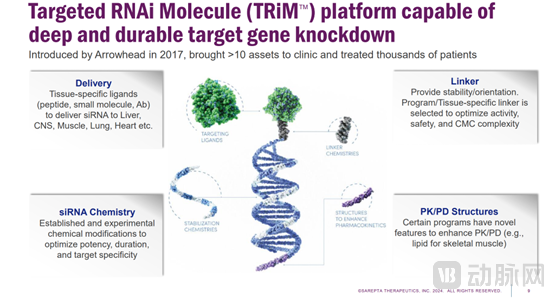
The TRiM™ platform optimizes four components for each candidate drug as needed. It includes an efficient RNA trigger, and the following components can be specifically optimized for different candidate drugs: high-affinity targeting ligands, linkers, stable candidate RNA drugs, and structures that enhance pharmacokinetics. By altering the targeting ligand conjugated to the RNA molecule, the platform enables specific delivery of RNAi therapies to different tissues, thereby achieving the treatment of various types of diseases.
Meanwhile, Arrowhead also applies its algorithms to the TRiM™ technology platform, such as optimizing trigger sequences, limiting cross-reactivity with non-target genes, excluding miRNA homology, maximizing activity, enhancing intrinsic stability, and rationally designing and configuring compounds.
Currently, the GalNAc technology developed by Alnylam can link N-acetylgalactosamine to siRNA. Receptors on the surface of hepatocytes recognize N-acetylgalactosamine, enabling highly specific entry into hepatocytes while limiting off-target effects. However, GalNAc cannot target tissues outside the liver, which restricts the application of RNAi therapies to the treatment of rare diseases and liver conditions.
According to Arrowhead Pharmaceuticals, unlocking the full potential of RNA interference (RNAi) requires expanding its application beyond the liver. Currently, the TRiM™ platform has demonstrated potential for targeting multiple tissues, including the liver, lungs, muscles, and the central nervous system. In April 2023, Arrowhead announced positive interim results from its ongoing Phase 1/2 clinical trial of ARO-RAGE, demonstrating that the platform has been optimized for pulmonary delivery.
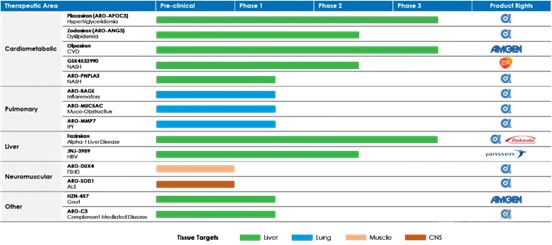
Currently, Arrowhead has 16 products in its pipeline, three of which have entered Phase III clinical trials: ARO-APOC3, ARO-ANG3, and Fazirsiran.
Among these, the first product poised for commercialization, Plozasiran (ARO-APOC3), has already submitted its marketing application and is expected to receive approval in 2025. Arrowhead Pharmaceuticals plans to announce updates in mid-2024 on the Phase 3 trial of Plozasiran for the treatment of familial chylomicronemia syndrome and severe hypertriglyceridemia. According to GlobalData, sales of Plozasiran are projected to reach $651 million by 2030.
Plozasiran (ARO-APOC3) is an RNAi therapeutic targeting the APOC3 gene for the treatment of hypertriglyceridemia (HTG). ARO-APOC3 is designed to reduce the production of apolipoprotein C-III (apoC-III), a key regulator of triglyceride metabolism. RNAi-mediated suppression of hepatic apoC-III production leads to reduced synthesis and assembly of very-low-density lipoprotein (VLDL). In two Phase II clinical trials (SHASTA-2 and MUIR), ARO-APOC3 demonstrated significant efficacy in lowering triglyceride levels, apoC-III levels, and non-high-density lipoprotein cholesterol (non-HDL-C) in patients with hypertriglyceridemia, with no serious adverse events reported. In another Phase II study, ARCHE-2, ARO-APOC3 showed robust effects in reducing triglycerides, low-density lipoprotein cholesterol (LDL-C), and other related parameters, while also helping to decrease hepatic fat fraction in patients.
ARO-ANG3 is an RNAi therapy targeting angiopoietin-like protein 3 (ANGPTL3), developed for the treatment of dyslipidemia, familial hypercholesterolemia (FH), and hypertriglyceridemia (HTG). ANGPTL3 is a hepatically synthesized inhibitor of lipoprotein lipase and endothelial lipase. Inhibition of ANGPTL3 has been proven to reduce serum low-density lipoprotein (LDL) levels as well as serum and hepatic triglyceride levels, making it a novel therapeutic target for cardiovascular disease. Fazirsiran is an RNAi therapy developed by Arrowhead Pharmaceuticals for the treatment of liver disease associated with alpha-1 antitrypsin deficiency (AATD).
US Oligonucleotide Leader Strengthens DMD Pipeline
The other key player in this transaction, Sarepta, known as the U.S. leader in small nucleic acid therapeutics, has released its preliminary report on net product revenues for the fourth quarter and full year of 2023: Among them, Elevidys (SRP-9001), a gene therapy for Duchenne muscular dystrophy (DMD), achieved annual sales exceeding $200 million (approximately RMB 1.437 billion) in 2023, with fourth-quarter 2023 sales reaching approximately $131.3 million, far surpassing expectations.
Duchenne Muscular Dystrophy is an X-linked recessive genetic disorder with a marked male predominance. Onset typically occurs between the ages of 3 and 5, and patients may die from respiratory and cardiac failure by the age of 20 to 30. It is also classified as a rare disease, with an incidence of approximately 10 per 100,000 male infants. The pathogenesis involves defects in the DMD gene, leading to dysfunctional dystrophin on the muscle cell membrane. This results in muscle cell injury, progressive necrosis, and atrophy, manifesting clinically as symptoms and signs of muscle weakness.
Elevidys is a recombinant gene therapy that packages a transgene encoding micro-dystrophin into an adeno-associated virus (AAV) vector. Administered via a single intravenous infusion, it enables patients’ muscles to produce a recombinant protein with partial dystrophin function, thereby benefiting patients harboring pathogenic DMD gene variants.
Elevidys’s Phase 3 confirmatory EMBARK trial did not meet its primary endpoint, the North Star Ambulatory Assessment (NSAA), but did achieve its secondary endpoints. Nevertheless, Sarepta submitted an efficacy supplement to its Biologics License Application (BLA) for Elevidys to the FDA, seeking to expand the indication to treat patients with Duchenne muscular dystrophy (DMD) harboring DMD gene mutations—i.e., pursuing full approval and expanding the indication to all age groups. Surprisingly, Sarepta’s stock price rose in response, gaining approximately 25% over three days.
Sarepta’s move to strengthen its DMD-related assets is also evident in this transaction. ARO-DUX4 and ARO-DM1, included in the deal, are precisely the assets Sarepta has targeted.
ARO-DUX4 is Arrowhead Pharmaceuticals’ first muscle-targeted RNAi therapeutic candidate, developed using its proprietary TRiM™ platform. ARO-DUX4 targets the gene encoding the human double homeobox 4 (DUX4) protein, serving as a potential treatment for patients with facioscapulohumeral muscular dystrophy (FSHD).
Preclinical data indicate that Arrowhead’s Targeted RNAi Molecule (TRiM™) muscle delivery platform can achieve functional delivery to various types of skeletal muscle. RNAscope detection of RNAi revealed that 76–99% of muscle fibers in the gastrocnemius contained TRiM™ RNAi following a single intravenous (IV) dose of 3 mg/kg in mice. Furthermore, non-human primates receiving three doses of 10 mg/kg (on Days 1, 7, and 28) of TRiM™ RNAi targeting myostatin achieved a 79% suppression of serum myostatin, with a reduction of more than 12% still observed at Week 70. ARO-DUX4 achieved dose-dependent knockdown of DUX4 and profound reduction of DUX4 target gene expression in differentiated FSHD patient-derived myotubes.
Currently, there is no specific effective treatment for FSHD worldwide.
Currently, Arrowhead is overseeing the ongoing trials of ARO-DUX4 and ARO-DM1, after which Sarepta will continue to advance these programs. Following Arrowhead’s completion of IND-enabling activities, Sarepta will also take responsibility for three additional preclinical assets. These projects leverage Arrowhead’s proprietary platform for CNS delivery and target spinocerebellar ataxia type 1, spinocerebellar ataxia type 3, and Huntington’s disease.
Sarepta will strengthen its early- to mid-stage product pipeline through this transaction, complement its existing portfolio in Duchenne muscular dystrophy (DMD) and gene therapy, and expand its business into new indications.