

Domestic GLP-1 Weight-Loss Leader Jiuyuan Gene Rings the Bell on HKEX, as 'Weight-Loss Wonder Drug' Begins Encroaching on Aesthetic Medicine Market
Today, after submitting its prospectus twice, Hangzhou Jiuyuan Gene Engineering Co., Ltd. officially listed on the Hong Kong Stock Exchange.
Established in 1993, Hangzhou Jiuyuan Gene Engineering Co., Ltd. is one of the earliest biotechnology enterprises in China engaged in the development of genetic engineering drugs. To date, the company’s business has expanded to cover four major therapeutic areas: orthopedics, metabolic diseases, oncology, and hematology, with eight marketed products and ten products in the pipeline. Among these, orthopedic products constitute its primary source of revenue.
However, Jiuyuan Gene is no longer placing heavy bets on these traditional businesses. The company gained widespread recognition following the surge in popularity of GLP-1 weight-loss drugs. At present, whether by being the first to secure approval for the weight-loss indication of liraglutide or by submitting the marketing application for China’s first semaglutide biosimilar, Jiuyuan Gene has emerged as a prominent player in the first tier of domestic GLP-1 drug manufacturers.
As Fu Hang, General Manager of Hangzhou Jiuyuan Gene Engineering Co., Ltd., stated, biopharmaceutical companies must continuously launch new products to achieve growth. The semaglutide biosimilar currently under development has undoubtedly opened up significant growth potential for Jiuyuan Gene.But the real challenge for domestically produced GLP-1 drugs has only just begun.
Old Bottles, Forced to Hold New Wine
Jiuyuan Gene originated from Huadong Medicine, another well-known listed pharmaceutical company in China.
In 1992, Huadong Medicine pioneered the research and development of genetic engineering drugs in China. The following year, Huadong Medicine, together with Lin’an Fushi, Taiwan Youyu Construction, and Hong Kong Yuanyu Investment, jointly established Jiuyuan Gene. At that time, nearly all of Jiuyuan Gene’s R&D personnel came from Huadong Medicine’s Genetic Engineering Group. In its initial years, Jiuyuan Gene explored various directions in genetic drug development. In 1996, Jiuyuan Gene successfully developed Gralfen, the first recombinant human granulocyte colony-stimulating factor (rhG-CSF) injection in China. By 2020, Jiuyuan Gene’s sales revenue exceeded RMB 1 billion for the first time, with a compound annual growth rate of over 25% in the preceding five years, making it one of the fastest-growing enterprises in Hangzhou Medical Port.
However, as the scope of centralized drug procurement continues to expand, Hangzhou Jiuyuan Gene Engineering Co., Ltd. has also encountered a growth bottleneck.
According to the prospectus, Hangzhou Jiuyuan Gene Engineering Co., Ltd. recorded operating revenues of RMB 1.307 billion, RMB 1.125 billion, RMB 1.287 billion, and RMB 473 million in 2021, 2022, 2023, and the first four months of 2024, respectively. During the same periods, its net profits amounted to RMB 119 million, RMB 59.867 million, RMB 120 million, and RMB 70.685 million, respectively. Both revenue and net profit figures indicate that Hangzhou Jiuyuan Gene Engineering Co., Ltd. is showing signs of growth stagnation.
In its prospectus, Hangzhou Jiuyuan Gene Engineering Co., Ltd. explained that the primary reason for revenue pressure was the inclusion of multiple core products in the centralized volume-based procurement (VBP) program. For instance, Jiuyuan Gene’s oncology drugs Jioting and Jifuwei, as well as its venous thrombosis product Yinuojia, were all included in the VBP. Although sales volumes of these products increased, their final sales revenue inevitably declined due to price reductions. Taking Jioting as an example, its average selling price plummeted from RMB 25,900 to RMB 3,400 after being included in the VBP. According to the prospectus, Jioting’s sales revenue from 2021 to 2023 was RMB 246 million, RMB 67.817 million, and RMB 16.548 million, respectively, reflecting a significant decline.
Against this backdrop, Hangzhou Jiuyuan Gene Engineering Co., Ltd. has pinned its new growth curve on GLP-1 drugs. Since 2023, sales of GLP-1 drugs have surged, making them a phenomenal force in the pharmaceutical industry.
According to statistics from the consulting firm CIC, the global market size of semaglutide soared from $300 million in 2018 to $20.6 billion in 2023, with a compound annual growth rate (CAGR) of nearly 200%. In the first half of 2024 alone, global sales of semaglutide reached $13 billion, securing its position as the top-selling drug of the year well in advance.
Amid the wave of domestic GLP-1 drug development, Hangzhou Jiuyuan Gene Engineering Co., Ltd. has taken the lead, with its developed liraglutide being the first to secure approval for the weight loss indication.
2005,Jiuyuan GeneStartedResearch on GLP-1 Receptor Agonists.Between 2017 and 2019, Hangzhou Jiuyuan Gene Engineering Co., Ltd. (Jiuyuan Gene) transferred the investigational product to Zhongmei Huadong, a wholly-owned subsidiary of Huadong Medicine, and entered into multiple agreements with the latter. On July 4, 2023, Huadong Medicine announced that Zhongmei Huadong had received the Drug Registration Certificate approved and issued by the National Medical Products Administration (NMPA), approving its marketing application for liraglutide injection for the indication of obesity or overweight. It is understood that currently, Zhongmei Huadong leases relevant production facilities from Jiuyuan Gene, and liraglutide is manufactured at Jiuyuan Gene’s site.
Moreover, Jiuyuan Gene’s independently developed semaglutide biosimilar is at the forefront of domestic counterparts for both glucose-lowering and weight-loss indications. Specifically, Jiuyoutai, indicated for glucose lowering, is the first semaglutide biosimilar in China to receive Investigational New Drug (IND) approval and complete Phase III clinical trials; it took the lead in submitting a New Drug Application (NDA) to the National Medical Products Administration in April 2024. Jikeqin, indicated for weight loss, received IND approval in January 2024 and is currently undergoing Phase III clinical trials.
However, the path ahead for Hangzhou Jiuyuan Gene Engineering Co., Ltd. is by no means smooth. For domestically produced GLP-1 drugs, realizing commercial value amidst the fierce competition of a red ocean is an inherent challenge.
Seizing the Entry Ticket to the Medical Aesthetics Industry
VCBeat has noted that, facing the pincer attack from the originator drugs semaglutide and tirzepatide, domestically produced GLP-1 weight-loss medications are opting for a detour by targeting medical aesthetics institutions.Leading the charge is Renhui Bio’s benaglutide injection, with Huadong Medicine close behind. Recently, Sihuan Pharmaceutical also signed cooperation agreements with medical aesthetics institutions ahead of the launch of its related products.
For weight-loss medications, medical aesthetic institutions are undoubtedly an alluring target market; however, as prescription drugs with strictly limited application scenarios and regulations, any form of association between weight-loss medications and medical aesthetic institutions is often fraught with risk.From the perspective of current commercialization strategies, domestically produced GLP-1 drugs are being marketed either directly to medical aesthetic clinics as standalone weight-loss injections or bundled into related health management packages for sale.Overall, domestic manufacturers of GLP-1 weight-loss drugs and medical aesthetic institutions are still in the initial phase of engagement and adjustment, adopting relatively low-key strategies.
As the second GLP-1 drug approved in China for weight management indications, Benaglutide Injection from Renhui Biopharma is being marketed to the non-public healthcare sector, primarily targeting medical aesthetic institutions, through the country’s largest distributor network. On July 27, 2023, Renhui Biopharma’s Benaglutide Injection, branded as Feisumei®, was approved for marketing in China for the treatment of obesity or overweight. The following month, Renhui Biopharma jointly held a new product launch event with Shanghai Pharma Cardinal Health, under the theme “Feisu Blooms: The Beauty of Body Contouring.” It is understood that Shanghai Pharma Cardinal Health possesses extensive resources in medical aesthetic channels, with many team members having years of experience working at multinational corporations such as Allergan, Galderma, and L’Oréal.
According to media reports, on the day of its launch, Feisumei® was signed by over 300 non-public medical institutions from across China, primarily aesthetic medicine clinics.Within one month of its market launch, Feisumei® achieved sales of over 70,000 units, instantly igniting the domestic medical aesthetics market.Through online searches, VCBeat identified promotional posters for Feisumei® produced by multiple medical aesthetics institutions in Zhejiang, Guangdong, Shandong, and other regions. Feisumei® is positioned as a high-efficiency weight-loss and healthy slimming solution, with an initial launch price of RMB 2,580 per vial—significantly higher than the average selling price of Novo Nordisk’s weight-loss version of semaglutide on pharmaceutical e-commerce platforms.
It is worth noting that, in order to meet compliance requirements for prescription drugs, Renhui Bio’s digital division will provide a “Support Program” around Feisumei®, including patient education, clinical training, and operational support, to promote medication safety for patients and assist medical institutions in smoothly implementing treatment protocols. As required, even in medical aesthetic clinics, users are eligible to purchase Feisumei® only with a prescription obtained from a physician.
In contrast, Huadong Medicine’s approach has been more low-key, even somewhat ambiguous.At the end of 2023, Huadong Medicine’s partner, Chengze Pharmaceutical, launched a health management product called “Jianfeizhen.” According to reports, “Jianfeizhen” combines liraglutide with “Yuexiaoyao,” a health management tool developed by Chengze Pharmaceutical that implements a 5+25-day intermittent dietary regimen. This integration aims to achieve weight management through the scientific synergy between medication and dietary interventions.
At the launch event for “Jianfeizhen,” the organizers stated that this product is primarily targeted at medical institutions across China and overseas.Many practitioners at medical aesthetic institutions reposted photos from the press conference, and some micro-business vendors even began promoting the products on online platforms.Its popularity and revenue-generating potential are no less than those of Renhui Bio’s Feisumei®.
However, interestingly, on the day following the press conference, Huadong Medicine issued a statement clarifying that Chengze Pharmaceutical’s marketing and product promotion activities were not authorized or permitted by Huadong Medicine, and seriously violated the agreement’s requirements for Chengze Pharmaceutical to conduct market promotion services in a lawful and compliant manner, demanding an immediate cessation of such activities.
Indeed, the alluring medical aesthetics market can be both a honey pot and arsenic. Media outlets have previously pointed out that in the actual application of Renhui Bio’s “Jianfeizhen” within medical aesthetic institutions, there may have been insufficiently strict vetting of institutional and practitioner qualifications, as well as off-label use. However, beyond respecting the nuances of the medical aesthetics market, domestic GLP-1 weight-loss drug companies are driven more by an urgent desire to secure entry into this vast market.
In late November, Sihuan Bio announced that its subsidiary, Huisheng Bio, had entered into an exclusive licensing agreement with Meiyankongjian, a non-wholly owned subsidiary under the same corporate umbrella, for the weight-loss formulation of semaglutide injection developed by Huisheng Bio. It is reported that the clinical trial application for Huisheng Bio’s semaglutide injection, indicated for overweight or obesity, was approved in August this year, and the product is currently in Phase III clinical trials.
Pursuant to the cooperation agreement, Huisheng Bio grants Meiyankongjian exclusive contractual rights in Mainland China and is responsible for the exclusive manufacturing and supply of the collaborative products to Meiyankongjian. Meiyankongjian agrees to pay consideration to Huisheng Bio and will additionally assume part of the clinical development work and costs for the glucose-lowering indication of semaglutide. Currently, Meiyankongjian maintains close collaborations with dozens of distributors, with its sales network covering more than 360 cities and over 5,900 medical aesthetic institutions across China. To date,Huisheng Biopharma has also secured an early entry ticket to the medical aesthetics market.
Nowadays, as the concept of non-surgical aesthetic medicine becomes increasingly integrated into daily life, people are growing more accepting of using surgical procedures, pharmaceuticals, medical devices, or other traumatic or invasive medical techniques to repair and reshape various body parts, leading to a rapid release of demand for aesthetic medical services.According to an analyst at Southwest Securities, the future market size of GLP-1 drugs for weight loss in China will approach RMB 100 billion.
The Way Forward for China’s Domestic “Miracle” Weight-Loss Drug
In a sense, amid the current lack of a fully developed regulatory framework, the large-scale entry of domestically produced GLP-1 weight-loss drugs into the medical aesthetics market is somewhat risky, but more importantly, it reflects a sense of helplessness.
On one hand, the originator semaglutide and tirzepatide are already at the gates.Their brand influence and market recognition are significantly superior to those of domestically produced weight-loss drugs in the same category, with clear advantages in penetration across both consumer markets and hospital sales. Currently, only two foreign companies have obtained approval to launch their next-generation weight-loss drugs in the Chinese market.
In June 2024, the National Medical Products Administration (NMPA) approved Novo Nordisk’s marketing application for Wegovy (semaglutide injection) for long-term weight management in China. The following month, Eli Lilly China announced that the NMPA had also approved tirzepatide injection for long-term weight management. With these approvals, two blockbuster GLP-1-based weight-loss drugs are now available in the Chinese market.
Among them, Wegovy took the lead. In mid-November, Wegovy was officially launched on major domestic internet healthcare platforms, including JD Health, Ali Health, and Meituan Pharmacy. As a result, online appointment bookings surged. A clinic partnered with these online platforms reported that newly arrived stock was nearly depleted due to the high volume of online orders. VCBeat has learned that under the regulatory framework for online sales of prescription drugs, most online platforms have adopted a model combining online appointments with offline medication dispensing. Taking the 1.5 ml (0.68 mg/ml) specification of Wegovy as an example, the sales price is approximately RMB 1,600, which includes consultation fees at offline medical institutions and other weight-loss-related service charges.
Notably, these internet healthcare platforms serve not merely as gateways for medication searches but also typically display the nearest partner medical institutions capable of providing Wegovy. During the online purchasing process, users must select a medical institution to register and schedule an appointment. Only after completing the processes of medication assessment, consultation, prescription issuance, and in-person dispensing—and upon the physician’s confirmation that the patient meets the indicated criteria—are they eligible to purchase the medication, thereby significantly ensuring regulatory compliance throughout the procurement process. To a certain extent, the e-commerce channels for GLP-1 weight-loss drugs have been dominated by the originator product.
On the other hand, the race for domestically produced GLP-1 drugs is already crowded with both established and emerging pharmaceutical companies seeking to strike gold.On the one hand, several pharmaceutical companies pursuing generic drug strategies, such as Chengdu Better Pharmaceutical, Livzon Pharmaceutical Group, and CSPC Pharmaceutical Group, have advanced their GLP-1 drug pipelines to the mid-to-late stages of clinical trials. On the other hand, a growing number of biotech firms are intensively exploring the development of innovative GLP-1 therapies. Notably, Innovent Biologics’ mazdutide, positioned as a competitor to Eli Lilly’s tirzepatide, has already submitted its marketing application and is expected to gain approval in 2025.
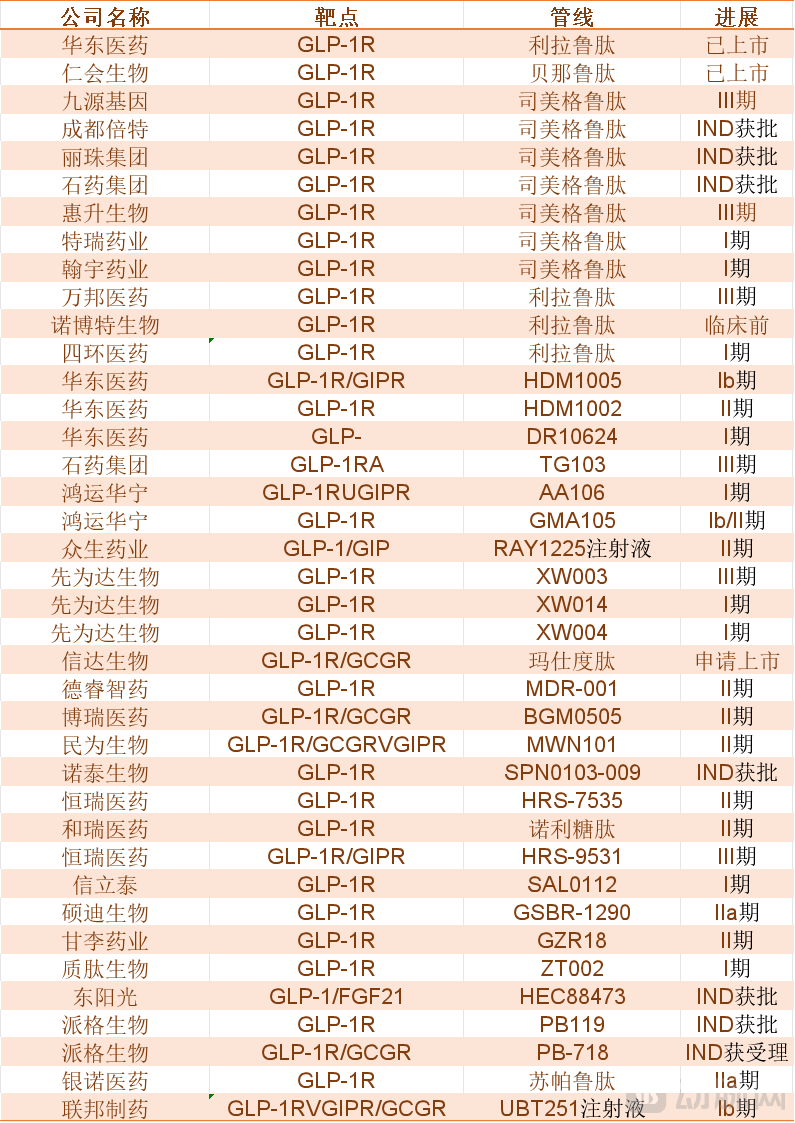
Progress in the Development of Domestic GLP-1 Weight Loss Drugs Data Source: Compiled by VCBeat from Public Data
Industry insiders predict that domestic GLP-1 weight-loss drugs will be launched in a concentrated wave between 2027 and 2030, making fierce market competition inevitable. Only a few leading pharmaceutical companies will be able to capture a share of this red ocean market. The development threshold for multi-target GLP-1 weight-loss drugs is higher, but they demonstrate superior efficacy and safety profiles, giving them a greater likelihood of gaining a competitive edge in the future. Consequently, the survival space for generic GLP-1 weight-loss drugs will be extremely limited.
It is precisely for this reason that the opportunities in the medical aesthetics market are particularly valuable to manufacturers of generic GLP-1 weight-loss drugs.In fact, medical aesthetic institutions are not inherently prohibited from offering GLP-1 weight-loss medications. Taking Feisumei® as an example, there are clear criteria for its use in weight management. Individuals with a BMI ≥28 kg/m², or those with a BMI ≥24 kg/m² accompanied by at least one weight-related comorbidity—such as hyperglycemia, hypertension, dyslipidemia, fatty liver disease, or obstructive sleep apnea syndrome—are considered eligible candidates for Feisumei®. In other words, a person who is 1.7 meters tall and weighs 70 kilograms meets the eligibility criteria for Feisumei®. Provided that pharmaceutical manufacturers strictly control the qualification requirements for medical aesthetic institutions, and these institutions rigorously manage their prescription processes in practice, most compliance risks can be avoided.
Whether it is Renhui Biopharma proactively offering its “Escort Plan” or Huadong Medicine’s deliberate avoidance, both reflect the cautious stance of GLP-1 drug manufacturers toward the medical aesthetics market. The immense consumer potential unleashed by this market undoubtedly warrants concerted efforts from all stakeholders to foster its healthy development.