

Amazon Web Services Launches Protein Folding Workbench: An End-to-End Cloud Platform for Accelerated Protein Structure Prediction with AlphaFold and Beyond

AWS
Cloud Computing Platform Provider
New drug development is a protracted and arduous endeavor, typically requiring more than 10 years. In this process, identifying drug targets and optimizing lead compounds are two critical and time-consuming stages that directly impact the progress of new drug development. Protein structural information is crucial to new drug development, as most drug targets are protein molecules. Understanding the three-dimensional structure of proteins helps elucidate their functions and predict interactions with small-molecule compounds, thereby guiding the design and optimization of drug molecules. In recent years, the emergence of new technologies such as the artificial intelligence algorithm AlphaFold has brought new hope to new drug development, with the potential to shorten the development cycle by 1–4 years. However, researchers still face numerous challenges when utilizing new technologies like AlphaFold:
● Cumbersome deployment and execution processes with long turnaround times
● Limited computational resource management and scalability
● Unable to achieve elastic scaling (operating in single-node mode)
● Complex homework submission environment, making it difficult to effectively manage access permissions for different personnel
● Lack of efficient solutions for results management and exception handling
To address these challenges, AWS has launched the Protein Folding Workbench solution, designed to simplify the use and deployment of models such as AlphaFold on the cloud, accelerate new drug development, and provide researchers with an efficient, secure, and scalable computing environment.
AWS offers flexible infrastructure services, encompassing over 800 compute instance types, a comprehensive suite of storage and data transfer tools, as well as high-performance computing platforms and application development layers. These capabilities empower customers to efficiently and securely conduct data processing, application development, and analytics, thereby enhancing operational efficiency and business agility. Building on this foundation, AWS has launched Protein Folding Workbench, an all-in-one cloud-based solution dedicated to protein structure prediction. Designed for ease of use, the platform enables one-click deployment without requiring specialized expertise, and provides end-to-end visualization of protein structures through an intuitive web interface, accelerating the drug discovery process. In addition to speeding up R&D, the solution features flexible project management capabilities and multi-dimensional control over costs and usage, facilitating more granular expense management. From a security perspective, it provides enterprise-grade user permission management, supports various enterprise authentication services, and leverages private networks to safeguard data privacy and ensure data security.
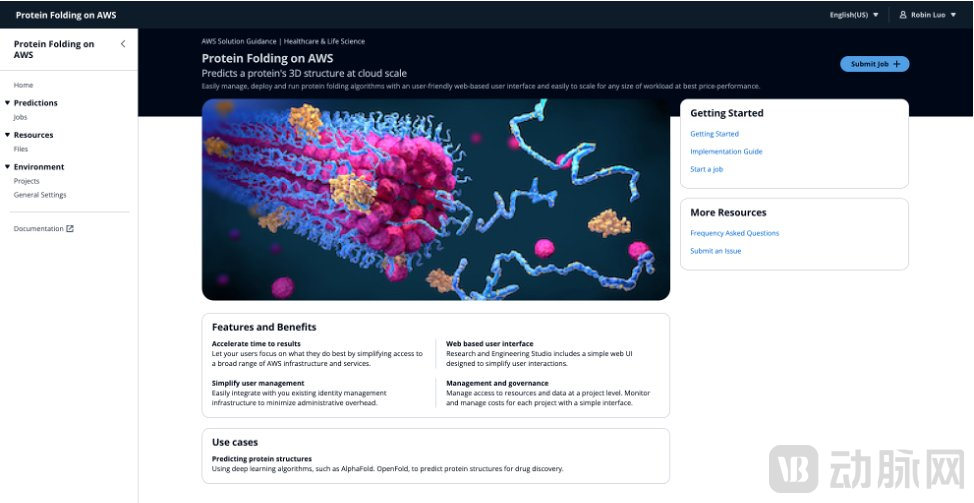
Below are the key features and advantages of the Protein Folding Workbench platform:
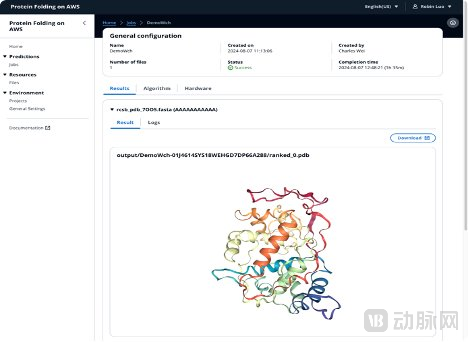
Task Management
Users can easily submit new jobs through a guided job creation wizard. The platform supports the import of single or batch sequence files and allows for customizable tag management, ensuring organized job handling. Input parameters can be uploaded as files, providing greater operational flexibility. Furthermore, the platform supports various GPU types, allowing users to select based on their needs. It also offers cost-optimized Spot Instance options to maximize savings. Upon job completion, users can not only view 3D visualization results online but also download the results and review logs to understand execution details.
Custom Algorithm
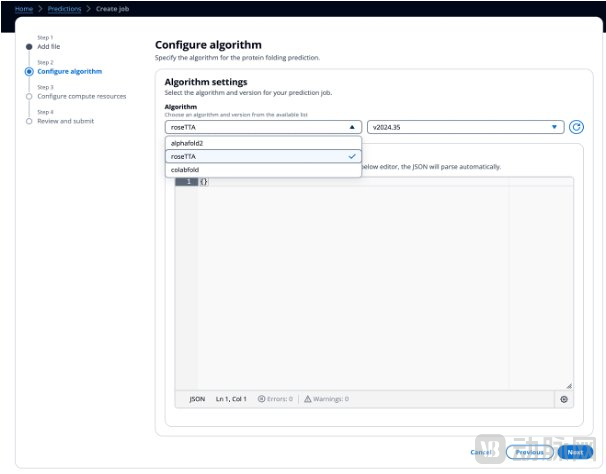
The platform not only comes with mainstream protein structure prediction algorithms, such as AlphaFold, RoseTTAFold, and ColabFold, but also supports user-defined algorithms. Users can package model algorithms into images and import them to the platform for execution according to their needs. This custom algorithm feature provides users with greater flexibility and autonomy. The platform also offers centralized management of protein sequence files, eliminating the need to use the AWS Management Console; users can directly upload files through the Protein Folding Workbench console, making the process both convenient and efficient. In addition, the solution supports metadata tagging, enabling more organized file management.
Project Management
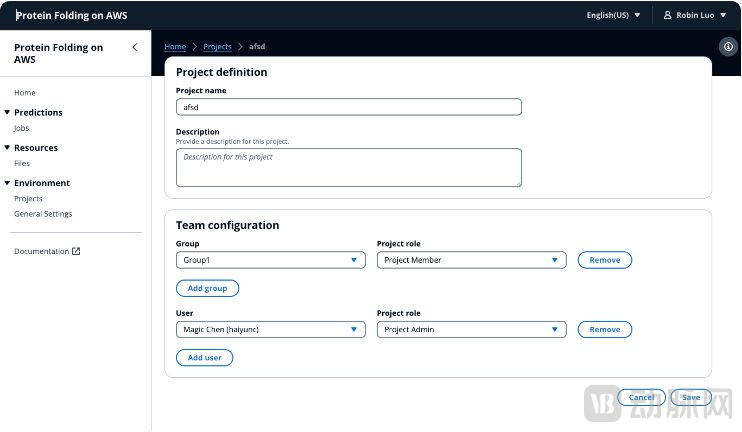
The platform features built-in project management capabilities, enabling users to easily assemble project teams, allocate computing resources, and implement granular control over team members’ access permissions. Additionally, the platform supports flexible configuration and integration with third-party systems, thereby enhancing collaborative efficiency. Whether it involves resource allocation, permission management, or external system integration, this project management functionality meets diverse user needs and ensures seamless, high-efficiency collaboration.
Cost Advantage
The platform adopts a pay-as-you-go model, allowing users to flexibly select instances of varying specifications based on their computational needs. Whether for short-term, small-scale tasks or large, long-term projects, the pricing remains highly affordable. For example, processing short amino acid sequences using a single V100 GPU for 46 minutes costs only RMB 18.59, while processing long amino acid sequences costs RMB 139.84, offering exceptional cost-effectiveness. Furthermore, the platform supports the separation of storage and computing, enabling near-zero-cost operation during idle periods. In summary, this pricing strategy allows users to consume resources on demand, reducing expenses while providing robust computational power, thereby doubling research efficiency with half the effort.
Case 1
A biotechnology company specializing in antibody R&D requires an in-depth understanding of protein three-dimensional structures to guide antibody design and development. By leveraging AWS’s Protein Folding Workbench platform, the company has significantly enhanced its antibody R&D efficiency. The platform’s advanced artificial intelligence algorithms enable accurate and efficient prediction of protein 3D structures, providing critical data support for antibody design. Based on the Protein Folding Workbench platform, the company can more rapidly identify antigenic epitopes on target proteins, thereby accelerating the development of high-affinity, high-specificity antibody products. According to a company representative, the introduction of this protein structure prediction platform will substantially shorten the antibody R&D cycle, reduce R&D costs, improve product quality, and further strengthen the company’s competitive advantage in the antibody field.
Case 2
A biotechnology startup focused on AI-driven drug discovery, the company employs an innovative model that integrates machine learning, bioinformatics, and chemical expertise to inject new momentum into pharmaceutical R&D. By deploying its proprietary artificial intelligence and machine learning algorithms on the Protein Folding Workbench platform, the company can accurately predict the three-dimensional structures of proteins. The Protein Folding Workbench platform accelerates the drug discovery and development process, providing critical support for target identification and molecular design. Notably, scientists can obtain reliable results using this cloud platform without needing to master relevant background knowledge. It also facilitates cross-departmental collaboration, boosting efficiency by 30%, while ensuring data security and intellectual property protection through private deployment.