

Dano Medicine Inks $1.07 Billion Exclusive Deal with Grand Pharmaceutical for Novel H. pylori Drug TNP-2198 Ahead of Hong Kong IPO

TenNor Therapeutics
Antibacterial New Drug R&D Developer
On November 28, 2024, according to the company’s official website, TenNor Therapeutics announced that it had entered into an exclusive commercial cooperation agreement with Grandlife Science Group regarding TNP-2198, a novel antibacterial drug for the treatment of Helicobacter pylori infection. TenNor Therapeutics has authorized Hangzhou Grand Biopharmaceutical Co., Ltd. (hereinafter referred to as “Hangzhou Grand”), a wholly-owned subsidiary of Grandlife Science Group, to serve as the exclusive commercial promotion service provider for TNP-2198 (rifoternidazole) in mainland China, Hong Kong SAR, and Macao SAR.
Pursuant to the collaboration agreement, Hangzhou Yuanda will pay TenNor Therapeutics an upfront payment, commercialization milestone payments, and sales milestone payments (with tiered sales milestones based on different levels of sales revenue), with the total aggregate payment amount not exceeding RMB 775 million. TenNor Therapeutics, as the Marketing Authorization Holder, will be responsible for the subsequent clinical development and regulatory registration for market approval of TNP-2198, while also paying Hangzhou Yuanda marketing and promotion service fees.
According to the official statement, TenNor Therapeutics will leverage Yida Life Science Group’s strong marketing capabilities in gastrointestinal management to achieve win-win cooperation, accelerate the commercialization of TNP-2198, and benefit more patients infected with Helicobacter pylori. Yida Life stated that this collaboration will further enrich its innovative product pipeline, strengthen its industrial layout and leading brand position in the field of gastrointestinal management, and better meet clinical needs.
Poised to Become the World’s First in 30 Years
Helicobacter pylori is a major pathogen responsible for chronic gastritis, peptic ulcers, and gastric cancer. In China, the infection rate among adults is as high as 50%, with over 340,000 new cases of gastric cancer attributed to H. pylori infection annually, accounting for 40% of global gastric cancer deaths. Both the White Paper on Helicobacter pylori Prevention and Control, first released by the Chinese Center for Disease Control and Prevention in 2023, and the Sixth Chinese Expert Consensus Report on the Diagnosis and Treatment of Helicobacter pylori Infection (2022), recommend the “screen-and-treat” strategy for H. pylori as a primary prevention measure against gastric cancer.
The growing problem of antibiotic resistance in Helicobacter pylori eradication drugs has led to a gradual decline in eradication rates in clinical practice. Currently, the bismuth-containing quadruple therapy recommended by the Sixth National Consensus Report on the Management of Helicobacter pylori Infection requires individualized treatment and fails to meet the needs for large-scale population eradication, becoming a major bottleneck in implementing H. pylori screening-and-eradication strategies. There is an urgent need in the H. pylori treatment market to develop first-line therapies that are safe, effective, convenient, capable of effectively overcoming drug resistance, and seamlessly integrated with urea breath test diagnostics.
TenNor Therapeutics’ TNP-2198 was developed against this backdrop. TNP-2198 is a novel drug candidate with a unique multi-target synergistic mechanism of action against microaerophilic and anaerobic bacteria,Poised to Become the First New Drug Developed Globally for Helicobacter pylori Infection in Over 30 Years, to address the need for implementing Helicobacter pylori screening-and-eradication and gastric cancer prevention strategies in regions with a high incidence of gastric cancer.
TNP-2198 offers advantages in overcoming antibiotic resistance, reducing the frequency of resistance development, and demonstrating efficacy against slow-metabolizing coccoid forms. It holds promise for providing a standardized eradication regimen that is safer, more effective, and simpler, while seamlessly integrating with the most commonly used urea breath test for diagnosis. This approach makes it feasible to implement Helicobacter pylori screening and eradication programs in populations at high risk for gastric cancer, thereby enabling gastric cancer prevention.
It is reported that seven Phase I to III clinical trials of TNP-2198 have been completed, yielding positive results. Currently, TNP-2198 has obtained Investigational New Drug (IND) approval in the United States, as well as Qualified Infectious Disease Product (QIDP) designation and Fast Track designation from the U.S. FDA.
On November 18, 2024, TenNor Therapeutics announced that TNP-2198, its global first-in-class novel drug for the treatment of Helicobacter pylori infection, had successfully completed Phase III clinical trials and met the pre-specified primary endpoints, demonstrating multiple advantages over bismuth-containing quadruple therapy. This was a multicenter, randomized, double-blind, Phase III clinical trial with bismuth-containing quadruple therapy as the control, designed to evaluate the efficacy and safety of the triple regimen comprising TNP-2198, amoxicillin, and rabeprazole for H. pylori eradication in treatment-naïve patients.
This study, led by Professor Zhou Liya of Peking University Third Hospital, was conducted across 40 hospitals nationwide. A total of 700 patients with Helicobacter pylori infection, who had not previously received eradication therapy, tested positive on the carbon-13 urea breath test (UBT), and had histologically confirmed infection, were enrolled. Patients were randomly assigned in a 1:1 ratio to receive either the TNP-2198 triple therapy (experimental group) or bismuth-containing quadruple therapy (control group), administered twice daily for 14 consecutive days. The primary efficacy endpoint was the UBT result obtained 4–6 weeks after completion of treatment.
In Phase III clinical trials, the resistance rates among infected patients to clarithromycin, metronidazole, levofloxacin, and amoxicillin reached 41%, 68%, 35%, and 8%, respectively, consistent with recent literature reports, indicating a serious problem of antibiotic resistance in Helicobacter pylori-infected individuals in China.
The primary population for efficacy analysis was the modified intent-to-treat (mITT) set, defined as infected participants who received at least one dose of the investigational medicinal product after randomization. In the mITT population, the *Helicobacter pylori* eradication rate with the TNP-2198 triple therapy regimen exceeded 90%, which was higher than that of the bismuth-containing quadruple therapy control (92.0% vs. 87.9%; difference, 4.1%; P<0.0001 for non-inferiority; P=0.0338 for superiority).
In the per-protocol (PP) population, i.e., infected patients without major protocol deviations affecting efficacy analysis, the eradication rate of the TNP-2198 triple therapy was also higher than that of bismuth quadruple therapy (93.7% vs. 90.3%; difference, 3.4%; non-inferiority test P<0.0001; superiority test P=0.0563).
In the microbiological intent-to-treat (Micro-ITT) population, defined as patients with baseline Helicobacter pylori culture positivity and available antimicrobial susceptibility testing results, subgroup analyses based on resistance to any of the five antibiotics currently used for H. pylori eradication demonstrated that the TNP-2198 triple therapy regimen achieved an H. pylori eradication rate exceeding 90%. This rate was consistently higher than that of the bismuth-containing quadruple therapy and aligned with the results observed in the primary analysis population, indicating that the TNP-2198 triple therapy regimen exhibits robust eradication efficacy against resistant infections.
Furthermore, the incidence of treatment-emergent adverse events (TEAEs), investigational medicinal product (IMP)-related TEAEs, and Grade 3 or higher TEAEs in the TNP-2198 triple therapy group was lower than that in the bismuth quadruple therapy group. Most events were Grade 1, and no serious adverse events (SAEs) related to the IMP occurred, indicating that the TNP-2198 triple therapy regimen has a favorable safety and tolerability profile.
The challenge in Helicobacter pylori eradication lies in antibiotic resistance. In recent years, improving acid suppression—particularly through the use of potassium-competitive acid blockers (P-CABs)—has helped enhance the eradication efficacy of bismuth-containing quadruple therapy, but it has not fundamentally addressed the increasingly severe problem of antibiotic resistance. As the first novel antibacterial agent with a unique mechanism of action, TNP-2198 has demonstrated positive results in Phase III clinical trials. The TNP-2198-based triple regimen achieved eradication rates exceeding 90% in both antibiotic-susceptible and antibiotic-resistant populations, offering a completely new solution for H. pylori eradication.
Currently,TenNor Therapeutics possesses a unique multi-target conjugate molecule technology platform,It serves as a significant source for its new pipeline. This technology platform comprises three components: the design, synthesis, and evaluation of multi-target conjugated molecules. Its core technology lies in the evaluation and testing system for conjugated molecules, which efficiently generates critical data during the drug discovery process to guide the design, synthesis, and optimization of these molecules, ensuring that drug candidates exhibit balanced multi-target activity and synergistic pharmacological effects. TenNor Therapeutics’ proprietary target indication-oriented isogenic resistant strain technology rapidly provides key technical information on conjugated molecules, validating whether the designed molecules possess multi-target activity, exhibit balanced activity against different targets, and demonstrate multi-target synergy.
Leveraging its multi-targeted conjugate molecule technology platform, TenNor Therapeutics has advanced multiple products into late-stage clinical trials, targeting common and serious conditions such as Helicobacter pylori infection, implantable medical device-associated infections, hepatic encephalopathy in liver cirrhosis, and diarrhea-predominant irritable bowel syndrome.
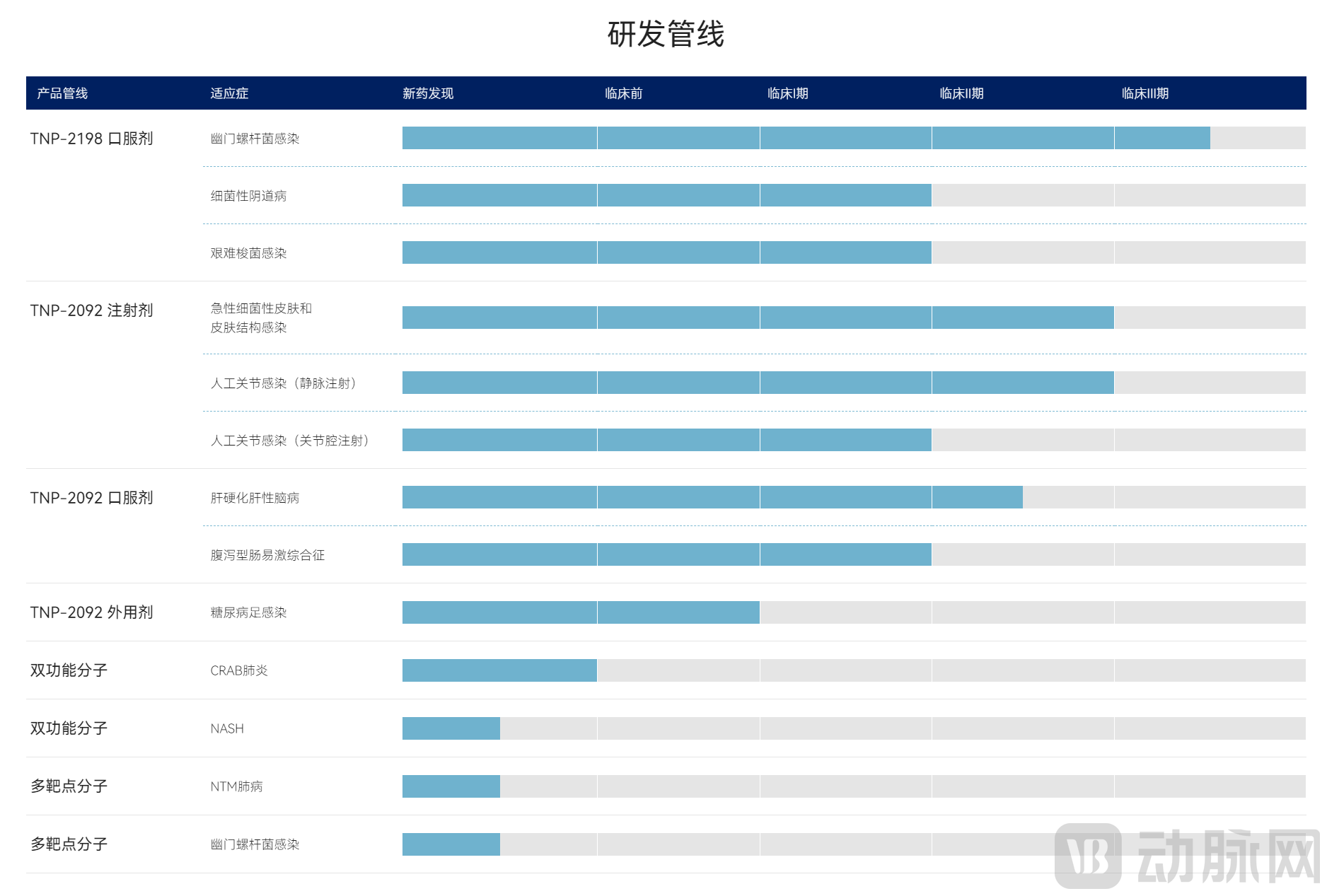
TenNor Therapeutics Pipeline
Grandpharma Group Consolidates Its Leading Position
Hangzhou Grand, an affiliate of the “Grand Pharmaceutical Group,” is the purchaser of TNP-2198. Established in December 2004 with a registered capital of RMB 40 million and covering an area of 11.2 mu, the company joined China Grand Enterprises Inc. in 2013, becoming its wholly-owned subsidiary.
Hangzhou Yuanda leverages live biotherapeutic products and macromolecular drugs as its dual engines, committed to developing high-quality biologics that benefit a broader patient population. With the goal of becoming a leader in the field of live biotherapeutics, the company is actively advancing the development of a pipeline of novel live biotherapeutic drugs. Meanwhile, it continues to build a portfolio of blockbuster candidates through systematic clinical evidence generation and multidimensional studies on efficacy and mechanisms of action.
Currently, Hangzhou Yuanda has two live bacterial drug products on the market. Its flagship product, "Bifidobacterium Tetraviable Tablets," is a new microbiome-based therapeutic agent with independent invention patents. It has been included in the 2019 National Reimbursement Drug List, ranks among the top in domestic annual sales, and enjoys a strong reputation among patients. Hangzhou Yuanda continues to increase its R&D investment, which accounts for more than 10% of its sales revenue.
In addition, the Company has one Class 1 large-molecule novel drug that has received clinical trial approval and is currently undergoing clinical studies, one large-molecule novel drug pending clinical trial application, and multiple innovative live biotherapeutic products with novel functions as well as genetically engineered live biotherapeutic products at various stages of research and development.
Hangzhou Yuanda has set “striving to be a leader at every stage of development” as its corporate goal, which explains why it took an interest in TenNor Therapeutics’ “first-in-class innovation in 30 years.” Furthermore, Hangzhou Yuanda has established a product R&D team covering the entire drug development chain, possessing integrated R&D capabilities essential for product development, including live bacterial strain screening, functional evaluation, process development, formulation research, quality research, manufacturing, and clinical studies. This collaboration is expected to further advance the commercialization of TNP-2198.
It is worth noting that Grand Life Sciences Group, to which Hangzhou Grand belongs, was established through multiple rounds of restructuring and reorganization after China Grand Enterprises Group fully acquired Sichuan Shuyang Pharmaceutical in 2001, with a particular focus on differentiated potential pipelines. Considering that TNP-2198, once approved for marketing, will become the first new antibacterial drug approved globally in over 30 years specifically for Helicobacter pylori infection, the acquisition of TNP-2198 aligns well with Grand’s strategy to consolidate its “industry-leading position in multiple fields, including blood products, live biotherapeutic products, perioperative hemostasis, and vaccines.”