

Saying No to 'Bottleneck' Challenges: Frontline Experts Share In-Depth Practical Insights on Transdermal Drug Delivery Systems
Imagine a medication that eliminates the cumbersome steps of oral administration and spares patients the pain of injections. With just a simple patch or topical application, it provides sustained drug release, offering a painless, non-invasive, side-effect-free, and convenient therapeutic experience. This is the allure of transdermal formulations, which are redefining the future of drug delivery.
Currently, transdermal formulations are already available for refractory conditions such as Alzheimer’s disease and Parkinson’s disease. Meanwhile, novel topical transdermal delivery approaches for refractory systemic lupus erythematosus and cancer are under active development. For instance, a research team at Northwest A&F University has reviewed advances in natural polymer-based transdermal drug delivery systems for cancer treatment, highlighting the broad prospects of this technology in the field of local tumor therapy.
The convenience of transdermal formulations not only greatly simplifies the treatment process, making medical care more humanized and patient-centered, but also opens up new market opportunities for pharmaceutical companies. However, this innovative drug delivery method, characterized by complex manufacturing processes, high R&D difficulty, and significant technical barriers, has introduced numerous new challenges in both laboratory research and practical production operations:
1. How to Perform and Assess Intradermal Retention and Tissue Distribution?
2. What data support is required for formulations that are not suitable for subcutaneous administration?
3. How many skin donors' reference and individual data are required to calculate transdermal equivalence using SAS software?
4. In the absence of restrictions on dosage, how is the optimal drug dosage determined?
5. How to avoid the backflow phenomenon?
6. How to reduce air bubbles during the production and preparation of gel patches?
7. How to control the basis weight when the cross-linking strength of the gel plaster increases with prolonged coating time during the coating process?
8. How to select the optimal control temperature for hot-melt coating? How to adjust the coating weight?
......
These common challenges have long plagued frontline R&D and production personnel at transdermal drug formulation companies in China.
As most domestic companies are still navigating the generic drug phase, rapidly closing the gap with international leaders and developing transdermal formulations with local characteristics has become a major challenge.
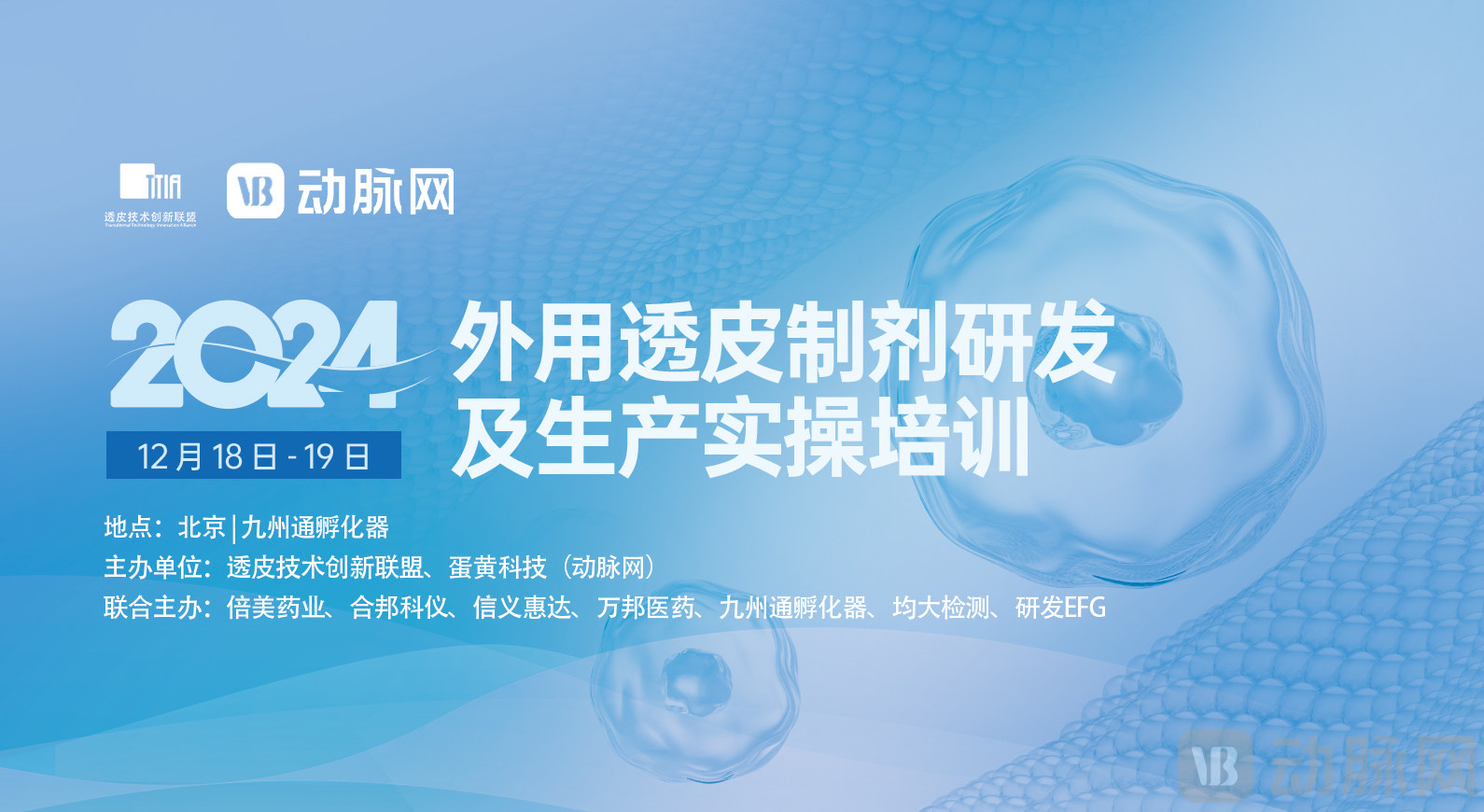
Driven by the urgent need to address common practical challenges, the Transdermal Technology Innovation Alliance, in partnership with VCBeat (Eggshell Tech), Beimei Pharmaceutical, Hebang Scientific Instruments, Xinyi Huida, Wanbang Pharmaceutical, Jointown Incubator, Junda Testing, and R&D EFG, will host the “2024 Practical Training on R&D and Manufacturing of Topical Transdermal Preparations” in Beijing on December 18–19. This training program will feature experts with extensive hands-on experience and in-depth understanding across all segments of the transdermal preparation industry chain, offering targeted instruction to address key difficulties and pain points in the practical aspects of research, development, and production.
What Benefits Does This Training Offer?
This training program features hands-on practical sessions focused on two key areas: laboratory and production. Participants will engage in in-depth operational training on R&D and production-related instruments and equipment, including semi-solid IVRT and IVPT testing, patch IVRT and IVPT testing, IVPT skin integrity assessment, large-scale production using gel patch equipment, and large-scale production using hot-melt adhesive patch equipment.
Inviting experts in the field of transdermal drug delivery systems withRich Practical Experience and Profound Understanding of Expert Instructors, as well as companies specializing in cutting-edge instruments and equipment for research and development and production processes,Addressing the Challenges and Pain Points in the Practical Aspects of R&D and Production, refine the key points for quality evaluation, including methodology validation, critical quality attributes, selection of raw materials, excipients, and solvents during development, and manufacturing processes.
Assist the R&D team in project initiation, formulation development, and process design, while fully considering potential issues that may arise during the R&D and production phases of the product, as well as specific manufacturing processes. Help R&D and quality personnel improve and optimize equipment, and reasonably layout production lines to achieve efficient large-scale production, furtherReduce production costs and accelerate the rapid commercialization of the pipeline.。
Training Outline
Topic 1: Clinical Development Strategy for Generic Topical Patch Products
Section 1: Basic Introduction to Topical Patches
Section 2: Regulatory Basis for the Clinical Development of Topical Patches
Section 3: Clinical Development Strategies for Topical Patches
Section 4: Key Considerations for PKBE of Topical Patches
Section 5: Key Considerations for Clinical Endpoint Bioequivalence Studies of Topical Patches
Topic 2: Breakthrough New Technologies in Clinical Trials of Topical Transdermal Preparations—OFM Microdialysis
Section 1: Introduction to the Principles of OFM Microdialysis Technology
Section 2: An OFM Application Case – Bioequivalence Evaluation of Acyclovir Cream in Dermal Interstitial Fluid
Section 3: Characteristics and Development Prospects of OFM Microdialysis
Topic 3: IVPT Data Requirements and Processing & SAS Software Practical Demonstration
Section 1: Introduction to SAS Software
1.1 Introduction to SAS
1.2 Introduction to SAS Software and Component DEMO
Section 2: IVPT Data Requirements
2.1 Integrity Requirements
2.2 Accuracy Requirements
2.3 Repeatability Requirements
2.4 Standardization
Section 3: Statistical Analysis and Calculation of IVPT Data
3.1 IVPT Endpoint—AMT Calculation
3.2 IVPT Endpoint—Jmax Calculation
3.3 Calculation of Drug Retention (ar) in the Skin (or Permeation Barrier)
3.4 Statistical Analysis Demonstration Using SAS Software
Topic 4: Discussion on the CDE Guidelines for In Vitro Release Testing (IVRT) and In Vitro Permeation Testing (IVPT) of Transdermal Drug Delivery Systems
Section 1: Summary of Differences Between IVRT and IVPT Based on USP <1724>, FDA Guidance, and NMPA CDE Guidelines
1.1 Skin Model Requirements
1.2 Skin Processing and Preservation
1.3 Experimental Design
1.4 Experimental Conditions
Section 2: Causes of IVRT/IVPT Failure and Solutions
2.1 Causes of IVRT Failure and Solutions
(1) Formulation Factors
(2) Factors Related to Release Media
(3) Experimental Apparatus Factors
2.2 Causes of IVPT Failure and Solutions
(1) Skin Barrier Factors
(2) Formulation-Skin Interaction Factors
(3) Experimental Setup Factors
Section 3: Analysis of Reasons for Deficiency Letters Regarding IVRT and IVPT in Submission Dossiers
3.1 Analysis of Reasons for Requests for Supplemental Information in IVRT/IVPT Submissions
(1) Reasons Related to Trial Design
(2) Causes Related to Trial Conditions
(3) Causes Related to Data Recording and Processing
(4) Reasons Related to Method Validation
(5) Reasons Related to In Vitro-In Vivo Correlation
3.2 Case Analysis of IVPT Deficiency Letters
Topic 5: Key Points in the Development and Manufacturing of Transdermal Patches
Section 1: A Historical Review of Transdermal Drug Delivery
Section 2: Development History of Transdermal Patches
Section 3: Classification of Transdermal Patches and Plasters
3.1 Acrylate Pressure-Sensitive Adhesives
3.2 Hydrogel Pressure-Sensitive Adhesives
3.3 Hot-Melt Pressure-Sensitive Adhesives
Section 4: Key Points in the Development of Transdermal Patches
Section 5: Advantages and Limitations of Transdermal Patches
Section 6: Transdermal Drug Delivery—Key Excipients in Transdermal Patches
6.1 Synthesis of Acrylate Pressure-Sensitive Adhesives
6.2 Hot-melt Pressure-sensitive Adhesive Excipients
6.3 Hydrogel Matrix Excipients
Section 7: Equipment Required for the Transition of Plasters and Patches from Laboratory to Production
7.1 Uniform Material Mixing Achieved by Variable-Cross-Section Vertical Kneading Mixer
7.2 Classification of Delivery Devices for Patches and Plasters
7.3 Transition of Plaster Patches from Laboratory-Scale to Production-Scale Coating Machines
7.4 A Three-Step Approach to Addressing Pain Points in the Production of Plaster Patches
Section 8 Requirements for Rational Transdermal Patches
Section 9: What Bottleneck Issues Do Plaster Patches Face?
Topic 6: Practical Training
Part 1: IVRT and IVPT Testing (Semi-solids/Patches) and Skin Integrity Assessment for IVPT
1. Instrument Operation
2. Skin Incubation
3. IVRT Experimental Procedure
4. Skin Integrity Test
5. IVPT Experimental Procedures
6. Post-experiment skin integrity test and recovery rate test
7. Experimental Precautions (e.g., sample leakage; inspection of samples and membranes/skins for abnormalities before and after the experiment; presence of backflow; abnormal sampling volume, etc.)
Part 2: Demonstration of Large-Scale Production Equipment for Gel Patches
Part 3: Demonstration of Large-Scale Production Equipment for Hot-Melt Adhesive Patches
More training outlines are being continuously updated......
Speaker

Ph.D. in Biopharmaceuticals, Founder of Beijing Beimei Pharmaceutical Co., Ltd., and Co-founder of Beijing Mingze Zhonghe Drug Research Co., Ltd.; has been engaged in drug R&D, registration, and industrialization since graduation; began focusing on the field of transdermal drug delivery in 2013, completed the registration and industrialization construction of multiple products, actively promoted cooperation with domestic chemical enterprises, and completed the filing work for domestically produced excipients for transdermal drugs.

Master’s degree from Anhui University of Chinese Medicine. Currently serves as the Company’s Deputy General Manager and Head of the Clinical Research Center, responsible for undertaking and conducting clinical trial service projects. To date, has led or participated in more than 1,000 clinical studies, covering generic drugs, innovative drugs, and medical devices, with hands-on experience in over 100 clinical trials involving topical transdermal formulations. Also appointed as the First-Term Member of the Clinical Trials Professional Committee of the Anhui Pharmacological Society, the Second-Term Member of the Drug Clinical Trials Professional Committee of the Anhui Pharmaceutical Association, and the First-Term Member of the Youth Committee on Innovative Technology Research in Drug Clinical Trials under the Zhongguancun Jiutai Drug Clinical Trial Technology Innovation Alliance.

Founder & General Manager, Beijing Hebang Xingye Scientific Instrument Co., Ltd.; Jointly trained graduate student of Jiangxi University of Chinese Medicine and Tsinghua University, majoring in Pharmaceutical Analysis; Author of 15 papers published in SCI-indexed and core journals; Principal investigator or key participant in more than ten national and industry-sponsored projects, including one project contributing to the National Pharmacopoeia standards and one to the cosmetic industry standards; Associate Translator of "Transdermal Drug Delivery Systems: From Innovation to Production"; Accumulated 12 years of work experience at world-renowned analytical instrument companies such as Thermo Fisher Scientific and Agilent Technologies (both Fortune Global 500 companies); Committee Member of the Pharmaceutical Analysis Professional Committee of the Chinese Association of Biotechnology for Medicine; Proficient in various analytical instruments and methods used in the pharmaceutical industry; Co-founder of the China Transdermal Technology Alliance, with extensive experience in the field of transdermal formulations.

Jointly trained by Jiangxi University of Chinese Medicine and Beijing Jiangzhong Institute of Pharmaceutical Research. With over ten years of experience in pharmaceutical analysis, possesses in-depth understanding and extensive project experience in in vitro dissolution and release, in vitro permeation, in vivo pharmacokinetics, and bioanalytical testing.

Council Member of the China Association of Ethnic Medicine, and Council Member of the Transdermal Drug Delivery Professional Committee of the World Federation of Chinese Medicine Societies.
Has been engaged in the field of hot-melt adhesive coating since 1996; participated in the development of China’s first hydrogel coating machine in 2001, and has accumulated extensive experience from laboratory to production stages for solvent-based, hot-melt, and gel-type transdermal drug delivery systems. Possesses unique insights into equipment selection and application for transdermal patch manufacturing.
Training Schedule
Opening Remarks
09:05-11:05
Clinical Development Strategy for Generic Topical Patch Products
Zhou Yan, Deputy General Manager, Anhui Wanbang
11:05-11:15
Tea Break
11:15-12:15
Breakthrough New Technology in Clinical Trials of Topical Transdermal Preparations—OFM Microdialysis
Tang Hongmin, General Manager, Hebang Keyi
12:30-13:30
Lunch
13:30-15:00
Overview of the Discussion on CDE Guidelines for In Vitro Release Testing (IVRT) of Transdermal Drug Delivery Systems and Experimental Procedures
Feng Ruini, Hebang Keyi
15:00-15:15
Tea Break
15:15-16:45
Discussion of CDE Guidelines on IVPT for Transdermal Drug Delivery Systems and Overview of Experimental Procedures
Feng Ruini, Hebang Keyi
17:00-18:30
Group Practical Session 1
Hands-on Training for Laboratory Instruments
Part 1: IVRT and IVPT Instrument Operation (Semi-solids/Patches)
Part 2:IVPT Skin Integrity Testing
Practical Production Training
Part 1: Demonstration of Large-Scale Production Equipment for Gel Patches
Part 2: Demonstration of Large-Scale Production Equipment for Hot-Melt Adhesive Patches
18:30-21:00
Dinner Networking & Q&A Session
IVPT Data Requirements and Processing & SAS Software Practical Demonstration
Feng Ruini,SAS China & Hebang Scientific Instruments
Tea Break
10:45-12:15
Key Points in the Development and Manufacturing of Transdermal Patches
Lin Weihua, Xinyi Huida, Manager
12:30-13:30
Lunch
13:30-16:30
Hands-on Session 2+3 in Groups
Hands-on Training for Laboratory Instruments
Part 1: In Vitro Release Testing (IVRT) and In Vitro Permeation Testing (IVPT) for Semi-Solids and Transdermal Patches
Part 2:IVPT Skin Integrity Test
Practical Production Training
Part 1: Demonstration of Large-Scale Production Equipment for Gel Patches
Part 2: Demonstration of Large-Scale Production Equipment for Hot-Melt Adhesive Patches
Training Overview
Training Name:2024 Practical Training on R&D and Production of Topical Transdermal Preparations
Training Time:December 18-19, 2024
Training Venue:Beijing | Jointown Incubator (No. 8 Hangfeng Road, Fengtai District, Beijing)
Host Organization:Transdermal Technology Innovation Alliance, Eggshell Tech (VCBeat)
Co-organized by: Beimei Pharmaceutical, Hebang Scientific Instruments, Xinyi Huida, Wanbang Pharma, Jointown Incubator, Junda Testing, R&D EFG (continuously updated)
Training Fees and Registration
Training Fees:
1. Individual Fee: 3,499 CNY/person
2. Group Rate: RMB 2,200 per person for the third participant and onwards
3. Preferential Policies (Choose One of Two):
(1)Alliance Members(Individuals/organizations that have paid to participate in alliance activities):¥500 off
(2)Early Bird Price: CNY 3,199 per person (payment before November 30)
Registration Contact:Ms. Li 18600925630

Complete the registration form to secure your limited spot.

Teacher Li
Phone/WeChat: 18600925630