

GE HealthCare to Acquire Full Control of Japanese Radiopharmaceutical Leader Nihon Medi-Physics in $1.45 Billion Deal

General Electric
A diversified service company providing global infrastructure and financial services

Sumitomo Chemical
Chemical Pharmaceutical Manufacturer

Nihon Med-Physics
Radiopharmaceuticals and Diagnostic Reagents R&D Manufacturer
On December 2, GE HealthCare (NASDAQ: GEHC) announced the acquisition of the remaining 50% stake in Nihon Medi-Physics (NMP) from Sumitomo Chemical, thereby securing full ownership of the Japanese radiopharmaceutical company. According to Sumitomo Chemical’s announcement,The transaction is expected to increase its operating revenue by approximately JPY 30 billion (approximately RMB 1.455 billion).。
As part of GE HealthCare, Nihon Medi-Physics (NMP) can leverage its expertise in developing and manufacturing proprietary and licensed radiopharmaceuticals for single-photon emission computed tomography (SPECT) and positron emission tomography (PET) molecular imaging procedures to detect and diagnose diseases. This acquisition positions NMP as the preferred partner for global innovators, helping other international innovative enterprises introduce novel radiopharmaceuticals to the Japanese and other Asian markets. Sumitomo Chemical and GE HealthCare expect the agreement to be completed in early 2025, subject to regulatory approval.
Annual Revenue Exceeds 1.3 Billion
NMP was established in 1973 and is headquartered in Tokyo, Japan. It was initially founded as a joint venture between the British life sciences company Amersham and Sumitomo Chemical. In 2004, GE Healthcare acquired Amersham, thereby obtaining a 50% stake in NMP and securing three seats on its board of directors.
NMP’s core business activities encompass the research, production, sales, procurement, and import/export of radiopharmaceuticals, radioactive medical devices, and related products. Its product portfolio is divided into two major sectors: diagnostic applications (SPECT and PET) and therapeutic applications (radioactive medical devices and radiopharmaceuticals).
Japan maintains extremely stringent regulations on radiopharmaceuticals. NMP is one of only two licensed radiopharmaceutical companies in the country, the other being PD Radio Pharma. Unlike other enterprises that operate on a nuclear pharmacy model, NMP directly holds multiple radiopharmaceutical approvals, capturing 70% of the total market share in Japan. Its market share stands at approximately 60% for SPECT diagnostic agents and nearly 100% for PET diagnostic agents. Financial reports indicate that NMP’s revenue for the fiscal year 2023 was JPY 28.2 billion (approximately RMB 1.333 billion).
NMP’s product portfolio includes GE Healthcare radiopharmaceuticals for clinical imaging in neurology, cardiology, and oncology, such as VIZAMYL® Injection (Flutemetamol (18F) Injection), an amyloid visualization radioactive tracer for the Alzheimer’s disease pathway; DaTSCAN® Injection (Ioflupane (¹²³I) Injection), used to evaluate patients with suspected Parkinson’s disease or dementia with Lewy bodies; and MYOVIEW® (Technetium (99mTc) Tetrofosmin), used for SPECT myocardial perfusion imaging in the evaluation of known or suspected coronary artery disease.
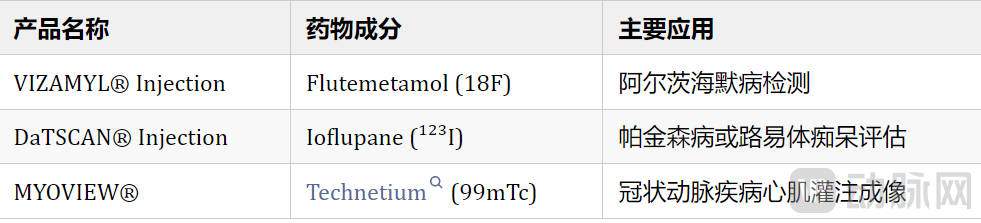 NMP Representative Products. Image source: Aiteyun AI
Currently, NMP operates two SPECT diagnostic radiopharmaceutical production sites and ten PET diagnostic radiopharmaceutical production sites in Japan, serving nearly 1,200 hospitals. Meanwhile, NMP is also focused on the research and development of radioactive tracers and theranostics, with multiple R&D pipelines having entered clinical development stages globally.
It is worth noting that NMP and Dongcheng Pharmaceutical, a leading Chinese radiopharmaceutical company, signed a memorandum of understanding as early as 2019, reaching a strategic cooperation intention on the research and development, registration, and production technology operations of relevant single-photon and positron radiopharmaceuticals, as well as therapeutic radiopharmaceuticals, in the Chinese market.
GE: Building a “Nuclear Medicine” Moat
Building on a century of accumulated expertise in molecular imaging, GE Healthcare has been deeply committed to technological innovation in nuclear medicine, contributing multiple “firsts” to the field of radiopharmaceuticals: the world’s first cyclotron; the first use of PET tracers for color imaging of amyloid in the brain to assess Alzheimer’s disease (AD); and the first SPECT tracer approved in Europe and the United States for detecting dopaminergic neuronal loss in the brain associated with parkinsonian syndromes and dementia.
Starting with the unveiling of its latest molecular imaging product, the Nuclear Solutions suite, along with a series of new advancements in radiotracers and other diagnostic imaging agents at the Society of Nuclear Medicine and Molecular Imaging (SNMMI) 2021 Annual Meeting, GE Healthcare has officially accelerated its strategic expansion into nuclear medicine, aiming to establish a robust competitive moat in this field.
In March 2021, GE Healthcare launched the StarGuide, a next-generation SPECT/CT system. This system leverages cutting-edge digital technology to help clinicians improve therapeutic outcomes in orthopedic surgery, cardiology, neurology, oncology, and other medical specialties. Its advanced 12-CZT digital focal-plane detector not only enables 3D patient scanning but is also optimized for targeted radionuclide therapy procedures—allowing simultaneous multi-tracer imaging in a single scan, thereby integrating therapy with diagnosis to monitor disease progression.
Subsequently, GE Healthcare announced the acquisition of Zionexa, a leading innovator in in vivo oncology and neurology biomarkers, to develop and commercialize Zionexa’s in vivo biomarkers and to advance the market launch of Cerianna (fluoroestradiol F-18), its FDA-approved PET imaging agent. Cerianna is used to detect estrogen receptor-positive lesions as an adjunct to biopsy in patients with recurrent or metastatic breast cancer.
In this acquisition of NMP, Kevin O’Neill, President and CEO of GE Healthcare’s Pharmaceutical Diagnostics (PDx) division, pointed out that Japan is the world’s third-largest pharmaceutical market and one of the countries with the leading number of cyclotrons, positioning it on the path to becoming a leader in the $7 billion global molecular imaging market.
At this year’s China International Import Expo (CIIE), GE HealthCare and Novartis signed a strategic cooperation memorandum. Both parties will focus on the fields of radioligand imaging and radioligand therapy, jointly establishing and promoting integrated diagnosis and treatment centers that meet “gold standard” criteria. Furthermore, they will explore and develop innovative therapies in nuclear medicine, working together to build a precision medicine ecosystem in nuclear medicine that integrates molecular imaging with radioligand therapy.
GE Healthcare is currently the only company in the industry with a complete product portfolio for nuclear medicine molecular imaging. Its representative devices (or systems) that have been launched include the following:
Based on groundbreaking Alcyone technology, this is a nuclear medicine system specifically designed by GE for cardiac imaging. It employs key innovative technologies such as CZT detectors and multi-pinhole collimators to directly convert gamma rays into digital signals, enhance resolution, and create a focused field of view on the heart. This enables high-quality cardiac image acquisition with scan times as short as three minutes, while offering the flexibility to reduce radiation dose, accelerate acquisition speed, or improve statistical data, thereby providing clinicians with more accurate information on cardiac function.
Launched in 2021, the new generation of dedicated cardiac nuclear medicine scanners features expanded field-of-view processing and new automated workflow capabilities. Leveraging GE Healthcare’s exclusive Alcyone technology and CZT module design, it offers a wider table and a 76% increase in field-of-view volume, enabling clinicians to position patients more flexibly, including those who are frail or have a high body mass index. The system also incorporates intelligent positioning workflows and device-free Alcyone motion detection and correction, generating high-quality images free of motion artifacts. Furthermore, it integrates dynamic acquisition with coronary flow reserve and absolute myocardial blood flow measurements, providing clinicians with more comprehensive and accurate information on cardiac anatomy and pathology to help determine the appropriate treatment plan for patients.
At this year’s China International Import Expo (CIIE), the leading nuclear medicine molecular imaging equipment made its global debut as the centerpiece of a new integrated ecosystem solution for Alzheimer’s disease. Leveraging GE Healthcare’s proprietary technology, the system enables a one-click amyloid-beta (Aβ) plaque imaging workflow. By administering a radiopharmaceutical diagnostic agent and performing PET/CT brain scans, the system automatically compares cerebral lesion data against an built-in standardized database. It then generates intuitive reports through one-click intelligent analysis, enabling the detection of potential pathological changes 10–15 years in advance and providing strong support for early diagnosis in the field of cardiac nuclear medicine.
In the Chinese market, GE Healthcare has achieved full localization of its nuclear medicine molecular imaging product portfolio and is building a precision nuclear medicine ecosystem by leveraging high-end medical device supply chains in the Beijing-Tianjin-Hebei and Chengdu-Chongqing regions.
Reference Article:
GE Announces Major Partnership! Accelerating Expansion in Nuclear Medicine. MedTech Home