

Fudan University Launches RMB 1B Sci-Tech Innovation Fund to Accelerate Technology Commercialization
On December 3, the Fudan Sci-Tech Innovation Fund of Funds was officially established.
The fund was jointly established by Fudan University, local governments, state-owned enterprises, and market-oriented institutions, with an initial total size of RMB 1 billion. Currently, the Fudan Sci-Tech Innovation Fund of Funds has exceeded its first-close target of RMB 500 million; it will achieve the second-close target next year, reaching the total initial scale of RMB 1 billion.
Notably, this is the largest fund-of-funds established by a Project 985 university this year, having exceeded its initial closing fundraising target.
1 Billion! Investing in the Transformation of Scientific and Technological Achievements
Since its preparatory phase was launched on December 3, 2022, under the leadership of Fudan University and with the joint support of various stakeholders, the Fudan Sci-Tech Innovation Fund of Funds has consistently adhered to its core positioning of “market-oriented mechanisms and professional operations.” It has successfully established a professional team that combines scientific expertise with high-level management capabilities, and has smoothly completed a series of preliminary preparations, including fund registration and filing as well as the first closing of capital raising.
With the official establishment of the Fudan Science and Technology Innovation Fund of Funds, the fund will fully leverage Fudan University’s abundant resources for the commercialization of scientific and technological achievements. It will focus on investing in “hard technology” sectors closely aligned with “Fudan’s strengths and national needs,” such as life and health, integrated circuits, artificial intelligence, new energy and new materials, and other strategic frontier innovation fields.
Meanwhile, the Fudan Sci-Tech Innovation Fund of Funds will guide its subsidiary funds to become “patient capital” and “long-term capital,” focusing on identifying and investing in projects with high growth potential, and is committed to building an “ecosystem” for the transformation of scientific and technological achievements both within and outside the university.
During the preparatory phase, the Fudan University Sci-Tech Innovation Fund of Funds has preliminarily mapped out Fudan University’s sci-tech innovation landscape, covering information on more than 5,900 researchers and 66 institutions, and plans to conduct in-depth research and project sourcing in the next stage. Furthermore, the Fudan University Sci-Tech Innovation Fund of Funds will focus its allocations on four types of fund managers: funds established by universities or research institutes; funds set up by high-caliber incubators aligned with its investment focus; industry-leading enterprises; and well-known market-oriented investment institutions.
To better promote the commercialization of scientific and technological achievements, Fudan University has innovatively launched the F-LAB project, with a flag-conferring ceremony held today. Initiated by Fudan University, the F-LAB project is jointly organized and implemented by the Fudan Science and Technology Innovation Fund of Funds, the Technology Transfer Center of Fudan University, and the Fudan University Alumni Association. It aims to serve as an integrated platform for the commercialization of scientific and technological achievements and science and technology innovation resources at Fudan University.
The F-LAB initiative aims to strengthen the deep integration of original, disruptive scientific research and technology with industrial applications, establish a world-class innovation ecosystem, and cultivate Chinese technology companies and sci-tech entrepreneurs with global influence. At the operational level, the Fudan Sci-Tech Innovation Fund of Funds will lead the promotion and implementation of F-LAB’s specific tasks, comprehensively integrate on-campus sci-tech innovation resources, connect with off-campus market-oriented resources, actively build the Fudan sci-tech innovation ecosystem, systematically and efficiently empower the commercialization of the university’s scientific and technological achievements, focus on application-driven innovation tracks, and strive to create an innovation “critical mass” for Fudan University.
Notably, for in-house talent with scientific expertise, the Fudan Sci-Tech Innovation Fund of Funds will provide comprehensive support through the F-LAB program, covering everything from initial technical ideas to project growth, thereby facilitating the translation of scientific achievements and ensuring the successful development of their projects.
Investing Early, Investing Small, and Investing in Innovation Has Become Part of Fudan’s DNA
In fact, Fudan alumni have long taken the lead in China’s venture capital and private equity community.
A set of survey data from Rongzhong Finance shows that among the 49 well-known figures in the venture capital and private equity sector surveyed, six were undergraduates of Fudan University, accounting for 12% and ranking first in the survey. These individuals include Yu Feng of Yunfeng Capital, Liang Xinjun of Fosun Capital, Li Ruigang of CMC Capital, Mi Qun of Lightspeed China Partners, Shao Jun of DT Capital, and Bao Fan of China Renaissance.
Based on Fudan University’s “University + Venture Capital” model—where venture capital firms established by Fudan University or its alumni build a bridge between academia and industry to support the growth of Fudan’s sci-tech projects—an increasing number of Fudan-affiliated investors are beginning to focus on investments in the commercialization of scientific and technological achievements.
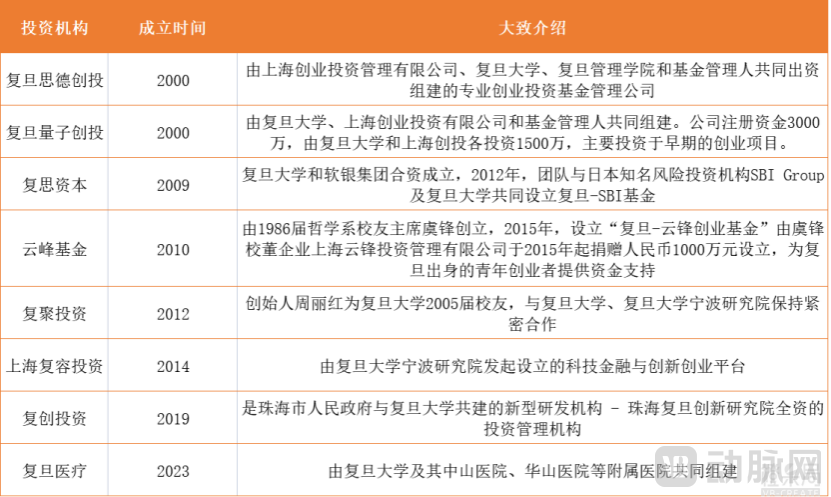 Fudan-affiliated venture capital firms; data sources: Juzi IT, Qichacha, and Dongmaicheng
Since 2000, “Fudan-affiliated venture capital firms” have leveraged their inherent connections with professors and alumni to identify and screen early-stage innovative projects that align with clinical needs and possess high potential for growth. Taking Fuchuang Investment as an example, this venture capital firm, wholly established by the Zhuhai Fudan Innovation Research Institute, includes team members Mr. Tang Yukuan and Mr. Gu Guangxin, both of whom are also affiliated with Fudan University.
Taking Fuchuang Investment as an example, this venture capital firm, wholly established by the Zhuhai Fudan Innovation Research Institute, comprises members exclusively from Fudan University. By systematically studying Fudan University’s technological innovation and industrialization directions, it has built a “Comprehensive Repository of Fudan University’s Technological Innovation Achievements” to make direct investments in major scientific research outcomes. Meanwhile, Fuchuang Investment has established project-based collaborations with Fudan University’s School of Innovation and Entrepreneurship, Institute of Intelligence, and other entities to facilitate the commercialization of these achievements.
Furthermore, the “Fudan–Yunfeng Entrepreneurship Fund,” established by Yunfeng Capital, encourages current Fudan University students to pursue independent technological innovation and entrepreneurship, providing graduates with financial support, entrepreneurial training, and mentoring. The fund has supported 151 innovation and entrepreneurship projects at Fudan University, among which 15 have secured subsequent venture capital financing totaling more than RMB 90 million.
With the official launch of the Fudan Sci-Tech Innovation Fund of Funds, more investors with a Fudan background will emerge in the market, and Fudan alumni will become an indispensable force in sci-tech innovation.
University Foundations Gain High-Profile Momentum
In 2023, university endowment funds gained significant momentum.
According to data from FOFWEEKLY, a total of seven new university-affiliated funds were established in China in 2023, with an aggregate size approaching RMB 5 billion. Notable institutions participating included Shanghai Jiao Tong University, Fudan University, Zhejiang University, Wuhan University, and Central South University. Early this year, domestic universities such as The University of Hong Kong and Tianjin University also joined the ranks of limited partners (LPs), committing capital at an unprecedented scale.
As we entered 2024, this trend continued. On January 15, Dongguan Qingshuiwan Phase II Venture Capital Partnership (Limited Partnership) added new shareholders, with The University of Hong Kong among them, bringing the fund’s registered capital to RMB 727.5 million. One week later, the Tiankai Jiuan Haihe Haitang Science and Technology Innovation Fund of Funds was officially established, with a scale of RMB 5 billion. The Peiyang Education Development Foundation of Tianjin University was one of its initiators. The fund will engage in both sub-fund investments and direct investments in the future.
From the perspective of the industrial ecosystem, universities themselves are a treasure trove of abundant resources. They not only have access to listed companies and leading capital firms but also possess R&D advantages, enabling close collaboration among industry, academia, and research. Through university-affiliated funds, these resources can generate synergistic effects where “1+1>2,” which is particularly crucial in the current market downturn. University funds can more precisely screen projects, empower entrepreneurship, and reduce due diligence costs, thereby achieving the strategic goal of “investing early, investing small, and investing in technology” in a cost-effective manner.
Currently, university endowment funds are generally committed to building a closed-loop system. In this system, alumni donations flow to the university as a Limited Partner (LP), which then commits capital to General Partners (GPs) to support alumni-led startups. As these ventures succeed, capital is returned and generates cash flow, thereby reinvesting in new alumni projects. This process not only revitalizes university assets and supports more alumni entrepreneurs but also strengthens ties among alumni, fostering market-oriented collaboration between research experts, entrepreneurs, and high-quality social capital.
It is foreseeable that, beyond market-oriented institutions, state-owned assets, government funds, and industrialization capital, university endowment funds will emerge as a significant force in the market. For the Fudan Sci-Tech Innovation Fund of Funds, the RMB 1 billion commitment is merely a starting point, with substantial room for future growth yet to be unlocked.