

Zeiss and Sony Enter the Race as Domestic Players Surge: Microsurgical Robots Poised for Breakout
The da Vinci system pioneered the era of surgical robotics, enabling the performance of complex surgical procedures via minimally invasive approaches. After more than two decades of development, it has been updated to its fifth generation and is widely used in laparoscopic surgeries across urology, thoracic surgery, obstetrics and gynecology, and general surgery. Today, laparoscopic surgical robots have also become highly sought-after equipment.
However, human tissues comprise intricate networks of blood vessels, lymphatic vessels, and nerves that sustain bodily functions at a microscopic level. Surgical interventions targeting these structures are not the forte of “Da Vinci”-type systems. The emergence of microsurgical robots has addressed the limitations of existing surgical robotic platforms.
In 2024, Symani, the microsurgical robotic system developed by the Italian surgical robotics company Medical Microinstruments (hereinafter referred to as MMI), was featured on TIME Magazine’s “Best Inventions” list, underscoring the groundbreaking significance of this product.
In simple terms,Microsurgical robots magnify the surgical field using microscopes or ultramicroscopes, employ sensors to scale down the surgeon’s hand movements and filter out manual tremors, thereby overcoming the inherent physiological tremor of approximately 100 micrometers in human hands, to achieve precise manipulation of minute anatomical structures.
In the primary market, microsurgical robots have attracted significant capital attention, with numerous domestic and international companies securing substantial financing over the past two years. As a global star in the microsurgical robotics sector, MMI completed a $110 million Series C financing round in 2024 to accelerate the commercialization of its products. In China, companies such as Angtai Weijing, Fuyi Medical, Weimou Medical, and Dishui Medical have successively closed new funding rounds, with some even completing multiple financings within a single year. Prominent investors including Temasek, Sequoia China, and Proxima Ventures have all placed bets in this field. Furthermore, multinational giants such as Sony and Zeiss have also established their presence in the sector.
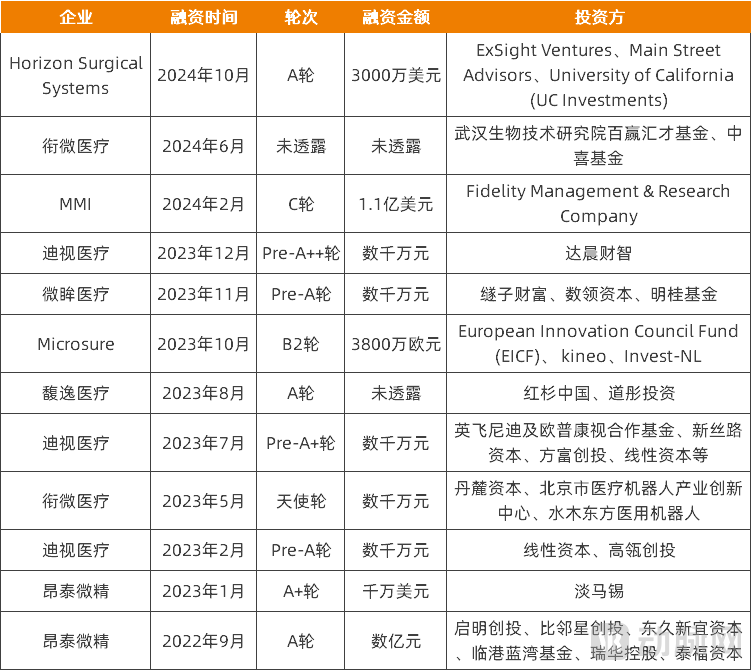
Financing Trends in Microsurgical Robotics Over the Past Two Years; Source: Artery Orange Database
Sun Shanshan, Managing Director of Proxima Ventures, told VCBeat thatMicrosurgical robotics is a field characterized by relatively low competition, high clinical application value, significant market potential, and substantial technical barriers.
Indeed, the global surgical robot market is fiercely competitive, particularly in the fields of laparoscopy and orthopedics, whileMicrosurgery remains a blue ocean, with substantial unmet needs across multiple specialties, including plastic surgery, ophthalmology, otolaryngology, neurosurgery, and vascular surgery.It is foreseeable that microsurgical robots will become the next booming field in surgical robotics.
Following its CE certification in 2019, MMI’s Symani received FDA approval for market launch in the United States in 2024 and entered the Asia-Pacific market. To date, it has obtained regulatory approvals in 35 countries and regions, accelerating its global commercialization. In addition, other companies both domestically and internationally have successively invested in the research and development of microsurgical robots, achieving breakthrough progress in 2024.
In May 2024, Sony unveiled its prototype microsurgical robot at ICRA 2024 (International Conference on Robotics and Automation); the device is also equipped with a 1.3-inch 4K OLED microdisplay developed by Sony Semiconductor Solutions Corporation, providing superior visual support for microsurgical procedures.
Microsure’s MUSA-3 is also among its products under development. The company’s previous-generation product, MUSA-2, received CE certification and was used in various clinical studies, but has been discontinued. Building on the MUSA-2, the MUSA-3 offers enhanced flexibility and combines surgeon comfort with improved ergonomics.
In China, Ontai MicroPrecision, Dishi Medical, Fuyi Medical, and Shendu Medical have deployed microsurgical robot products. Among them, in 2024, Ontai MicroPrecision’s microsurgical robot entered the animal testing phase; Dishi Medical’s microsurgical robot has obtained the registration test report and completed animal experiments, and is currently preparing for human clinical trials.
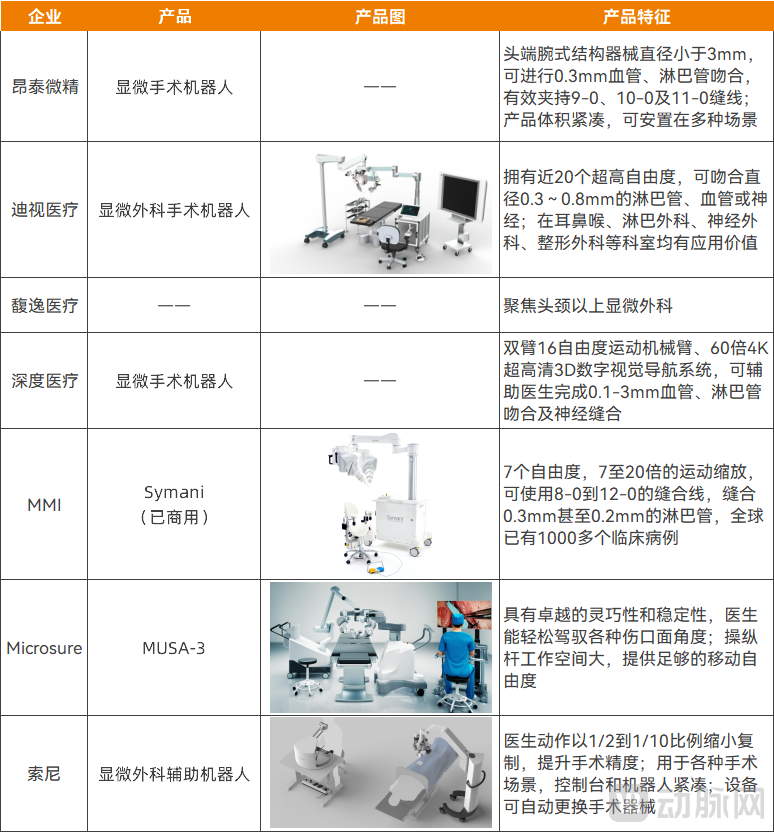 Selected Microsurgical Robots in China and Abroad (“—” indicates that no relevant public information was found). Source: company official websites and public reports.
Compared with existing surgical robots, the most significant breakthrough of microsurgical robots lies in motion scaling and the filtering of fine hand tremors.
Taking Sony’s microsurgical robot as an example, the surgeon’s hand movements at the console are replicated by the tips of the robotic arm’s surgical instruments at a scaled-down ratio of approximately 1:2 to 1:10, thereby enabling surgical manipulation of extremely minute structures.
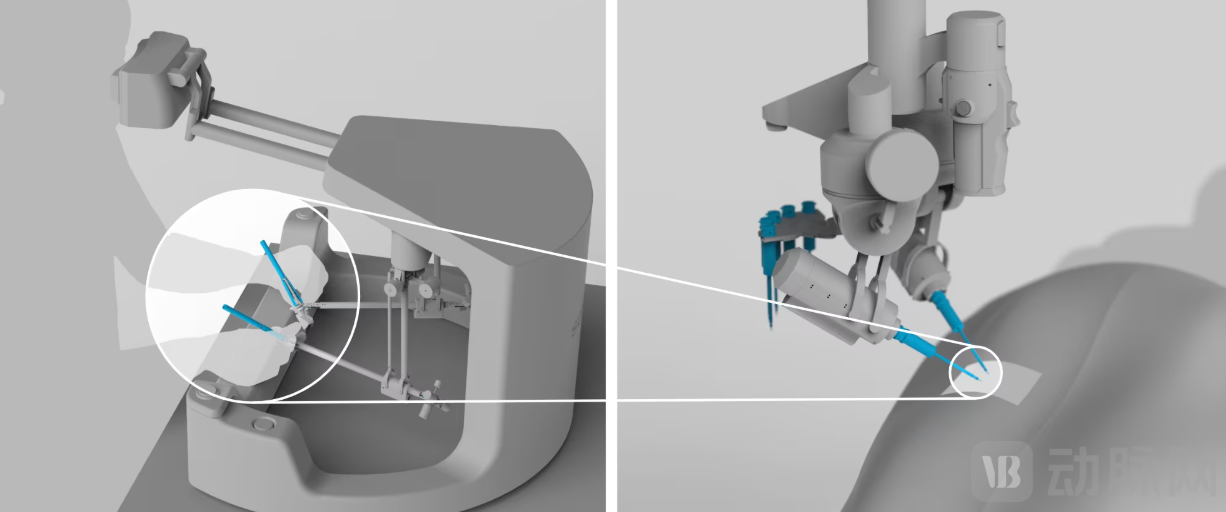 Schematic Diagram of Motion Scaling in Microsurgical Robots. Image Source: Sony Official Website
Following motion scaling and tremor filtration, surgeons can operate microsurgical robots to stably grasp sutures finer than a human hair, enabling the anastomosis of blood vessels, lymphatic vessels, or nerves smaller than 1 mm. For instance, the Symani system offers motion scaling from 7x to 20x, allowing the use of 8-0 to 12-0 sutures even in the smallest vessels.
In recent animal experiments conducted by Ontai Microsurgery, surgeons successfully performed anastomosis of 0.6 mm and 0.5 mm caudal vessels in mice using a microsurgical robot. Traditionally, practicing stable manipulation and precise suturing on mouse tail vessels has been an essential rite of passage for microsurgeons, requiring extensive training to achieve competency.
The degrees of freedom (DOF) of the robotic arm are closely related to the flexibility of surgical manipulation. To enable flexible execution of surgical tasks in microscopic or super-microscopic scenarios, microsurgical robots are designed with as many degrees of freedom as possible.Disvision Medical’s microsurgical robot features nearly 20 degrees of freedom, assisting surgeons in performing highly difficult, ultra-microscopic, precise, and dexterous maneuvers. DeepCare’s microsurgical robot is equipped with dual-arm robotic manipulators offering 16 degrees of freedom, enabling precise control during surgical procedures.
In addition to enabling microsurgery at minute anatomical sites, the robotic system itself is more compact than other surgical robots, facilitating efficient installation and seamless integration with other surgical equipment, or even collaborative operation with other surgical robots during procedures.
Antai Weijing’s microsurgical robot is seven times smaller than the da Vinci system, allowing for seamless integration into existing operating room environments without the need for additional space modifications, and enabling portable movement between different operating rooms. Sony’s microsurgical robot is also designed for various facilities and surgical scenarios, achieving maximum compactness for both the console and the robot.
Microsurgical robots hold significant application value in fields such as plastic surgery, otolaryngology, neurosurgery, and vascular surgery. Companies are validating surgical scenarios during the research and development process to explore broader applications. Among them, Symani, which has already entered the commercialization stage, has accumulated more clinical cases and is conducting research based on a wider range of indications, providing valuable references for other products.
Specifically, Symani has been applied in surgeries for breast cancer, lymphedema, head and neck cancer, and trauma, with 1,000 surgical cases reported worldwide.

Clinical Application Areas of the Symani Microsurgical Robot, Source: MMI Official Website
In August 2024, MMI announced the completion of a preclinical study in which Symani successfully repaired cerebral blood vessels in animal models, marking the first demonstration of such robot-assisted microsurgery in the brain. During the procedure, Symani enabled surgeons to perform extremely delicate maneuvers deep within the cranial cavity—tasks beyond the capability of the human hand alone—thereby opening up possibilities for expanding Symani’s applications into neurosurgery.
Overall, microsurgical robots continue to push beyond human physiological limits, challenging one “impossibility” after another in the medical field.
The microsurgical robots described above can be applied across multiple departments and a variety of surgical scenarios, and are commonly referred to as general-purpose microsurgical robots.Driven by the unique physiological characteristics and specific surgical requirements, microsurgical robots have evolved into a distinct product category in ophthalmology: ophthalmic microsurgical robots.
The eyeball has a complex structure, with an intricate network of blood vessels. The retinal vasculature features vessel diameters ranging from only 40 to 200 micrometers, imposing extremely high demands on surgical precision and operational stability.Traditional manual operations are limited in stability and precision, particularly due to insufficient spatial resolution and depth perception of target microstructures, as well as a lack of force feedback, since the movements required for dissection fall below the surgeon’s sensory threshold. This has made ophthalmic microsurgical robots a major mainstream direction for research and development.
Cui Di, founder of Dish Medical, stated that ophthalmic microsurgical robots and general-purpose microsurgical robots share commonalities in their underlying technologies, including high-safety, high-precision motion control, flexible robotic body mechanism design, specialized instrument manufacturing processes, precise filtering of hand tremors, and the adoption of high-speed, safe master-slave control methods. “The greatest difference lies inGeneral-purpose microsurgical robots are mostly used for surgeries on the body surface or superficial areas, mainly targeting anastomosis, clamping, and dissection of blood vessels, lymphatic vessels, vas deferens, etc., larger than 0.1 mm, with a focus on high dexterity and flexibility in operation; whereas ophthalmic microsurgical robots need to enter the eyeball and perform surgery within the ocular cavity, requiring the scleral puncture point to be used as a remote center fixed point for piercing and dissecting retinal tissues and blood vessels ranging from 0.01 to 0.2 mm, thus demanding higher precision control of the surgical robot and finer manufacturing processes for the instruments.”
In 2019, the ophthalmic surgical robot developed by Preceyes BV received CE certification; in 2022, the company was acquired by ZEISS. Additionally, Horizon Surgical Systems (USA), ForSight (Israel), and AcuSurgical (France), as well as Chinese companies Antai Weijing, Dishi Medical, Weimou Medical, and Xianwei Medical, have also developed robotic systems for ophthalmic microsurgery.
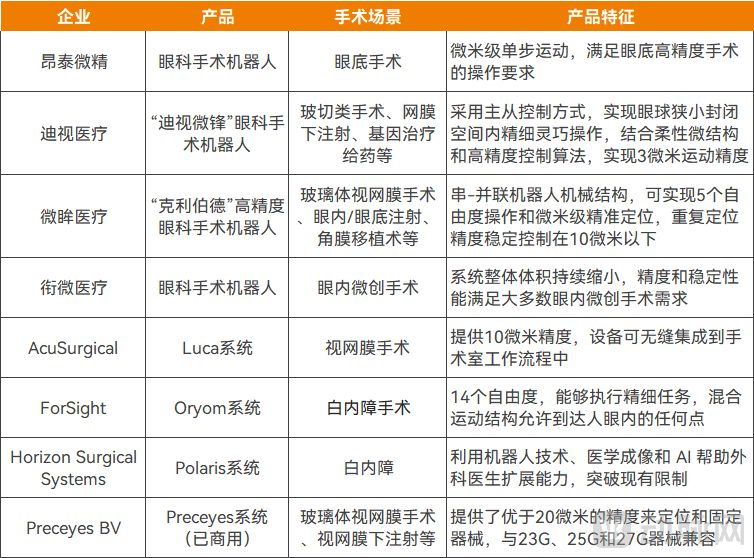
Ophthalmic Microsurgical Robots and Their Product Features, Source: Company Websites and Public Reports
Subretinal injection is one of the important routes for fundus drug administration, playing an increasingly significant role in the pharmacological and surgical treatment of various fundus diseases.However, the diameter of retinal veins is mostly below 200 micrometers, and the ideal surgical precision is 10 micrometers. Physiological tremors in human hands make manual injection extremely difficult; risks may arise from needle insertion that is too deep or too shallow, as well as improper control of injection volume and pressure. Therefore,Precision, stability, and uniform speed during injection procedures are critically important, which underscores the value of ophthalmic microsurgical robots.
In June 2024, Disheng Medical’s “Dishi Weifeng” ophthalmic surgical robot initiated a multi-center registrational clinical trial. During the procedures for the first cohort of enrolled patients, ophthalmology experts successfully utilized the robot to perform precise subretinal injection, facilitating the clearance of subretinal hemorrhage. Currently, the registrational clinical trial for “Dishi Weifeng” is nearing completion.
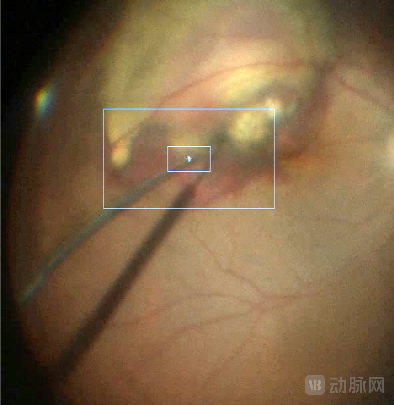
"DiShi WeiFeng" for Subretinal Injection
Weimou Medical’s ophthalmic surgical robot also enables micro-dose drug injection and visualized operation, improving the success rate of drug administration and making ophthalmic surgeries less invasive and more precise.
Membrane peeling is another highly challenging procedure in ophthalmic surgery, and the dexterity of ophthalmic surgical robots enables more precise execution of this task.For example, the Preceyes system offers surgical precision of less than 10 micrometers, enabling surgeons to perform procedures such as epiretinal membrane peeling and internal limiting membrane removal for macular holes.
Furthermore, ophthalmic microsurgical robots can further enhance surgical precision and improve the consistency of outcomes in procedures such as vitrectomy and cataract surgery.
In July 2024, AcuSurgical announced the successful completion of its first clinical study on vitrectomy using the Luca surgical robot. In the study, seven patients underwent procedures with Luca, all of which were successful. Luca can be seamlessly integrated into operating room workflows, enabling surgeons to perform multiple procedures in a single day while effectively executing core vitrectomy tasks.
In April 2024, ForSight announced that its Oryom surgical robot had completed its first robotic cataract surgery. Featuring 14 micro-degrees of freedom and a hybrid motion structure, Oryom is capable of performing delicate tasks, allowing surgeons to operate at any point within the human eye. Surgeons have praised the device as “highly flexible and accurate.”
Meanwhile,Innovations in products and technologies such as intraoperative OCT, novel FBG materials, and AI have created more favorable conditions for the research, development, manufacturing, and clinical application of ophthalmic microsurgical robots, thereby accelerating their development and adoption. Ophthalmic microsurgical robots will not only revolutionize ophthalmic surgery itself but also drive transformations in drug delivery methods, such as serving as delivery platforms for gene therapy and cell therapy.
The transformative impact of microsurgical robots on microsurgery is evident. Beyond their intrinsic value to the surgical procedure itself—enhancing operational precision, improving the consistency of surgical outcomes, and reducing surgical risks—they can significantly shorten the learning curve for surgeons, thereby increasing the supply of therapeutic resources.
According to MMI projections, the number of eligible robotic microsurgery procedures is expected to grow to 22 million by 2028. In the future, microsurgical robots will also drive significant advancements in miniaturized instruments, making the related market a force to be reckoned with.
“Drawing on the model of the da Vinci Surgical System, microsurgical instruments will become more miniaturized, enabling the grasping and dissection of more fragile tissues; materials will be softer and safer, thereby enhancing surgical safety; instruments will exhibit greater durability, leading to lower per-use costs; and customized microsurgical devices may also emerge, including handheld instruments and those with flexible, multi-degree-of-freedom ends,” said Cui Di.
The vast target patient population will make China a key and fast-growing segment of the global microsurgical robotics market.As can be seen from the previous analysis of product portfolios and R&D progress of various companies, the market landscape for microsurgical robots differs from that of many other high-end medical devices. For most other high-end devices, multinational corporations typically have products with years of clinical application and hold a significant market share in China, while domestic companies catch up through R&D and gradually achieve import substitution after launching their own products.
Among global startups in the field of microsurgical robotics, MMI, Microsure, and Preceyes BV—which focuses on ophthalmology—were established relatively earlier and have made faster progress in product development; most other companies were founded around 2020–2021, with their products still in the research and development stage.
Although MMI’s Symani has launched its global commercialization, it will still take time from regulatory approval to market launch even if the product is to enter the Chinese market.
“Among domestically developed products with relatively rapid progress, registration applications are expected to be submitted by 2026. Even for foreign products, registration in China would take approximately two years. Consequently, the market launch timelines for domestic and imported products will be very close. Furthermore, based on currently available indications and functionalities, domestic products are no inferior to their foreign counterparts,” stated Cui Di.
Sun Shanshan noted that robotics is a systemic engineering endeavor. As robots become smaller and operate at more microscopic scales, their servo motors, drive hardware, and other components differ significantly from those of traditional robots. Although underlying technologies from industrial robots can be leveraged, challenges remain in the precision machining of components and material selection. For instance, miniature surgical instruments at the tip of robotic arms must balance product stability, diversity of types, and cost control.
In Sun Shanshan’s view, domestic products have even surpassed their foreign counterparts. For instance, although MMI’s Symani has undergone iterations, its overall design remains biased toward an earlier generation, and its form factor is relatively bulky. In contrast, domestic products hold advantages in both technical parameters and the scope of indications.“Overall, the global market remains in a phase of continuous product refinement and exploration of clinical applications, with no single company or product having established dominance.”
In other words,Domestic microsurgical robots are virtually on par with the global pace of development. In this context, current market entrants have the opportunity to become the “Da Vinci” of the microsurgery field.
Next, companies will face a tense race.
References:
Wan Guangming, Wang Mingyang. Emphasizing the clinical application of subretinal injection technique [J]. Recent Advances in Ophthalmology, 2024, 44(4): 253-257. doi: 10.13389/j.cnki.rao.2024.0050
Wang Bing, Chen Pei, Yong Hongfang, et al. Current Status and Progress in the Application of Microsurgical Robotic Systems for Fundus Diseases [J]. Journal of Robotic Surgery (Chinese & English), 2024, 5(2): 186-193.