

Photon-Counting CT Priced at $7 Million per Unit Sweeps the Chinese Market

Siemens Healthineers
Medical Solutions Provider
In 2024, photon-counting CT broke through in the Chinese market.
In an era where ultra-high-end 640-slice CT scanners can be acquired for under RMB 10 million, the unit price of RMB 50 million for photon-counting CT has not hindered its market entry.
Within just one year of its market launch, the product has been adopted by nearly 10 hospitals in China. Top-tier institutions such as Peking Union Medical College Hospital, Ruijin Hospital, and The Second Affiliated Hospital of Zhejiang University School of Medicine were among the first buyers. Additionally, a large number of Grade III hospitals have included it in their procurement plans, awaiting increased production capacity from the manufacturer.
After More Than 30 Years of Spiral CT Dominance, Is the Era of Photon-Counting CT About to Begin?
In the past competition among spiral CT systems, CT manufacturers heavily invested in core components, continuously increasing the rotation speed of the X-ray tube–detector assembly and narrowing the detector width, to achieve higher-resolution imaging.
However, the race for higher rotation speeds was nearing its end around 2010. Generally, the maximum centrifugal force that CT structures can withstand is 75 G, corresponding to a maximum rotation speed of 0.25 seconds per revolution, with temporal resolution approaching its limit. In terms of spatial resolution, detector stacking encountered a bottleneck in 2014; after reaching 320 rows, detector dimensions approached their physical limits, making it impossible to fit more acquisition units into the gantry.
Amidst these challenges, CT manufacturers have identified two viable pathways. The first involves restructuring the entire CT architecture by embedding hundreds of independent X-ray sources within the gantry. These multiple X-ray sources expose and switch in rotation, replacing the rotating imaging approach of single- (or dual-) source spiral CTs, thereby overcoming the temporal resolution limitations imposed by rotational speed. Hence, it is termed “static CT.”
Second, innovation in detector raw materials involves introducing photon-counting detectors made from specialized semiconductors to create “photon-counting CT.” Specifically, the new detectors can directly convert X-ray photons into electronic signals and individually record the energy of each photon, thereby enabling clearer measurement of transmitted beam spots. Meanwhile, photon-counting detectors do not require the scintillator elements and septa needed by energy-integrating detectors, thus allowing fabrication with smaller detector elements and consequently raising the upper limit of spatial resolution (up to 40 lp/cm).
Compared with static CT systems still in the clinical stage, photon-counting CT is advancing at a slightly faster pace. To date, Siemens Healthineers’ dual-source photon-counting CT system, NAEOTOM Alpha, has received regulatory approval in major markets including the FDA (United States), CE (Europe), and NMPA (China), with more than 100 commercial installations completed worldwide.
At the recently concluded RSNA, attendees further elucidated the clinical value of photon-counting CT.
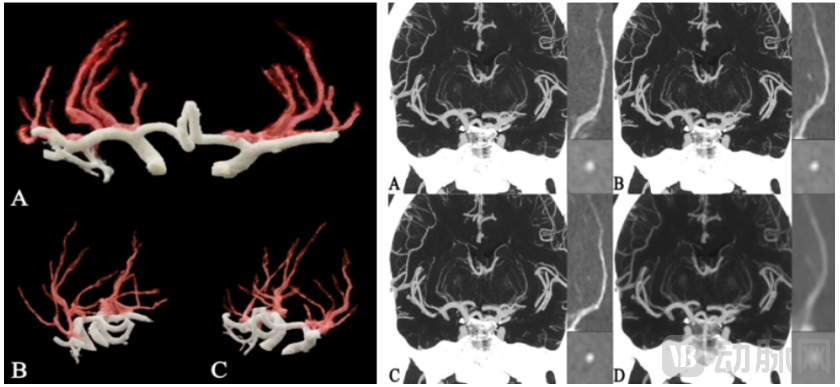
Jiangsu Province Hospital of Chinese Medicine is the first hospital in China to introduce photon-counting CT, and its radiology researchers presented a new breakthrough in microvascular imaging based on photon-counting CT in an oral presentation at the RSNA Eye site.
In optimizing lenticulostriate artery imaging on head and neck CTA, relevant research teams designed multiple comparative protocols for image reconstruction parameters, evaluating their performance in terms of noise suppression, vessel edge sharpness, contrast, and diagnostic confidence, ultimately identifying an optimal parameter combination.
The study results demonstrate that photon-counting CT significantly enhances the visualization of lenticulostriate arteries, providing novel technical support for the early diagnosis and treatment of cerebral small vessel disease (CSVD) and intracranial atherosclerotic stenosis (ICAS).
The Most Discussed Topic at the Symposium: "Integration of AI and Devices"
The photon-counting CT newly installed at the First Affiliated Hospital of Zhengzhou University in April enabled radiology researchers to present their latest findings on the most influential stage in the field of radiology within just one month. In an oral presentation titled “Photon-Counting CT: How Does Next-Generation CT Technology Improve AI-Assisted Diagnostic Outcomes?” they reported on the facilitating role of photon-counting CT in artificial intelligence.
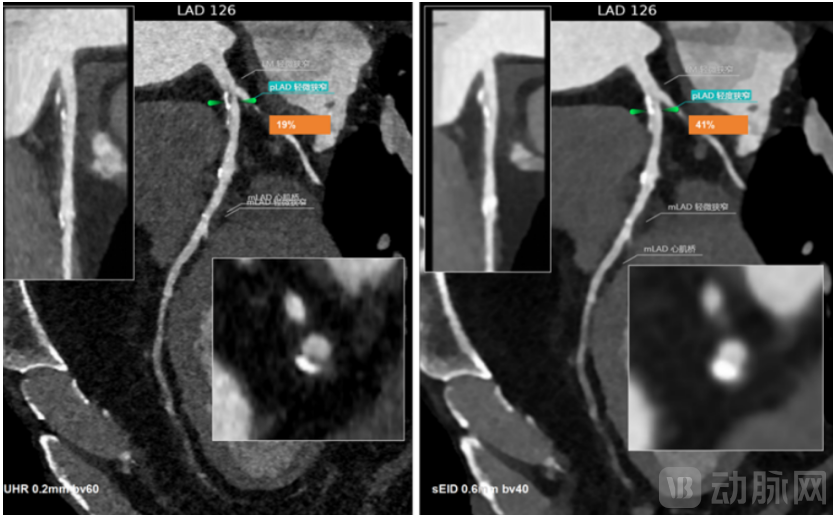
The research team performed coronary CT angiography (CCTA) on 50 patients using the ultra-high resolution (UHR) mode of photon-counting CT, reconstructing both ultra-high-resolution images with a 0.2 mm slice thickness and standard reconstructed images with a 0.6 mm slice thickness. The two sets of images with different slice thicknesses for each patient were separately input into AI-assisted diagnostic software to record the software’s assessment of coronary artery stenosis severity, which was then compared with the results from invasive coronary angiography (ICA).
The results showed that 30% of the 12 moderate stenoses diagnosed on images with a 0.6 mm slice thickness were reclassified as mild stenosis on UHR images. Furthermore, compared with standard reconstruction, UHR images from photon-counting CT demonstrated significantly higher agreement with invasive coronary angiography (ICA), the gold standard, for coronary stenosis grading (Kappa=0.874, p<0.001). This indicates that UHR images from photon-counting CT can optimize coronary stenosis grading and significantly improve the accuracy of AI-assisted diagnostic software.
As Siemens Healthineers’ photon-counting CT is the only one approved by China’s National Medical Products Administration (NMPA), both Peking Union Medical College Hospital and Ruijin Hospital have implemented or are currently negotiating the acquisition of the dual-source “NAEOTOM Alpha” system this year.
However, the NAEOTOM Alpha’s days of standing alone at the top may not last long.
Last October, the newly installed photon-counting CT at Stanford Medicine was not from Siemens Healthineers; GE HealthCare, which is still seeking market approval, scored a first by completing the installation of its prototype system at this U.S. university.
Three months later, Radboud University Medical Center (Radboudumc) in the Netherlands also began using Canon Medical’s experimental photon-counting CT system, which is still seeking regulatory review and approval.
The competition among the three companies corresponds precisely to the three technological pathways for photon-counting detectors: cadmium telluride (CdTe), cadmium zinc telluride (CZT), and deep-silicon (Si).
Among them, Siemens Healthineers has chosen cadmium telluride (CdTe) as the detector material. With its high atomic number, high density, and wide band gap, CdTe’s optimal operating X-ray energy range covers nearly all energy levels used in medical imaging, security screening, and non-destructive testing equipment, making it regarded as the ideal material for implementing multi-energy spectral photon-counting X-ray technology.
Furthermore, the higher atomic number of CdTe detectors implies greater photoelectric absorption efficiency, while high carrier mobility and lifetime ensure that more carriers are transported to the electrodes without being trapped en route, enabling a detection efficiency of over 95% for 60 keV X-rays. In terms of energy resolution, the high resistivity of CdTe also ensures minimal leakage current at high operating voltages, thereby reducing noise during CT operation.
Canon Medical Systems has selected CZT, which, like CdTe, belongs to the II-VI group of compounds and shares similar performance characteristics and advantages. In comparison, CZT has a lower density, higher resistivity, and wider bandgap, resulting in superior performance at room temperature. According to relevant articles from MedTech Study Club, Professor Jie Wanqi, who has long been engaged in research on CZT detectors in China, developed a gamma radiation dosimeter centered on CZT crystals that is only the size of a mobile phone. This device can detect radiation levels as low as 0.18 μSv/h, equivalent to the cosmic background radiation level, demonstrating that the sensitivity of CZT can reach the physical limit.
During its initial explorations, GE Healthcare also experimented with using CZT to fabricate detectors but ultimately shifted to the deep-silicon approach. Compared with the other two technologies, deep-silicon detectors impose stringent requirements on thickness; however, they are relatively easier to manufacture and yield a greater number of segmented energy bins, thereby delivering multi-energy images with richer detail.
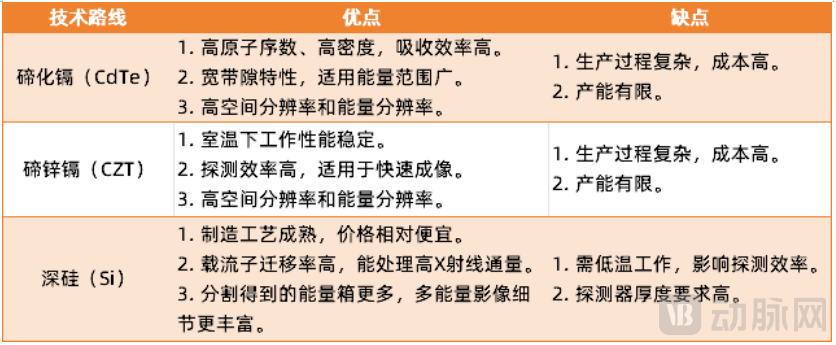
Advantages and Disadvantages of Three Technical Routes: Cadmium Telluride (CdTe), Cadmium Zinc Telluride (CZT), and Deep Silicon (Si)
As Canon Medical and GE Healthcare’s photon-counting CT systems are still in the market access phase, it is not yet possible to evaluate the respective technological pathways or the comparative advantages and disadvantages of the complete systems in real-world clinical applications. However, based on the recent performance of NAEOTOM Alpha, these two latecomers appear to be slightly lagging in the market.
Having secured a leading advantage, Siemens Healthineers has not rested on its laurels. During this year’s RSNA, Siemens Healthineers launched two new photon-counting CT systems, the Naeotom Alpha.Prime (a single-source photon-counting CT) and the Naeotom Alpha.Pro, aiming to further smooth out the price curve for photon-counting CT technology.
This is a crucial step for photon-counting CT entering the clinical era. Currently, hospitals purchasing photon-counting CT systems generally have strong research needs. If Siemens Healthineers can reduce prices to boost sales, photon-counting CT may benefit patients both domestically and abroad at an earlier stage.
Domestic Equipment Manufacturers May Overtake Competitors with Photon-Counting CT
In the strategic contest surrounding photon-counting CT, vendors such as GE HealthCare and Canon Medical Systems are indeed at a disadvantage, yet they still possess the capability to expand their market share.
On one hand, the CT market is enormous; although Siemens Healthineers holds a leading position, it has captured only a small fraction of the market. On the other hand, the competition in photon-counting CT is not merely a battle over detector technology. While Siemens Healthineers’ detector laboratory has managed to shorten the natural formation time of cadmium telluride crystals—from three million years down to just three months—it clearly still fails to meet current production capacity demands. If GE Healthcare and Canon Medical Systems can subsequently identify semiconductor fabrication pathways with lower costs and higher yields, they still have the potential to catch up and surpass the leader.
So, can domestic medical imaging equipment manufacturers that missed the race for the ultra-high-end spiral CT market hope to overtake competitors by leveraging photon-counting CT? The answer is yes.
In their past efforts to overcome detector challenges, companies such as Siemens Healthineers and Canon Medical Systems directly acquired semiconductor manufacturers and subsequently redesigned CT architectures. However, for Chinese enterprises, mature global manufacturers of CdTe, CZT, and deep silicon have all been acquired by multinational corporations (MNCs), which no longer sell these semiconductors externally. Therefore, to break through these barriers, domestic companies must address the issue at its source by independently mastering the material preparation technologies for photon-counting CT detectors.
Fortunately, China is not lacking in advanced processes for the preparation of rare and dispersed metal materials. Statistics show that two companies, Lead Material Technology and Ditek, are already capable of producing semiconductors such as CZT and CdTe required for photon-counting CT scanners. Among them, Aotai Medical, a subsidiary of Lead Material Technology, has achieved a breakthrough by unveiling China’s first self-developed photon-counting spectral CT scanner in October 2023.
Meanwhile, United Imaging Healthcare and Neusoft Medical, the leading domestic medical imaging equipment manufacturers, have also been deeply engaged in photon-counting CT for many years. United Imaging Healthcare leads the “Photon-Counting Spectral CT R&D Project” under the key special program of “Diagnostic and Therapeutic Equipment and Biomaterials” from the National Key R&D Program during the 14th Five-Year Plan period, in collaboration with Ditec. The latter currently provides substrate-grade CZT single crystals, detector-grade CZT single crystals, CZT radiation detection and imaging devices with dedicated electronic readout systems and complete solutions, as well as CdTe, ZnTe, and CdMnTe single crystals.
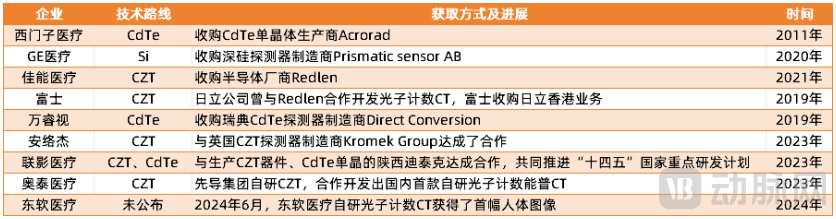
Comparison of Technical Routes and Latest Achievements Among Photon-Counting CT Developers
Overall, domestic equipment manufacturers are fully poised for the development of photon-counting CT. Thirty years ago, they had to start from scratch; today, China’s medical imaging industry chain has taken robust shape. Facing the next cycle of imaging equipment development, they are well-positioned to lead the field.