

China's Healthcare Giant CR Pharma Spent Over $18B on Five Acquisitions This Year—What’s Next?

CR SANJIU
Pharmaceutical R&D, Production, Sales, and Related Health Service Provider

JZJT
Traditional Chinese Medicine Manufacturer

Dong-E E-Jiao
Dong-E E-Jiao and its series product manufacturer

China Resources Double-Crane
Chemical Pharmaceutical Preparations Manufacturer
CR PHARMA COMM
Pharmaceutical Circulation Service Provider

DIRUI
Developer, Manufacturer, and Distributor of Medical Diagnostic Products
This Year, the China Resources Group Is on a Rampage!
In February, China Resources Double-Crane acquired 100% equity interest in China Resources Zizhu for RMB 3.115 billion;
In June, Kpc Pharmaceuticals, Inc., a subsidiary controlled by CR SANJIU, announced the acquisition of a 51% equity stake in Shenghuo Pharmaceutical for RMB 1.791 billion;
In July, Boya Bio-pharmaceutical Group Co.,Ltd. acquired 100% of the equity of Green Cross Hong Kong for RMB 1.82 billion, thereby indirectly acquiring Green Cross (China) Biological Products Co., Ltd.;
In August, CR SANJIU acquired a 28% stake in Tasly for over RMB 6.2 billion, becoming its controlling shareholder;
In October, Jiangzhong Pharmaceutical Co., Ltd. (JZJT), a subsidiary of China Resources, acquired a 51% equity stake in Jiangzhong Yinpian for RMB 86.1238 million.
Since the beginning of this year, the China Resources group has spent over RMB 13 billion on mergers and acquisitions.
Amid the slowdown in primary and secondary markets, why is the China Resources group making bold M&A moves? What signals have its strategic initiatives this year sent?
As a pharmaceutical giant with annual revenue exceeding RMB 200 billion, the China Resources (CR) conglomerate comprises 10 listed companies and over 730 unlisted enterprises. Its listed entities include CR SANJIU, Jiangzhong Pharmaceutical, Dong-E-E-Jiao, Kpc Pharmaceuticals, China Resources Double-Crane, Boya Bio-pharmaceutical Group, CR PHARMA COMM, China Resources Medical Holdings, Dirui Industrial, and Tasly.
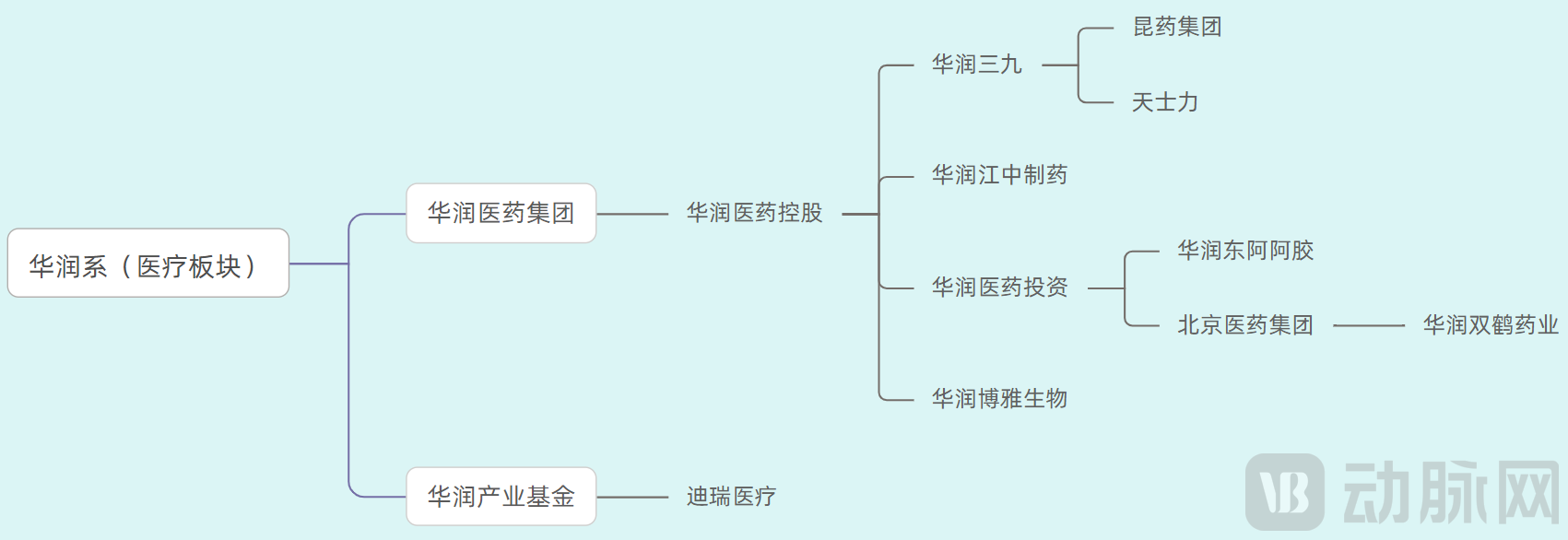
(Structure of the China Resources Medical Sector, Chart by VCBeat)
Similar to overseas giants, China Resources Pharmaceutical Group has also accelerated its corporate development through mergers and acquisitions, rapidly growing into a domestic pharmaceutical powerhouse. From Huayuan Group to Sanjiu Group, from Aonuo Pharmaceutical to Kunming Shenghuo, and from Double-Crane Pharmaceutical and Zizhu Pharmaceutical to Wandong Medical... China Resources Pharmaceutical Group has gradually built a carrier-grade pharmaceutical platform through acquisitions. This platform covers traditional Chinese medicine, innovative drugs, blood products, vaccines, and high-end medical devices, with business operations spanning the entire industry chain.
Meanwhile, the bulk acquisitions by China Resources Pharmaceutical Group have also triggeredIssue of Horizontal Competition. Specifically, the business of the acquired company competes with that of other subsidiaries, leading to friction and competition that easily results in resource wastage and fails to leverage the advantages of group-wide synergy.
In November 2024, Kpc Pharmaceuticals, Inc. completed its acquisition of Shenghuo Pharmaceutical. Taking this merger as an example, Kpc Pharmaceuticals had been integrated into CR SANJIU in January 2023. Previously, its business covered drug R&D, manufacturing, sales, and commercial wholesale, involving multiple fields such as cardiovascular and cerebrovascular diseases, orthopedics, antimalarial treatments, gynecology, and gastroenterology.
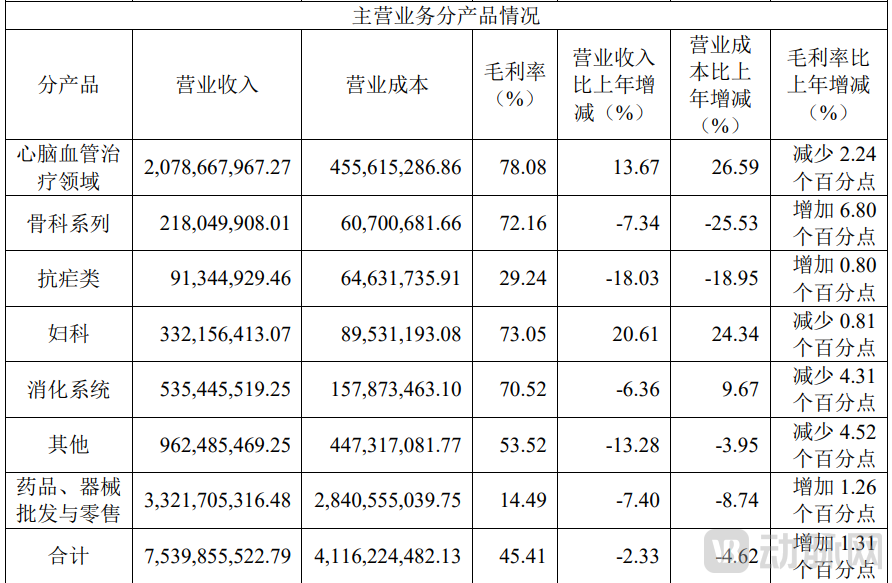
(KPC Pharmaceuticals 2023 Annual Report)
At the time, Kpc Pharmaceuticals’ pharmaceutical distribution business competed with CR SANJIU’s existing operations, and its blockbuster product, Xuesaitong Soft Capsules, which generated hundreds of millions of yuan in revenue, also competed with Shenghuo Pharmaceutical, a subsidiary of CR SANJIU.
To address horizontal competition, China Resources has resolved the issue through divestitures, mergers and acquisitions, and integration. After CR SANJIU acquired a controlling stake in Kpc Pharmaceuticals, Inc., it gradually divested the latter’s pharmaceutical distribution business and reduced its equity stakes in non-core businesses such as Fuda Pharmaceutical and Tian’an Pharmaceutical. This strategic shift enables Kpc to focus on the healthy aging sector, adhering to its strategic goals of becoming “a leader in the silver economy health industry, a premier provider of premium traditional Chinese medicines, and a leader in elderly health and chronic disease management,” while accelerating the development of the Notoginseng industrial chain.
Regarding the issue of horizontal competition involving Xuesaitong products, Kpc Pharmaceuticals, Inc. resolved it by acquiring Shenghuo Pharmaceutical with the support of CR SANJIU. It is understood that Xuesaitong is a proprietary Chinese medicine used for cardiovascular and cerebrovascular diseases such as stroke-induced hemiplegia, cerebral collateral stasis, and cardiac vessel stasis. Its main active ingredient is Panax notoginseng total saponins, an effective fraction extracted from Panax notoginseng. The product is primarily available as a lyophilized injection, followed by soft capsules and hard capsules.
In the Chinese market, only Kpc Pharmaceuticals, Inc. and Shenghuo Pharmaceutical produce Xuesaitong soft capsules. The Xuesaitong series of products from Kpc Pharmaceuticals is the primary driver behind the significant revenue growth in its cardiovascular and cerebrovascular sector; Shenghuo Pharmaceutical’s “Lixuwang” brand Xuesaitong soft capsules are designated as a National Key New Product.
Following the completion of its acquisition and integration of Shenghuo Pharmaceutical, Kpc Pharmaceuticals, Inc. is poised to achieve a synergistic effect greater than the sum of its parts in the Blood-Saitong soft capsule product line. On one hand, the merger will unify the Blood-Saitong market, reduce competition, and establish the combined entity as the sole supplier with pricing power. On the other hand, the integrated team, sales network, supply chain, and brand will boast enhanced competitiveness and operational strength, leveraging existing expertise to accelerate market expansion.
From the perspective of CR SANJIU, this merger and restructuring represents an integration of the Panax notoginseng industry. Currently, Kpc Pharmaceuticals, Inc. possesses a complete industrial chain spanning from GAP-compliant cultivation of Panax notoginseng and processing of decoction pieces to the extraction of Panax notoginseng total saponins, formulation production, and specialized marketing and promotion.
In line with its strategic plan, Kpc Pharmaceuticals, Inc. has launched the “777” brand, aiming to establish the brand perception that “Notoginseng is 777” and to reinforce consumer awareness of Panax notoginseng saponins (PNS), the active ingredient in Xuesaitong Soft Capsules. The company will also expand its Notoginseng product pipeline and broaden its Notoginseng product portfolio to meet patients’ specialized and multi-level needs.
In addition to addressing horizontal competition, the China Resources group has also accelerated the integration of its traditional Chinese medicine business through mergers and acquisitions.
In August 2024, CR SANJIU acquired a 28% stake in Tasly for RMB 6.212 billion, becoming its controlling shareholder. As a leading enterprise in the traditional Chinese medicine (TCM) sector of China’s A-share market, Tasly has developed a comprehensive modern TCM product portfolio primarily focused on cardiovascular and cerebrovascular medications. Adhering to international innovation standards and modern medical criteria, the company has leveraged its flagship product, Compound Danshen Dripping Pills, to drive a series of branded products including Yangxue Qingnao Granules (Pills), Qishen Yiqi Dripping Pills, and Yiqi Fumai Lyophilized Powder for Injection.
In the traditional Chinese medicine (TCM) market, Tasly promotes lean production and intelligent manufacturing, integrating digital technologies throughout the entire drug lifecycle to establish an intelligent manufacturing system centered on modern TCM, thereby securing significant production advantages. Meanwhile, Tasly has optimized every segment of the industry chain, including raw material cultivation, processing, extraction, formulation, and distribution. By adhering to international standards for management, the company has extended quality control from the formulation stage back to extraction and herbal cultivation, addressing inconsistencies in standardization across all links of the industrial chain.
The acquisition of Tasly will facilitate resource integration and mutual complementarity. For instance, Tasly holds advantages in the intelligent manufacturing of traditional Chinese medicine (TCM), while CR SANJIU has accumulated certain capabilities in automation, informatization, and digitalization through projects such as the intelligent transformation of its Guanlan base. The combination of the two may spark further innovations in the intelligent manufacturing of TCM.
Furthermore, CR SANJIU is a leader in the traditional Chinese medicine (TCM) industry chain, with strategic layouts spanning TCM raw materials, TCM formula granules, premium proprietary Chinese medicines, and the Panax notoginseng industry chain. Tasly, on the other hand, boasts multiple TCM products with annual sales exceeding RMB 100 million each, along with 101 products in its research and development pipeline. Within this pipeline, two classic TCM formulations are at the stage of applying for production approval, while 19 innovative TCM products are undergoing Phase II and Phase III clinical trials. Following the acquisition of Tasly, CR SANJIU will enrich its TCM product portfolio and strengthen its R&D capabilities.
Moreover, their sales channels are complementary. Tasly holds an advantage in hospital-based sales, while CR SANJIU focuses more on the OTC (over-the-counter) channel. The combination of the two will create a robust sales network covering both in-hospital and out-of-hospital markets. Leveraging this sales network, along with CR SANJIU’s strengths in marketing and hospital distribution bidding, the products of CR SANJIU and Tasly will reach broader markets and accelerate the commercialization of new products.
Following the integration of resources between CR SANJIU and Tasly, the traditional Chinese medicine (TCM) industry chain will be completed, strengthened, and extended. Mutual empowerment across segments—including TCM herb cultivation, innovative R&D, intelligent manufacturing, and channel marketing—will enhance the core competitiveness of the entire industry chain.
Notably, CR SANJIU’s acquisition of Tasly also involves horizontal competition: Tasly’s pharmaceutical retail chain business competes with the retail chain operations of China Resources Pharmaceutical Commercial Group (CR PHARMA COMM), a subsidiary of China Resources; additionally, Tasly’s eszopiclone tablets compete with CR SANJIU’s zopiclone tablets. In response, China Resources has committed to resolving the existing horizontal competition issues in accordance with statutory procedures within five years after the completion of the transaction.
In fact, CR SANJIU had long planned the integration of the traditional Chinese medicine (TCM) industry. In December 2023, it launched the “Chain Aggregation Initiative” for innovative integration in modern TCM. It is understood that China Resources Group regards the development of the TCM industry as a key mission for central state-owned enterprises to undertake national strategies. Guided by the National “14th Five-Year Plan” for the Development of Traditional Chinese Medicine, CR SANJIU has formulated and implemented the “High-Quality Development Plan for the TCM Industry Chain” of China Resources Group, based on an overall industrial perspective.
The acquisition of Tasly can also be viewed as the strategic implementation of CR SANJIU’s development of the traditional Chinese medicine (TCM) industry chain. According to publicly disclosed research materials from CR SANJIU, the company will continue to focus on investment and integration opportunities within the industry. On one hand, it will ensure the effective integration of Kpc Pharmaceuticals, Inc., leverage synergistic value, and advance the progress of the Tasly project. On the other hand, it will adopt diversified approaches to support the company’s overall innovation-driven transformation through investments and mergers and acquisitions, while intensifying its exploration of investment opportunities in the innovative drug sector.Continue to focus on promising and high-potential brand assets within the core business of CHC (Consumer Health Care) self-care products.。
In addition to CR SANJIU, other subsidiaries under China Resources are also integrating the traditional Chinese medicine (TCM) industry. For instance, in October 2024, JZJT proposed to acquire a 51% equity stake in Jiangzhong Yinpian from Jiangzhong Pharmaceutical Co.,Ltd. for RMB 86.1238 million. JZJT is a pharmaceutical manufacturing enterprise with a market capitalization of tens of billions of yuan. Its product portfolio includes over-the-counter (OTC) drugs, prescription drugs, general health products, and others, covering multiple therapeutic areas such as spleen and stomach disorders, gastrointestinal conditions, throat ailments, tonics, rehabilitation nutrition, premium herbal supplements, cardiovascular and cerebrovascular diseases, gynecology, and urology. The company was incorporated into China Resources Group in 2019, becoming one of its directly managed business units.
Previously, Jiangzhong Pharmaceutical (JZJT) established two China Well-Known Trademarks, “Jiangzhong” and “Chuyuan,” as well as two Jiangxi Province Famous Trademarks, “Yang Jisheng” and “Sanghai.” Notably, the “Jiangzhong” brand is valued at over RMB 30 billion. Its flagship product, Jiangzhong Brand Jianwei Xiaoshi Tablets, has ranked first in the traditional Chinese medicine–digestive category of the “China OTC Product List” for 20 consecutive years, with cumulative sales exceeding 5 billion boxes.
Jiangzhong Yinpian is also a subsidiary of Jiangzhong Pharmaceutical Co.,Ltd., which holds a 51% stake in the company. Jiangzhong Yinpian is primarily engaged in the production of traditional Chinese medicine (TCM) decoction pieces, the manufacturing of TCM products for health preservation, wellness, and beauty, as well as the cultivation of TCM medicinal materials. The company offers more than 600 varieties of TCM decoction pieces, with an annual production capacity exceeding 3,000 tons.
JZJT acquires Jiangzhong Yinpian to secure upstream resources in traditional Chinese medicine, enhance the TCM industrial chain, and reduce related-party transactions.
Interestingly, in recent years, state-owned capital has been accelerating its influx into traditional Chinese medicine (TCM) enterprises. For instance, the Heilongjiang Provincial State-owned Assets Supervision and Administration Commission (SASAC) became the actual controller of ST Jiuzhi (formerly “Jiuzhitang”) in November 2024; the Shanxi Provincial SASAC became the actual controller of Guangyuyuan in 2021; and the Zhejiang Traditional Chinese Medicine Health Industry Group became the controlling shareholder of Conba in 2020.
It is widely believed in the industry that, supported by policy-driven initiatives and the entry of state-owned capital, the traditional Chinese medicine (TCM) industry will usher in a new cycle of development.
Within the China Resources group, CR SANJIU is regarded as the M&A platform for the traditional Chinese medicine segment, while China Resources Double-Crane handles M&A for the chemical pharmaceutical segment.
China Resources Double-Crane is a subsidiary of CR PHARMA COMM, with four major business platforms: generic drugs, infusion solutions, differentiated pharmaceuticals, and innovative drugs, covering new drug R&D, formulation production, drug sales, API manufacturing, and pharmaceutical equipment.
This year, the primary focus of the China Resources (CR) group appears to be internal resource integration, a trend evident in both its traditional Chinese medicine and chemical pharmaceutical sectors. In February 2024, China Resources Double-Crane announced the acquisition of 100% equity interest in CR Zizhu for RMB 3.115 billion, with the transaction completed in April.
Prior to the merger and acquisition, China Resources Zizhu was also an enterprise under CR PHARMA COMM, with 100% of its equity held by China Resources North Pharmaceutical Group. Following the M&A, China Resources Zizhu will be fully integrated into China Resources Double-Crane.
CR Zizhu is primarily engaged in the research and development, manufacturing, and sales of pharmaceuticals, covering areas such as women's health, oral care, ophthalmology, diabetes, and active pharmaceutical ingredients (APIs). Among its portfolio, Yuting, CR Zizhu’s flagship product, has maintained the leading market share in China’s contraceptive market since its successful launch in 1998.
The acquisition of China Resources Zizhu will enrich China Resources Double-Crane’s pharmaceutical product portfolio in women’s health, ophthalmology, and stomatology, thereby strengthening its market position in specialized therapeutic areas. Meanwhile, the marketing resources and cost advantages of China Resources Zizhu will create synergies with China Resources Double-Crane, further enhancing its competitiveness.
CR PHARMA COMM stated: This acquisition is primarily aimed at internal restructuring, optimizing resource allocation, and integrating the chemical pharmaceutical business, so as to enhance the economies of scale and synergies between China Resources Zizhu and China Resources Double-Crane, thereby promoting the Company’s overall performance.
It is worth noting that China Resources Double-Crane stated in a recent research activity that the company will increase its M&A efforts in strategic areas.Currently, China Resources Double-Crane primarily focuses on three directions for mergers and acquisitions.:
One focus is the synthetic biology sector, where the company primarily acquires technology-driven synthetic biology firms or traditional fermentation enterprises to expand China Resources Double-Crane’s overall scale in synthetic biology through technological empowerment. To date, China Resources Double-Crane has acquired Shenzhou Biology and will continue to monitor projects in the synthetic biology field.
The second category comprises leading enterprises in niche segments. These companies must be top players in specialized fields (such as ophthalmology, pediatrics, and psychiatry/neurology). Through mutual empowerment, their future growth potential can be better ensured. The specialized business of China Resources Double-Crane Pharmaceutical Co., Ltd. aligns with the company’s strategic requirements, serving as a key engine for its medium- to long-term development and guiding its selection of M&A targets. Products within this specialized business must feature clear clinical value, differentiation, and resilience against volume-based procurement in the short term.
The third category comprises innovative incubator enterprises or products, where strategic investments are made based on commercialization and industrialization collaborations. An example is Subi-1 (a therapeutic agent for diabetic foot ulcers), which the company introduced this year through business development (BD) arrangements.
It can be seen that, compared with previous large-scale M&A activities, China Resources Double-Crane is shifting towards M&A focused on product upgrades and innovation capabilities.
Beyond business integration, companies under the China Resources umbrella have also seized the opportunity presented by the market downturn to acquire enterprises against the trend, thereby accelerating business expansion.
Boya Bio-pharmaceutical Group Co.,Ltd. joined the China Resources family in 2021 and, under the guidance of China Resources Group, has focused on blood products. Since then, Boya Bio has been continuously divesting its non-blood product businesses and has set a target to expand the number of plasma collection stations to more than 30 during the 14th Five-Year Plan period.
However, as of the end of 2023, Boya Bio-pharmaceutical Group Co.,Ltd. operated only 16 plasmapheresis stations, falling significantly short of its target.
To accelerate the expansion of its plasma collection stations, Boya Bio-pharmaceutical Group Co.,Ltd. acquired 100% equity interest in Green Cross Hong Kong (Hong Kong) for RMB 1.82 billion in July 2024, thereby indirectly acquiring Green Cross (China). Following the completion of the acquisition, Boya Bio-pharmaceutical will hold full ownership of a blood products manufacturing enterprise, adding one production license, four operational plasmapheresis stations, and expanding its plasma station footprint into two provincial regions.
Compared with the costly establishment of blood stations, acquisition is clearly a faster route. Another reason for the premium acquisition of Green Cross was its production capacity for plasma-derived Factor VIII and sales rights for recombinant Factor VIII, which complemented Boya Bio-pharmaceutical Group Co.,Ltd.’s product portfolio.
From China Resources Double-Crane’s acquisition of CR Zizhu to Kpc Pharmaceuticals’ acquisition of Shenghuo Pharmaceutical, and from Boya Bio-pharmaceutical Group’s acquisition of Green Cross to CR SANJIU’s acquisition of Tasly, followed by Jiangzhong Pharmaceutical’s acquisition of Jiangzhong Yinpian, China Resources-affiliated healthcare enterprises have been actively engaged in acquisitions from the beginning to the end of the year. More importantly, these companies regard investment and M&A as a key strategic priority for the future and are currently intensifying their efforts to identify suitable targets. It is expected that the China Resources group will frequently announce major investment and M&A developments in the near future.
In the past, we have analyzed and explored the M&A paths of many multinational corporations (MNCs). Now, can China Resources carve out an M&A path characteristic of a Chinese-style MNC?