

Grand Pharma Announces Strategic Licensing Agreement for Innovative Dry Eye Therapies OC-01 and OC-02 in Greater China

Corxel Pharmaceuticals Hong Kong
Cardiovascular Metabolic Disease Treatment Drug Developer
On December 11, Grand Pharmaceutical Group Limited announced that it had recently entered into a strategic product in-licensing cooperation agreement with Corxel Pharmaceuticals Hong Kong Limited (“Corxel”).
Pursuant to the agreement, upon satisfaction of the relevant conditions, the Company will obtain the exclusive rights to develop and commercialize in the Greater China region (Mainland China, the Hong Kong Special Administrative Region of China, the Macao Special Administrative Region of China, and the Taiwan region) the first-in-class innovative product varenicline tartrate nasal spray (“OC-01”) for the treatment of dry eye disease, as well as the OC-02 (Simpinicline) nasal spray (“OC-02”).
OC-01 has been launched in China, and OC-02 has completed its U.S. Phase IIb clinical trial
Corxel is a biotechnology company headquartered in the United States and China. Its products, OC-01 and OC-02, are two highly selective cholinergic receptor agonists that treat dry eye disease by activating the trigeminal parasympathetic pathway to increase the secretion of natural tears.
Phase III clinical studies of OC-01 demonstrated that, compared with the control group, OC-01 significantly improved tear secretion in patients with dry eye disease. Natural tear secretion in subjects increased markedly from baseline, with a significantly higher proportion of subjects achieving an increase in Schirmer’s test score of ≥10 mm from baseline. Furthermore, OC-01 exhibited a favorable safety and tolerability profile.
OC-01 utilizes an innovative intranasal delivery method, enabling rapid onset of action and immediate stimulation of tear secretion. It significantly increases natural tear production in patients with dry eye disease, enhances tear film stability, and interrupts the vicious cycle of dry eye pathophysiology. Furthermore, OC-01 requires only twice-daily nasal spray administration, offering convenience that avoids the cumbersome nature of traditional eye drops and is expected to improve patient compliance. This product holds promise as a novel, safe, effective, and convenient therapeutic option for patients with dry eye disease.
In terms of product registration, OC-01 was approved for marketing in the United States in October 2021. It is currently the world’s first and only preservative-free, multi-dose, sterile-packaged nasal spray approved for the treatment of mild, moderate, and severe dry eye disease. In mainland China, OC-01 received marketing approval from the National Medical Products Administration of the People’s Republic of China in November 2024.
Furthermore, OC-01 was approved for marketing in the Macao Special Administrative Region of China in February 2023; it was introduced into the Hainan Boao Lecheng International Medical Tourism Pilot Zone in April 2023 as an imported drug urgently needed for clinical use; the first prescription in the Guangdong-Hong Kong-Macao Greater Bay Area was issued at The University of Hong Kong-Shenzhen Hospital in December 2023; and it was approved for marketing in the Taiwan region in November 2024.
OC-02 completed its Phase IIb clinical study in the United States for dry eye disease, with results demonstrating that the product promotes tear film production and improves signs and symptoms in patients with dry eye disease.
With the introduction of these two products, Grand Pharmaceutical will further deepen its innovative product portfolio in the field of ophthalmology, providing superior treatment options for patients with dry eye disease.
According to the announcement, Grand Pharmaceutical Group Limited has currently established an innovative drug product portfolio characterized by “specialization, a comprehensive series, and multiple varieties.” The company has reserved a range of globally innovative products for the treatment of “myopia,” “dry eye disease,” “pterygium,” “post-ocular surgery anti-inflammatory and analgesic care,” “Demodex blepharitis,” and “meibomian gland dysfunction caused by Demodex.” Significant progress has been made in R&D, with several innovative products expected to receive regulatory approval and launch within the next three years.
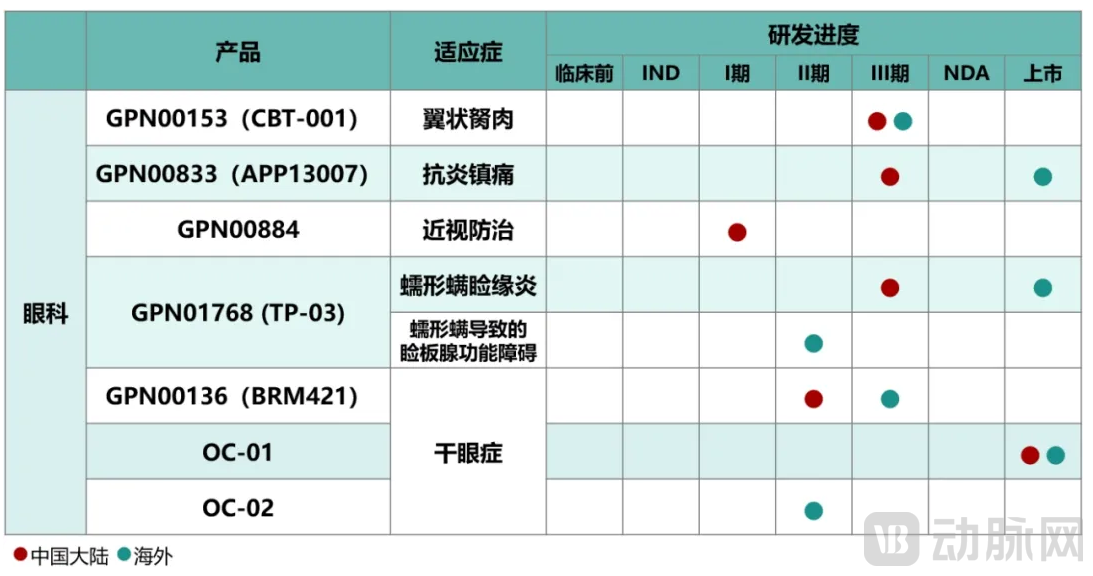
Among these, GPN01768 (TP-03), a globally innovative ophthalmic drug for the treatment of Demodex blepharitis, has completed its Phase III clinical study in China and is preparing to submit a marketing authorization application; GPN00833, a hormonal nanosuspension eye drop for anti-inflammatory and analgesic purposes, completed its domestic Phase III clinical study in November 2024 and met the clinical endpoints; GPN00153 (CBT-001), an innovative improved new drug for the treatment of pterygium, administered the first patient in its Phase III clinical study in China in March 2024; and GPN00884, a globally innovative ophthalmic drug for delaying the progression of myopia in children, administered the first patient in its Phase I clinical study in China in June 2024.
Innovative Drug Delivery Methods: Progress Made in Multiple New Therapies for Dry Eye Disease
Dry eye disease is a common chronic ocular surface disorder in clinical practice, characterized by symptoms such as dryness, foreign body sensation, and stinging; in severe cases, it may impair vision.
Among all ophthalmic diseases, dry eye disease (DED) has the second-highest incidence rate, which is increasing year by year. Statistics indicate that the prevalence of DED in China is approximately 21%–30%, with a conservative estimate of around 360 million affected individuals. Currently, patients with DED account for more than 30% of total outpatient visits in ophthalmology departments at medical institutions; this proportion is projected to rise to 40% within the next 5–10 years.
Currently, the medical understanding of the pathogenesis of dry eye disease is quite comprehensive, but the therapeutic efficacy of available pharmacological treatments remains suboptimal.
Currently, the clinically prevalent treatment for dry eye disease is artificial tears. Most commercially available artificial tear products are eye drops administered via the ocular surface. Natural tears have a complex composition, containing thousands of components, whereas currently marketed artificial tears can only mimic one or several components of the tear film, making it difficult to truly replicate natural tears. Furthermore, ocular surface administration suffers from low bioavailability and short drug residence time, necessitating frequent dosing. This poses a risk of long-term drug-induced irritation and compromises patient compliance.
This is primarily due to the unique anatomical structure of the eye, which imposes higher requirements on drug formulation technologies. First, physiological mechanisms such as the blink reflex and nasolacrimal drainage result in short ocular surface retention time and low drug delivery to target tissues. Second, specialized barriers like the tear film and cornea reduce drug permeation. Third, limitations associated with ophthalmic solution formulations include issues such as blurred vision caused by viscosity-enhancing agents, exacerbation of patient symptoms by preservatives, poor tolerance to certain excipients, and an increased incidence of local adverse reactions.
Based on the characteristics of medications for dry eye disease, pharmaceutical companies both domestically and internationally have developed drugs utilizing various drug delivery systems to achieve prolonged ocular retention, enhanced bioavailability, and improved long-term safety.
For example, in 2016, Xiidra, an LFA-1 antagonist eye drop developed by Takeda Pharmaceutical Company, received FDA approval for the treatment of dry eye disease. In May 2019, Novartis acquired the global rights to Xiidra from Takeda. In 2022, Xiidra’s sales reached $487 million, directly leading to a decline in sales of its main competitor, Restasis.
In addition, an increasing number of novel dry eye disease therapeutics with diverse mechanisms of action are intensively entering the mid-to-late stages of clinical development. For instance, thymosin beta-4, an anti-inflammatory dry eye drug developed by RegeneRx; Icomucrete, a mucin secretagogue developed by Alcon AG; SYL1001, a biologic new drug developed by Sylentis SA; and SJP-0132, developed by Senju Pharmaceutical, have all entered Phase III clinical trials.
In China, varenicline tartrate nasal spray (OC-01), introduced by Corxel Pharmaceuticals, was approved for marketing this November, becoming the first approved nasal therapy for dry eye disease in the country.
This collaboration between Grand Pharmaceutical Group and Corxel Pharmaceuticals is not only a strategic alliance between two industry leaders but also a significant impetus for the field of dry eye disease treatment, which is poised to disrupt China’s traditional market for dry eye medications.
References:
Cracking Down on Sodium Hyaluronate – VCBeat