

A New Trillion-Yuan Healthcare Data Market Unveiled: Beijing Completes First-Ever In-Hospital Health Data Transaction
Recently, the carotid artery stenting dataset from Xuanwu Hospital of Capital Medical University (comprising 2,550 records at the time of registration) was registered for asset ownership confirmation at the Beijing International Big Data Exchange (hereinafter referred to as “Beijing Big Data Exchange”), with the transaction completed simultaneously.
This Is Beijing’s First-Ever Transaction of Public Hospital Health Data in History, the transaction was led by the Beijing Data Exchange, with Xuanwu Hospital supplying the data assets and Yingli Law Firm providing legal services related to the data transaction.
According to Xuanwu Hospital, the transaction data has undergone rigorous anonymization, cleaning, integration, and standardization processes, strictly protecting patient privacy while ensuring data accuracy and usability. In the future, this dataset will be applied to the research and development of domestically produced carotid artery stents, helping medical institutions gain a more precise understanding of cerebrovascular diseases in the Chinese population.

Data Asset Registration Certificate of Xuanwu Hospital, Capital Medical University
When the digital health wave first emerged, the immense value hidden within medical data was widely discussed. However, progress was stifled by unresolved challenges related to data standardization, interoperability, security, openness, and sharing. Despite theoretical projections of a market worth hundreds of billions, it has attracted little practical interest from observers.
The completion of this transaction appears to provide an answer to all this—the barriers that previously led to a reluctance and unwillingness to share have been overcome,The Era of Free Flow of Health Data Has Arrived.
Prior to the completion of Xuanwu Hospital’s data transaction, China’s health data trading market had already gained significant momentum since the second half of 2023.
In August 2023, the Shandong Health and Medical Big Data Management Center, together with co-building units of the National Health and Medical Big Data Center (North), pioneered initiatives in data trading and circulation. By leveraging the “Population Epidemiological Analysis Report,” they obtained the first on-exchange trading certificate for a health and medical data product in China, and successfully completed the first on-exchange transaction of a data product at the end of the same month.
In the following six months, the Fujian Big Data Exchange also achieved a “zero breakthrough,” securing the first on-exchange transaction of a health and medical data product in Fujian Province with its *Analysis Report on Endocrine and Metabolic Diseases in Xiamen*.
However, the essence of both aforementioned data transactions is report trading based on health data.What the buyer purchases is the result generated based on health data, rather than the right to use the health data itself.As of May 2024, based on the aggregation, governance, and management of health and medical data, Guangdong Provincial People’s Hospital formally supported health data trading with datasets as the underlying assets. This was achieved after data anonymization and secure encryption, resulting in two health and medical data products: “Guangdong Academy of Medical Sciences Diabetic Retinopathy Diagnosis Data Product” and “Guangdong Academy of Medical Sciences Heart Disease Diagnosis and Prediction Data Product.”
In October 2024, Shanghai General Hospital achieved another breakthrough by securing 18 data product listing certificates in a single day. These included multimodal datasets commonly used in AI-assisted diagnosis, such as those for pulmonary nodules, diabetic retinopathy, CT-FFR, and breast ultrasound, as well as disease-specific datasets covering spermatogenic disorders, acute leukemia gene mutations, and transplant prognosis. Some of these datasets comprised up to 512 data dimensions, with storage sizes reaching as high as 100 TB.
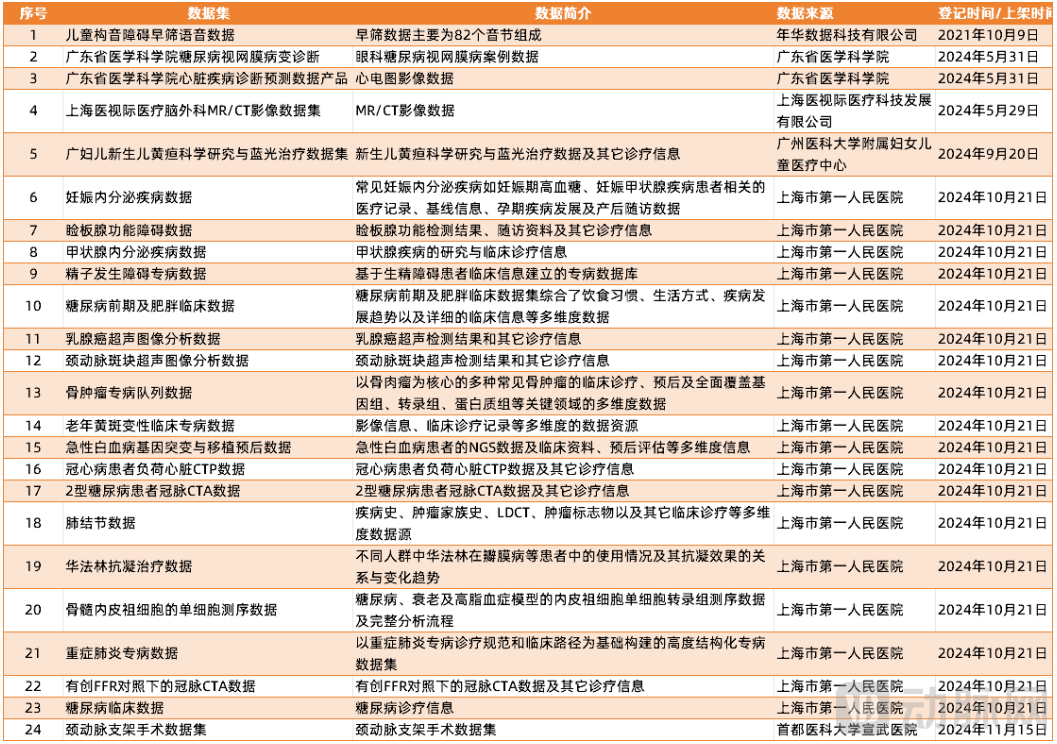 Statistics on Datasets Listed on Various Data Exchanges (Incomplete Statistics)
Compared with the aforementioned events, the transaction involving Xuanwu Hospital carries its own unique positive significance. On one hand, a review of publicly available information reveals that prior to this transaction, Xuanwu Hospital had only listed its assets, with no publicly reported on-exchange transactions (although off-exchange transactions centered around research institutions may have existed). This transaction can thus be regarded as pioneering on-exchange trading of health data.
On the other hand, this transaction differs from previously completed public health data transactions in China in two major aspects.
First, the form of health data transactions completed in the past was usually the sale of targeted reports generated based on medical data, with buyers not having direct access to the data. AndThe subject of this data transaction is the medical data itself, which means that the buyer has the right to independently train and analyze the purchased de-identified medical data as agreed upon in the contract.。
Second, the update frequency of previous data asset registration certificates was relatively slow, with many assets taking up to a year to be updated, whereas Xuanwu Hospital will update its datasets on a weekly basis. WhenWhen the buyer identifies insufficient data volume in practical applications, high-frequency updates will provide the possibility of expanding the dataset and facilitate subsequent data transactions between both parties.。
As stated by Xuanwu Hospital, this represents a significant stride in data-driven medical innovation and the promotion of high-quality development. It ushers in a novel model for leveraging data circulation to support the Healthy China initiative, setting a new benchmark for the compliant application of healthcare data across China.
To date, health data products offered by major exchanges can be broadly categorized into four types:First, corpus data; second, ready-to-use platforms and AI models; third, analytical reports based on health data; and fourth, specialized device- and disease-specific health datasets.The four major product categories can theoretically meet the vast majority of health data demands in the market, and a health data trading model under ideal conditions has taken initial shape.
However, in the process of turning the ideal model into reality, there are still many systemic issues to be addressed in the health data trading market.
Although the Xuanwu Hospital transaction has brought disruptive significance to the industry, there are still many systemic issues in the health data trading market that need to be resolved.
Huang Di, a Senior Consultant at Beijing Yinghe (Guangzhou) Law Firm, is participating in the drafting of local standards in Guangdong Province regarding the compliant registration of health and medical data assets. She believes that industries such as the internet and finance have a high degree of digitalization, creating favorable foundational conditions for forming high-quality data resources. Furthermore, these industries feature numerous business models and application scenarios that rely on data support. For instance, e-commerce platforms analyze user data, such as browsing history and purchasing behavior, to trade or share this information, thereby achieving precise matching for advertising placements and improving ad conversion rates. The financial sector, meanwhile, has long leveraged data to build risk assessment models and credit rating models, enabling precise evaluation of risks associated with various types of credit.
In contrast, the market-oriented application of health and medical data involves extensive personal privacy and sensitive information. It is essential to employ technical measures and compliance frameworks to safeguard patients' personal information rights, thereby striking a balance between efficiently unlocking the value of data as a factor of production and protecting patient privacy.
First,Complex Ownership of Health Data, often possess dual attributes of personal and public data, involving diverse subjects of data rights. That is, patients, medical institutions, health industry authorities, and medical equipment manufacturers may all be holders or controllers of health and medical data. How to resolve the ownership of these data through compliance and rights confirmation systems is a prerequisite for their market-oriented application.
Secondly, due toHealth Data Lacks a Unified Pricing Standard, pricing remains challenging. At this stage, the market primarily relies on negotiated pricing between buyers and sellers. Data providers assess a price range based on factors such as data quality, scarcity, and intended use, while data buyers negotiate according to their specific needs and budget constraints.
Finally, all medical institutions'Inconsistent Formats and Standards for Health and Medical Data, which makes the integration of high-quality data resources technically challenging. Furthermore, many hospitals are unable to provide frequent dataset updates, resulting in persistently high acquisition costs for data buyers and making it difficult to expand dataset capacity.
Currently, there are two main approaches to addressing the aforementioned issues. The first involves drawing on international experience to resolve these issues individually. For instance, regarding ownership rights, the United States employs Creative Commons licenses and Open Database Licenses for public databases protected by copyright or related rights under its Copyright Act, thereby authorizing users to exploit and develop such resources for commercial or non-commercial purposes. In the United Kingdom, data protected by copyright or database rights are subject to the Open Government Licence under frameworks such as the Government Licensing Framework and the Freedom of Information Act, permitting free copying, publication, distribution, transmission, and adaptation for both commercial and non-commercial use; meanwhile, charged licenses are imposed for data reuse that exceeds the scope stipulated by the Re-use of Public Sector Information Regulations.
On the other hand, China is continuously improving its relevant regulatory documents. In September 2023, the China Appraisal Society issued the “Guidance on Data Asset Valuation,” which combines valuation approaches such as the income approach, cost approach, and market approach, along with factors affecting data quality—including accuracy, consistency, and completeness—to assess the value of data assets and provide a basis for transaction pricing.
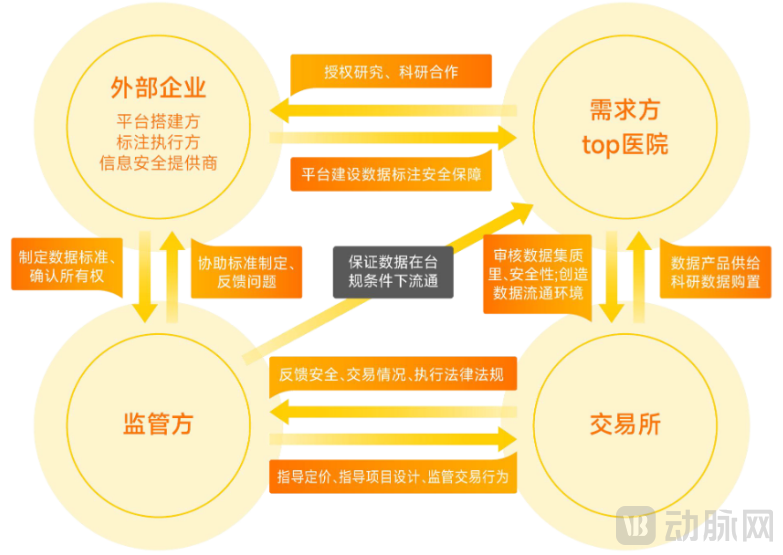
Ideal Conditions for Health Data Trading Models
Despite the numerous obstacles still hindering data trading, healthcare institutions, enterprises, exchanges, and regulatory bodies all have incentives to drive health education forward from a long-term perspective.
For hospitals, although medical IT construction under policy guidance can enhance their comprehensive competitiveness in the long run, it is recorded as costs in the income statement in the short term. Therefore, despite continuous policy support, many hospitals are still reluctant to invest significant efforts in medical informationization.
The realization of health data trading could change this situation. By selling de-identified data at scale, hospitals can transform data governance from a cost center into a revenue stream, thereby stimulating their initiative to further deepen informatization construction.
For AI and health IT companies, the trading of health data has also brought positive impacts. Previously, when these enterprises conducted application R&D based on clinical data, they were often constrained by collaborations with a limited number of hospitals, which could lead to regional bias in algorithm performance and hinder broad adoption.
Once health data trading reaches scale, these companies are poised to reduce their reliance on hospitals by integrating data from multiple institutions at the outset of R&D to develop more robust artificial intelligence. Furthermore, this new model enables greater independence in the commercialization of AI products, thereby mitigating potential intellectual property disputes.
The issue is that although the variety of health data products available in the current market is more diverse than in the past, there are no substitutes, leading to relatively high prices for health data. This makes it difficult to fully meet buyers’ demands for data volume and diversity, and may even result in the value of models trained by buyers failing to offset their training costs. Consequently, trading volumes in the health data market will remain low in the short term.
Therefore, as larger-scale and multi-tiered medical institutions enter the market, and big data exchanges list a richer array of high-quality health data products, we may witness the true value embedded in health data trading amidst full competition—it will become the core force driving the comprehensive digital and intelligent transformation of China’s healthcare system.