

Domestic TSLP Pipelines Claim Half of the Emerging Billion-Dollar Respiratory Immunology Market
TSLP Pipelines Have Remained Hot from the Beginning to the End of the Year, with Major Shifts Imminent in the Trillion-Yuan Respiratory and Immunology Market.
In late November, Aclaris’s stock price doubled in two days, driven by the TSLP pipeline acquired from Boaoxin. In September, Upstream successfully went public and raised $255 million, leveraging its “repurposed” TSLP pipeline. Not to mention that in January, Aiolos Bio resold a TSLP pipeline—purchased from Hengrui for $25 million less than four months earlier—for $1.4 billion.
Behind the transaction lies a vast unmet clinical need.
In the field of respiratory diseases, where asthma and chronic obstructive pulmonary disease (COPD) are the predominant conditions, biologic targeted therapies—represented by Novartis’s anti-IgE monoclonal antibody, GSK’s anti-IL-5 monoclonal antibody, Sanofi’s anti-IL-4R monoclonal antibody, and AstraZeneca’s anti-TSLP monoclonal antibody—have made significant strides in asthma treatment but have encountered successive setbacks in the COPD arena.
Under these circumstances, research into biologics for chronic obstructive pulmonary disease (COPD) has begun to shift toward type 2 inflammation (accounting for approximately 20%–40% of COPD patients) and non-type 2 inflammation. The R&D paradigm has also evolved from symptomatic treatment to addressing underlying causes, and from downstream targets to upstream targets. Upstream targets represented by thymic stromal lymphopoietin (TSLP) and interleukin-33 (IL-33) have garnered increasing attention from pharmaceutical companies during this process, leading to the heightened interest in TSLP-related transactions.
According to a report by Precedence Research, the global market size for asthma and COPD reached $35.3 billion in 2021, with a projected compound annual growth rate (CAGR) of 5.4% from 2022 to 2030. As the respiratory immunology market enters the era of biologic targeted therapies, it is poised for further expansion.
The Multi-Billion Respiratory Market: Change Is Imminent.
The field of respiratory immunology is at a critical turning point in its development.
The emergence of biologic targeted therapies has begun to gradually transform the treatment paradigm for respiratory diseases.
In the past, treatment regimens for asthma and COPD were based on dilating overly constricted bronchi, using agents such as long- and short-acting β2-adrenergic agonists and anticholinergics. Subsequently, clinical practice began to combine long- and short-acting β2-adrenergic agonists with glucocorticoids. Representative drugs from this phase include AstraZeneca’s budesonide and GSK’s salmeterol/fluticasone combination. However, since corticosteroids can easily cause adverse reactions while controlling symptoms, the iteration of respiratory medications has not ceased.
As research has deepened, it has been discovered that respiratory system inflammation is dominated by Th2 cells. These Th2 cells produce various cytokines, including IL-4, IL-5, and IL-13, which are involved in the pathogenesis of inflammation. Consequently, targeted therapies have begun to emerge, such as GSK’s mepolizumab (anti-IL-5), AstraZeneca’s benralizumab (anti-IL-5Rα monoclonal antibody), and Sanofi’s dupilumab (anti-IL-4Rα monoclonal antibody).
Among these, Novartis’s omalizumab was the first biologic targeted therapy approved globally for the treatment of moderate-to-severe asthma. Mepolizumab, the first IL-5-targeted biologic therapy approved worldwide, is indicated for severe eosinophilic asthma. It was approved for marketing in the United States in 2015 and in China in 2021, becoming the first IL-5 monoclonal antibody approved in China. Its sales exceeded $2 billion in 2023.
After years of development, the landscape of biologic targeted therapy in asthma has taken initial shape. In contrast, no new biologic targeted therapies for chronic obstructive pulmonary disease (COPD) have emerged for over a decade, until 2024, when Sanofi’s dupilumab was successively approved in Europe, the United States, and China for the treatment of COPD. Meanwhile, GSK’s mepolizumab has achieved success in Phase III trials and submitted a New Drug Application (NDA), while AstraZeneca and Amgen’s anti-TSLP agent, tezepelumab, has demonstrated significant clinical benefits in Phase II trials. The transformative impact of biologics on asthma management appears poised to be replicated in the field of COPD.
According to survey data from the China Adult Pulmonary Health Study, it is estimated that there are approximately 100 million patients with chronic obstructive pulmonary disease (COPD) in China, making it a major chronic condition on par with hypertension and diabetes. With the approval of biologic targeted therapies, the COPD market is poised for significant reshuffling.
The development of biologic targeted therapies for COPD has been a tortuous journey.
Previously, the development of biologics for chronic obstructive pulmonary disease (COPD) primarily focused on products that were already marketed or in late-stage clinical trials, such as studies expanding the indications of asthma biologics to include COPD. Typical examples include AstraZeneca’s benralizumab and GSK’s mepolizumab, both targeting interleukin-5 (IL-5). Although these agents failed to meet their primary endpoints in clinical trials for expanded COPD indications, subsequent analysis of the trial data revealed that significantly benefiting subpopulations could be identified from different patient groups.
Subsequently, GSK redesigned the clinical protocol and announced positive results from the Phase 3 MATINEE study of mepolizumab for the treatment of COPD in the second half of 2024.
Other multinational corporations (MNCs) have drawn inspiration from this, placing greater emphasis on the selection of key populations in the design of clinical trials for chronic obstructive pulmonary disease (COPD). Consequently, we observe that Sanofi’s itepekimab targeted a subgroup of smokers, AstraZeneca’s tozorakimab focused on patients with a history of moderate-to-severe COPD exacerbations, and the beneficiary population for Roche’s astegolimab was concentrated among patients with low eosinophil counts (<300 cells/μL).
Although IL-5(R) got an early start, it was IL-4Rα that emerged as the frontrunner.
Dupilumab, the IL-4Rα monoclonal antibody co-developed by Sanofi and Regeneron, was approved in November 2023 for asthma in adolescents aged 12 years and older and adults. It subsequently received European approval in July 2024 for adults with poorly controlled COPD and elevated blood eosinophils, followed by simultaneous approvals in the United States and China in September.
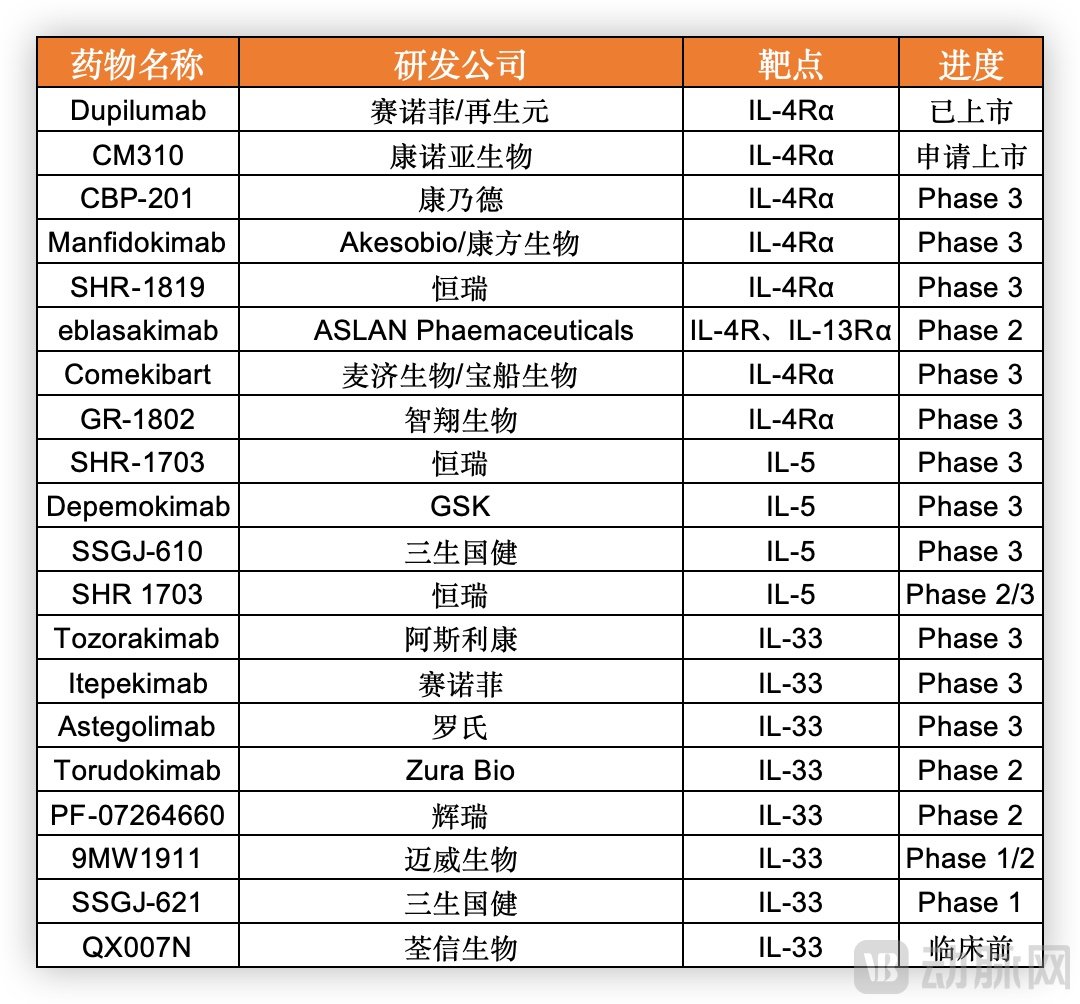
Leading Respiratory and Immunology Biologic Targeted Therapies: Compiled from Public Information
As the only biologic currently approved for both asthma and COPD, dupilumab holds a first-mover advantage and occupies a leading position in the field of type 2 inflammation-driven immune-mediated inflammatory diseases. Meanwhile, Sanofi’s potential future blockbuster anti-IL-33 candidate, itepekimab, has demonstrated robust data in Phase II clinical trials for COPD. If it can maintain this momentum in the Phase III trials, with results expected to be read out next year, respiratory immunology is poised to become a new growth engine for Sanofi’s future performance.
Of course, competitors are not far behind. After GSK’s mepolizumab was approved in January 2024 for severe eosinophilic asthma in adolescents aged 12 years and older and adults, the company submitted an application to the FDA on December 9 for adjunctive maintenance treatment in patients with eosinophilic COPD, positioning it to potentially become the first biologic approved for monthly administration in COPD patients.
Furthermore, the table reveals a substantial number of pipeline candidates in late-stage clinical development, suggesting that the respiratory field may witness a surge of new drug approvals in the coming years. In terms of target portfolio layout, Sanofi appears relatively more comprehensive.
Early research targets for biologic drugs in COPD were primarily located downstream in cellular signaling pathways, but are now extending upstream.
Data from recent clinical studies on COPD indicate that targeting broader cytokines, specifically IL-4 and IL-13, is more advantageous than blocking individual cytokines (such as IL-5) or their primary targets (i.e., IL-5Rα). Furthermore, IL-33 and TSLP, as upstream regulators in airway inflammation for both high-expression type 2 inflammation and low-immune-response type 2 inflammation, hold promise as future directions for precision therapy in COPD.
This is precisely the rationale behind Sanofi’s IL-33 monoclonal antibody, itepekimab. By combining it with dupilumab, the therapy can address both Type 2 and non-Type 2 inflammatory markets, creating complementary advantages. To this end, Sanofi has expressed optimism that this combination alone could generate over $5.5 billion in revenue within the COPD field.
With the development of upstream targets represented by TSLP and IL-33, the respiratory immunology market will witness a surge in new drug launches in the coming years.
From symptomatic to etiological, from downstream to upstream: the future development trend of biological drugs in the respiratory field.
The TSLP target, which has been thrust into the spotlight due to Bio-Thera Solutions’ BD deals and Hengrui Medicine’s arbitrage profit from Aiolos Bio at the beginning of the year, is aligning with this development trend.
TSLP is an airway epithelium-derived cytokine that is released in response to environmental stimuli such as allergens, viruses, bacteria, and pollutants. It acts in concert with other epithelial-derived alarmin cytokines (such as IL-25 and IL-33) to promote downstream inflammatory responses, including both type 2 and non-type 2 inflammation.
Taking asthma as an example, thymic stromal lymphopoietin (TSLP) acts at the early upstream stage of the inflammatory cascade and does not require biomarker screening, demonstrating favorable efficacy in approximately 30%–40% of patients with severe non-eosinophilic phenotype asthma. Furthermore, targeting TSLP exerts broad effects on autoimmunity and effectively controls multiple immune-mediated diseases, including asthma, chronic rhinosinusitis with nasal polyps (CRSwNP), and chronic obstructive pulmonary disease (COPD).
Tezepelumab, jointly developed by AstraZeneca and Amgen, is currently the only approved anti-TSLP monoclonal antibody worldwide. It represents a biologic therapy without phenotypic or biomarker restrictions, overcoming the limitations in treating eosinophilic asthma. Furthermore, clinical trials of tezepelumab are underway for multiple indications, including asthma, chronic rhinosinusitis with nasal polyps, eosinophilic esophagitis, chronic spontaneous urticaria, COPD, atopic dermatitis, and allergies.
Currently, there are more than 20 active TSLP pipelines worldwide, with Chinese-developed pipelines accounting for over half; their future development warrants attention.
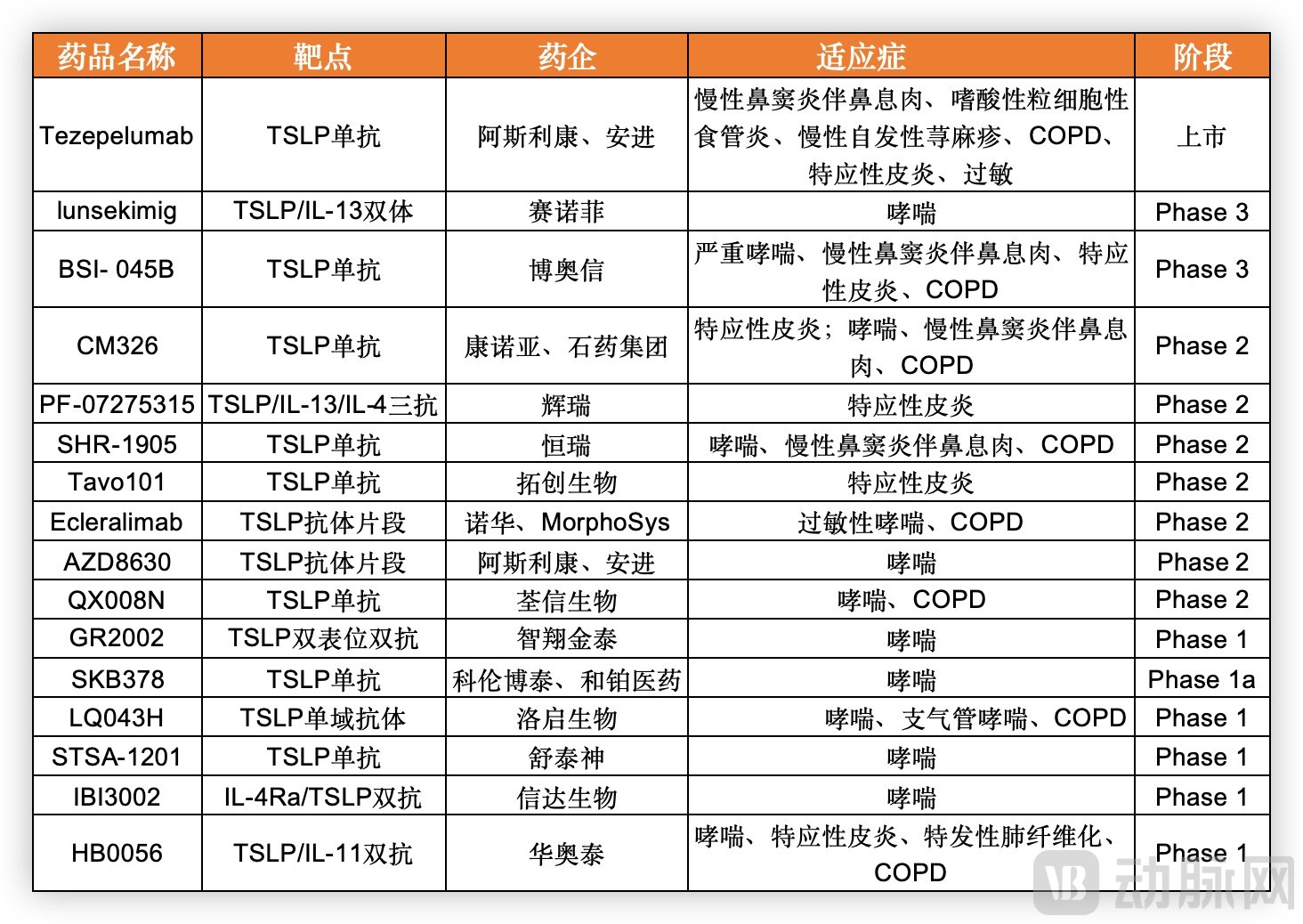
Partial TSLP Product Pipeline, Compiled from Publicly Available Information
From the perspective of the competitive landscape, multinational corporations (MNCs) such as Sanofi, AstraZeneca, GSK, Pfizer, and Johnson & Johnson are all involved. In terms of their pipelines, their strategic focus lies in TSLP-based bispecific antibodies and even trispecific antibodies, such as TSLP+IL-13 and TSLP+IL-13+IL-14. In contrast, apart from Innovent Biologics’ TSLP+IL-14R bispecific antibody and Zhixiang Jintai’s TSLP bispecific epitope antibody, Chinese pharmaceutical companies are primarily concentrated on developing TSLP monoclonal antibodies. In future competition or business development (BD) transactions, domestic TSLP pipelines will still maintain their unique advantages.
In terms of R&D progress, Sanofi and Boaoxin have entered Phase III clinical trials, taking a leading position. Over the years, Sanofi has gradually gained a lead in the respiratory therapeutic area through its own efforts. Although its portfolio is relatively comprehensive, it appears to lack a TSLP candidate for COPD; it remains to be seen whether Sanofi will acquire a domestically developed TSLP asset. In addition to Sanofi, AstraZeneca has focused on upstream targets TSLP and IL-33, with promising future potential.
Although Hengrui Medicine “mistakenly” sold the global rights to SHR1905 to Aiolos Bio, the drug still holds strong potential in the Chinese domestic market, driven by the patient compliance advantage of its semi-annual dosing regimen. Similarly, Locus Biosciences’ LQ043 has adopted a differentiated mode of administration; compared with conventional injectable antibody drugs, its inhalable formulation is undoubtedly more patient-friendly. Currently, among global pipelines under development, only LQ043 and AstraZeneca’s AZD8630 utilize an inhalable formulation.
It is evident that with the surge in interest surrounding the TSLP target, pharmaceutical companies that have pursued differentiated innovation strategies in this field are poised to become market focal points in the future. GSK’s willingness to allow Aiolos Bio to capture substantial margins stems not only from the inherent potential of TSLP but also from the twice-yearly dosing regimen of SHR1905, which was a significant factor attracting GSK’s engagement.
New-generation targets represented by TSLP and IL-33 will usher respiratory immunology into a new era of therapeutic paradigms. This transition also presents an opportunity for Chinese pharmaceutical companies to stage a comeback.
"Only by following MNCs can you reap the rewards."
Whether it is the combination of Sanofi’s dupilumab and itepekimab, or the two tri-specific antibodies approved by Pfizer for clinical trials in China in mid-2024, the core rationale behind their strategic layouts lies in addressing both type 2 and non-type 2 inflammation. Taking Pfizer’s IL-4/IL-13/IL-33 tri-specific antibody PF-07264660 and its IL-4/IL-13/TSLP tri-specific antibody as examples, the IL-4 and IL-13 targets are designed to address type 2 inflammation, while IL-33 and TSLP are intended to cover non-type 2 inflammation.
So, which domestic pharmaceutical companies are following suit?
According to the CDE website, the clinical trial application for Innovent Biologics’ Class 1 novel drug IBI-3002 was accepted on December 7. IBI-3002 is a bispecific antibody targeting IL-4Rα and TSLP, featuring potent dual blockade of IL-4Rα and TSLP. In vitro functional assays demonstrated that it outperforms marketed monoclonal antibodies with the same targets. By simultaneously targeting IL-4Rα and TSLP, IBI-3002 has the potential to inhibit both type 2 and non-type 2 inflammation, with possible synergistic effects in suppressing type 2 inflammation, thereby holding promise for superior efficacy in the treatment of type 2 inflammatory diseases.
Previously, a clinical study of IBI-3002 for asthma registered by Innovent Biologics was searchable on the ClinicalTrials.gov website. In early 2024, the first-in-human Phase I clinical trial of IBI-3002 completed its first patient dosing in Australia. The current application for clinical trials in China indicates that Innovent will accelerate the domestic development progress of IBI-3002.
Looking back at the BSI-045B and BSI-502 assets involved in the business development (BD) transaction between Boaoxin and Aclaris, BSI-045B is a TSLP monoclonal antibody, while BSI-502, although still in the preclinical stage, is a novel bispecific antibody targeting both TSLP and IL-4R. With such promising candidates in its pipeline, it is understandable that Aclaris has gained market recognition, leading to a doubling of its stock price within two days.
In addition, among the two pipelines that Keymed Biosciences licensed out to Belenos in a NewCo structure in July 2024, CM512 is also a bispecific antibody targeting TSLP and IL-13. It remains to be seen how Belenos will subsequently position this pipeline. Meanwhile, HB0056, the world’s first bispecific antibody targeting TSLP/IL-11 independently developed by Hua Aotai, completed dosing of the first subject in New Zealand in early December.
Overall, as new therapies continue to reach the market, the respiratory immunology sector is poised for a new growth cycle. The forward-looking strategies of Chinese pharmaceutical companies, coupled with a vast patient population, create ample room for multiple blockbuster drugs. It remains to be seen which players will secure advantageous positions in this transformation.
References:
《Chinese Expert Consensus on the Diagnosis and Management of Severe Asthma (2024)》
“Current Status and Prospects of Biologic Therapy in Severe Asthma”
“Expert Consensus on the Mechanisms and Targeted Therapy of Type 2 Inflammatory Diseases”
“The Big Four Biologics Battle for COPD”
《Towards precision medicine in COPD: Targeting type 2 cytokines and alarmins》