

Fanxing Opto-Medical's Founder Dong Guoqing: Delong 4K Optical Nasal Endoscope Receives NMPA Innovative Medical Device Approval, Redefining True 4K Endoscopy
In the universe of modern medicine, the endoscope is undoubtedly a shining star. Hailed as the doctor’s “third eye,” this slender imaging device can enter the patient’s body through small incisions or natural orifices to trace the presence of disease, thereby opening the door to precise, minimally invasive treatment.
Since the invention of the endoscope by German physician Philipp Bozzini in 1806, German endoscopy has remained at the forefront of the industry, serving as a leader in innovation within the field. Focusing on the research and development of minimally invasive surgical optical endoscopes and medical imaging systems,BEIJING FANXING GUANGDIAN MEDICAL TREATMENT EQUIPMENT CO LTD(hereinafter referred to as: Fanxing Optoelectronics) is also one of the followers of German innovative technologies. Since the establishment of the company, Founder and Chairman Dong GuoqingSteadfastly committed to a single goal, which is"Develop domestically produced endoscopes that surpass German products in the future.". Therefore, when Fanxing Optoelectronics' first independently developed endoscopic camera system was approved in 2008, Dong Guoqing named it“Delong”, symbolizing a Chinese dragon surpassing Germany.
As time flies,In December 2024, the Delong 4K Optical Nasal Endoscope Was Officially Approved by the NMPA for Market Launch, becomingThe World's First Approved 4K Optical Endoscope. Throughout this journey, Dong Guoqing has witnessed the evolution of domestically produced products from imitation to independent research and development, and now to surpassing their counterparts; he has gained new insights into domestic innovation.
Imitate, Follow, Lead: Innovation Begins with Heritage
In 1998, Fanxing Optoelectronics was established in Beijing, focusing on the manufacturing of endoscopes, endoscopic camera systems, and related peripheral products. Although Fanxing Optoelectronics was primarily engaged in product agency sales during this phase, the team also attempted to innovate within the industry.Launch of Waterproof Camera Systemgaining fame for what peers jokingly called “putting a vest on an original machine.” Looking back, Dong Guoqing recalls: “Although it involved only minor adjustments to the product—what would now be considered merely a small innovation—it was no simple feat of innovation at the time. This enabled our products to remain leading and best-selling among domestically produced alternatives for over five years.”
At that time, few domestic companies were focused on the research and development of endoscopes; most were engaged in assembling or distributing imported overseas products. As the range of distributed products expanded, Dong Guoqing’s understanding of the endoscopy market deepened. He gradually realized:If we fail to independently develop endoscopes and neglect innovation, we will remain perpetually dependent on others.Thus, the company proposed“"Striving for Innovation, Change, and Development"slogan, and innovation has become the corporate DNA of Fanxing Guangdian, which it has steadfastly upheld to this day.
In 2003, Fanxing Optoelectronics introduced camera system components from France and made its first attempt at product assembly, laying the foundation for subsequent research and development. Until 2008,Fanxing Optoelectronics independently developed China's first standard-definition endoscopic camera system with video recording capabilities, the Delong F168D., filling the gap in domestically developed products in this field at that time. The Delong F168D is hailed by Beijing Fanxing Guangdian Medical Treatment Equipment Co., Ltd. as its first-generation innovative product and also as the first generation of Chinese-made endoscopes. Since then, built-in recording functionality in camera control units has become an industry standard.
Building on the foundation of the Delong F168D, Fanxing Optoelectronics has been deeply engaged in endoscopic innovation, launching its product in 2013.China's First Independently Developed HD Three-Chip Endoscopic Camera System: Delong HD380This device’s USB high-definition recording and 1-gigabit Ethernet image transmission capabilities represent a world-first innovation, signifying that the key technical indicators of domestically produced endoscopes have reached a globally leading level. In the same year, the Delong HD380 obtained both the European CE certification for medical devices and U.S. FDA clearance. The Delong HD380 thus became Fanxing Optoelectronics’ landmark second-generation innovative product, marking the entry of domestically produced endoscopes into competition with imported brands.
In 2016, at the MEDICA trade fair in Düsseldorf, Germany, Dong Guoqing saw foreign companies exhibiting 4K camera systems for the first time. For endoscopes, image clarity is a core direction of development. The emergence of 4K technology has increased image clarity several times over, providing doctors with clearer and more detailed images, thereby significantly improving surgical precision and patient treatment outcomes. At that time, hardly any other companies were capable of developing 4K products.
He felt immense pressure, and a subtle signal began to emerge:A Major Industry Upheaval Is ImminentAmidst the surging tide, Fanxing Optoelectronics keenly perceived both crisis and opportunity, and resolutely embarked on its third R&D journey the following year (2017).
This time, Fanxing Optoelectronics' goals are not only focused on4K Camera Systemrefinement, but also boldly ventured into uncharted territories —Design and Manufacturing of Optical Endoscopes. This cross-sector endeavor has propelled Fanxing Optoelectronics to leapfrog intoGlobalA rare few companies with R&D capabilities in both optics and imaging, it also means that the company has stepped into a new “battlefield” full of unknowns and challenges.
The Path to R&D in Optical Endoscopy Is Marked by High Technical Barriers. Compared with imaging products, optical endoscopes differ vastly in design philosophy, material selection, optical lens polishing, and manufacturing processes, with each stage presenting unprecedented challenges. In the face of these difficulties, Fanxing Optoelectronics has dedicated itself to intensive research for nearly a decade, investing substantial R&D fundsOver RMB 30 million,Having Undergone6 failures. Successfully developed in December 2024Delong 4K Optical Nasal Endoscope, Approved with an Innovative Medical Device Registration Certificatesuccessfully launched into the market. Fanxing Optoelectronics’ perseverance and breakthroughs along this journey have not only carved out a differentiated competitive niche for itself, but also injected strong momentum into technological innovation within the industry.
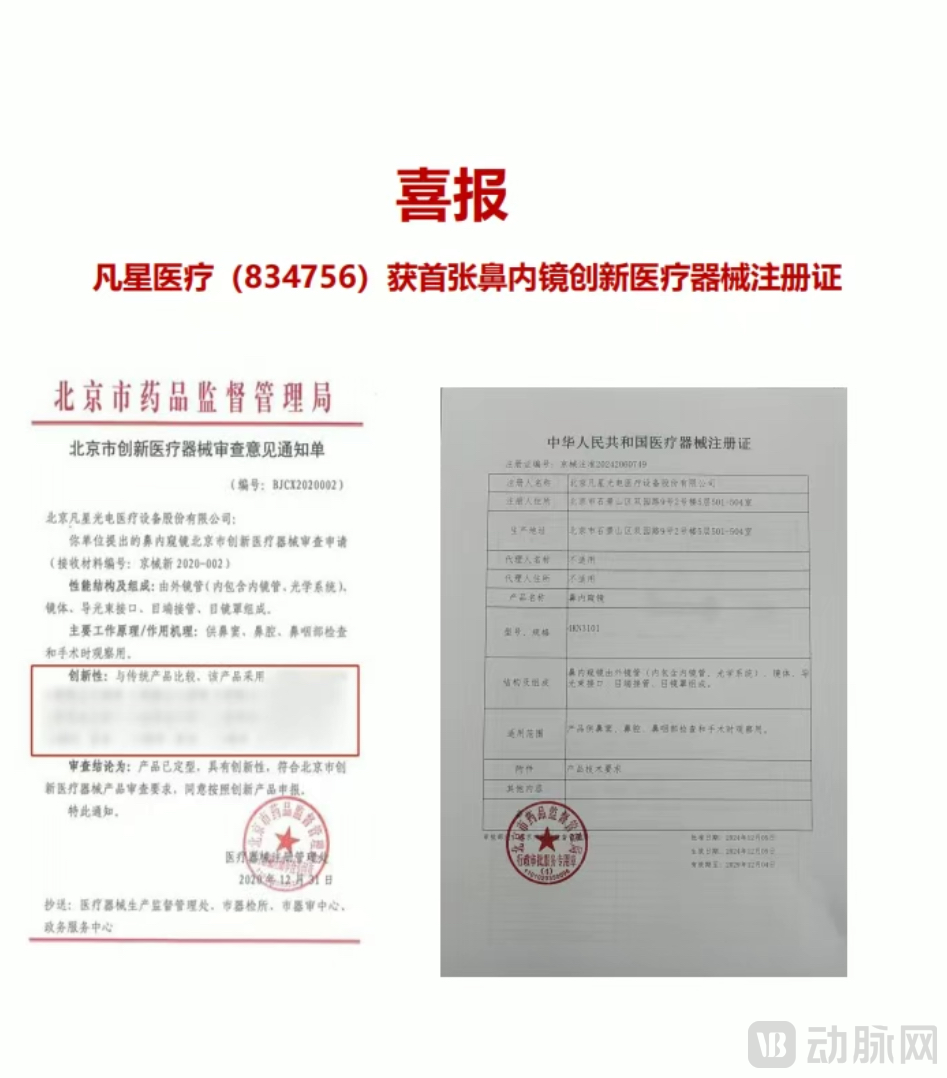 Fanxing Optoelectronics Products Approved (Photo Provided by Interviewee)
When recounting the three innovation journeys of Beijing Fanxing Guangdian Medical Treatment Equipment Co., Ltd., Dong Guoqing could hardly conceal his excitement. This represents a significant turning point, both for the company and for the development of domestically produced endoscopes in China. He remarked, “It is no exaggeration to say that our initial foray into innovation was driven solely by the need to ‘survive’ in the market. But later we realized,”Only innovation has enabled us to evolve from imitation and following to surpassing."This represents a crucial step for both Fanxing Optoelectronics and the development of domestically produced endoscopes."
A Fine Steed Deserves a Fine Saddle: Pioneering the 4K Optical Endoscope Series
In Dong Guoqing's WeChat Moments,“Catch Up and Overtake”It has been set to the top position. This is his motto and the goal that Fanxing Optoelectronics has always strived to achieve. The success story of 4K optical endoscopes also epitomizes Fanxing Optoelectronics’ rise from behind to surpass its competitors.
Compared with traditional high-definition resolution, 4K can provide clearer and more delicate image details. In minimally invasive surgical operations, the clearer the field of vision, the better it can guide doctors in surgery. In recent years, the concept of 4K has been repeatedly mentioned in the field of endoscopy, however, optical 4K is rarely heard of. Dong Guoqing explained: "Optics and 4K are two completely different technical fields. Combining the two requires overcoming many difficulties.""In his view, the greatest challenge lies not in technology, but in shifting mindsets."
Optical endoscopes primarily emphasize the use of their own optical imaging systems to capture images, whereas 4K technology relies on CMOS chips to process and display the captured image signals. Their functional positions also differ: an optical endoscope is a complex imaging system mainly composed of an objective lens, a relay rod lens system, an eyepiece, a fiber-optic illumination system, and mechanical structures; in contrast, 4K technology primarily acts on the imaging stage of the optical endoscope.Even if the processing system meets the 4K standard, if the resolution of the endoscope’s optical lens fails to meet the optical technical specifications required by the CMOS sensor, the overall image quality will not achieve true 4K performance.
However, in the market, researchers of optical endoscopes and developers of 4K CMOS chip camera systems tend to focus on their respective single domains. Few manufacturers pursue both avenues simultaneously, which has become a significant factor currently constraining the development of 4K optical endoscopes.
To fill this gap, Fanxing Optoelectronics conducted in-depth research into the relationship between optics and 4K technology, pioneering the proposal of“4K Optical Chain Theory”, and to promote the understanding within the medical endoscopy industry that the relationship between optics and CMOS chips follows the image-space modulation transfer function formula: 1000/2*x (pixel size) = optical resolution (LP/mm). The “Delong 4K Optical Chain Theory” posits that every link in the entire chain, starting from the optical endoscope, must meet the resolution requirements of 4K CMOS chips to ensure that the full 4K system achieves true high-level 4K performance. This theory has been explicitly protected by a U.S. invention patent.
The Delong 4K Nasal Endoscopy System truly integrates a 4K system with a 4K lens to deliver authentic 4K imagery.This product has not only been approved through the “Beijing Innovative Medical Device” review channel, but has also obtained European and U.S. invention patents, truly realizingThe latecomers have surpassed the pioneers.
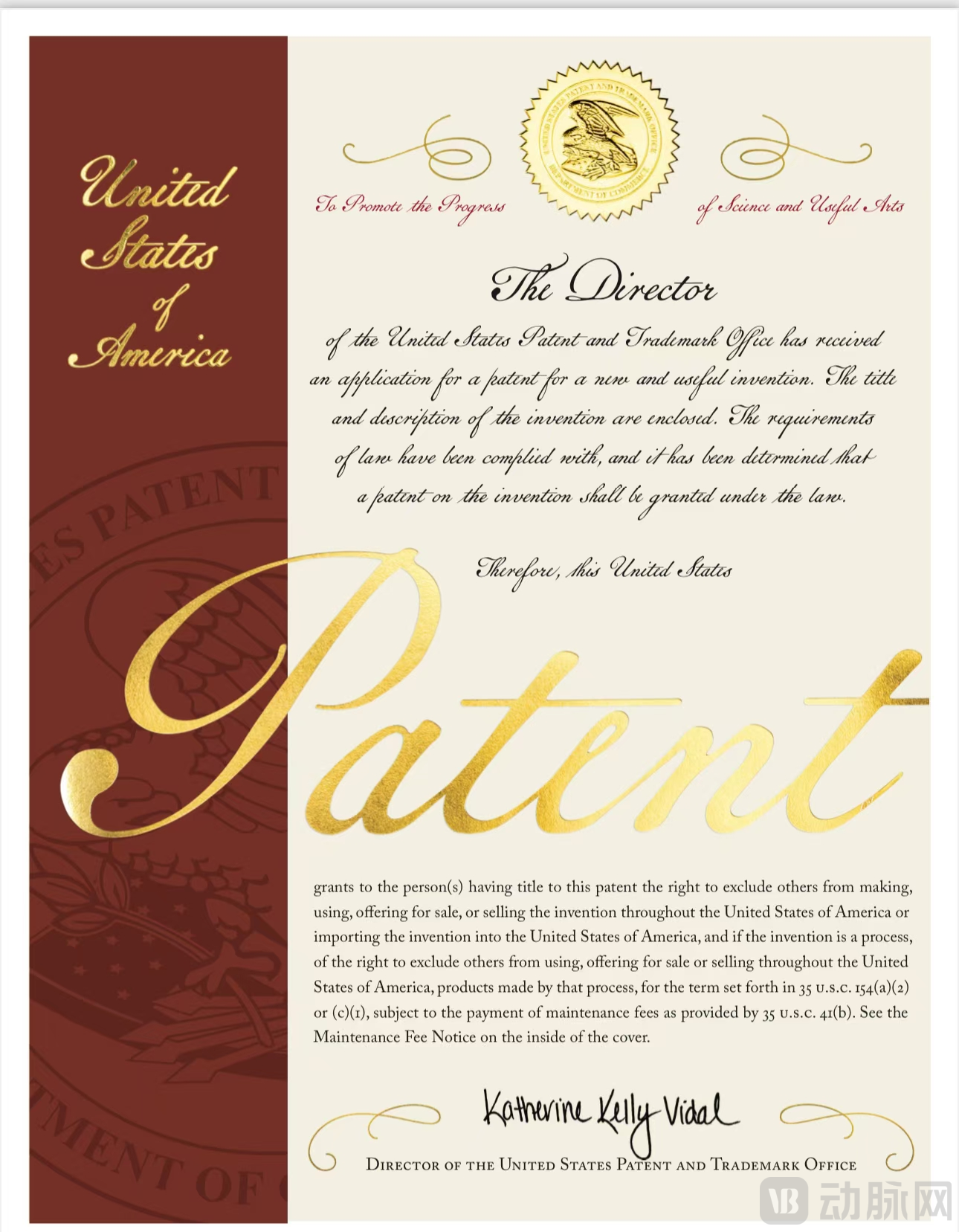
Fanxing Optoelectronics Optical Endoscopes and Integrated Endoscopy SystemsAwarded a U.S. invention patent (Photo provided by the interviewee))

Fanxing Optoelectronics’ Optical Endoscope and Endoscope Integration System Granted Invention Patents in 45 European Countries (Photo provided by interviewee)
Dong Guoqing stated, “As the saying goes, a good horse deserves a good saddle.”Only when the system is compatible with the optical lens, in order to maximize the efficacy of endoscopy.”
Nowadays, the 4K nasal endoscope has obtained the National Medical Device Innovation Registration Certificate., for Fanxing Optoelectronics, this marks breakthroughs in two key areas:First, the technical indicators have reached an internationally leading level; second, pioneering inventions have been achieved.Dong Guoqing stated, “The 4K nasal endoscope has undergone rigorous clinical validation, confirming that it surpasses existing products on the market in terms of clarity and transparency. We are deeply honored and proud to have received the National Medical Device Innovation Registration Certificate, while also feeling a profound sense of responsibility.” Looking ahead, in the field of minimally invasive surgical endoscopy, Fanxing Optoelectronics will continue to drive innovation, using this highest honor bestowed by the state as motivation to press forward.
Let Technology Speak: Shattering Prejudices Against “Made-in-China” Products
Since its inception, Beijing Fanxing Guangdian Medical Treatment Equipment Co., Ltd. has been driven by Dong Guoqing’s sincere commitment to domestically produced “self-made” solutions. Previously, the company continuously proposed innovative concepts, emulating and catching up with overseas endoscopic products in an effort to achieve domestic substitution at the earliest possible date. However, after the “Delong 4K Optical Chain Theory” redefined 4K optical endoscopy, Fanxing Guangdian opened up a new track in the endoscopy field, bringing it one step closer to realizing domestic substitution.
Physicians are the operators of endoscopes and the only “judges” who can personally assess whether these devices meet the standards for domestic substitution. Imported endoscopes have been entrenched in Chinese operating rooms for decades; both seasoned clinical experts and newly trained surgeons have primarily learned on and used imported endoscopes.It is not easy to break doctors' ingrained operational habits.. The Delong 4K optical nasal endoscope, with its ultra-high resolution, delivers exceptional brightness, allowing physicians to maintain a greater distance from the target area and operate within a larger working space. As a novel device without precedent, it is capable ofReshaping clinical operational habits, starting with domestically produced 4K systems.
Starting with the Delong 4K optical nasal endoscope, Fanxing Guangdian has advanced the development of its 4K optical endoscopy series, while its 8K laparoscope has also been launched. It is reported that the R&D team at Fanxing Guangdian is currently developing“3D + Rotating 4K Optical Endoscopy System” is undergoing type testingand has filed for invention patents in the United States and Europe. In the future, this product may be recognized as a national-level innovative medical device. The “3D + Rotating 4K Optical Endoscopy System” aims to address the existing drawbacks of clinical 3D endoscopes,It effectively overcomes the dilemma of a constrained and limited field of view caused by its inability to rotate flexibly.Meanwhile, this product allows flexible switching among 3D and 2D views and 3D fluorescence imaging, enabling surgeons to perform various delicate and complex procedures with a diverse, comprehensive perspective, ensuring precision, stability, and efficiency.
In recent years, the development of new-quality productive forces has become a key policy-driven direction, providing core momentum and technical support for achieving domestic substitution. As medical technological advancements are closely linked to public health and well-being, domestic substitution in this field is particularly crucial.
Dong Guoqing believes that in the process of promoting domestic substitution in the field of medical devices,The top priority is to ensure that doctors are not “forced into a disadvantageous position” when using domestically produced products., this not only demonstrates respect for physicians’ professional competence but also underscores responsibility for patients’ safety and health. Only when domestically produced medical devices surpass imported products in technical performance and offer user-friendly operation that enables physicians to use them with ease and satisfaction can the goal of domestic substitution be considered truly achieved.
In addition,Actively building a strong corporate image is also an important direction for promoting the substitution of domestic products for imports.Looking back, it is undeniable that domestically produced medical devices have lagged behind their overseas counterparts in terms of technical proficiency. Although significant advancements have been made in the capabilities of domestic equipment in recent years, overturning the long-standing market perceptions regarding domestic products is no easy feat and cannot be achieved overnight. Consequently, overseas products continue to hold a larger market share than domestic ones in the current endoscopy market.
Of course, the development of domestic industries is akin to a long marathon, requiring ample time for consolidation, accumulation, and growth. As an increasing number of Chinese enterprises, such as BEIJING FANXING GUANGDIAN MEDICAL TREATMENT EQUIPMENT CO LTD, actively engage in research and development, meticulously refining their products with high standards and strict requirements, Dong Guoqing believes thatIt is only a matter of time before the market’s entrenched prejudices against domestically produced products are overturned; in the future, Chinese-made minimally invasive endoscopes will surely secure a place on the global stage.