

Candid Therapeutics Announces Three TCE Collaborations in One Day, Securing $13.2 Billion in Total Deal Value

EpimAb Biotherapeutics
Developer of Tumor Bispecific Antibodies

Candid Therapeutics
Developer of Immune Disease Treatment Methods

NextFab Studio
None
If we were to identify the hottest niche segment in the pharmaceutical industry in 2024, T-cell engagers (TCEs) would undoubtedly be at the top of the list. The frequent occurrence of major transactions, large-scale financing rounds, mergers and acquisitions, and the emergence of the NewCo model have collectively demonstrated the exceptional vitality and fervor of this sector.
On December 16, the hot TCE sector once again became a key area of strategic investment for the pharmaceutical industry. Within a single day, Candid Therapeutics announced TCE collaborations with three companies: Harbour BioMed, EpimAb Biotherapeutics, and Ab Studio. The total value of these partnerships is known to reach up to $1.32 billion (approximately RMB 9.614 billion).
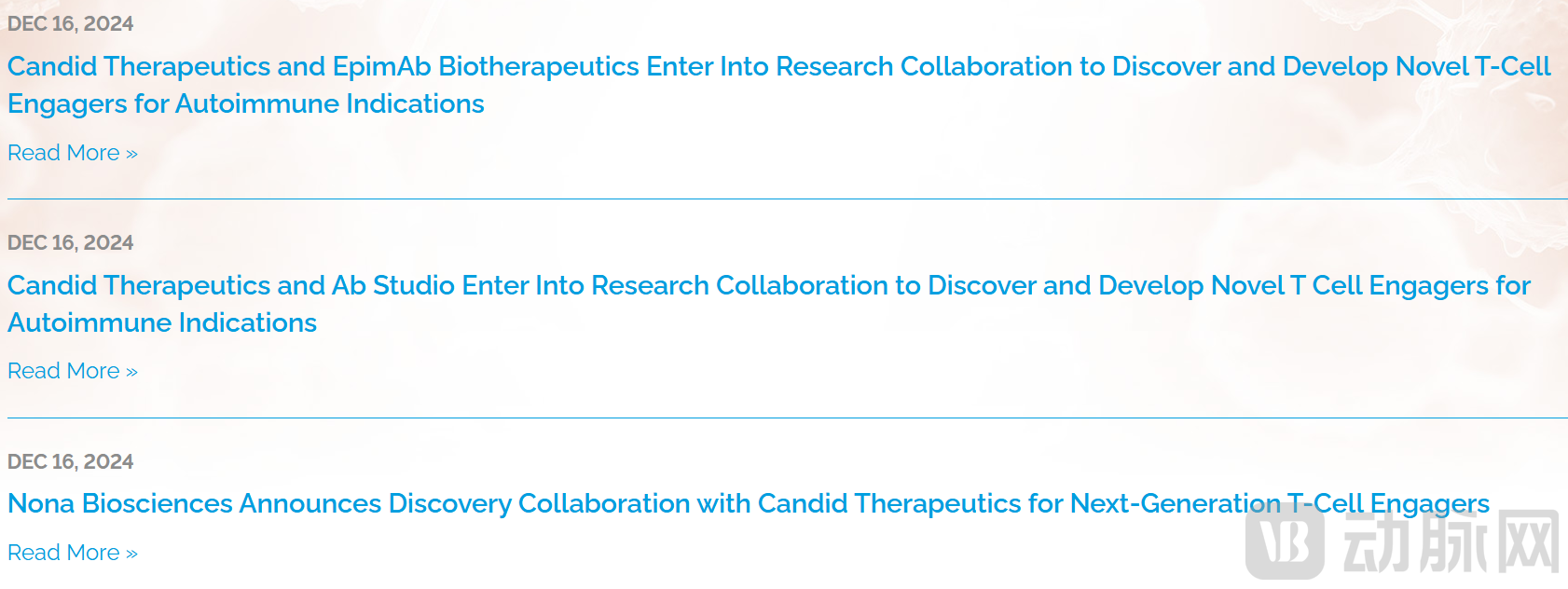
Candid Partners with Harbour BioMed, EpimAb Biotherapeutics, and Ab Studio (Image source: Candid official website)
On December 16 (local time), Candid announced that it has entered into a research collaboration and license agreement with Harbour BioMed, a subsidiary of Hansoh Pharma, to develop next-generation T cell engagers (TCEs). Under the terms of the agreement, Harbour BioMed is eligible to receive an upfront payment and potential milestone payments totaling up to $320 million. Candid will be responsible for all subsequent development of the product.
On the same day, Candid Therapeutics announced a strategic research collaboration with EpimAb Biotherapeutics to discover and develop novel TCE candidate drugs for autoimmune indications. Under the terms of the agreement, if multiple candidates successfully reach the commercialization stage, Epimab Biotherapeutics is entitled to an upfront payment and total development and sales milestone payments exceeding $1 billion, as well as royalties based on net sales. Candid Therapeutics holds exclusive global rights to develop and commercialize the collaborative projects.
On another front, Candid announced that it has entered into a strategic research collaboration with Ab Studio to discover and develop novel TCEs for the treatment of autoimmune diseases. Under the terms of the agreement, Ab Studio will receive undisclosed payments. Candid holds exclusive rights to develop and commercialize the collaborative programs.
Behind the three partnerships secured by Candid Therapeutics within a single day lie strong Chinese influences. As two Chinese biotech firms, Harbour BioMed and EpimAb Biotherapeutics need no further introduction. Although Ab Studio is a biotechnology company based in the San Francisco Bay Area of the United States, it too bears significant Chinese characteristics.
Ab Studio was founded in 2017, with Dr. Yue Liu, a Chinese scientist, serving as a co-founder and President. Dr. Liu has over two decades of experience in antibody drug development, having begun his research on antibodies in 1992. After graduating from the Department of Biology at Nanjing University, Dr. Liu pursued his master’s degree at Suzhou Medical College under the supervision of Professor Changgeng Ruan, an academician of the Chinese Academy of Engineering. Professor Ruan was one of the earliest scientists in China to conduct antibody research using hybridoma technology, and his laboratory was among the first in China to work on recombinant antibodies.
Currently, Ab Studio possesses multiple computer-aided design (CAD)-based technology platforms, including a series of multispecific antibody platforms, an internalizing antibody platform, and an antibody-enzyme platform targeting protein aggregation diseases. In 2019, Ab Studio successfully licensed out several anti-tumor bispecific antibody projects to Genor Biopharma and spun off a therapeutic antibody company, Ab Therapeutics. Ab Therapeutics licensed the bispecific antibody platform patents from Ab Studio and is developing new anti-tumor bispecific antibodies with investment support from Genor Biopharma. Since its inception, Ab Studio has licensed out multiple bispecific and trispecific antibody assets and published numerous research papers in high-impact, peer-reviewed journals.
In addition to the fact that all three TCE collaborations are related to China, Candid itself is a TCE company with strong Chinese elements. In September this year, Candid announced its establishment and simultaneously announced the acquisition of the biotechnology companies Vignette Bio and TRC004. Notably, the two companies acquired by Candid, along with the two core pipeline assets obtained through these acquisitions, both originate from Chinese biotech firms.
Vignette Bio is a NewCo established by Foresite Labs with an exclusive license to EMB-06 from EpimAb Biotherapeutics.EMB-06, the core pipeline asset, is a novel BCMA×CD3 bispecific T-cell engager (TCE). This bispecific antibody mediates T cell-specific killing of BCMA-expressing tumor cells by binding to BCMA on the surface of tumor cells and activating T cells, and is primarily indicated for the treatment of relapsed or refractory multiple myeloma.TRC 2004 is a NewCo established by Two River and Third Rock, to which Genor Biopharma has licensed GB261.Core asset GB261 is a novel, differentiated CD20/CD3 bispecific T-cell engager (TCE). As a highly promising bispecific therapeutic antibody for B-cell malignancies, GB261 demonstrates significant competitive advantages over other CD3/CD20 inhibitors and holds the potential to become a superior and safer TCE therapy.
From the perspectives of business development (BD), mergers and acquisitions (M&A), clinical trials, financing, and the NewCo model, the TCE therapeutic landscape is witnessing multifaceted growth.
In terms of business development (BD), in addition to the Chinese companies mentioned above, several other domestic pharmaceutical firms—including Enmab Therapeutics, Tongrun Biopharma, Keymed Biosciences, and WuXi Biologics—have secured BD licensing deals for TCE therapies this year, with total transaction values exceeding $4 billion. Regarding deal activity, according to incomplete statistics from VCBeat, nearly 23 transactions occurred in 2024, with a total value surpassing $9.8 billion.Among these transactions, the two with the highest value for domestic projects are the CD3/CD19 bispecific T-cell engager (TCE) deal between Tongrun Bio and Merck & Co. ($1.3 billion), and the novel TCE candidate drug deal between EpimAb Biotherapeutics and Candid Therapeutics ($1 billion).
In terms of acquisitions, in January this year, Merck & Co. announced the acquisition of Harpoon for a total of $680 million at a price of $23 per share.Through this acquisition, Merck & Co. not only secured a promising DLL3/CD3 antibody currently in clinical development but also acquired Harpoon’s multiple trispecific antibody platforms, including the next-generation multispecific antibody platforms—ProTriTAC and TriTAC-XR, which are specifically activated within the tumor microenvironment—thereby enabling rapid entry into the TCE赛道 (trispecific cellular engager) arena.
In the field of clinical research, there are currently over 120 T-cell engager drugs in global clinical trials.VCBeat’s analysis reveals that nearly half of the TCE drugs in clinical stages involve or are led by Chinese pharmaceutical companies. In addition to the biotech firms mentioned earlier that have already completed transactions, domestic biotechs are at the forefront of global new drug development for TCEs targeting CD19/CD3, CD20/CD3, CD3/CLDN-18.2, and CD3/DLL3.
In terms of financing, Candid Therapeutics, a company focused on TCE therapies, announced in September this year that it had secured $370 million in Series A funding, setting the record for the largest single-round financing in the European and American life sciences sector this year. In the TCE field, the NewCo capital operation model is also becoming increasingly popular. According to incomplete statistics from VCBeat, out of six NewCo transactions in 2024, five involved TCE pipeline deals.
Why Has TCE Become a Strategic Battleground for Major Companies? Likely Because TCE Offers Broad Application Scenarios in Hematologic Malignancies, Solid Tumors, and Autoimmune Diseases.
In the field of hematologic malignancies, seven T-cell engager (TCE) bispecific antibodies have been approved globally to date, primarily from Amgen, Roche, and AbbVie. These agents target BCMA, GPRC5D, CD20, and CD19, among others, and have received approval for multiple hematologic indications, including multiple myeloma and diffuse large B-cell lymphoma.
In the field of solid tumors, Amgen’s tarlatamab received accelerated approval from the FDA in May this year for the treatment of third-line small cell lung cancer (SCLC), becoming the first T-cell engager (TCE) therapy approved for solid tumors and paving the way for the prominent role of TCEs in this area. Furthermore, TCE bispecific antibodies targeting PSMA, STEAP-1, and other antigens continue to release promising early-stage data in prostate cancer.
Even more noteworthy is the rise of TCE in the field of autoimmune diseases.Currently, more than 20 T-cell engager (TCE) drugs in active development worldwide have initiated clinical studies for autoimmune diseases, primarily focusing on target combinations such as CD3×CD19, CD3×CD20, and CD3×BCMA. In China, companies including Innovent Biologics, Keymed Biosciences, Genrix Pharmaceuticals, Chia Tai Tianqing Pharmaceutical, New Times Pharmaceutical, Ecostar, Yiyi Biopharma, Green Bamboo Biotherapeutics, Ismabio, Keymed Biosciences, Eternity Biopharma, Tian Guangshi Biotechnology, Junshi Biosciences, and SinoCellTech have already advanced their respective products into clinical trials.
It is evident that, with technological optimization and the accumulation of research, the application scope of TCE (T-cell engager) drugs will continue to expand, extending from oncology to autoimmune diseases and other fields. Chinese pharmaceutical companies are actively present across these subsectors and are poised to leave an indelible mark on the history of TCE drug development. With synergistic efforts across the industry chain, it is expected that the TCE field will accelerate its development, bringing more accessible therapies to patients.
References:
1. "Raising Over $3 Billion in China! MNCs Bet on TCE Therapy"
2. “NewCos Cluster as Chinese Pharma Companies Crowd into This Sector”