

Mindray and Tencent Launch 'Qiyuan Critical Care Large Model', Pioneering the Era of AI-Powered Intensive Care

Mindray
Medical Device R&D Manufacturer

Tencent
Internet Comprehensive Service Provider
Since the wave of large language models swept across the globe, the healthcare industry has continuously advanced its exploration of next-generation intelligence. In less than two years, common scenarios such as triage and consultation, quality control, follow-up visits, and rehabilitation have all been empowered by large models, seemingly poised to completely reinvent the entire digital health sector.
However, constrained by the inherent heterogeneity and privacy concerns of clinical data, the depth of large model application during the diagnostic phase remains limited—falling short of their utilization in pre-diagnostic and other stages—and has yet to fully unleash their potential value in the healthcare sector.
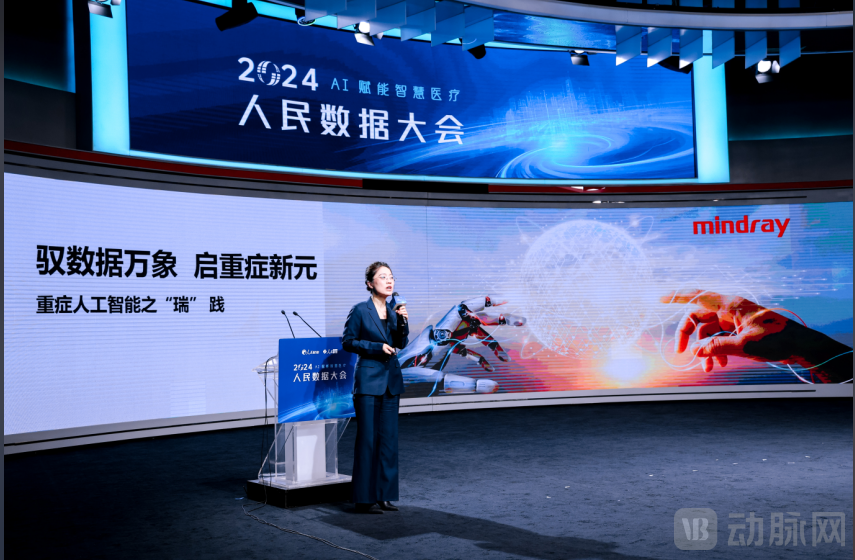
To break the status quo, Mindray, a leading Chinese medical device manufacturer, has partnered with Tencent Health to enter the field by focusing on critical care scenarios. Recently, in Beijing, they launched the world’s first large language model for critical care medicine implemented in clinical practice—the “Qiyuan Critical Care Large Model”—aiming to push the boundaries of large model capabilities and bring more possibilities to clinical practice.
Unlike general clinical departments, the intensive care unit (ICU) can be regarded as a convergence of multiple specialties. For a single critically ill patient, various devices—such as vital signs monitors, ventilators, and extracorporeal membrane oxygenation (ECMO) systems—are simultaneously connected, continuously generating diverse streams of vital signs data, device parameter logs, and imaging data from modalities like ultrasound and computed tomography (CT), thereby aggregating into massive and complex data flows.
What makes the situation even more challenging is the significant uncertainty inherent in ICU data. The condition of critically ill patients can change rapidly; indicators that are stable one moment may suddenly spiral out of control the next due to factors such as outbreak of infection or acute deterioration of organ function.
Therefore, critical care physicians must not only possess exceptional professional competence but also process, precisely locate, and integrate the deluge of data within extremely limited timeframes to make accurate diagnostic and therapeutic decisions. Consequently, there is an urgent need in intensive care units for intelligent, high-efficiency data management and analysis tools to assist medical teams in gaining a critical advantage in the race against death.
To address the various challenges present in intensive care units, the Qiyuan large language model adopted a specialized "three-step" strategy during training.
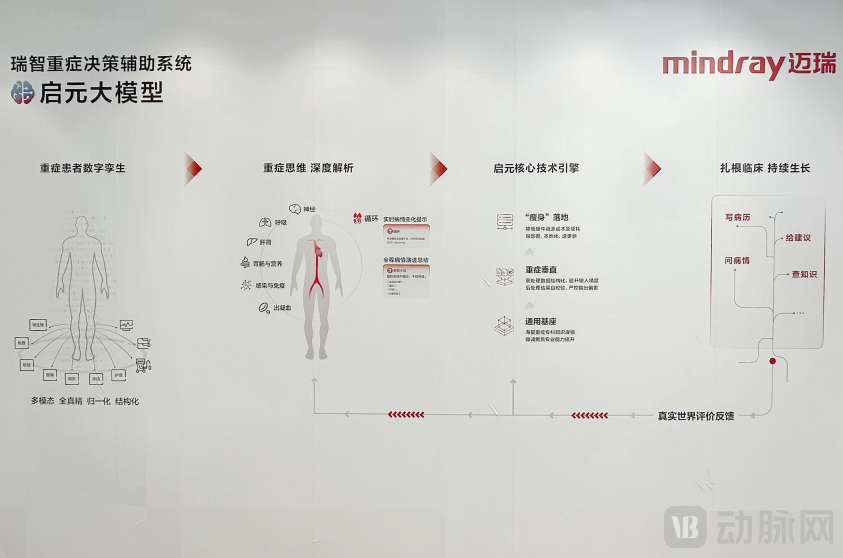
First, the Qiyuan large language model organizes patient data to reconstruct patient profiles as the primary input. It then conducts an in-depth analysis of these profiles using the clinical reasoning of critical care physicians, serving as the secondary input. By leveraging its inherent learning capabilities, the Qiyuan model achieves four core functions: critical care knowledge retrieval, condition-related Q&A, recommendation generation, and medical record documentation.
For patients whose information has been consolidated into comprehensive medical data sets, the Qiyuan large language model can reconstruct the complete trajectory of their disease progression within five seconds. It precisely and automatically extracts relevant clinical indicators and parameters, analyzes and organizes the data, and then presents a concise yet accurate summary of the patient’s condition and treatment status to healthcare professionals.
Furthermore, the Qiyuan large language model can rapidly integrate and reconstruct a comprehensive, multi-dimensional digital profile of the patient based on data collected since admission. It conducts in-depth analysis of this profile to predict subsequent clinical trends and provide recommendations, thereby assisting healthcare professionals in making informed decisions for subsequent therapeutic interventions.
In the practices of some hospitals, the Qiyuan large model has demonstrated the unique efficiency-enhancing capabilities of large models.
Taking medical record documentation as an example, the Qiyuan large language model has virtually liberated healthcare professionals from manual and cognitive burdens, achieving an intelligent leap in medical documentation. Leveraging baseline diagnostic and treatment data already entered into the system, it automatically generates well-structured, precisely formatted medical records guided by clinical reasoning—standardized and efficient—assisting physicians in completing documentation within one minute, thereby boosting efficiency by more than 30-fold.
Furthermore, the Qiyuan large language model has constructed an on-demand accessible “compendium” of critical care medicine, subdivided into nine major subgroups. It assists healthcare professionals in diagnostic and therapeutic workflows by precisely locating relevant critical care knowledge and synthesizing key knowledge snippets capable of effectively addressing the complex clinical conditions of current patients. Clinical simulation data show that the recommendations and critical care knowledge analyses provided by the Qiyuan large language model have achieved an accuracy rate as high as 95%, offering diagnostic and therapeutic support significantly above the average level for physicians in remote areas or those with less seniority.
It is worth noting that even after acquiring the aforementioned diverse capabilities, the Qiyuan large language model still retains substantial potential for growth.
According to Dai Weiwei, General Manager of Mindray’s Digital Intelligence Ecosystem Product Line, Mindray will continue to focus on the field of critical care diagnosis and treatment, constantly improving functions such as personalized diagnostic and therapeutic recommendations for critical care syndromes, quality control in critical care, and research assistance, thereby further expanding the capability boundaries of the Qiyuan large model in critical care scenarios.
In selecting the foundation model for its critical care large language model, Mindray has chosen Tencent’s Hunyuan large model, which is fully self-developed across the entire technology stack. This decision builds upon nearly a decade of collaborative exploration in the field of AI between Mindray and Tencent. The Hunyuan model boasts over one trillion parameters and has processed more than seven trillion tokens, demonstrating robust capabilities in Chinese language understanding and generation, logical reasoning, and reliable task execution.
Building on this foundation, large medical language models trained on extensive medical text data—leveraging a medical knowledge graph and medical literature that encompass 2.85 million medical entities, 12.5 million medical relationships, and cover 98% of medical knowledge—possess robust capabilities in understanding and generating medical texts. These models can accurately comprehend and respond to healthcare-related queries, offering functionalities such as multi-turn medical dialogue, medical content generation, and AI-assisted clinical decision-making.
In the critical transition from general-purpose large models to specialized large models for intensive care, Mindray has adopted a dual approach. On one hand, through multi-center clinical collaborations, it has carried out data collection, cleaning, and annotation to build a high-quality critical care database, ensuring that the trained large model can provide accurate diagnostic and treatment recommendations as well as medical records compliant with clinical standards. On the other hand, under the guidance and assistance of clinical experts, it has continuously supplemented and refined its specialized knowledge base for critical care.
Leveraging Mindray’s RuiZhi Critical Care Decision Support System, the Qiyuan Large Model incorporates multimodal data, interweaving and complementing diverse data forms to comprehensively reflect patient status from multiple dimensions. Furthermore, it integrates information on changes in patient condition that has been deeply synthesized and refined through clinical reasoning, thereby providing the large model with profound and insightful evidence for decision-making.
Furthermore, Mindray and Tencent have been gradually shaping the critical care reasoning capabilities of their large language models (LLMs) through interaction with clinical practice. In actual application, an efficient feedback mechanism has been established to encourage healthcare professionals to evaluate and provide timely feedback on the LLM outputs. This approach strengthens clinical logical reasoning and gradually forms a thinking pattern aligned with critical care clinical logic and practical needs, significantly reducing the likelihood of hallucinations caused by data bias or incompleteness.
Notably, to meet the requirements for localized hospital deployment, both parties leveraged model quantization, distillation, and compression techniques to streamline the large language model. This optimization enables efficient operation with minimal computational resources while ensuring data privacy and security, allowing seamless integration into daily clinical workflows and truly serving as an “intelligent assistant” for critical care treatment.
Industry insiders stated that the Qiyuan large language model has radically restructured traditional clinical workflows, optimizing previously problematic areas such as inefficient information flow and difficult data integration. This has made diagnostic and treatment processes smoother and more efficient, significantly enhancing the precision and quality of care. Meanwhile, medical resources can be allocated and utilized in a more scientific and rational manner, effectively delivering transformative results in cost reduction and efficiency improvement for the entire healthcare industry.
Meanwhile, large language models liberate healthcare professionals from burdensome administrative tasks, enabling them to devote more energy to precise diagnosis and treatment, scientific research, and compassionate patient care. This will undoubtedly reshape the harmonious relationship built on strong trust between doctors and patients, truly allowing the healthcare industry to achieve high-quality development that is both efficient and humane.
For the entire healthcare industry, the launch of the “Qiyuan Critical Care Large Model” not only provides intensive care units with a new auxiliary tool but also successfully validates the immense technical feasibility of large models in the medical field, marking a significant milestone in the clinical application of “AI + Healthcare.”
At the same time, we can foresee that high-quality large language models require robust foundational support. In the future, more medical device companies will inevitably collaborate with leading providers of general-purpose large language models, such as Tencent, to leverage their respective strengths and unlock greater possibilities for digital healthcare.
Therefore, the groundbreaking achievements in intensive care are merely a starting point.
In the medical field, clinical scenarios such as ultrasound imaging and in vitro diagnostics also hold immeasurable value. We need more enterprises, physicians, and hospitals to join forces in exploring the various possibilities of large models in clinical applications, thereby truly unlocking the clinical value of medical large models.