

Anteris Technologies Launches U.S. IPO to Advance DurAVR TAVR Platform with Triple Innovation

Anteris
Cardiac Valve Researcher
Recently, Australian artificial heart valve manufacturer Anteris Technologies (“Anteris”) announced the launch of its initial public offering (IPO) in the United States, aiming to raise $100 million to advance the development of its DurAVR transcatheter heart valve technology.
The aortic valve serves as the gateway to the heart. Blood from our body must pass through the aortic valve before being distributed to various parts of the body. In a healthy state, the aortic valve is flexible; however, under the influence of various harmful factors, it may become calcified and stiff. Consequently, the originally spacious “gateway to the heart” becomes narrowed and unable to open fully.
Aortic Stenosis (AS) is one of the most common types of valvular heart disease.
Currently, there are three main methods for treating aortic stenosis.
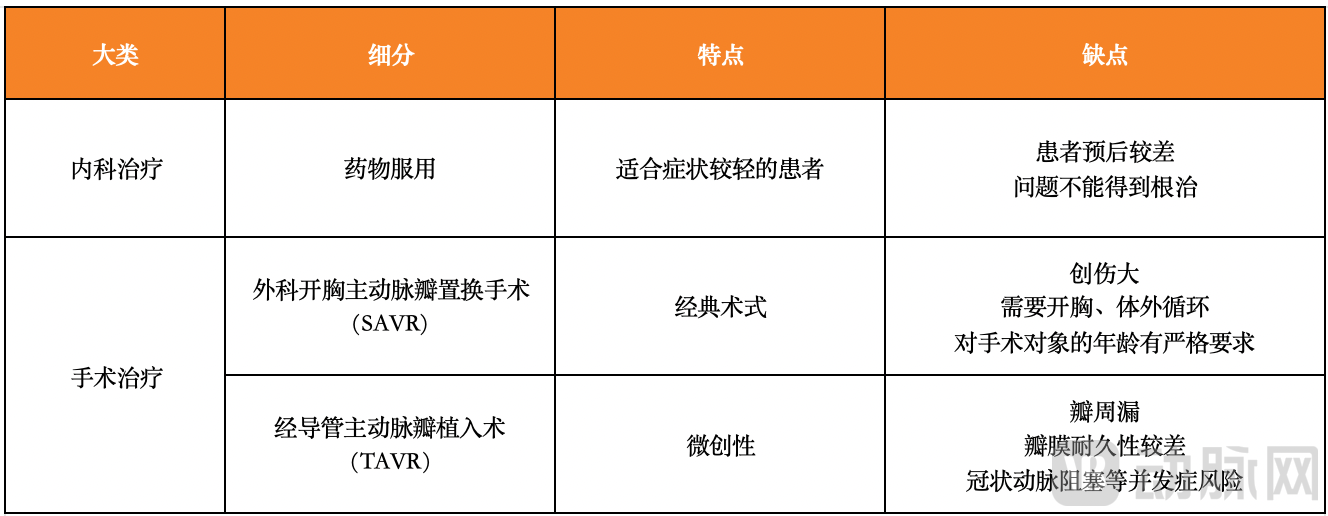
(Public information, chart by VCBeat)
TAVR refers to a minimally invasive therapeutic technique in which a prosthetic aortic valve is delivered to the aortic root via interventional catheterization and deployed for fixation, thereby replacing the function of the diseased aortic valve.
TAVR does not require open-heart surgery, carries lower risks, and enables faster recovery, making it particularly suitable for patients who are poor candidates for surgical intervention, have compromised cardiac function, or are elderly.In recent years, with the advancement of TAVR technology and the improvement of technical proficiency among medical teams, the volume of TAVR procedures has increased significantly. According to data from the National Center for Medical Quality Control in Cardiovascular Diseases, the number of hospitals capable of performing TAVR reached 634 in 2023, covering 31 provinces and municipalities, with the number of procedures approaching that of surgical aortic valve replacement.
It is worth noting that TAVR also has certain drawbacks.
Currently, TAVR devices are primarily categorized into two types: self-expanding and balloon-expandable. Regardless of the delivery system used, a replacement bioprosthetic valve is implanted. This bioprosthetic valve has a limited lifespan and may require future valve replacement. If the valve is positioned too shallowly or too deeply during the procedure, patients may experience paravalvular leak, characterized by regurgitant blood flow around the valve, necessitating further treatment or monitoring.
Coronary artery obstruction is also one of the most severe complications of TAVR. Once it occurs, the 30-day mortality rate can reach 40%.1。
Anteris’ DurAVR transcatheter heart valve product has improved the aforementionedClinical Pain Points. DurAVR is a novel biomimetic valve crafted from a single piece of material in its natural shape, designed to mimic the performance of the human aortic valve prior to disease onset. Its innovation lies in:
First, the adoption of ADAPT technology has enhanced durability.ADAPT is the company’s exclusively patented anti-calcification material. Derived from bovine pericardial tissue, it has been clinically proven to remain free of calcification for up to 10 years and has been used in 55,000 patients worldwide as cardiac and vascular patches.
Second, the ComASUR delivery system enables precise junctional apposition.Conventional TAVR products are prone to displacement, whereas the DurAVR transcatheter heart valve is precisely delivered via the advanced ComASUR delivery system. Utilizing a balloon-expandable delivery method, it ensures perfect alignment of the valve with the native cardiac leaflets, achieving optimal valve positioning.
Third, it facilitates vascular access.The DurAVR transcatheter heart valve product features large open cells within its stent frame, providing superior hemodynamic properties and facilitating improved coronary access.
The DurAVR THV product can optimize hemodynamic performance, and clinical trials are currently underway.
In July 2023, Dr. Anita Asgar, Co-Director of the Structural Heart Disease Program at the Montreal Heart Institute (Montreal, Canada), performed a procedure on an 84-year-old male patient, implanting the DurAVR THV. This marked the first use of the DurAVR THV in a valve-in-valve (ViV) procedure.
Valve-in-ValveValve-in-valve is a cardiac valve repair technique. Its therapeutic principle involves the transcatheter implantation of a new valve within a dysfunctional bioprosthetic valve, thereby creating a two-layered valve structure, hence the name “valve-in-valve.” For patients with life-threatening conditions whose original bioprosthetic valves have failed due to calcification or structural deterioration, implantation of a new heart valve is necessary. This procedure avoids open-chest surgery, offering patients a better treatment option.
Based on hemodynamic assessment metrics, the patient’s valve demonstrates favorable hemodynamic performance, with an 88% reduction in the mean pressure gradient.2, which restored the patient to near-normal physiological status, with a final pressure gradient of only 6 mmHg after valve implantation. These results are consistent with those observed in the extensive valve-in-valve (ViV) transcatheter heart valve (THV) studies of DurAVR, indicating successful procedural outcomes.
The four valves in the heart are the aortic valve, mitral valve, pulmonary valve, and tricuspid valve. Damage or defect in any one of these four cardiac valves can lead to valvular heart disease. Among these, diseases affecting the aortic and mitral valves are the most prevalent globally. More specifically, aortic stenosis (AS) and mitral regurgitation (MR) are the most common types.
The optimal treatment for MR and AS is TAVR, a transcatheter intervention that offers lower risk and minimal invasiveness, thereby largely avoiding the drawbacks of traditional surgical procedures.
Among the many leading companies overseas focusing on the TAVR sector, Edwards Lifesciences has demonstrated outstanding performance. According to data from Wall Street investment firm Needham, global sales of TAVR medical devices reached $6.74 billion in 2023, with Edwards holding a market share as high as 57.9%, establishing it as the global leader in transcatheter heart valve replacement technology.
In 2024, Edwards Lifesciences accelerated its acquisition strategy to ensure market and technological competitiveness.
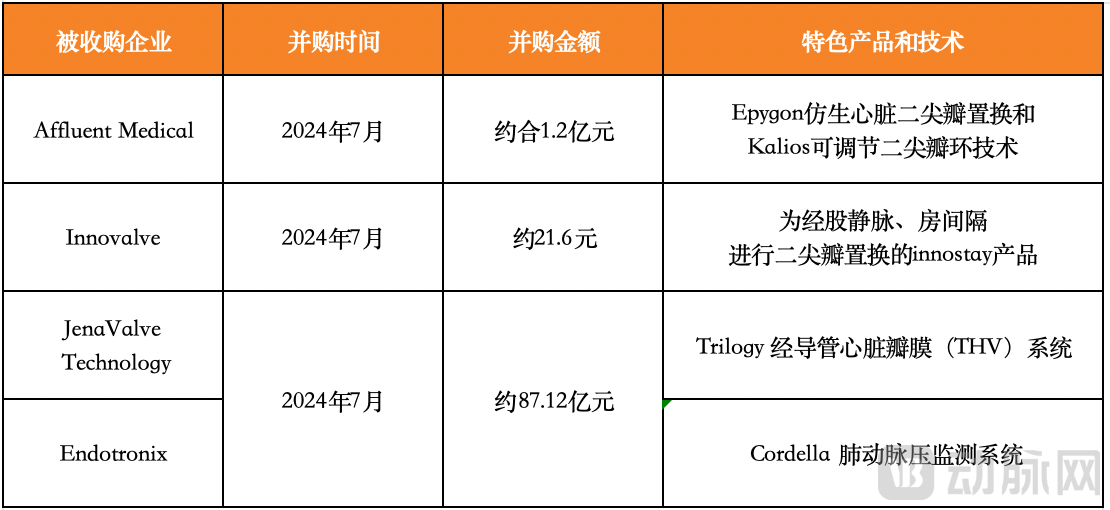
(Public information, graphic by VCBeat)
In July alone, Edwards Lifesciences announced three major acquisitions.
Recognition of Chinese Innovative Enterprises’ Valve Product R&D Capabilities. In August 2024, Edwards Lifesciences issued an acquisition offer to Jiangsu Jieshi Medical Technology Co., Ltd. (Jieshi Medical), a domestic company under which J-Valve TF (Jiecheng Medical) operates, seeking to purchase the overseas rights to its transcatheter aortic valve system, J-Valve.
Jiecheng Medical is one of the “leaders” in the field of transcatheter aortic valve replacement (TAVR) in China and the only company in the country to have commercialized treatments for both aortic regurgitation and aortic stenosis. It is reported that Jiecheng Medical’s J-Valve TA transapical interventional heart valve replacement system received certification from the National Medical Products Administration (NMPA) as early as 2017, making it one of the first domestically produced TAVR products approved for market launch in China. This product can simultaneously treat the dual indications of severe aortic insufficiency (regurgitation) and stenosis. In August 2023, the J-VALVE TF valve was granted “Breakthrough Device Designation” by the U.S. Food and Drug Administration (FDA).
According to Frost & Sullivan data, the number of TAVR procedures in China is projected to reach 109,500 by 2030, with a compound annual growth rate (CAGR) of 36.6% from 2021 to 2030. The CAGR for TAVR procedures in China exceeds the global average during the same period.
Compared with developed countries, research in the field of heart valves in China started relatively late. However, driven by technological innovation, growing market demand, and supportive policies, many companies, including Venus Medtech, VitaFlow Medical, and Peijia Medical, have already secured a position in the TAVR sector.
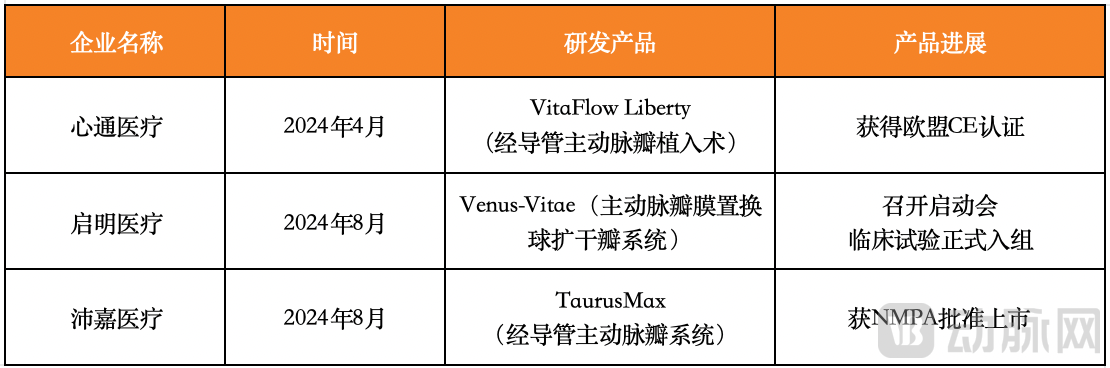
(Public data, graphic by VCBeat)
The market is sufficiently large to accommodate more new entrants. Medical device companies such as Nuomai Medical, BaiRen Medical, Yixin Medical, JianShi Technology, and Kokai Life Sciences are also continuously increasing their R&D investments and launching new products and technologies.
At the same time, it should be noted that China’s TAVR market penetration rate remains low due to multiple factors, including high surgical complexity, substantial physician training costs, and a significant financial burden on patients. With anticipated breakthroughs across various fields in the future, the TAVR market is poised to give rise to several leading enterprises.
Reference Article:
1: Luo Jianfang, Li Jie, Sun Yinghao, et al. First Two Cases in Asia of Cerebral Embolic Protection Using TriGUARD3 During Transcatheter Aortic Valve Replacement, Chinese Circulation Journal
2: “The World’s First, Valve Disruptor Plans IPO” — MedDevice Home