

Mindray Launches World's First Critical Care Large AI Model 'Qiyuan', Files Updated Hong Kong IPO Prospectus

Mindray
Medical Device R&D Manufacturer

Tencent
Internet Comprehensive Service Provider
Recently, Mindray and Tencent jointly launched the world’s first large AI model for critical care, the “Qiyuan Critical Care Large Model.” The model has already been deployed at the First Affiliated Hospital of Zhejiang University School of Medicine.
Built upon the general-purpose foundation of Tencent’s Hunyuan large model, the Qiyuan large model incorporates a specialized knowledge base for critical care medicine. It enhances input precision through pre-processing, strictly controls output deviation via post-processing, and continuously improves its critical care analytical capabilities through an interactive loop with clinical medical and nursing practices. This large model features three core intelligent applications:
Mindray stated that, starting from critical care medicine, it will continue to explore the intelligent applications of large models in emergency medicine, anesthesiology, radiology, and clinical laboratories.
This large language model represents a major achievement by Mindray in the field of AI. Since 2009, Mindray has been exploring the integration of AI technologies with its three core product lines—medical imaging, in vitro diagnostics, and patient monitoring & life support—achieving significant results.
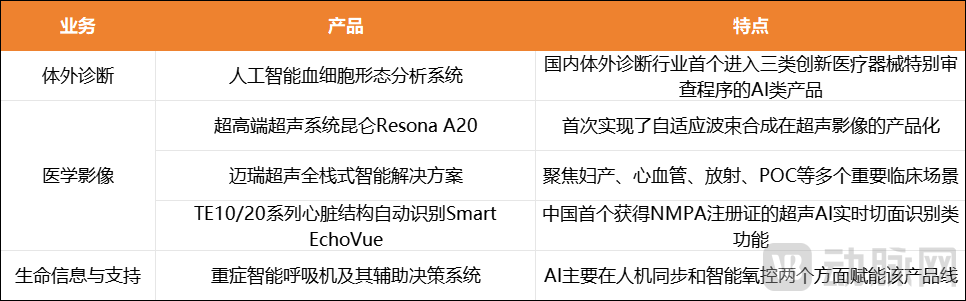
Mindray's AI Strategic Layout
In 2022, the AI-powered automated peripheral blood cell morphology analyzer co-developed by Mindray and Tencent became the first AI-based product in China’s in vitro diagnostics industry to enter the Special Review Procedure for Innovative Class III Medical Devices. This product significantly reduced the average slide review time for physicians from 25–30 minutes to just 30 seconds, substantially decreasing their workload.
Building on its comprehensive portfolio of medical devices, Mindray has successively launched three smart healthcare solutions—“RayCloud++,” “Mindray Smart Lab,” and “Mindray Connect” (collectively known as the “Sanrui” ecosystem)—which correspond to its three major product lines: medical imaging, in vitro diagnostics, and patient monitoring & life support. This has established a preliminary “Device + IT + AI” digital-intelligent healthcare ecosystem, accelerating the digital and intelligent transformation of the medical device industry.
Digital and intelligent transformation has become a global consensus in the healthcare industry. Over the past two years, medical device and equipment manufacturers both in China and abroad have also begun to explore the application of large AI models.
June 2023,Neusoft MedicalThe “Tianyi Medical Large Model” has been launched to provide physicians with auxiliary decision support for medical image analysis and disease diagnosis, offer patients convenient consultation services, and deliver conversational interaction and data insights to hospital administrators. Additionally, Neusoft’s Feibiao Medical Image Annotation Platform 4.0 has undergone a comprehensive upgrade by leveraging the Medical Image Segmentation Model (MISM), featuring enhanced efficiency, precision, intelligence, and scalability.
July 2023,Rebo AI & Shuju MedicalJointly released the “Light of Taishan Large Model for Medical Equipment Operations and Maintenance,” aiming to achieve intelligent O&M management of medical devices, accurately predict equipment failures, optimize maintenance workflows, and enable real-time monitoring of device performance and data analysis. Given that no such industry-specific large model has been launched either in China or globally, its release holds milestone significance.
In 2024, large language model (LLM) technology rapidly transitioned from concept to practical application, beginning to cover various healthcare scenarios.
April,United Imaging GroupLaunch of the uAI Yingzhi Large Model, a foundational large model specialized for the medical sector. This large model has given rise to products in imaging, text, and multimodal domains, with gradual implementation in clinical applications. It not only assists physicians in achieving efficient and intelligent image annotation but also enables applications in scenarios such as electronic medical record documentation and cross-hospital digitization of medical data, thereby providing physicians with a more efficient experience in report recording.
GE HealthcareDuring the China International Import Expo (CIIE), its large language model product “ManualGPT” was launched. Functioning similarly to a “device engineer,” the product provides guidance to clinical staff during the installation or use of new equipment, thereby shortening the user learning curve. Currently in internal beta testing, the system supports multiple GE CT, MRI, and ultrasound devices.
With the advancement of AI technology, large models are now capable of analyzing multimodal information, such as text, images, and genomic data. The integration of multimodal data can enhance the richness of training datasets, and various vertical large models specialized in specific diseases or medical disciplines, developed based on multimodal databases, are poised to become a key direction for the future development of medical large models.
In addition to the large models mentioned earlier, such as the Qiyuan Critical Care Large Model, there are numerous other large model products focused on specific medical subfields available on the market.
In October 2023, Yisheng Jiankang launched “Aichao GPT,” a gynecology-focused solution that provides female users with precise endocrine testing and health management services.
In April 2024, the Tianhe Lingshu large language model, designed for the field of Traditional Chinese Medicine (TCM) acupuncture, provides recommendations for various acupuncture therapies, including needle insertion and moxibustion.
In May, JD Health launched “Liaoyu Xiaoyuzhou,” an AI psychological companion product powered by large language models;
In June, the Zhongshan Ophthalmic Center of Sun Yat-sen University and Huawei jointly released ChatZOC, a large ophthalmology model, to empower medical care, education, research, prevention, and management in ophthalmology;
In July, the world’s first large AI model for medical device registration and filing applications was launched in Beijing, helping enterprises reduce submission costs and cut the time required for preparing registration documentation by 90%;
In August, KingMed Diagnostics released its first large language model for medical laboratory testing, the “Yujian Yiyan Large Model,” and launched the intelligent agent “Xiao Yu Yi,” achieving full-process digitalization and intelligence in medical laboratory production and services;
On November 27, Peking University First Hospital released the “Shen Shuo Large Model,” which is dedicated to the field of nephrology.
There are countless specialized large language models (LLMs) in healthcare that have been released. According to the "2024 Annual White Paper on Digital Healthcare Innovation," LLMs in the medical vertical currently encompass diverse data formats, including medical text, medical imaging, life omics, and protein engineering. Based on incomplete statistics, there are over one hundred LLMs related to healthcare, covering a wide range of scenarios and nearly all segments of the digital health industry.