

China's Original Innovation Powers Global Leadership in High-Intensity Focused Ultrasound Industry
“Why Did Modern Science and the Industrial Revolution Not Emerge in China?”
This is the “Needham Question,” a century-old puzzle posed by British scholar Joseph Needham in the late 19th century, intended to express his reflection on why China and the West experienced such divergent trajectories in science and technology—one declining significantly while the other rose dramatically. Today, the “Needham Question” has become a lingering cautionary reminder for the Chinese people, urging them to continuously enhance their scientific and technological strength and original innovation capabilities, accelerate the building of a leading power in science and technology, and avoid a recurrence of history.
Especially in the current era of increasingly fierce global technological competition, original innovation capability representing cutting-edge technology has become one of the essential factors determining the core competitiveness of a country and a nation.In November 2024, relevant leaders of the State Council also mentioned the keyword “original innovation” twice at the National Conference on Scientific and Technological Innovation, emphasizing its foundational and critical role, as well as its importance to human well-being and international scientific and technological competition.
The world is currently undergoing profound changes unseen in a century, with a new round of scientific and technological revolution and industrial transformation accelerating. According to the "Research on China's Innovation Index" released by the National Bureau of Statistics in October 2024,China’s overall innovation index has surged from 35th globally in 2013 to 12th in 2023, marking its formal entry into the ranks of innovative nations.
From the “Needham Question” to building an “innovation-oriented country,” generations of industry leaders have started from scratch and continuously produced a series of major original scientific and technological achievements.Among the many achievements in technological innovation, high-end medical equipment, regarded as a “pillar of national strength,” is playing an increasingly important role in improving public health and strengthening the nation’s scientific and technological prowess.
The high-end medical equipment industry is characterized by high barriers to entry, innovation intensity, and talent density, making it a critical sector for national livelihood, economic development, and national security. Compared with developed countries in Europe and the United States, China started later in the field of high-end medical devices; however, since the reform and opening-up, driven by the state’s emphasis on and support for technological innovation, China’s independent R&D capabilities have been continuously strengthened.
In 1983, China’s first domestically developed cranial CT scanner passed national appraisal and completed its first human head imaging scan; in 1997, the world’s first prototype of high-intensity focused ultrasound (HIFU) for tumor treatment was unveiled in China; in 1999, China’s first independently developed 1.5T superconducting MRI system was launched, ending the country’s reliance on imports... These industry pioneers broke the monopoly previously held by foreign brands in the high-end medical equipment market. However, as frontier scientific discoveries and original technological achievements continue to emerge, the primary entities driving original innovation are facing new opportunities and challenges.
First, since the reform and opening-up, China's annual average growth rate of R&D expenditure has reached 18.6%.In 2023, this figure surged to RMB 3.3278 trillion, 233 times that of 1991, making China the world’s second-largest investor in research and development (R&D), trailing only the United States.This significant growth has provided ample financial support for researchers in China, enabling them to pursue higher-level innovative achievements and fundamentally enhancing the country’s capacity for original innovation.
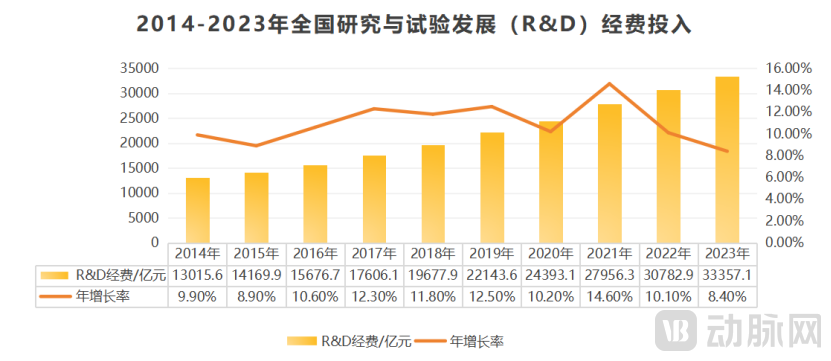
VCBeat Graphics
Furthermore, in the context of the new era, practical issues such as how to enhance the diversification of innovation directions, further strengthen the integration of scientific and industrial innovation, and improve the closeness of cross-disciplinary and cross-industry collaboration have become “bottlenecks” constraining the enhancement of China’s original innovation capabilities and the high-quality development of high-end medical equipment. These opportunities and challenges presented by the times require China to continuously reinforce its position as a primary innovator from a global perspective, so as to maintain a leading edge in global technological competition.
Although China’s R&D investment has increased a hundredfold, the U.S. federal R&D budget reached $210 billion in 2024, marking the largest amount in history. Moreover, it is undeniable that in the forefront of the global high-tech race, the “low-hanging fruit” is nearly exhausted. For frontier fields such as high-end medical equipment, achieving higher goals in original innovation requires concerted efforts and collaboration among industry, academia, research institutions, healthcare providers, and government agencies.
First, basic research is characterized by long cycles, high uncertainty, and a considerable distance from industry and technology. Researchers need to maintain creative critical thinking skills and adopt rigorous methods of verification, examine problems from different perspectives, actively participate in domestic and international industry conferences and academic exchanges, engage with the industry to understand cutting-edge technologies and market trends, and thereby address the real pain points in clinical practice and industry through high-quality original innovation solutions.
Secondly, clinical demand is the core driver of innovation in medical devices. As the primary practitioners in clinical settings, physicians need to identify genuine needs in practice, propose innovative ideas, participate in the research and development process, validate the clinical efficacy of new technologies, and actively promote their application.Professor Wang Zhibiao of Chongqing Medical University conceived the bold idea of “ultrasound tumor therapy” from the clinical practice of “ultrasound termination of early pregnancy,” and established the theoretical foundation of “focused ultrasound biology” through medical-engineering collaboration, transforming this basic research into a Chinese original innovation—the Haifu Knife.®, successfully expanded to 32 countries and regions worldwide.Such cross-sector collaborations not only accelerate the translation of original innovations from concept to practical application, but also bring more advanced, effective, and safer treatment options to patients worldwide.
Furthermore, for enterprises that play a dominant role in technological innovation, the key lies in continuously enriching their product portfolios around original innovative technologies, prioritizing product demands in emerging scenarios, and actively advancing the research and development of major products. This approach aims to achieve self-sufficient manufacturing capabilities in high-end mainstream equipment, critical core components, and high-value medical materials. Taking focused ultrasound as an example,After more than 30 years of technological R&D and over 20 years of industrialization, the Chongqing Haifu team has developed more than ten models of high-end medical equipment centered on three major series: benign and malignant tumors, common diseases, and rehabilitation and healthcare. To date, it has cumulatively treated more than 300,000 patients with solid benign and malignant tumors worldwide.Demonstrating the Unique Value of Enterprises in Driving the Transformation of Innovative Technologies into Real Productive Forces.
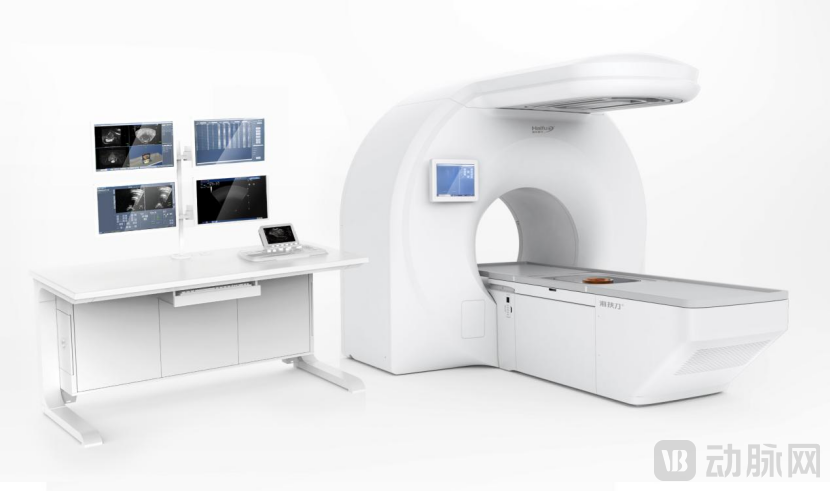
HIFU Knife®Focused Ultrasound Tumor Treatment System, Model JC300
Finally, the national government plays a unique guiding and supportive role in promoting original innovation. The “14th Five-Year Plan” for the Development of the Medical Equipment Industry proposes the development of high-efficiency therapeutic equipment, such as ultrasound systems, in key priority areas; Made in China 2025 lists high-performance medical devices as one of the ten key fields for breakthroughs; the Report to the 20th National Congress of the Communist Party of China emphasizes the need to “strengthen basic research, highlight originality, and encourage free exploration”; and relevant departments at all levels have successively introduced supportive policies such as “trade-in programs” and “procurement of domestically produced products.”
“Original innovation,” characterized by its non-consensual, transformative, high-risk, and disruptive nature, is distinct from general innovative research and typically requires specialized funding models for support. Since its establishment in 1986, the National Natural Science Foundation of China (hereinafter referred to as the NSFC) has played a significant role in promoting the development of basic research and supporting original innovations in basic research in China.
According to data released by the National Natural Science Foundation of China (NSFC) over the past decade, the number of applicants for NSFC projects has increased year by year. In 2024, the NSFC received a total of 384,564 project applications, representing a 26.31% increase from the previous year.
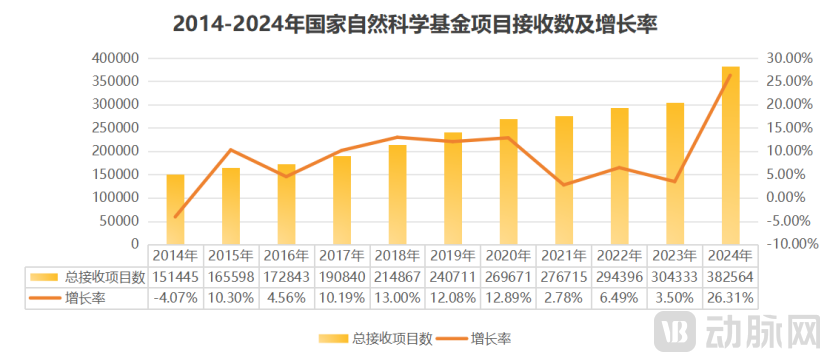
VCBeat Chart
Among these, the funding recipients of the National Major Scientific Instrument Development Project are institutions engaged in “the development of original scientific instruments and core components that play a significant role in promoting scientific advancement, exploring natural laws, and opening up new research fields,” with the aim of “enhancing China’s capacity for original innovation.”
In November 2024, the National Major Scientific Instrument Development Project titled “Positioning-Guided and Therapeutic Regulation System Based on Intracranial Millimeter-Scale Acoustic Source Points,” led by Professor Wang Zhibiao of Chongqing Medical University in collaboration with Tsinghua University, Nanjing University, Army Medical University, and other institutions, was approved for funding, with direct project funding amounting to RMB 80.28 million.This project focuses on the treatment of neuropsychiatric disorders and brain science, aiming to develop a major scientific research instrument that integrates non-invasiveness, precise localization, fine-grained intervention, and real-time monitoring for the treatment of deep brain disorders and brain science research.
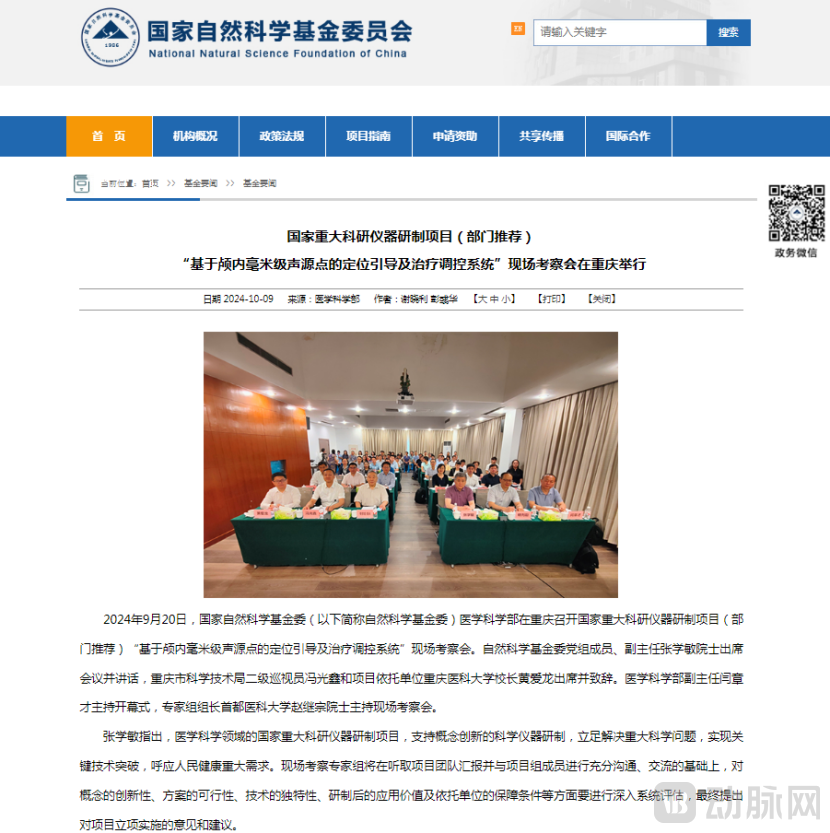
Led by Professor Wang Zhibiao of Chongqing Medical University
"Localization-Guided and Therapeutic Modulation System Based on Intracranial Millimeter-Scale Acoustic Sources"
Secured funding approval from the National Natural Science Foundation of China
Recently, at an academic conference, Professor Wang Zhibiao discussed how he became involved with focused ultrasound, a pioneering Chinese innovation. “Thirty-six years ago, I was an attending physician in obstetrics and gynecology, busy performing surgeries every day. At that time, I often asked myself: What are the consequences of organ resection for patients? Is there a technology that can treat diseases while minimizing harm to patients, or even preserving organs? That technology is focused ultrasound.”
36 years ago, the Chinese medical device market was almost entirely monopolized by foreign companies, with neither medical device regulatory frameworks nor quality certification centers in place. Yet, it was precisely under such challenging circumstances thatProfessor Wang Zhibiao led his team through more than a decade of foundational research, starting from scratch, and ultimately developed the world’s first extracorporeal focused ultrasound device for non-invasive treatment in 1999—the Haifu Knife.®Officially obtained CFDA (now NMPA) certification.In 2002, the device was exported to the University of Oxford in the United Kingdom, pioneering the export of large-scale, high-end medical equipment “created in China” to developed countries.
“Technologies such as B-mode ultrasound, CT, MRI, PET, and proton and heavy ion therapy did not originate in China. What Chinese doctors take pride in is that focused ultrasound technology was born in China, representing an original innovation by Chinese physicians,” said Professor Wang Zhibiao.
In 2011, Professor Wang Zhibiao’s team was awarded one of the first National Major Scientific Instrument Development Projects for their research on “Spherical Focused Acoustic Systems,” receiving direct funding of RMB 60 million.Through the research of this project, the team led by Professor Wang Zhibiao established the world's first system capable of generating alternating ultra-high pressure (-108 Pa ~ 1010Pa), ultra-high temperature (300 K ~ 6800 K), ultra-fast heating/cooling (>1012The scientific instrument “Spherical Focused Acoustic Collection System,” designed for extreme acoustic conditions (K/s), provides novel research conditions for expanding the cognitive boundaries of the field of acoustics.Currently, the instrument has been made openly accessible to over 20 institutions, facilitating collaborative research on 92 projects and resulting in the publication of 56 papers in top-tier industry journals, thereby promoting interdisciplinary integration and innovative development in related frontier sciences.
Over the past three decades since its establishment, the National Natural Science Foundation of China has overseen a continuous increase in investment in basic research within the country. This has led to a steady emergence of frontier scientific discoveries and original technological achievements, particularly significant breakthroughs in high-end medical equipment based on “new theories, new methods, new materials, new tools, and new technologies.” These breakthroughs have not only facilitated technological progress and industrial upgrading but also contributed Chinese innovative wisdom and solutions to the development of the global healthcare sector.
According to statistical data from the National Medical Products Administration, China has emerged as the world’s second-largest medical device market, with operating revenues reaching RMB 1.3 trillion, and a series of “national flagship” medical devices have been introduced in rapid succession.
In the future, through the joint efforts of industry, academia, research institutions, healthcare providers, and government bodies, China will strengthen basic research, promote the translation of scientific achievements, deepen original innovations, build interdisciplinary collaboration platforms, optimize the policy environment, and actively engage in international cooperation. These initiatives aim to drive breakthroughs in innovative technologies in key fields such as high-end medical devices, thereby enhancing the nation’s competitiveness and influence within the global innovation system and making greater contributions to social progress and human health.