

PulseX Medical Launches Maicim®, a Critical Care Large Model to Redefine ICU Workflows
Among the numerous departments in hospitals, rapidly extracting the most direct and effective information from massive and complex data has always been a significant challenge for medical staff. The situation is particularly severe in the Intensive Care Unit (ICU).
At the bedside of every ICU patient, various medical devices are densely arranged, continuously generating vast amounts of multidimensional clinical data. The sheer volume and high dimensionality of these data make them inherently difficult to interpret, while emergent clinical situations—such as sudden-onset infections or rapid deterioration of organ function—further exacerbate the challenges in data processing.
Therefore, ICU medical staff must rapidly identify and integrate critical information from a vast amount of rapidly changing data within an extremely short time frame to make the most accurate diagnostic and treatment decisions possible. In reality, they often bear invisible pressure in their work.
In light of this current situation, large language models may be the best solution available today.
On December 19, 2024, Hangzhou Maixing Medical Technology Co., Ltd. (hereinafter referred to as "Maixing Medical") joined forces with Zhejiang Hospital to launch Maicim, a self-developed large language model specialized in critical care.®Version 1.0. Professor Hu Weihang, Director of the Department of Critical Care Medicine at Zhejiang Hospital, stated that this model leverages AI to process the vast amounts of multimodal data generated in the ICU. Through in-depth analysis and mining, it distills the core information most needed by healthcare professionals, enabling data simplification and comprehensive assessment, thereby assisting medical teams in gaining a critical advantage in the race against death.
Split Maicim®capabilities, we can broadly categorize them into two aspects: “efficiency enhancement” and “quality improvement.”
So-called “efficiency enhancement” aims to improve the operational efficiency of intensive care units (ICUs). In the rapidly evolving landscape of critical care, meticulously documenting changes in patients’ conditions and their diagnostic and therapeutic processes is an indispensable task that allows no room for negligence. However, the associated administrative documentation consumes substantial time and energy from healthcare professionals, directly compromising the quality and efficiency of patient care.
Huang Kezhi, CEO of Maixing Medical, stated: “Given the limited medical resources in China, digital solutions are undoubtedly the most effective and easily scalable approach at this stage to enhance diagnostic and treatment capabilities in ICUs and reduce clinical error rates. We aim to leverage large language models to delegate mechanized, highly repetitive tasks currently performed by ICU staff to AI as much as possible, thereby enabling healthcare professionals to maximize their value.”
From the current stage of Maicim®In terms of capability, this large language model covers nearly all information entry scenarios in the ICU. Taking Maicim®Taking the Smart Ward Round Assistant as an example, this application helps physicians quickly access patients’ historical clinical indicators and medication records. Information that previously required reviewing extensive medical charts can now be easily retrieved through conversational interactions with the assistant. Furthermore, the assistant can perform comparative analyses of multiple indicators within seconds, providing multidimensional comparisons between clinical manifestations and medication regimens, thereby serving as a comprehensive intelligent aide for physicians and significantly enhancing work efficiency.
The medical record documentation assistant is also designed with efficiency in mind. It enables physicians to generate discharge summaries that comply with medical standards and are tailored to each patient’s individual condition with a single click, significantly reducing the time spent on documentation. Tasks that previously required several hours can now be completed within seconds, allowing doctors to devote more energy to clinical diagnosis and treatment.
Furthermore, the intelligent handover assistance feature of large language models enables physicians to generate reports on significant changes in a patient’s condition over the past 24 hours with a single click. By presenting information across multiple systems, it provides clinicians with a comprehensive and clear review of the patient’s clinical status. This auxiliary function significantly improves handover efficiency, allowing incoming physicians to rapidly grasp the evolution of the patient’s condition and engage in more in-depth and comprehensive discussions. This ensures greater precision and rigor in diagnostic and therapeutic decision-making, thereby providing a higher level of care assurance for critically ill patients.
Overall, Maicim®...has effectively enhanced the interoperability and analytical processing capabilities of ICU-related data. According to Huang Kezhi, when Maicim®After freeing ICU medical staff from massive amounts of repetitive labor, the efficiency of ICUs in relevant hospitals improved significantly within months.
In its past development, medical AI has often been criticized by the industry for focusing on “efficiency enhancement” rather than “quality improvement.” In other words, if AI capabilities are limited to reducing physicians’ workload without delivering incremental value to relevant clinical departments, such AI solutions will struggle to achieve successful commercial deployment.
To address this issue, Maicim®It not only learns from a vast amount of medical text information but also integrates more complex multimodal imaging examinations and specialized critical care data, aiming to provide capabilities previously unattainable in ICUs while improving efficiency.
According to Huang Kezhi, the critical care large language model was developed in strict adherence to the clinical pathways for critically ill patients, thereby enabling it to fully leverage the unique advantages of AI in the three key stages of clinical assessment, diagnosis, and treatment.
In the assessment phase, Maicim®Capable of comprehensively understanding the causal interplay within individual organs and among multiple organs, extracting deep-seated patterns from multimodal data—including structural data, medical records, and imaging—thereby ensuring a holistic perspective and accurate assessment.
During the diagnostic phase, by integrating medical clinical practice guidelines and the latest research papers, the system infers disease progression to facilitate early diagnosis and early treatment. In the treatment phase, the model provides personalized diagnostic and therapeutic recommendations based on changes in the patient’s condition, thereby achieving precision medicine through a “one-disease, one-strategy” approach.
During clinical diagnosis and treatment, physicians can leverage multimodal organ assessment capabilities to monitor the real-time status of patients’ major organs and accurately determine trends in organ changes. Particularly in the evaluation of seven core systems—cardiac function, respiratory system, nervous system, liver, kidneys, digestive system, and immune system—the large language model can rapidly provide assessment results from multiple dimensions, including hemodynamics, coagulation function, and immune response. This approach reduces the risk of misdiagnosis and missed diagnoses, significantly enhancing both the accuracy and efficiency of clinical assessments.
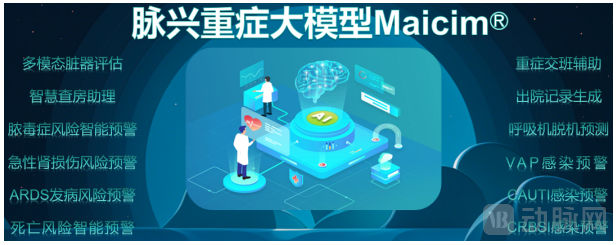
Maicim: VCBeat's Critical Care Large Language Model®Major Application Scenarios
In clinical practice, Maicim®It can provide early warnings for two high-incidence, high-risk conditions: sepsis and acute kidney injury (AKI). Supported by an intelligent early warning system, the algorithm continuously monitors changes in patients’ clinical status in real time and calculates the probability of developing these two conditions. This dynamic early warning capability enables physicians to detect clinical changes at an early stage and intervene promptly, thereby improving treatment success rates and reducing the incidence of complications.
Weaning management from mechanical ventilation is a critical component of critical care. In this scenario, Maicim®It enables dynamic analysis of patients' clinical data and daily assessment of their readiness for weaning from mechanical ventilation. This big data-driven weaning recommendation serves as an expert-level consultation for physicians, significantly improving the success rate of weaning.
Furthermore, large language models can continuously monitor mortality risk factors by comprehensively analyzing multiple physiological parameters of patients. Upon detecting an elevated mortality risk, the system automatically issues alerts to prompt physicians to take timely interventions. This intelligent monitoring capability enables clinicians to identify potential critical conditions more rapidly, thereby enhancing the overall safety and efficacy of intensive care treatment.
In short, Maicim®Capable of rapidly analyzing disease patterns, predicting the progression of conditions, and providing optimal summaries and analyses of patient status. This intelligent diagnostic and treatment system for critical care specialties not only enhances the quality of medical services, shortens diagnosis time, and alleviates physicians’ workload, but also delivers more timely and precise medical care to patients, thereby truly achieving improved efficiency and quality in the ICU.
For the entire healthcare industry, Maicim®Its launch not only provides a new auxiliary tool for ICUs but also introduces a novel data-driven paradigm for medical diagnosis and treatment, paving the way for the future development of “AI + Healthcare” in clinical applications.
However, these achievements are only the beginning.
At Maicim®At the same time, Maixing Medical jointly established the “Zhejiang Provincial Clinical Research Center for Critical Care Medicine Critical Care Big Data Alliance” with Zhejiang Hospital, Taizhou Hospital of Zhejiang Province, and Dongyang People’s Hospital. Through collaborative efforts, the Alliance will promote scientific research output and the development of innovative clinical big data products in the field of critical care by unifying data standards and enabling data sharing, ultimately achieving a transformative improvement in the quality and efficiency of medical services.

“Zhejiang Provincial Clinical Research Center for Critical Care Medicine Critical Care Big Data Alliance” Established in Hangzhou
General Manager Huang Kezhi of Hangzhou Maixing Medical Technology Co., Ltd., Professor Yan Jing of Zhejiang Hospital, Party Secretary Xu Yinghe of Taizhou Hospital of Zhejiang Province, and Party Secretary Lv Zhong of Dongyang People's Hospital (from left to right)
The establishment of the alliance holds profound positive significance for ICU care and the broader field of medical AI. As Professor Yan Jing, President of the Critical Care Medicine Branch of the Zhejiang Medical Doctor Association, stated, “Intelligence and smart technologies are indispensable to the construction and development of critical care medicine. By building this data alliance, we will inject new momentum into clinical applications, significantly enhance the quality of clinical decision-making, drive comprehensive improvements in data standardization and quality, foster deeper cross-center collaboration, and facilitate the continuous optimization of clinical pathways and quality control indicators. Looking ahead, we firmly believe that the Critical Care Medicine Big Data Alliance will become a key force leading innovation in the healthcare sector.”
We sincerely invite our colleagues to join hands, leveraging the Critical Care Medicine Big Data Alliance as a new platform to jointly write a new chapter in the field of medical health and contribute our wisdom and strength to enhancing human health and well-being. Let us work together to create a brighter future.”