NewCo May Be Harder Than We Think: Challenges and Strategies in Biotech Out-Licensing via NewCo Models
Leads Biolabs
Innovative Therapy Developer
“As far as I know, in a currently high-profile NewCo transaction, the overseas fund had already secured the multinational corporation (MNC) that would ultimately complete the acquisition before the deal was even initiated. Everyone simply worked together to create the NewCo with the end goal in mind.” This revelation, made by a senior investor at a year-end closed-door meeting, has undoubtedly caused considerable apprehension among many biotech companies racing down the NewCo path.
Previously, some investors stated that at least half of domestic biotech companies had begun attempting NewCo transactions. However, by year-end, fewer than 10 completed NewCo deals had been publicly announced in China. So, where exactly is the bottleneck for NewCo transactions, which offer the dual advantages of financing and business development (BD)?
At this stage, the hidden barriers to NewCo transactions may be far higher than people imagine.Beyond objective factors such as default targets, data, and clinical progress, the NewCo model—a transaction structure initiated and closed overseas—is also constrained by industry ecosystem circles. Biotech companies outside these circles may face undervaluation of their assets, compression of their equity interests, or even fail to secure a seat at the negotiation table.
Even so, it is an indisputable fact that China’s biotech industry has become a major source of global new drug development.How to Navigate the Short-Term Challenges at the Dawn of the NewCo Transaction Boom? How to Win the Trust of Unfamiliar Counterparts Through Professionalism? How to Secure Ideal Transaction Consideration at a Negotiating Table That Is Not Yet Entirely Fair? These are the pressing questions currently facing China’s biotech sector. The two recent cases cited in this article may offer some food for thought.
A Successful NewCo: How to Secure an Entry Ticket?
In early November, Leads Biolabs, a biotech company headquartered in Nanjing, Jiangsu Province, and U.S. venture capital firm Aditum Bio jointly announced the establishment of a new drug development company, Oblenio Bio. This collaboration is based on LBL-051, Leads Biolabs’ globally first-in-class CD19 x BCMA x CD3 trispecific T-cell engager antibody. Concurrently, Leads Biolabs granted Oblenio Bio an exclusive option and license to develop, manufacture, and commercialize LBL-051 worldwide. In consideration for this transaction, Leads Biolabs received a $35 million upfront payment and an equity stake in the newly formed company, Oblenio Bio.
This NewCo deal centered on a star target has further fueled the already surging momentum of NewCo transactions. It is understood that Leads Biolabs’ LBL-051 offers a differentiated therapeutic option for certain autoimmune diseases and holds promise as a blockbuster, revolutionary drug embodying the “Pipeline in a Product” strategy.However, securing this NewCo deal ticket was no easy feat for Leads Biolabs.It is understood that the NewCo transaction between Leads Biolabs and Aditum Bio took approximately six months to complete, a process that was far from easy. Among them,The most challenging part is how a China-based biotech can earn the trust of top-tier USD-denominated funds, particularly specialized healthcare funds.
Zuo Honggang, CFO of Leads Biolabs, noted that when selecting NewCo partners, the company prioritizes partner strength—specifically, the capability to advance pipeline development and facilitate drug commercialization. It is also essential to prepare for the lengthy process of building trust with overseas USD-denominated fund partners, continuously demonstrating the company’s professionalism through engagements across various fields. In practice, once a foundation of mutual trust is established, buyers urgently seeking high-quality assets are often more willing to extend greater goodwill in transactions.
Unlike multinational corporations (MNCs), which have become familiar with the technical capabilities and data quality of Chinese biotech firms through asset transactions in recent years, most overseas investment institutions still maintain a relatively low level of trust in Chinese biotech companies. Building such recognition requires time to accumulate. In the interim, Chinese biotech firms need to showcase their strengths across as many scenarios as possible and engage in frequent interactions to demonstrate their team’s professionalism to potential partners.
Of course, in addition to the patience and initiative demonstrated during negotiations, what enabled top-tier overseas funds to trust a relatively unfamiliar Chinese biotech company—and to commit substantial capital and clinical resources in the short term to the latter’s novel drug pipeline—wasGreater Efforts Lie Beyond the Transaction。
Most critically, this entails corporate-level understanding, planning, and targeted investment in asset transactions. From a long-term perspective, NewCo transactions involve the company’s overall strategy and its broader business development (BD) strategy.In a sense, NewCo structures business development (BD) transactions in two steps. Serving as a precursor to BD, the NewCo model allows biotech firms to secure initial funding, advance clinical trials, and generate additional data before engaging in higher-value BD deals with multinational corporations (MNCs). For domestic biotechs at this stage, this represents an ideal scenario. However, it presupposes that biotechs must strategically and proactively determine which assets to retain for in-house R&D, which to license out directly via BD, and which to channel through a NewCo for indirect transactions. By aligning these decisions with their own strategies and resources, biotechs can better navigate the protracted transaction process.
Zuo Honggang pointed out that regarding pipeline strategy, Leads Biolabs has a clear collaboration plan on whether its pipeline is better suited for business development (BD) or the NewCo model. For instance, some earlier-stage pipeline assets in the fields of autoimmunity and T-cell engagers (TCEs) are actively pursuing the NewCo model, with the expectation that such collaborations will facilitate overseas clinical trials and unlock the vast potential of international markets. In contrast, more clinically mature pipeline assets are better suited for BD. In the highly competitive ADC sector, the company plans to wait for clinical data readouts before selecting the appropriate model. This flexible strategic approach enables Leads Biolabs to formulate optimal development paths tailored to the characteristics of each pipeline asset and market conditions, thereby establishing a robust and sustainable growth model.
Furthermore, and perhaps most importantly, the international composition of domestic biotech teams is a critical factor in securing entry into NewCo structures. For instance, at Leads Biolabs, the heads of each stage of new drug development have prior experience working at U.S. multinational corporations (MNCs). This background not only fosters a culture of high internal standards but also ensures greater familiarity with MNC strategies and development practices for new drugs, thereby laying the foundation for gaining recognition of their data from overseas institutions.
The international composition of domestic biotech teams is increasingly demonstrating its influence on NewCo transactions and even the success or failure of business development (BD) efforts.
The tailwinds have yet to reach the Biotech sector.
The “NewCo” wind blew from the beginning to the end of 2024.However, the NewCo trend has yet to reach China’s biotech sector.
Current NewCo transactions are highly dependent on overseas markets.
On the one hand, the closing and exit of the NewCo transaction depend on overseas markets.It is evident that, recently, an increasing number of domestic biotech companies are actively pursuing NewCo structures or business development (BD) initiatives, seeking to identify the most suitable transaction models.
At the core of NewCo’s foundation lie two elements: assets and markets, representing value creation and value realization, respectively. At this stage, if its pipeline assets rely solely on the domestic market and lack global competitiveness, NewCo will find it difficult to achieve an exit. This is because multinational corporations (MNCs) are virtually the only buyers, and overseas initial public offerings (IPOs) remain nearly the sole channel for capitalization-based exits. In other words, in the short term, biotech companies can only realize their value overseas. Whether future NewCos can achieve exits by selling to large domestic pharmaceutical companies or by listing on the STAR Market or the Hong Kong Stock Exchange remains to be seen.In other words, NewCo’s true growth opportunity lies overseas in the current and foreseeable future.
AdditionallyOn the one hand, following the establishment of NewCo, the advancement of R&D for its new drug pipeline relies on overseas resource pools.Objectively speaking, leveraging overseas teams to manage domestic innovative drug assets entails extremely high costs but relatively low efficiency. Nevertheless, this approach is often irreplaceable. For Chinese biotech companies, whether conducting clinical trials or pursuing commercialization in the U.S. market, they are essentially entering an existing market to compete for a share. Resources related to clinical development, commercialization, and regulation are finite, making it unlikely to generate additional incremental resources. Unless the team possesses exceptional capabilities, it is unlikely to outperform local competitors.
In the global operational process of new drug development, regarding the drug's mechanismUnderstanding of the System, PIViscosity, fundamental elements such as the design of clinical protocols are difficult for domestic operational teams to grasp in the short term. Therefore, while overseas operational teams may exhibit lower efficiency, the models they employ and the data they ultimately generate may, in fact, be more accurate.
For domestic biotech companies, the biggest challenge with NewCo transactions at present is that they have yet to gain sufficient bargaining power in overseas markets on which they are heavily dependent.For instance, Chinese biotech firms often believe their assets are undervalued in transactions. Furthermore, an investor from a domestic dual-currency fund previously noted that during the formation of NewCos, top-tier U.S. venture capital firms were unwilling to co-invest with Chinese funds, even when dealing with innovative drug assets operated by Chinese entities. This latter case illustrates, to some extent, how limited bargaining power affects the ability of Chinese biotech companies to successfully complete NewCo transactions.
At this stage, those seeking to participate in NewCo transactions—whether as asset buyers, sellers, or early-stage shareholders—should gain a deeper understanding of overseas pharmaceutical industry operations, particularly in the United States. This includes aspects such as asset valuation, pricing mechanisms, and insights into future trends in the pharmaceutical sector; however, this learning process is by no means easy. Nevertheless,In a mature pharmaceutical ecosystem, different participants should have distinct roles and responsibilities. However, at this specific historical juncture, Chinese biotech companies are at the bottom of the cycle. Whether establishing NewCos or pursuing business development (BD) deals, the vast majority of exit strategies culminate in the U.S. market. Chinese biotech firms need to adapt to this reality and await the cyclical turnaround.
A NewCo That Nearly Succeeded: Why Pivot to BD?
By mid-November, Bio-Thera Solutions (Nanjing) Co., Ltd., also headquartered in Nanjing, Jiangsu Province, announced that it had entered into an exclusive global license agreement (excluding Greater China) with Nasdaq-listed Aclaris Therapeutics for BSI-045B and BSI-502. Under the terms of the agreement, Bio-Thera will receive over $40 million in upfront cash payments to cover part of the development costs and drug product material expenses. In addition, Bio-Thera will acquire a 19.9% equity stake in Aclaris Therapeutics and become eligible for more than $900 million in R&D and sales milestone payments, as well as single-digit percentage royalties on net sales.
This is not a NewCo transaction, but rather an atypical business development (BD) deal. It is understood that both BSI-045B and BSI-502 have demonstrated strong therapeutic potential in autoimmune indications. Specifically, BSI-045B targets thymic stromal lymphopoietin (TSLP), blocking its interaction with the receptor complex and disrupting signal transduction, thereby preventing TSLP-targeted immune cells from releasing pro-inflammatory cytokines. BSI-502 is a humanized bispecific antibody targeting both TSLP and IL-4Rα; it blocks upstream TSLP receptor signaling and downstream IL-4Rα activation, thereby inhibiting this major pro-inflammatory pathway.
According to Dr. Ye Xinliang, Chief Strategy Officer and Head of Business Development at Boaoxin Biologics, the company began considering accelerating the clinical development programs for Bosakitug and BSI-502 through external collaborations as early as during the 2023 J.P. Morgan Healthcare Conference. Since 2024, Boaoxin Biologics’ BD team has devoted substantial time to discussing the possibility of establishing a NewCo with dozens of institutions from China, the United States, and Europe, including many top-tier global U.S. dollar funds.
However, Bio-Thera Solutions ultimately chose to complete the transactions for BSI-045B and BSI-502 through a business development (BD) approach. This is, in fact, a dilemma faced by many biotech companies. At this stage,The NewCo transaction is still in its early stages, and the inclusion of certain flexible terms may introduce uncertainty into the subsequent development of the pipeline.
For instance, after the establishment of NewCo, investment institutions need to build a new management team. In this process, overseas funds may leverage their extensive industry resources to efficiently assemble an innovative drug development team. However, as domestic biotech companies, they may worry that the team members selected by the fund are not the most suitable candidates in their view for developing these pipelines. After all, for biotech companies, the ultimate core objective is to successfully develop new drugs.In practice, this uncertainty may be further exacerbated by the cross-holdings among investment institutions, placing biotech companies in an even more disadvantaged position.
Therefore, in current asset transactions, biotech companies often lean more toward business development (BD). Relatively speaking, when facing BD buyers within the same pharmaceutical industry, domestic biotech firms can wield greater bargaining power.In the subsequent business development (BD) transaction, Aclaris Therapeutics committed to dedicating substantial resources to the late-stage development of BSI-045B and BSI-502 to achieve specified milestones. Furthermore, should any new asset transactions involving BSI-045B and BSI-502 occur prior to this, Aclaris Therapeutics agreed to share the proceeds with Boaoxin Biologics. More importantly, Aclaris Therapeutics possesses extensive expertise in the development of autoimmune-related therapeutics and rich clinical trial experience, which can significantly enhance the efficiency of the clinical development of BSI-045B and BSI-502.
In a sense, NewCo and BD are not mutually exclusive transactions; together, they provide biotech companies with a pathway to survive the downturn in the capital markets.
Is NewCo’s Future Being Strangled?
Of course, the fact that NewCo transactions are somewhat constrained by relatively strong overseas markets does not mean that such deals cannot continue. At least over the next five years, NewCo formations will persist, and their frequency is expected to accelerate. This has become a consensus view within the pharmaceutical industry regarding the NewCo trend.This is driven by factors on both the supply and demand sides.
On the one hand, MNCs have a strong demand for new drug pipelines.As sales growth of traditional drugs shows a downward trend, multinational corporations (MNCs) face significant pressure to continuously replenish their pipelines. Amid rapid technological iterations, MNCs are more inclined to acquire relatively mature pipelines to quickly establish a presence in new therapeutic areas. Internal R&D efficiency at MNCs is low, with 60% of their new drug pipelines originating from licenses granted by biotech companies. After years of accumulation, China’s innovative drug industry has become an important component of the global innovative drug ecosystem. In particular, as high-quality pipelines such as Legend Biotech’s cell therapy drugs demonstrate strong performance in overseas pharmaceutical markets, MNCs naturally pay greater attention to innovative drug pipelines from Chinese biotech firms. This reflects a straightforward supply-and-demand match for new drug pipelines.
On the other hand, domestic biotech companies require continuous financing to support the advancement of new drug development.In recent years, with the withdrawal of US dollar funds and decreasing capital commitments from large domestic private enterprises as limited partners (LPs), primary market financing for China’s biotech sector has nearly ground to a halt. Although the rise of local state-owned capital has injected some additional funds, government-backed funds often apply unique criteria in selecting investment targets, leaving only a small fraction of biotech companies able to secure financing. More importantly, no drivers have emerged in the short term to alleviate this challenging funding environment. This means that the need for Chinese biotech firms to monetize pipeline assets in exchange for capital remains persistent.
It is against this backdrop that, in a sense, the emergence of the NewCo transaction model offers Chinese innovative drug enterprises a new pathway to generate cash flow and realize overseas value over the next five years—a critical development for biotech companies.However, domestic biotech companies need to give NewCo more patience.Just as it took China’s biotech industry over a decade to gain the acceptance of global top-tier pharmaceutical ecosystems for domestic clinical data, leading overseas investment funds also require more time to build trust in Chinese biotech companies.
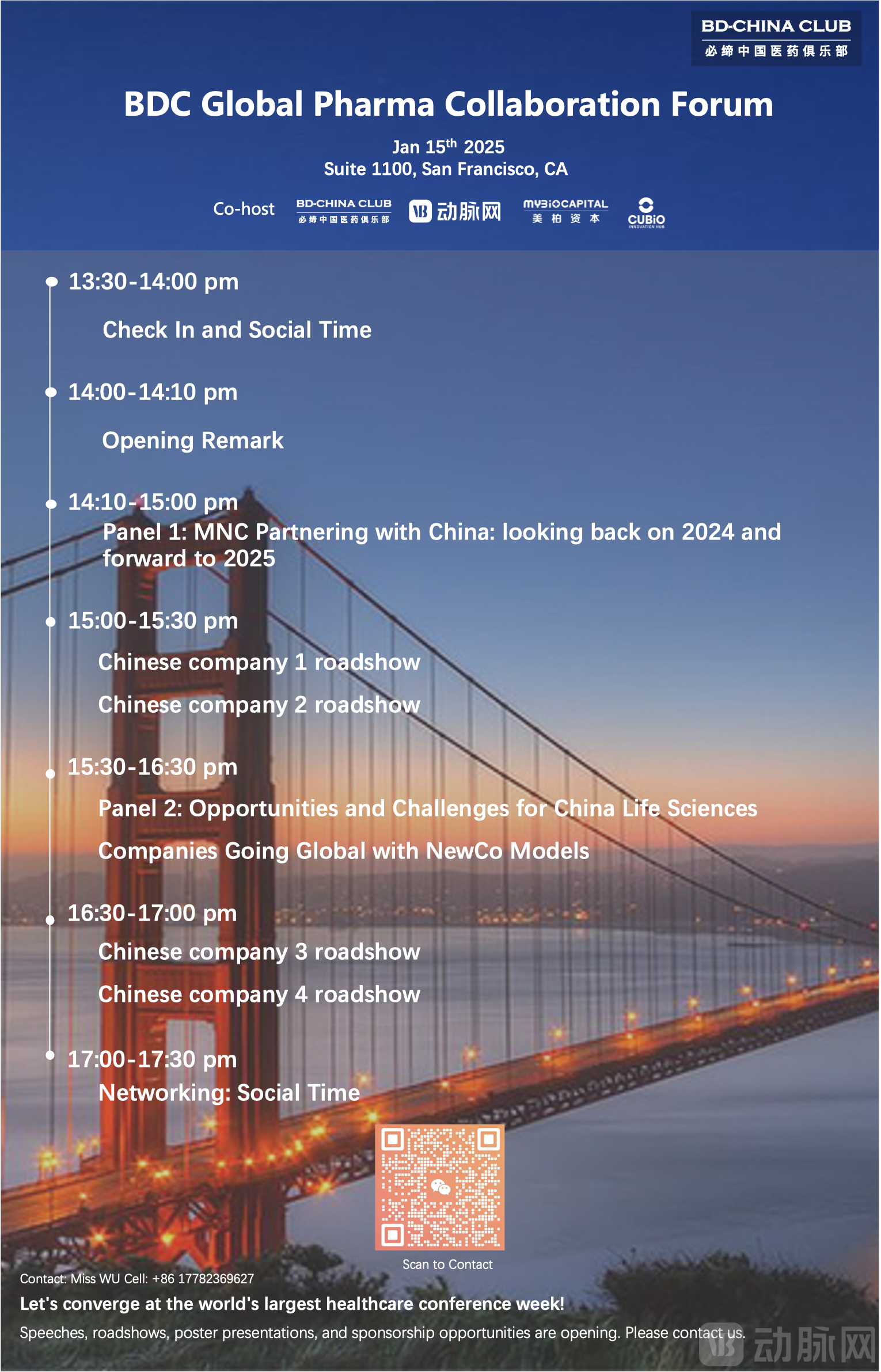
On January 15, 2025, the BD-CHINA Global Pharmaceutical Cooperation Forum, initiated by the BD-CHINA Pharmaceutical Club and co-organized by VCBeat, will be held in San Francisco. This event aims to create a dedicated platform for showcasing and exchanging insights on Chinese pharmaceutical innovation during the JPM Week. We sincerely invite industry colleagues to register and participate!
[Conference Attendance Recommendations]
1. The JPM Main Forum is scheduled for January 13–15, spanning three days. The VCBeat China Global Pharmaceutical Cooperation Forum avoids the peak attendance period by taking place on the afternoon of the third day. Located just across the street from the main forum venue, it offers attendees a convenient and relaxed opportunity to participate amidst their busy schedules, while also providing an ideal setting for summarizing and exchanging insights from the entire event.
2. The forum consists of general attendance in the afternoon and a networking cocktail reception in the evening, combining industry insights with business networking to facilitate both formal and informal exchanges.
3. If you are a regular attendee of JPM, you are welcome to join this forum to reconnect with old friends and meet new faces. If this is your first time participating, it is even more important to take advantage of thisPlatform, find a familiar discourse system, and join hands to embark on the broad path of global BD cooperation.