

Yueer App Launches with 1M+ Disease Knowledge Base to Deliver Lifelong Family Health Management Solutions
Amidst the bustling pace of December, Yue'erwan Health has achieved a series of remarkable milestones.
On the 5th, the Yue’er APP was launched on the Huawei AppGallery. On the 8th, Yue’erwan Health received the “Excellence in Innovation Award” at the AI Healthcare Innovation Development Competition of the 2024 AIMES Conference. On the 19th, the Yue’er APP team visited Tsinghua University to deliver an artificial intelligence practical course for students from Tsinghua University School of Clinical Medicine and Peking Union Medical College School of Clinical Medicine.Several smart city platforms are simultaneously negotiating collaborations, while dozens of hospitals are tendering for AI-assisted medical systems...
This is made possible by Yue’erwan Health, which leverages its proprietary medical artificial intelligence model—AIMES—to provide comprehensive, round-the-clock, lifelong (“three-all”) family health management for individuals and households. Its services span health consultations, chronic disease management, self-care medical guidance, critical illness analysis, immune assessment, personalized medical reports, and interpretation of health reports. By integrating multimodal data, it offers personalized recommendations on health trends and healthy lifestyles. Most importantly, the Yue’er APP will provide effective solutions to address the longstanding challenges of difficult and costly access to medical care for the general public.


Yue'er App, image provided by the interviewee

“Excellence in Innovation Award” trophy from the 2024 AIMES Conference AI Healthcare Innovation Development Competition, photo provided by the interviewee
Unlike other AI healthcare companies, Yue'erwan Health was born into a family with a story.
Dr. Wang Xiaobin, Founder and Chairman of Gaoneng Capital, told VCBeat that more than 30 years ago, in order to understand how computer languages in artificial intelligence courses mimic human thinking, she, a fresh graduate with a bachelor’s degree in computer software, directly enrolled in a master’s program in psychology to study human thought and motivation. By chance, she went on to become one of the earliest distinguished women in the investment banking sector to earn a doctoral degree.
Twenty-five years ago, just as the internet wave began to sweep into China, Wang Xiaobin, who had already worked for nearly a decade, resolutely left his enviable high-paying executive position to return to his professional roots. He founded his first internet company and established Gaoneng Capital. Since then, his career has gained unstoppable momentum, with direct investments and fund management exceeding RMB 30 billion. His portfolio has spanned diverse sectors, from mining to aerospace IoT, and from state-owned enterprise reform to healthcare investment. After exploring such a wide range of industries, he has now focused on unraveling the mysteries of life.
In 2022, as he shed the heavy burden of reforming central state-owned enterprise funds and Gem Flower Healthcare Group, and with the tidal wave of large AI model technology sweeping across the globe, Wang Xiaobin stated, “After more than 30 years, my neuronal genes are ultimately unable to escape their pursuit of artificial intelligence.”
In 2022, Gaoneng Capital launched the “Yue’erwan Health” brand, entering the AI healthcare sector. With the goal of promoting healthy lifestyles, it aims to build an international health management brand. Leveraging core disciplines in oncology, genetics, immunology, and nutrition, the platform provides Chinese families with comprehensive, all-time, and full-lifecycle (“Three-Alls”) health management services.
Master 1,000,000+ disease knowledge points to provide professional diagnosis and treatment recommendations for patients
Upon opening the Yue’er app, users are first greeted by a system prompt stating: “For your health, I have studied over 1 million disease-related knowledge points, more than 3 million journal articles, and information on over 100,000 medications.” Wang Xiaobin told VCBeat, “This vast global repository of medical knowledge is unmatched by any individual physician or hospital.”
The reason why the Yue'er App can achieve this lies in its possession of a massive database.To launch this health app, Gaoneng Capital integrated and acquired three companies, rapidly leveraging its proprietary medical artificial intelligence model—AIMES—for comprehensive enhancement.
Yue'er APP integrates massive data resources, including 30 million sample group datasets, over 3 million bioinformatics data points, more than 20 publicly available international databases, and multiple cross-omics integrated databases. By integrating and sharing these rich data resources, the platform conducts in-depth analyses of users' health status, thereby tailoring more targeted and accurate health management solutions to meet diverse user needs.
However, the sheer volume of data does not equate to information accessibility. To transform complex data into user-friendly insights, the Yue Er Wan Health team leverages AI technologies—including interactive technologies, data mining, and data integration and analysis—to convert this knowledge into personalized health management recommendations.
Unlike traditional general-purpose large language models, the Yue'erwan Health team has adopted Retrieval-Augmented Generation (RAG) technology. This AI approach combines information retrieval techniques with language generation models. By retrieving relevant information from external knowledge bases and incorporating it as prompts for large language models, this technology enhances the model's capability to handle knowledge-intensive tasks, such as question answering, text summarization, and content generation.
Zhang Bangqun, General Manager of Health Product R&D at Yue'erwan, stated: “The primary objective of RAG technology is to ensure that AI responses to patients are based solely on learned guidelines, standards, consensuses, journal literature, and records of relevant doctor-patient dialogues, thereby avoiding the hallucinations and risks associated with traditional large language models and guaranteeing the professionalism, accuracy, seriousness, and rigor of medical practice.。”
Moreover, the Yue’er app emphasizes the perception of user emotions, leveraging AI technology to facilitate in-depth dialogue and communication with patients, thereby enabling more accurate detection of their emotional fluctuations. “This precise recognition of emotions not only helps provide patients with more natural, humanized interactions, considerate psychological companionship, coherent logical frameworks, and empathetic medical intelligence, but also delivers emotional value, offering customers an AI-driven smart experience that differs from traditional hospitals,” said Zhang Bangqun.
Deploying the “Nine-Grid” Service Model to Establish Full-Lifecycle Family Health Management
Yue’erwan Health adheres to the core philosophy of “AI-driven, insurance-based, building China’s first family health service platform,” and has constructed its unique “Nine-Grid” business model. This model comprehensively covers nine key areas: medical care, pharmaceuticals, laboratory testing, nutrition, insurance, rehabilitation, wellness, mind-body-spirit health, and health tourism. Notably, the “Nine-Grid” business model centers on commercial insurance, utilizing commercial health insurance as the primary payment mechanism.
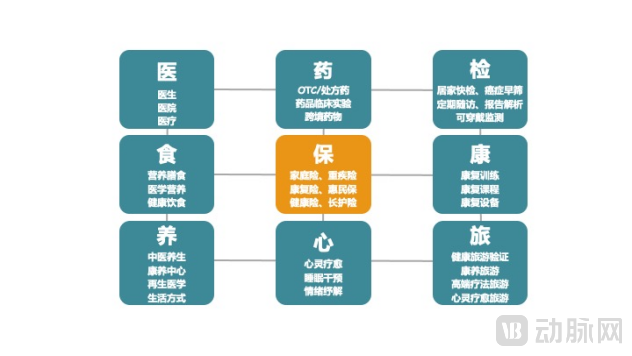
Yue'erwan Health Services Division, photo provided by the interviewee
Wang Xiaobin told VCBeat that this is because many internet healthcare platforms went through a prolonged period of heavy cash burn during their early stages, making it difficult to establish sustainable business models. To address this,Yue'erwan Health has clearly defined its goal from the outset: to build a platform that does not charge patients any additional fees.“Unlike life insurance, the market demand for commercial health insurance stems from providing proactive, continuous health management interventions for individuals with pre-existing conditions—both during illness and in post-recovery phases—rather than offering traditional critical illness or accident coverage, or financial payouts at the end of life. It aims to control disease progression while delivering health management services both inside and outside hospitals, ultimately reducing healthcare expenditures for patients and the national medical insurance system,” she said.
Under the traditional healthcare model, patients often rely on public health insurance to cover high medical costs. However, with the widespread adoption and development of commercial health insurance, patients will have more payment options, thereby alleviating pressure on the public health insurance system.
Taking the treatment of liver disease as an example, the traditional “triad” of liver cancer—progressing from hepatitis to cirrhosis and then to hepatocellular carcinoma—is not an uncontrollable process. In reality, many patients with hepatitis, upon learning of their condition, often allow the disease to progress unchecked due to a lack of effective management and intervention measures. By integrating commercial health insurance, however, patients can gain early access to professional screening, medical examinations, and home-based health management services. These services not only enable patients to monitor disease progression in a timely manner but also effectively reduce the risk of disease advancement and deterioration through personalized, proactive health management plans, thereby controlling the transformation to cancer.
Wang Xiaobin revealed,Yue'erwan Health plans to introduce an insurance brokerage firm next year, formally entering the commercial health insurance sector to provide users with more diversified health protection options, alleviate household medical payment burdens, and reduce national medical insurance expenditures.。
In addition to its strategic layout in the commercial insurance sector, Yue'erwan Health is also accelerating its expansion into other service segments. In the realm of pharmaceutical services, Yue'erwan Health is rapidly advancing the development of an e-commerce platform designed to provide cost-effective medication packages for patients with chronic diseases. Meanwhile, the platform is actively aggregating the latest global information on clinical drug trials, building a bridge of hope for patients seeking novel therapies.
In the field of home-based testing and monitoring, Yue'erwan Health is collaborating with multiple partners to jointly develop more intelligent health monitoring devices that track users' health data in real time and provide personalized health recommendations based on individual conditions. In terms of rehabilitation services, Yue'erwan Health will introduce a diverse range of rehabilitation programs and plans to help patients recover their health more rapidly.
In the health tourism sector, Wang Xiaobin stated that Yue'erwan Health has become one of the first batch of health tourism verification institutions certified by the Ministry of Culture and Tourism. It is actively promoting collaborations with high-standard, medical-grade health tourism institutions to provide an online-to-offline closed-loop smart support system for clients’ recuperation, holistic mind-body-spirit rehabilitation, natural healing, vitality wellness, and vacationing. “Regardless of their location, clients can use the Yue'er platform to share their complete health data with on-site rehabilitation therapists, thereby providing professional support for emergency medical treatment.”
In this way, Yue'erwan Health has achieved a comprehensive, AI-driven overview of family health management, safeguarding the healthy lives of every family.
Integrate B-side resources to provide scenarios for the ecosystem
When discussing his understanding of the platform's operational model, Wang Xiaobin stated,The platform does not directly engage in consultation services; instead, it leverages AI agents and enterprises within the “Nine-Grid” ecosystem to jointly deliver professional health services to F-side (i.e., family-end) users.。
She termed this concept the “FBI Architecture”: F stands for Family, reflecting the hereditary and clustering characteristics of diseases within families; B encompasses the nine sectors of medical services, forming a vast healthcare ecosystem; I signifies diversity, representing not only Insurance, AI (Artificial Intelligence), and Investment, but also embodying the enduring spirit of medical benevolence.
Behind this operational model, Yue'erwan Health requires a robust and diversified B-side ecosystem for support. Regarding service provider onboarding, Zhang Bangqun revealed that over 10,000 pharmacies are expected to be listed on the platform, while more than 30 branches will join to offer psychological services. Meanwhile, in terms of collaboration with medical institutions, the platform has established close ties with nearly 100 organizations. Furthermore, the platform has already made strategic moves in testing services, with over 100 types of tests currently available, providing users with comprehensive health monitoring solutions.
Wang Xiaobin is equally “ambitious” about the future development of the Yue’erwan Health Platform. She aims to transform it into the Douyin and Xiaohongshu of the healthcare vertical, creating a social platform where users can access health knowledge and share their personal health and wellness experiences. This vision stems from Wang’s deep industry expertise accumulated over more than two decades, as well as her profound understanding of the current wave of AI technologies. In her view, Yue’erwan Health enjoys unique competitive advantages.Since its inception, the platform has successfully operationalized nine major service modules within just one year and attracted over 30,000 registered family users.
Today, digital and intelligent healthcare has become the development direction of the medical and health sector. Currently, the global “AI + Healthcare” market size has exceeded $5 billion, and it is projected to surge to $70 billion by 2032, with a compound annual growth rate (CAGR) of over 29%. At present, the healthcare industry is entering the era of large AI models, characterized by diverse market demands, accelerated technological iteration, and frequent favorable policy releases, thereby providing innovative enterprises with greater opportunities for development.
Nevertheless, the industry continues to face certain challenges, such as data security and privacy protection, healthcare regulation and legal compliance, market competition, and user demands. Having weathered several waves of technological and capital influx, Wang Xiaobin remarked with calm confidence, “By continuously pursuing technological innovation, refining our products and services, and providing platform support and empowerment, Yue’erwan Health is well-prepared to embrace the new wave of digital and intelligent transformation in healthcare.”