

Cleerly Secures $106M Series C Funding and FDA-Cleared AI Solutions for Hundreds of Millions of Cardiovascular Patients Worldwide

Cleerly
Developer of Artificial Intelligence Digital Care Platform
Recently, AI cardiovascular imaging company Cleerly announced the successful completion of a $106 million (approximately RMB 800 million) Series C financing round. The round was led by Insight Partners, with participation from Battery Ventures and existing investors. The funding will continue to accelerate Cleerly’s commercialization and clinical research efforts.
Against the backdrop of continuous population growth and accelerating aging, the incidence of cardiovascular disease has continued to rise in recent decades, making it the leading cause of death globally. According to statistics from the World Heart Federation (WHF), there were 12.1 million deaths due to cardiovascular disease in 1990. By 2021, the number of deaths from cardiovascular disease had reached 20.5 million, accounting for nearly one-third of all global deaths.
However, some patients with cardiovascular disease may not exhibit obvious symptoms. These individuals may have normal cholesterol levels and lack symptoms such as shortness of breath or chest pain, remaining asymptomatic within the body. Nevertheless, without timely monitoring and intervention, certain conditions may progress to severe cardiac problems, thereby posing a threat to health.
Cleerly was founded in the United States in 2017, focusing on the development of artificial intelligence and imaging analysis-based diagnostic technologies for cardiovascular diseases. It has secured multiple rounds of financing to date:
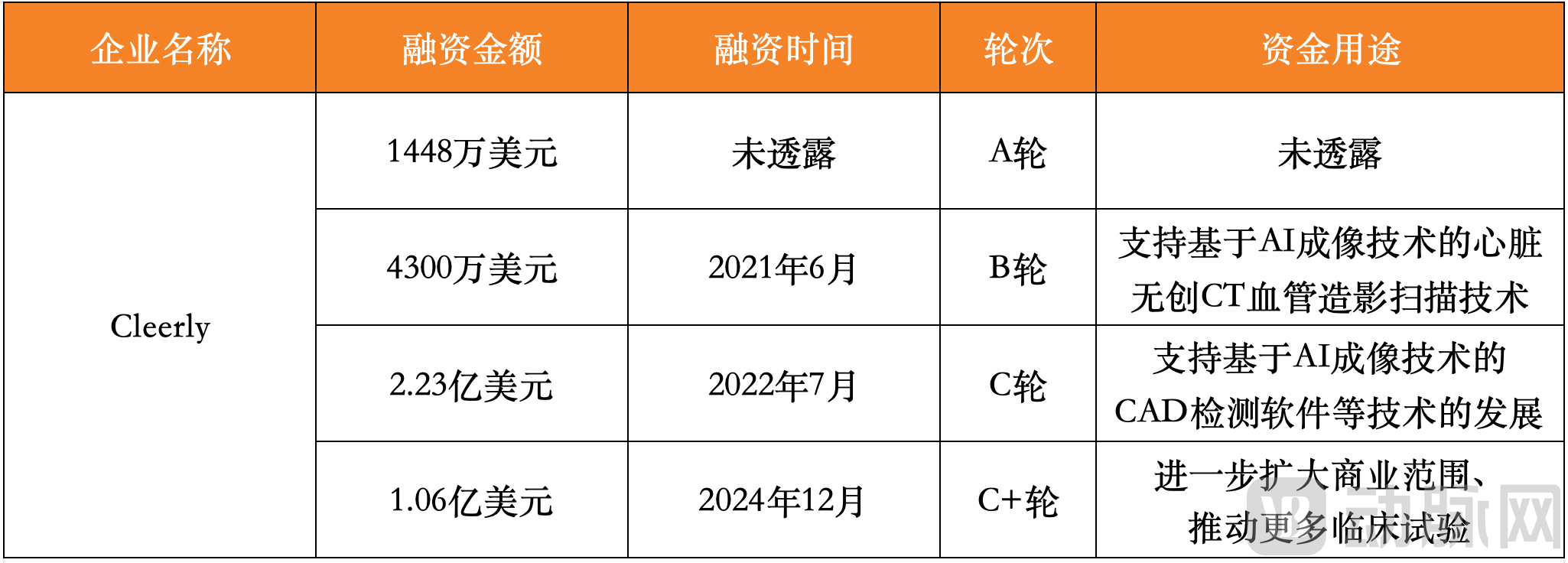
(Public information, chart by VCBeat)
Since its founding in 2017, Cleerly has been dedicated to integrating artificial intelligence with high-precision medical imaging to develop a novel system for the early screening and diagnosis of heart disease. The company initially focused on leveraging computed tomography (CT) imaging combined with AI algorithms to analyze coronary artery health, thereby enhancing the identification and diagnosis of heart disease.
The company’s founding team possesses a robust medical background, with prior affiliations at prestigious institutions such as Harvard Medical School and George Washington University (GWU) Hospital in Washington, D.C. Founder and Chief Executive Officer Dr. James K. Min specializes in cardiovascular disease prevention and cardiovascular imaging. He previously served as Professor of Radiology and Medicine at Weill Cornell Medicine and as Director of the Dalio Institute of Cardiovascular Imaging (ICI) at NewYork-Presbyterian Hospital.
Currently, cardiovascular diagnostic methods mainly include electrocardiography (ECG), echocardiography, coronary computed tomography (CT) angiography, coronary angiography, cardiac enzyme testing, and radionuclide imaging.
Among these, coronary angiography is the gold standard for diagnosing coronary heart disease. It requires injecting contrast media into the blood vessels to visualize the coronary arteries. However, this procedure is invasive and may cause mechanical injury to the vessel wall during the operation; furthermore, the contrast media can impair hepatic and renal function.
As technology continues to advance, Cleerly’s AI-driven imaging technology has introduced new approaches to cardiovascular diagnosis and treatment, successfully yielding two innovative products. The first is the CAD Staging System, which has received FDA Breakthrough Device Designation; the second is the Cleerly ISCHEMIA algorithm software, which has obtained FDA 510(k) clearance.
CAD Staging System is an investigational software device based on non-invasive imaging that analyzes critical and actionable features of coronary atherosclerosis, stenosis, and ischemia. It enables precise identification of heart disease through the analysis of non-invasive images, akin to how colonoscopy provides early detection of colorectal cancer.
The second product is the ISCHEMIA analysis software, an automated decision-support tool based on machine learning algorithms. Leveraging its robust AI capabilities, the software determines the likelihood of coronary ischemia by quantitatively measuring atherosclerosis, stenosis, and significant vascular morphology from patients’ coronary computed tomography angiography (CCTA) images.
Plaque type is associated with the risk of heart attacks and can serve as a direct basis for assessing the likelihood of acute cardiac events. Leveraging ISCHEMIA algorithm technology, 3D models of coronary arteries can be generated for patients, thereby enabling precise identification of luminal and vessel wall structures. Furthermore, this algorithm allows for comprehensive quantitative and qualitative assessment of plaque burden in each coronary artery and automatically evaluates the severity of stenosis in coronary CT scans.
This enables patients and physicians to clearly determine the quantity and type of plaques, thereby allowing physicians to better assess the patient’s risk of heart disease. This technology not only enhances the comprehensiveness of diagnostic reports but also provides physicians with more personalized risk assessments.
Cleerly’s product has demonstrated safe and reliable clinical efficacy. A study on Cleerly’s AI-powered non-invasive CT scanning showed that the product can clearly detect signs of heart disease, with performance comparable to that of invasive coronary angiography, the current “gold standard.” Furthermore, it carries a lower risk of complications.1. The use of Cleerly products can largely avoid the risks associated with invasive procedures, such as catheter-induced arterial injury, allergic reactions, renal impairment, myocardial infarction, and stroke.
Artificial intelligence is fundamentally transforming every aspect of human life.
China has a large population of patients with cardiovascular disease. According to data from the "Report on Cardiovascular Health and Diseases in China 2023" released by the National Center for Cardiovascular Diseases, the current number of people with cardiovascular disease in China is 330 million. With the accelerating aging of the population, the incidence and mortality rates of cardiovascular disease in China may continue to rise in the future.
As an auxiliary tool, AI technology provides patients and physicians with a safe and efficient diagnostic and treatment model, holding broad prospects for the future. Currently, companies such as Shukun Technology, CareWorth Electronics, and RaySense Intelligence are increasing their investments in the “AI + Cardiovascular Imaging” sector.
We look forward to more healthcare companies continuously enhancing their innovation capabilities, striving to break through technical barriers, and deepening the integration of artificial intelligence with the cardiovascular field, which is of great significance for improving the quality of life for patients with cardiovascular diseases.
Reference Article:
1. “Over 700 Million! Latest Financing Round for Innovative Medical Device Companies” – Siyu MedTech