

Haier Biomedical to Absorb and Merge with Shanghai RAAS in $8.3 Billion Deal to Forge Global Biotech Leader
Haier Biomedical
R&D and Manufacturer of Biomedical Cryogenic Storage Equipment
On the evening of December 22, Haier Biomedical issued an announcement proposing to absorb and merge with Shanghai RAAS, a leading enterprise in the blood products industry. Prior to the announcement, Haier Biomedical had a market capitalization of approximately RMB 11.2 billion, while Shanghai RAAS was valued at around RMB 47.9 billion. If completed, this acquisition would become a landmark case exemplifying accelerated industry consolidation under the guidance of the “Six M&A Measures” and the “Eight STAR Market Measures.”
Both Haier Biomedical and Shanghai RAAS are listed companies under “Yingkang Yisheng,” Haier Group’s big health industry platform. As the first listed company incubated through Haier Group’s innovation strategy in its big health sector, Haier Biomedical focuses on providing integrated digital solutions for smart laboratories, digital hospitals, and intelligent blood management within the fields of life sciences and healthcare innovation. Its products and solutions have been deployed in more than 150 countries and regions worldwide.
Shanghai RAAS is currently one of the largest manufacturers of blood products in China. Its main products include human albumin, intravenous immunoglobulin (IVIG), specific immunoglobulins, and coagulation factor products. The company was listed on the Shenzhen Stock Exchange in 2008.
In June 2024, Shanghai RAAS became a member of Haier Group’s big health ecosystem brand, Wincon Life. Through Haiyingkang, Haier Group acquired a 20% stake in Shanghai RAAS for RMB 12.5 billion and obtained 26.58% of the voting rights. Following the restructuring of the board of directors, Haiyingkang became the controlling shareholder of the company, and Haier Group became the actual controller.
Regarding the structure of this transaction, the two parties are planning for Qingdao Haier Biomedical Co., Ltd. to absorb and merge with Shanghai RAAS by issuing A-shares to all shareholders of Shanghai RAAS in a share-swap arrangement, while also issuing A-shares to raise matching funds. In addition, Qingdao Haier Biomedical Co., Ltd. and Shanghai RAAS intend to suspend trading of their shares starting from the market opening on December 23, 2024, with the expected suspension period not exceeding 10 trading days.
The key to this internal restructuring lies in building a world-class leading integrated biotechnology enterprise, improving the layout of the blood ecosystem industrial chain, and leveraging synergistic value.Based on the business analysis of both parties, perfecting the layout of the blood ecosystem industry chain will be the top priority of this transaction.。
Blood products are therapeutic agents manufactured through the separation and purification of plasma from healthy donors or specific immune human plasma, such as human serum albumin, human immunoglobulin, and human coagulation factors. These blood products are classified as essential medicines with inelastic demand, playing an irreplaceable role in emergency medical care and the treatment of certain specific diseases.
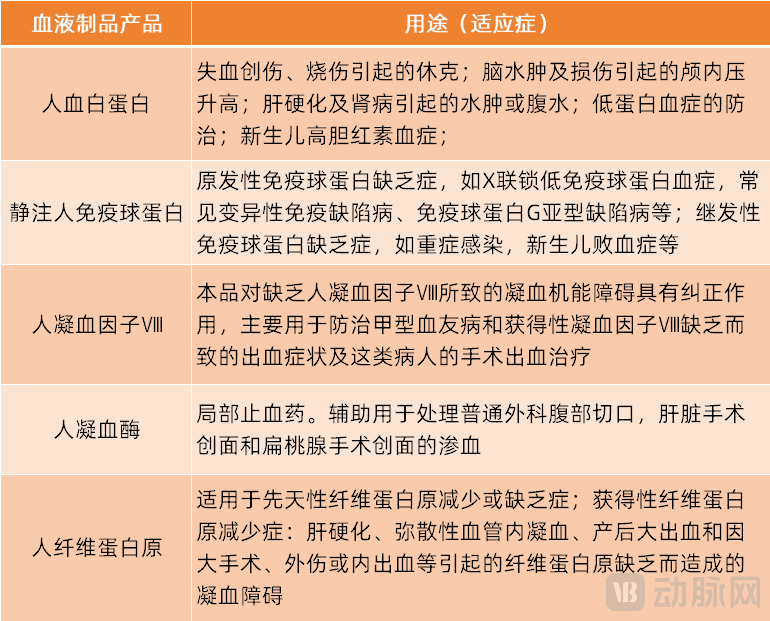
(Uses of blood products, incomplete statistics)
Shanghai RAAS is a leading enterprise in China’s blood products industry. In 2023, its revenue reached RMB 7.964 billion, representing a year-on-year increase of 21.27%. Currently, Shanghai RAAS operates five blood products production bases, with its product portfolio covering three major categories: albumins, immunoglobulins, and coagulation factors. It is one of the few blood products manufacturers in China capable of extracting six components from plasma, and it boasts one of the most comprehensive ranges of coagulation factor products within the domestic industry.
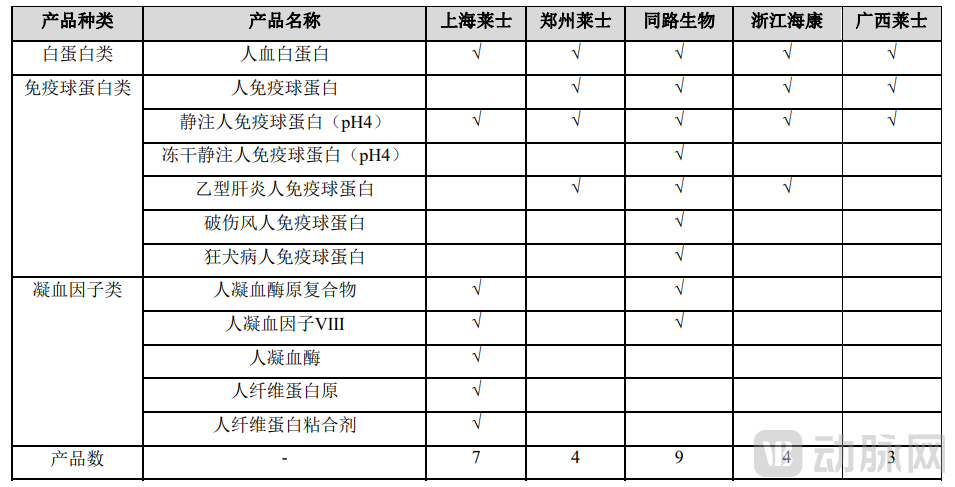
(Shanghai RAAS's blood products)
In addition, through its wholly-owned subsidiary Tonglu Pharmaceutical, Shanghai RAAS has obtained authorization from Grifols and GDS to serve as the exclusive distributor in mainland China for their human albumin products, as well as blood screening systems, blood screening test reagents, and blood screening test kits, thereby conducting sales operations for imported human albumin and blood screening-related products.
As of now, Shanghai RAAS operates 44 plasmapheresis plasma collection stations across 11 provinces (autonomous regions), including Guangxi, Hunan, Hainan, Shaanxi, Anhui, Guangdong, Inner Mongolia, Zhejiang, Hubei, Jiangxi, and Shandong. The number of plasma stations, their geographic distribution, and the annual plasma collection volume all rank among the industry leaders.
Unlike Shanghai RAAS, Haier Biomedical’s blood products business primarily provides comprehensive digital solutions for scenarios such as digital blood collection and supply for plasma stations and hospitals, digital hospital blood usage, and blood component collection. Its product portfolio includes blood refrigerators, automated plasma/cell banks, flat-plate plasma quick-freezers, platelet constant-temperature oscillating storage cabinets, plasma separators, and intelligent sterile transfer chambers.
From an industrial chain perspective, Haier Biomedical serves as a supplier of blood separation equipment, testing devices, and plasma collection consumables, with Shanghai RAAS being its downstream customer. This restructuring will facilitate the integration of upstream and midstream resources in the blood products sector for both parties, optimize the layout of the blood ecosystem industry chain, reduce costs, and enhance their competitiveness within the blood products industry.
Moreover, following the completion of the merger and acquisition, both parties will operate as a unified group to minimize internal friction, enhance effective communication, and strengthen their competitive edge in the market.
Furthermore, as an innovative enterprise that pioneered the integration of emerging technologies such as the Internet of Things (IoT) and cloud computing into blood products, Haier Biomedical holds significant advantages in smart blood usage. For instance, its Intelligent Blood Management System leverages IoT technology to collect real-time data on equipment operation, user interactions, and abnormal events. Through unified platform-based management, the system enables distributed storage and self-service operations for blood banks.
Leveraging Haier Biomedical’s digital advantages, this restructuring transaction will help Shanghai RAAS accelerate production, the pace of improvement in the informatization, automation, and intelligence of facilities and equipment such as testing and warehousing, to advance its production, testing, and other related activitiesEnd-to-End ProcessofDigitalizationandInformatization Construction,Enhancing Digital and Intelligent Capabilities。
In fact, digital transformation and upgrading have become mandatory initiatives for blood product manufacturers.. In June 2024, the National Medical Products Administration (NMPA) issued a notice to implement the Three-Year Action Plan for Smart Supervision of Blood Product Production (2024–2026). The Action Plan points out that it is necessary to accelerate the informatization construction in the production and testing links of blood products, and promote the establishment of an information management system covering the entire process from the entry of source plasma into the facility to production and testing.
"The Action Plan" is expected to basically achieve informatization management of blood products manufacturing enterprises by the end of 2026, improve the regulatory efficiency of blood products, and ensure the quality and safety of blood products.
The absorption and merger of Shanghai RAAS by Haier Biomedical comes at an opportune time. Post-merger, Haier Biomedical’s comprehensive digital solutions for scenarios such as smart blood utilization can be directly applied to Shanghai RAAS’s blood stations, as well as its production and testing processes, rapidly enhancing its level of digital and intelligent transformation.
Beyond upstream-downstream collaboration and digital empowerment, the merger between Haier Biomedical and Shanghai RAAS further underscores Yingkang Yisheng’s ambitions in the biotechnology sector: its plan to build a world-leading biopharmaceutical enterprise.
Previously, the Haier group acquired a 20% stake in Shanghai RAAS for RMB 12.5 billion, thereby gaining controlling interest in the company. Since then, the Haier group has deepened its footprint in the biotechnology sector, building on its foundation in blood products.
After acquiring a controlling stake in Shanghai RAAS, Yinkang Life announced its support for the company’s strategy of simultaneously advancing “plasma collection expansion” and “plasma fractionation optimization.” In terms of “plasma collection expansion,” it will support Shanghai RAAS in establishing new plasma collection stations and developing a broader portfolio of blood-derived products, thereby enhancing its overall production capacity and comprehensive plasma utilization rate.
In terms of "fractionation," we will support Shanghai RAAS in strengthening the global integration of R&D, manufacturing, and clinical resources for blood-derived pharmaceuticals and other biologics, while exploring pipeline opportunities in non-plasma sectors such as active and passive immunization, recombinant proteins, and cell therapies.
As can be seen, in its desizing strategy, Shanghai RAAS is not only developing blood products but has also expanded R&D into other areas of biopharmaceuticals.。
For example, Shanghai RAAS’s SR604 injection, the world’s first monoclonal antibody therapy targeting activated protein C for hemophilia, successfully obtained clinical trial approval in March. It has currently entered the patient enrollment phase of Phase I clinical trials, and the relevant invention patents have been granted in nine countries, including China, the United States, and European nations.
SR604 monoclonal antibody injection is a monoclonal antibody formulation intended for the prophylactic treatment of bleeding in patients with hemophilia and congenital factor VII deficiency. Previously, some of its preclinical research findings were published as a cover article in Blood, an international journal of hematology. To date, no product targeting the same mechanism has been marketed globally.
In the first half of 2024, Shanghai RAAS’s subsidiary, Taitai Biological Products, completed the Phase III clinical study objectives for human fibrinogen in CFD indications, achieving the expected outcomes.
In the long run, it may be inevitable for Yingkang Life to support Shanghai RAAS in its layout of biopharmaceuticals. At this stage, beyond blood products, emerging biotechnologies such as monoclonal antibodies, fusion proteins, antibody-drug conjugates (ADCs), bispecific antibodies, gene therapy, and cell therapy are continuously emerging. Compared with the traditional pharmaceutical market, the global innovative drug market is in a stage of rapid development. Data shows that since the beginning of the "14th Five-Year Plan" period, a total of 113 domestically produced innovative drugs have been approved for marketing in China, with the market size reaching RMB 100 billion.
For Shanghai RAAS and Qingdao Haier Biomedical Co., Ltd., both require a higher-level development platform; Yingkang Yisheng, meanwhile, needs a world-class, international, research-driven biotechnology enterprise.
Therefore, upon the completion of this restructuring transaction, Shanghai RAAS’s strengths in blood product manufacturing and biopharmaceutical R&D will be combined with Qingdao Haier Biomedical Co., Ltd.’s advantages in life sciences and medical innovation. Under the coordinated oversight of Wincon Life, this integration will create a flagship biotechnology enterprise. This biotech flagship will not only be the leading player in blood products but also a biotechnology leader strategically positioned in high-growth innovative drugs.
In addition,Following the merger of Qingdao Haier Biomedical Co.,Ltd. and Shanghai RAAS, the two parties are also expected to join forces in overseas markets, thereby enhancing their international competitiveness.Haier Biomedical currently has over 800 overseas distributors, covering more than 150 countries and regions worldwide. It has established a network of user experience training centers centered in Nigeria, the United Kingdom, the United Arab Emirates, Singapore, and other locations, as well as warehousing and logistics hubs in the Netherlands, the United States, and elsewhere. In the first half of 2024, Haier Biomedical’s smart blood management solutions were implemented in nearly 10 countries, including Morocco, Senegal, Tanzania, and Kenya.
Shanghai RAAS intensified its overseas market expansion in the first half of 2024, achieving a year-on-year growth of 351.55% in overseas revenue. Meanwhile, it will leverage Grifols’ global network to further expand the overseas market for intravenous immunoglobulin (IVIG), thereby realizing the internationalization and optimized upgrading of its business operations.
Based on this, the merged Shanghai RAAS is expected to further expand its market by leveraging Haier Biomedical’s overseas market channels and service capabilities. Haier Biomedical will also enrich its product portfolio with Shanghai RAAS’s offerings, thereby enhancing its international competitiveness and bargaining power.。
Furthermore, Haier Biomedical and Shanghai RAAS share numerous other industrial synergies, including product R&D, market networks, and cost management. By integrating their respective advantages, the two companies may establish a comprehensive biotechnology leader with sustained growth potential and international competitiveness.
It is worth noting that both Haier Biomedical and Shanghai RAAS are experts in mergers, acquisitions, and integration.
From 2013 to 2023, Shanghai RAAS successively acquired equity stakes in Zhengzhou RAAS Blood Products, Toler Biopharmaceuticals, Zhejiang Haikang Biological Products, and Guangxi RAAS Biopharmaceuticals. Through integration, the acquired companies drove rapid business growth for Shanghai RAAS, as evidenced by its significant revenue increase to RMB 4.288 billion, RMB 6.567 billion, and RMB 7.964 billion in 2021, 2022, and 2023, respectively.
Haier Biomedical has long adhered to a dual-growth strategy driven by both organic development and external expansion. In recent years, companies such as Haier Biomedical Technology (Chengdu) Co., Ltd. (formerly Sichuan Haishengjie Cryogenic Technology Co., Ltd.), Haier Blood Technologies (formerly Chongqing Sanwei Pharmaceutical Co., Ltd.), Jinweixin, Kangsheng Biotechnology, and Haier Biomedical Technology (Suzhou) Co., Ltd. (formerly Suzhou Houhong Intelligent Technology Co., Ltd.) have successively joined Haier Biomedical.
It is understood that Haier Biomedical integrates its acquisition targets through the “Concentric Circles” system, enabling rapid development and business integration of these entities. Following their acquisition, the target companies have achieved high-speed growth with the support of Haier Biomedical. For instance, since joining Haier Biomedical, Haier Blood Technology has rapidly expanded its plasmapheresis certifications, upgraded its products, and resumed production under existing licenses; its scale in 2023 nearly doubled compared to the pre-acquisition period. After its integration, Haier Biomedical Technology (Suzhou) has aligned its business and technologies with Haier Biomedical, resulting in a 50% year-on-year increase in new orders in 2023. Since its inclusion, Haier Biomedical Technology (Chengdu) has achieved a compound annual growth rate (CAGR) of 30%.
It is believed that the merger and restructuring between Haier Biomedical and Shanghai RAAS will also rapidly demonstrate a "1+1>2" effect.
In recent years, most domestic blood product companies in China have adopted an expansion model for plasma collection stations that prioritizes mergers and acquisitions, with self-built facilities playing a supplementary role.Mergers and acquisitions are gradually becoming a key component of long-term strategic planning in the blood products industry.。
In May 2023, Shaanxi Coal and Chemical Industry Group acquired a 20.99% stake in Pailin Bio for RMB 3.844 billion through its subsidiary, Shengbang Yinghao. Pailin Bio, a listed company specializing in blood products, offers 11 blood product variants and operates 38 plasma collection stations, ranking third in the industry for both metrics. By pursuing both organic growth and external expansion, Pailin Bio has achieved leapfrog development, with its plasma collection volume exceeding 1,200 tons in 2023, thereby entering the top tier of blood product manufacturers with annual collections surpassing 1,000 tons.
In July 2024, Boya Bio-pharmaceutical Group proposed to acquire 100% of the equity of Green Cross Hong Kong for RMB 1.82 billion, thereby indirectly acquiring the domestic blood products entity, Green Cross (China) Biological Products Co., Ltd. Green Cross (China) offers 16 product specifications across 6 varieties, operates 4 plasma collection stations, and achieved a plasma collection volume of 104 tons in 2023. Upon completion of the acquisition, Boya Bio-pharmaceutical will add one production license, four operational plasmapheresis plasma collection stations, and expand its plasma station footprint into two additional provinces.
In August 2024, Tiantan Bio, a professional blood products company under Sinopharm China National Biotec Group (CNBG), acquired 100% equity interest in Wuhan Zhongyuan Ruide, a wholly-owned subsidiary of CSL Asia Pacific, for $185 million through its controlling subsidiary, Chengdu Rongsheng Pharmaceutical. Wuhan Zhongyuan Ruide operates five plasma collection stations in Hubei Province, all of which have obtained Plasma Collection Licenses and are engaged in normal plasma collection operations. In 2023, the company collected a total of 112.37 metric tons of plasma.
The prevalence of mergers and acquisitions in the blood products industry is due toCompared with spending money to build blood stations, acquisition is obviously faster.More importantly, under strict regulation and high entry barriers, mergers and acquisitions are one of the few ways for blood product companies to achieve rapid growth.。
Specifically, since May 2001, the Chinese government has not approved any new blood products manufacturers, implementing a cap on the total number of such enterprises. Currently, there are fewer than 30 blood products companies operating normally in China. The industry features extremely high entry barriers, making blood products manufacturing licenses a scarce resource.
The State also imposes strict regulations on the establishment and management of plasmapheresis stations: such stations may only be established by blood product manufacturers, implementing a “one-to-one” plasma supply relationship. The establishment of plasmapheresis stations must comply with relevant planning requirements, and only one plasmapheresis station is permitted within each plasma collection area.
In 2016, the National Health and Family Planning Commission issued the "Opinions on Promoting the Healthy Development of Plasmapheresis Stations," strictly controlling the approval for the establishment of new plasmapheresis stations and favoring blood product manufacturers with strong R&D capabilities, high comprehensive plasma utilization rates, and standardized plasmapheresis station management. However, more than half of domestic blood product enterprises do not qualify to establish new plasma collection stations. Therefore,Significantly Increased Difficulty in Establishing New Plasmapheresis Stations,The Number of Plasma Collection Centers Is Difficult to Increase Rapidly in the Short Term。
To gain a competitive edge in the market, blood product manufacturers have been expanding their scale and influence through mergers and acquisitions, thereby securing advantageous competitive positions. Meanwhile, the state encourages leading enterprises, including those in the pharmaceutical industry, to continuously grow stronger and larger through mergers and reorganizations. Supported by national regulatory policies and driven by the industry’s own development needs,Further Catalyze.Industry Consolidation of Blood Product Manufacturers。
In 2023, the combined plasma collection volume of the six leading blood products companies accounted for 70%-80% of the total plasma collection in China. As industry consolidation accelerates, market leaders are expected to strengthen their dominant positions.
It should be noted that,State-owned enterprises have played a significant role in this wave of acquisitions and consolidation in the blood products industry.. For instance, behind Shengbang Yinghao, the acquirer of Pailin Biological, stands the Shaanxi Provincial State-owned Assets Supervision and Administration Commission (SASAC); behind Boya Bio-pharmaceutical, the acquirer of Green Cross Hong Kong, is China Resources Pharmaceutical, with its actual controller being the State-owned Assets Supervision and Administration Commission of the State Council; Tiantan Biological, the acquirer of Wuhan Zhongyuan Ruide, is a subsidiary of Sinopharm China National Biotec Group... Perhaps, much like the traditional Chinese medicine market, the blood products industry has also entered the "era of state-owned capital."
Currently, domestic demand for blood products continues to grow, the market size is expanding, and a long-term supply shortage persists. The core factor constraining supply lies in the quantity and quality of upstream plasmapheresis centers.
To alleviate the supply-demand imbalance, provinces across China have intensified efforts to establish new plasmapheresis centers. For instance, Yunnan Province planned to add 19 new plasmapheresis centers from 2021 to 2023; Inner Mongolia Autonomous Region planned to add no more than six such centers from 2022 to 2025; and Jilin and Liaoning Provinces each planned to add two or one new center, respectively. According to statistics, the number of plasmapheresis centers operated by listed blood product companies in China reached 217 in 2023, representing a 30% increase. The establishment of these centers is expected to effectively drive an increase in plasma collection volumes, thereby addressing the supply-demand gap.
Furthermore, enhancing technological capabilities is a core strategy for blood product manufacturers to alleviate the supply-demand imbalance. Currently, leading overseas blood product companies can isolate more than 20 products from plasma, whereas domestic blood product enterprises in China offer no more than ten varieties. Among these, only a small number of companies are capable of producing technically demanding coagulation factor products, with relatively limited annual output. It is anticipated that as domestic blood product manufacturers improve their processes and advance their technologies, they will steadily and rapidly increase the comprehensive utilization rate of plasma, thereby strengthening their overall competitiveness.
Overall, apart from M&A integration, establishing new plasmapheresis stations, improving production processes, and advancing technological capabilities will be the key strategic priorities for domestic blood product manufacturers.