

Quanterix Acquires EMISSION for $70 Million to Strengthen Simoa Platform and Expand Multiplex Capabilities

Quanterix
Provider of Digital Biomarker Analysis Solutions
Under the terms of the agreement, Quanterix will complete the initial acquisition of EMISSION for $10 million in cash, with an additional $10 million payable upon EMISSION’s achievement of specified technical milestones. Furthermore, EMISSION may be eligible to receive up to $50 million in contingent consideration based on future performance. Quanterix anticipates that this transaction will drive growth in both revenue and gross margin in 2026, laying a solid foundation for the company’s next phase of development.
Acquisition Purpose: To Update Simoa’s Core Technology
Single Molecule Array (Simoa) immunoassay technology is the core technology of Quanterix. Simoa technology utilizes microwell plates and magnetic beads to capture target molecules, with each microwell containing only a single magnetic bead immobilized with a large number of capture antibodies. When the target antigen in the sample binds to the capture antibodies, it further binds to reporter molecules labeled with detection antibodies, forming a “sandwich” structure. By exciting the fluorophores on the reporter molecules, detection of individual target molecules can be achieved.
It is worth noting that the core of Simoa technology lies in its unique ability to isolate individual immune complexes using paramagnetic beads, as well as its innovative approach of capturing single molecules in femtoliter-sized wells for digital readout. However, as the Simoa technology stack expands toward higher-order multiplexing and multi-omics capabilities, mastering the core component—magnetic beads—becomes critical.
Headquartered in Georgetown, Texas, EMISSION specializes in the production of large-scale, highly uniform dye-encapsulated magnetic beads. These beads are not only suitable for low-to-medium multiplex assays but also enable precise readout on its proprietary medium-plex platform.
It is understood that the two companies had already been collaborating for many years prior to this acquisition, with Quanterix stating that it had validated Emission’s bead technology for use in its upcoming next-generation Simoa platform.
Weak Instrument Sales Prompt Quanterix to Double Down on AD Testing
According to Quanterix’s Q3 2024 financial report, its revenue achieved a 13% year-over-year increase, reaching $35.7 million. Notably, this marks the sixth consecutive quarter in which Quanterix has delivered double-digit growth.
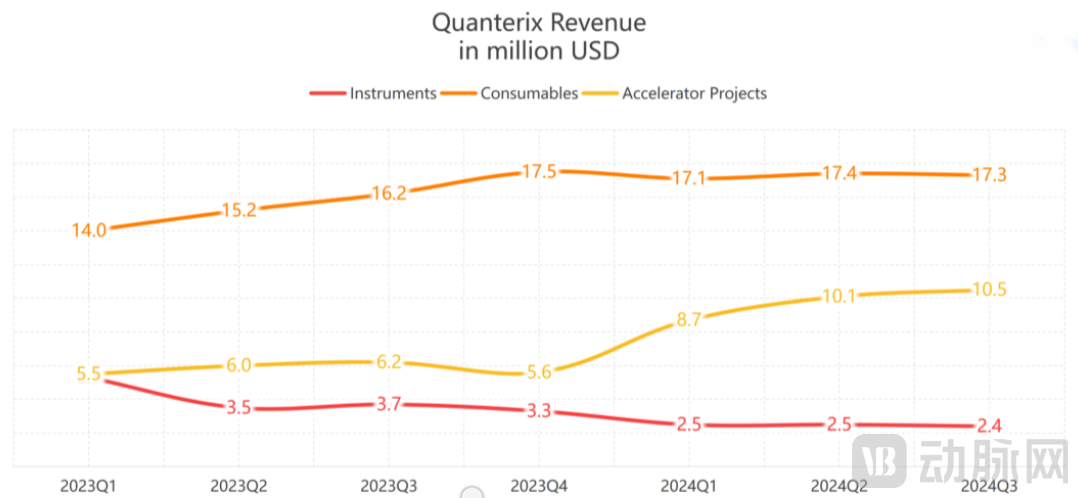
Quanterix Revenue Performance
Despite weak instrument sales, Quanterix’s Accelerator laboratory services revenue surged 36%, driven by advances in Alzheimer’s disease (AD) testing, while consumables revenue rose 8%, becoming a key driver of the company’s overall revenue growth.
As early as 2022, Quanterix entered into an agreement with Eli Lilly and Company to secure rights to use P-tau217 antibody technology, laying a favorable foundation for the development of plasma-based Alzheimer’s disease biomarkers. Following the FDA’s sequential approvals of Eli Lilly’s Kisunla (donanemab) and Eisai and Biogen’s Lecanemab therapy, Quanterix’s stock price and trading volume surged, with its share price rising by 13%.
The associated revenue growth has also bolstered Quanterix’s confidence. It is understood that Quanterix plans to iteratively upgrade its Alzheimer’s disease testing portfolio by launching the LucentAD Complete product. This product enhances diagnostic accuracy by measuring five protein biomarkers—p-Tau 217, Aβ40, Aβ42, NfL, and GFAP—and generating a score using an algorithmic approach. Trial data show that, compared with standalone p-Tau 217 testing, the algorithm-driven multi-analyte assay reduces the proportion of results falling in the indeterminate range from 31.2% to 10.5%, a threefold reduction, while maintaining an overall accuracy rate exceeding 90%.
Products Already Approved, Domestic Companies Accelerate Their Layout
Blood-based biomarker testing for Alzheimer’s disease (AD) using single-molecule immunoassay technology has begun to emerge in clinical applications. In China, multiple innovative companies have keenly recognized the significant potential of this field and are actively making strategic investments.
On August 20, 2024, Youdi Bio’s flagship product, the UD-X™ Fully Automated Single-Molecule Fluorescence Immunoassay Analyzer, successfully obtained China’s first clinical registration certificate for a single-molecule array (Simoa®) immunoassay analyzer. When used in conjunction with its配套 detection kits, this analyzer meets the clinical and community screening needs for qualitative and quantitative detection of trace protein biomarkers in various body fluid samples, offering femtogram-level sensitivity.
In February of the same year, Yuce Biotech’s independently developed “Beta-Amyloid 1-42 (Aβ1-42) Assay Kit” and “Phosphorylated Tau-181 Protein Assay Kit” also obtained Class II medical device registration certificates approved by the Jiangsu Provincial Medical Products Administration. When used in conjunction with the AST-Dx90 instrument, which is based on a single-molecule analysis strategy, these two AD assay kits achieve a detection sensitivity at the fg/mL level, with results available in just 10 minutes.