

DaBang Bio Launches First-in-Class Frog Skin-Based Wound Dressing Targeting Radiation-Induced Skin Injury and Chronic Wounds
As a key focus and long-standing hotspot in surgical research, the call for "domestic substitution" of chronic wound dressings is growing louder.
In recent years, the treatment of chronic wounds has progressively evolved toward specialization, professionalization, systematization, and modernization. Among these advancements, the theory of moist wound healing has been widely applied, positing that maintaining a moist wound environment facilitates healing. The TIME (Tissue, Infection/Inflammation, Moisture, Edge) framework has become a key principle guiding chronic wound management, emphasizing debridement of wound tissue, control of infection and inflammation, maintenance of moisture balance, and management of wound edges.
In the field of dressings, the development of novel dressings, such as nanosilver dressings and hydrogel dressings, has successively emerged. These dressings offer superior wound conformity, antimicrobial properties, and moisture retention. In terms of pharmaceuticals, the development of agents that promote healing and control infection, such as novel growth factors and antimicrobial peptides, has provided new therapeutic options for chronic wound management. Furthermore, the advent of new diagnostic and therapeutic modalities, including negative pressure wound therapy (NPWT), stem cell therapy, and gene therapy, has brought new hope to the treatment of chronic wounds.
However, despite advances in chronic wound treatment technologies, there remains a lack of personalized and precise treatment regimens tailored to individual patients and specific wound types. Traditional debridement techniques suffer from non-selective tissue removal, excessive reliance on the operator’s experience, and potential risks of patient pain and excessive bleeding. Physical therapies, such as hyperbaric oxygen therapy and ultrasound, play a role in the management of chronic wounds but are limited by issues such as uncertain treatment depth and efficacy. While biological therapies like stem cell therapy and gene therapy theoretically offer the potential to accelerate chronic wound healing, these technologies remain immature and have not yet been widely adopted in clinical practice.
Chronic wound management involves not only physiological aspects but also psychological and social dimensions, which significantly influence treatment outcomes; however, current therapeutic approaches often overlook these factors. Furthermore, the high cost of chronic wound care imposes a substantial economic burden on both patients and healthcare systems, creating an urgent need for the development of more cost-effective treatment strategies.
An innovative therapy aimed at meeting the needs of personalized treatment, improving therapeutic efficacy, and enhancing patients' quality of life is urgently needed.
In 2023, Dabang (Guangzhou) Biotechnology Co., Ltd. (hereinafter referred to as “Dabang Biotech”) was established. Leveraging the technological expertise of the Key Laboratory of Nuclear Technology for Medical Translation at Sichuan University, the company focuses on medical devices and equipment for the treatment of radiation-induced skin injuries, burns, and chronic wounds. It is also committed to promoting the clinical application and industrialization of novel functional dressings, such as frog-skin biological dressings.
Starting from Radiation-Induced Skin Injury: Preparing Wound Dressings from Frog Skin
As amphibians, frogs possess a rich evolutionary history, with their skin having evolved robust defensive capabilities to counteract various adverse factors. Frog skin exhibits excellent air permeability, moisture vapor transmission rate, and lightness, along with favorable biocompatibility and wound-healing properties.
Since 2009, the R&D team at Dabang Bio has been dedicated to research on the bioactive regeneration of frog skin, continuously deepening its expertise in this field. The company has secured 16 grants in the dermatology sector and holds a total of 23 intellectual property rights domestically and internationally, including 3 U.S. patents and 20 Chinese patents.
Professor Zhang Shuyu, Chief Scientist at Dabang Biotech, is an expert in the fields of hard-to-heal wounds and bioactive peptides. He and his team discovered the unique function of a specific peptide component in frog skin—a frog-derived peptide named RIFSP-2. This peptide can inhibit SCD1-mediated fatty acid synthesis, thereby alleviating inflammatory damage caused by STING activation in irradiated skin cells. Radiation at specific doses can induce frog skin to produce various special peptides, which increase cell survival rates and reduce radiation-induced apoptosis and senescence.
Therefore, at its inception, Dabang Biotechnology primarily focused on the field of tumor radiotherapy. Similar to the pain points in chronic wound management, the treatment of radiation-induced injuries also faces challenges such as a lack of personalized therapy, limitations in debridement techniques, insufficient physical and adjunctive therapies, as well as the psychological impact and economic burden associated with wound care.
Among these, the complexity of post-radiotherapy injury has become a major pain point. This complexity is manifested not only in local tissue damage but also in systemic responses. Meanwhile, individual differences lead to varying sensitivity and responses to radiotherapy, necessitating highly personalized treatment strategies. Furthermore, there is a clinical lack of precise treatment plans tailored to individual patients, particularly posing challenges in predicting which patients will develop severe post-radiotherapy injuries.
On the other hand, the population of patients in urgent need of treatment continues to grow. According to the 2024 statistical data released by the National Cancer Center, China records nearly 5 million new cancer cases annually, making it the country with the largest number of cancer patients worldwide. When including the existing prevalent cases, the total number of cancer patients amounts to approximately 12 million. Radiotherapy is one of the key modalities in cancer treatment; an estimated 60%–70% of cancer patients require radiotherapy. Among those undergoing radiation therapy, more than 95% experience radiation-induced skin injuries, with radiation-induced chronic ulcers being the most severe complication associated with such skin damage.
Driven by the continuous improvement of regulatory policies for radiopharmaceuticals and the rising per capita healthcare expenditure, the penetration of radiotherapy in China is gradually expanding. The growth rate of the industry’s market size is expected to accelerate further, while the market for radioactive treatments for chronic, non-healing wounds will also expand steadily, presenting significant growth potential in the future.
Li Peiyu, CEO of Dabang Biologics, further pointed out: “The initial aim of the project was to address radiation-induced injuries caused by tumor radiotherapy. However, as our research progressed, we recognized that the challenges associated with radiation damage in tumor radiotherapy share similarities with those encountered in the treatment of chronic wounds. Chronic wounds, such as diabetic foot ulcers, are often difficult to heal due to local tissue hypoxia and inflammatory responses, making their management a global health concern. If we can develop a product that not only advances the treatment of radiation-induced wound injuries but also improves the healing of chronic wounds, it would represent a significant market opportunity.”
Currently, there are fewer than 10 biological dressings approved for market launch both domestically and internationally that target the repair of all chronic wounds. Among these, none are specifically designed for the repair of radiation-induced chronic wounds. The research achievements of Dabang Bio will provide new interventional strategies for the prevention and treatment of radiation-induced skin injuries.
Innovative Irradiated Frog Skin Technology: New Product Enters Pilot Production Phase for Mass Manufacturing
Dabang Biologics’ products primarily use the skin of the black-spotted frog (Rana nigromaculata) as the raw material. In terms of manufacturing processes, the production workflow for Dabang Biologics’ frog skin dressings involves multiple meticulous steps: first, the frog skin undergoes thorough cleaning, precise cutting, and initial disinfection; next, it is subjected to decellularization; subsequently, an innovative irradiation technology is applied to remove frog skin cells and immunogenicity, rendering the product acellular and thereby avoiding rejection reactions; finally, rigorous sterilization procedures are completed.
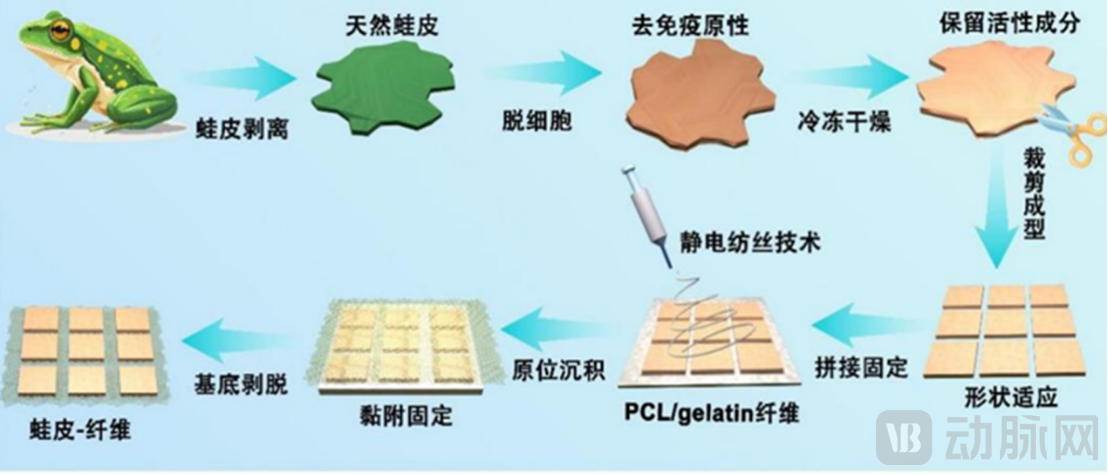
Preparation Process. Image source: Dabang Biotech
In terms of technological innovation, Dabang Biotech employs ultraviolet (UV) irradiation technology in the preparation of its frog skin biological dressings. The ingenuity of this technique lies in its ability to effectively preserve the intact skin structure of the frog skin as well as bioactive substances within it, such as peptides, thereby enhancing wound healing efficacy. Similar products, such as irradiated porcine skin, have been widely used in clinical burn treatment. In comparison, frog skin is thinner and more flexible, giving frog skin dressings a distinct advantage in conforming to wounds located on certain human joints.
In terms of clinical indications, frog skin biological dressings feature a thin, breathable, and highly flexible structure that ensures superior conformity to wound beds. These properties make them particularly suitable for wound dressing, with ideal efficacy in managing wounds on frequently moving areas such as fingers and joints. Leveraging these characteristics, frog skin dressings hold promise for expansion into broader clinical scenarios. They are effective for a wide range of acute and chronic wounds—including surgical incisions, pressure ulcers, diabetic foot ulcers, lower-extremity arterial and venous ulcers, radiation-induced skin ulcers, and infected wounds such as sinus tracts—as well as for difficult-to-heal wounds like burns and scalds. Furthermore, frog skin dressings exhibit excellent biocompatibility and safety. Rich in bioactive peptides, they significantly enhance wound healing capacity, thereby promoting rapid wound closure.
It is worth noting that the raw material for Dabang Bio’s frog skin biological dressing is sourced from artificially bred black-spotted frogs (one of the most widely distributed amphibians in China). Their short breeding cycle and high yield give the finished product a significant advantage in raw material costs. Compared with dermal matrix dressings derived from porcine or bovine sources, frog skin dressings have a much lower clinical price and are expected to maintain strong price competitiveness after entering the market.
Li Peiyu told VCBeat that Dabang Bio indeed faced challenges during the R&D and pilot production phases. Since frog skin had not been previously applied in the medical device field, biosafety studies were critical and involved a substantial workload. The company needed to devote significant efforts to exploring and verifying its safety, ensuring that future products would not pose any potential risks to users.
Secondly, in terms of product finalization, establishing model numbering rules and dimensional design specifications are critical challenges we must urgently address, as these factors directly determine whether the product can precisely meet market demands and facilitate subsequent standardized production. Furthermore, the lack of regulations and guidelines for non-clinical studies presents another challenge; as a pioneer, Dabang Biologics needs to drive numerous groundbreaking initiatives from scratch.
Fortunately, Dabang Bio’s pre-clinical trial preparations are progressing steadily. The company is currently in the laboratory phase, finalizing key technologies and manufacturing processes, while conducting multi-batch production to enter the pilot-scale manufacturing stage for evaluating critical performance characteristics and validating efficacy.
From Domestic Substitution to Active Global Expansion
As domestic high-end dressing technologies, represented by Dabang Bio, continue to innovate, the competitiveness of Chinese-made high-end dressing products in the international market is steadily strengthening. Compared with the pre-pandemic period, the proportion of overseas revenue for domestic medical device companies has reached a new level. This highlights an inevitable trend toward global expansion, particularly for Chinese companies whose product lines are competitive enough to rival those of foreign enterprises.
Dabang Biologics is no exception.
At this stage, the company has chosen the United Kingdom as the starting point for its overseas business expansion, with further plans to penetrate European and American markets. Li Peiyu stated, “Our high-value biological dressings derived from irradiated frog skin are a unique product in the UK market.” Dabang Biotechnology’s overseas market advisors include frontline general practitioners (GPs) from NHS institutions. Through them, it has been learned that the incidence of skin injuries in the UK—such as diabetic ulcers, chronic wounds, burns, and radiation-induced injuries from radiotherapy—is extremely high, creating substantial demand for innovative wound care products. Moving forward, Dabang Biotechnology will collaborate with the NHS to position the UK as an ideal market for addressing these healthcare needs.
Moving forward, Dabang Bio will complete the integration of its internal resources, recruit a cohort of specialized technical talent, and strengthen its intellectual property portfolio. In terms of commercialization, the company will adopt a sales model combining direct sales with distribution, while simultaneously establishing “one-stop” specialized diagnosis and treatment platforms for chronic non-healing wounds in hospitals.
The Guangdong Institute of New Biomaterials and High-End Medical Devices is a demonstration base for the transformation of achievements from the National Innovation and Cooperation Platform for Biomaterials, jointly established by four national ministries and commissions: the National Medical Products Administration (NMPA), the Ministry of Science and Technology (MOST), the Ministry of Industry and Information Technology (MIIT), and the National Health Commission (NHC). As a provincial public welfare institution, it specializes in regulatory science research and is committed to promoting the commercialization of innovative medical device technologies through market-oriented mechanisms.
Under the leadership of Academician Wang Yingjun of the Chinese Academy of Engineering, the Institute for High-End Medical Devices aggregates high-quality resources with international characteristics across the full translation chain of high-end medical devices, including the National Engineering Technology Research Center, regulatory science research bases and key laboratories under the National Medical Products Administration (NMPA), and the GHWP (Guangzhou) College. It has established a CRMI innovation achievement translation model led by regulatory science and centered on “regulatory innovation, R&D, translation services, clinical promotion, data support, and investment drive.” This initiative aims to build a highland for high-end medical device innovation and achieve self-reliance and controllability in China’s high-end medical device sector.