

Will a Large Number of Gene Sequencers Lose Their 'Domestically Made' Status? New Procurement Policy Raises the Bar for Localization
At year-end, China’s domestically produced gene sequencer industry welcomes major policy developments.
In early December, the Ministry of Finance released a notice soliciting public comments on the “Notice on Matters Concerning Standards for Domestic Products in Government Procurement and Related Implementation Policies (Draft for Comment)” (hereinafter referred to as the “Draft for Comment”). The Draft for Comment specifies that in government procurement activities, where both domestic and non-domestic products are competing, a 20% price deduction shall be applied to the quoted prices of domestic products, and the evaluation shall be conducted based on the prices after such deduction. Furthermore, if a procurement project or procurement package includes multiple products, and the total cost of products supplied by a vendor that meet the standards for domestic products accounts for more than 80% of the total cost of all products provided by that vendor, a 20% price deduction shall be applied to the overall price of the products supplied by that vendor, and the evaluation shall be conducted based on the price after such deduction.
This means that in the government procurement process, domestically produced gene sequencers will create a price gap compared to imported brands. During the commercialization of gene sequencers, government procurement is one of the primary implementation scenarios, and the significant price difference undoubtedly gives domestic brands an additional edge. However, the Draft for Comments provides detailed definitions for "domestic products," which may jeopardize the status of many gene sequencers currently on the market.
Highest Threshold for Domestically Produced Products
According to the "Draft for Comments", domestic products must simultaneously meet the requirements of being manufactured within China, having the cost proportion of components produced within China reach the specified ratio, and complying with the requirements for key components and key processes of specific products...and the other three major standards. The latter two of these three standards set an extremely high threshold for domestic products.
Specifically,Product manufactured in China, which means that the product should be manufactured within China, i.e., the transformation of attributes from raw materials and components to the final product must occur within China’s customs territory. Herein, “attribute transformation” refers to the creation of a new product that is fundamentally different from the original raw materials or components through manufacturing, processing, or assembly, resulting in a new name and characteristics (including intended use). For overseas brands, the requirement for domestic production can be relatively easily met through indirect approaches.
Notably, as the second and third provisions of the domestic product standards, the Draft for Comments requires that the proportion of component costs incurred within China to the total product cost must meet the specified criteria, and that key components of the product must be manufactured in China with key processes completed therein.This firmly establishes stringent criteria for domestically produced goods, serving as the most rigorous distinction between genuine and counterfeit domestic products.At this stage, the specified proportions for various products have not yet been clarified. The Ministry of Finance, in conjunction with relevant departments, will determine the specific requirements for the proportion of component costs incurred within China for each product, based on industrial development conditions and after extensively soliciting opinions.
As the crown jewel of life science tools, the production of high-throughput gene sequencers involves multiple modules, including optics, mechanics, electronics, fluidics, software, and algorithms.Some industry analysts point out that, given the highly complex supply chain of high-throughput gene sequencers, an excessive emphasis on domesticating components could lead to a decline in the production capacity of terminal gene sequencing instruments, due to the low maturity of China’s domestic supply chain ecosystem.
At present, although the research, development, and production of certain precision optical components, fluidic devices, and wafers remain highly challenging and still rely on imports, domestic high-throughput sequencers have achieved a high level of localization across multiple modules.。In other words, domestically produced gene sequencers are already capable of meeting the strictest definition of “made in China.”
Specifically, the optical module is responsible for high-precision imaging and signal detection, converting data generated during the sequencing process into readable sequence information by capturing fluorescence or electrical signals.Currently, companies such as MGI Tech have achieved breakthroughs in optical systems. For instance, the DNBSEQ-T7 sequencer has implemented a high-resolution imaging system, and its related optical components are gradually being localized in China.。The mechanical module provides high-speed, high-precision motion control and positioning capabilities, ensuring the stability and accuracy of the sequencer during operation.At the current stage, MGI's DNBSEQ-T7 sequencer,Salus Pro Sequencer by Sailu Medical, have all achieved localization of these components.
The electronic module comprises a high-precision, fast-response temperature control system and an electronic master control system, which are responsible for the instrument’s overall electrical control and data processing, ensuring the efficiency and stability of the sequencing process. The fluidic module involves a high-precision micro-pipetting system, a flow path system design with low carryover ratio and high uniformity, and a bypass contamination-prevention liquid path system design, ensuring precise sample handling during sequencing and preventing contamination.Currently, MGI's DNBSEQ-T7 sequencer is gradually achieving localization of its fluidics module.Salus Pro Sequencer by Sailu MedicalalsoThrough Microfluidics Technology,Reduces reliance on complex optical systems.
The software and algorithm modules are responsible for the real-time processing and analysis of sequencing data, as well as instrument fault diagnosis and maintenance, thereby enhancing the accuracy and reliability of sequencing data through complex computational methods.At this stage,Algorithm ModuleMGI's DNBSEQ-T7 sequencer is also gradually achieving localization in its software and algorithm modules.. Genetron Health's FASTASeq 300 sequencer has achieved full domestic production across its entire platform and has made innovations in base-calling algorithms, among other areas.
In a sense, afterPreviouslyAfter a decade of pioneering efforts from scratch, China’s gene sequencer industry has, to some extent, broken its reliance on overseas technologies and components, with certain leading enterprises now possessing fully domesticated capabilities.The release of this “Draft for Comments” has established formidable competitive barriers for these domestic gene sequencer brands. In the third year of the full-scale commercial boom, Chinese-made gene sequencers have finally secured the strongest endorsement at the regulatory recognition level.
Driven by Preferential Policies
In China, the demand for domestically produced alternatives has persisted because gene sequencing involves highly sensitive data such as human genetic information. During the commercialization of Chinese-made gene sequencers, preferential policy support has provided significant assistance.This is also why the domestic origin of gene sequencers is of paramount importance.
Overall, policy incentives for domestically produced gene sequencers cover all stages from R&D and manufacturing to market access, including expedited review and approval channels, intellectual property protection, and financial support during the R&D and production phases, as well as import restrictions, preferential government procurement, and tax benefits during the market access phase.
In terms of R&D and production,As early as April 2018, the National Development and Reform Commission (NDRC) and seven other ministries jointly issued the “Opinions on Promoting the Demonstration and Application of the First Set(s) of Major Technical Equipment,” aiming to address procurement difficulties associated with the first high-throughput gene sequencers. The policy proposed providing priority examination support, in accordance with the law, for core and key patent applications related to such first-set products, thereby improving the quality and efficiency of patent examinations, enhancing the timeliness of grant decisions and the stability of patent rights. Furthermore, it called for increased financial support for research and development (R&D) and innovation in major technical equipment. Enterprises engaged in the R&D and manufacturing of such equipment are eligible for pre-tax super-deduction benefits for corporate income tax under existing tax policies, while those recognized as high-tech enterprises enjoy a reduced corporate income tax rate of 15%. These measures have significantly stimulated the vitality of independent R&D in gene sequencing instruments.
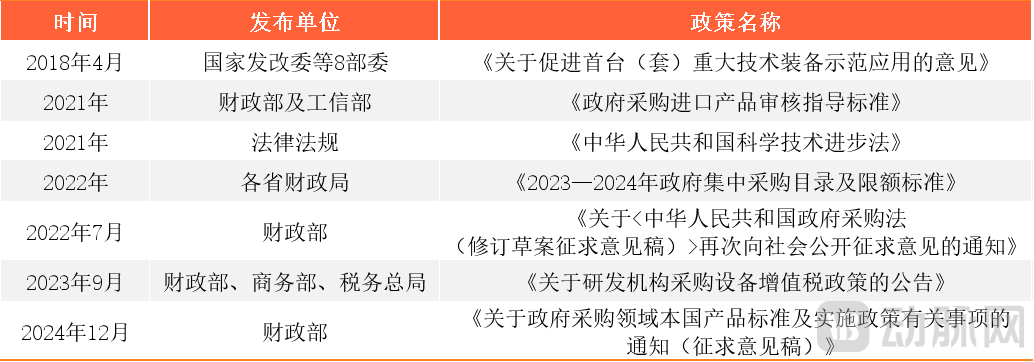
Regarding import restrictions,In 2021, the Ministry of Finance and the Ministry of Industry and Information Technology jointly issued the “Guidance Standards for Reviewing Government Procurement of Imported Products,” mandating that 100% of next-generation sequencing platforms be procured from domestic sources. In the same year, the revised “Law of the People’s Republic of China on Progress in Science and Technology” was promulgated, explicitly stipulating that government procurement should prioritize domestically produced instruments that meet functional, quality, and other performance requirements, thereby gradually enhancing the level of domestic equipment configuration in public medical institutions.
Furthermore, in 2022, provincial finance bureaus successively issued the “Catalogue and Threshold Standards for Government Centralized Procurement (2023–2024),” emphasizing that government procurement should prioritize domestic goods, construction projects, and services. Where the procurement of imported products is strictly necessary, procuring entities shall rigorously comply with review procedures as stipulated by relevant regulations. Specifically, in the field of medical devices, public healthcare institutions’ procurement of imported medical equipment will be subject to unified expert evaluation and preliminary review by the competent industry authorities.
In terms of government procurement preferences,In addition to the 20% price deduction proposed by the Ministry of Finance this time, in July 2022, the Ministry of Finance issued the "Notice on Soliciting Public Comments Again on the 'Draft Amendment to the Government Procurement Law of the People's Republic of China (for Comment)'", which clarified that government procurement shall procure domestic goods, construction, and services, except for those that cannot be obtained within the territory of China or cannot be obtained under reasonable commercial conditions, those procured for use outside of China, and those otherwise provided for by other laws and regulations. This explicitly establishes "supporting domestic industries" as a government procurement policy at the legal level.
In terms of tax incentives,In September 2023, the Ministry of Finance, the Ministry of Commerce, and the State Taxation Administration jointly issued the “Announcement on Value-Added Tax Policies for Equipment Procurement by R&D Institutions,” clarifying that, to encourage scientific research and technological development, value-added tax will continue to be fully refunded for domestically produced equipment purchased by domestic-funded R&D institutions and foreign-funded R&D centers.
Thus, it is evident that in the early stages of commercialization, China’s domestic gene sequencer industry was driven almost entirely by preferential policies.According to Illumina’s previously released semi-annual financial report for 2024, the number of newly installed units in China continued to decline during the first half of 2024. Combined with MGI Tech’s financial report for the same period, the number of newly installed next-generation sequencing (NGS) instruments under its proprietary brand has surpassed that of Illumina. This figure includes installations from equipment launched through collaborations between MGI Tech and midstream gene sequencing service providers. For domestic NGS instrument manufacturers, their status as Chinese-made products serves as a powerful weapon to counter the first-mover advantage of overseas brands.
Overseas Brands Have Begun to Fight Back
Since the approval and market launch of China’s first second-generation sequencing (SGS) product in July 2014, dozens of gene sequencers have been approved for marketing in China. Based on the origin of their core sequencing chemistry systems, these gene sequencers can be categorized into two major types: OEM (Original Equipment Manufacturer) devices and independently developed devices. Among them, OEM devices are further divided into imported OEM devices and domestically produced OEM devices. At present, while domestically produced OEM devices represent the most diverse category in the market, imported OEM devices remain the most widely adopted.
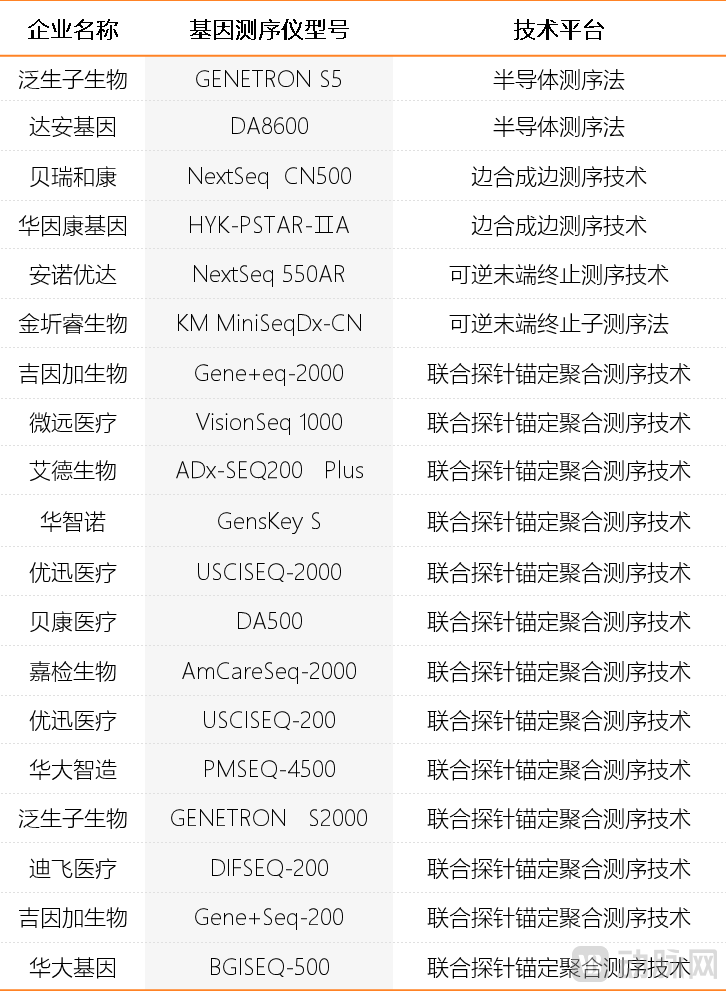
In July 2014, the former China Food and Drug Administration (CFDA), after review, approved the market launch of BGI’s BGISEQ-1000 and BGISEQ-100 gene sequencers and their associated reagent kits for the detection of fetal chromosomal aneuploidy. It is understood that the sequencing chemistry systems of these two instruments were derived respectively from Complete Genomics, which was acquired by BGI, and from Life Technologies’ Ion Torrent platform under license. Subsequently, other sequencers such as DaAn Gene’s DA8600, CapitalBio’s BioelectronSeq 4000, and Berry Genomics’ NextSeq CN500 also received approval for market launch, with their corresponding sequencing chemistry systems likewise sourced from overseas brands.
Industry analysts have observed that the history of OEM-branded sequencers among domestic gene sequencing service providers constitutes half the story of the development of domestically produced gene sequencers. Prior to the full localization of gene sequencer manufacturing, midstream gene sequencing service providers held substantial clinical resources but lacked hardware development capabilities, leaving them vulnerable to constraints imposed by upstream suppliers. Meanwhile, overseas gene sequencer brands seeking to enter the Chinese market faced significant barriers related to regulatory approval and market access. This complementarity between the two parties drove a brief period of prosperity in the OEM production of gene sequencers.
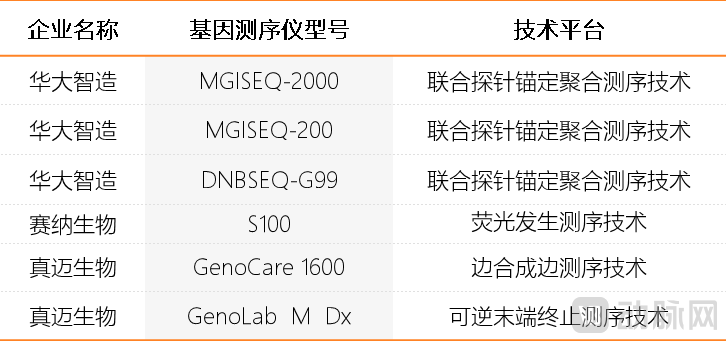
In 2015, MGI Tech launched the first commercially available domestically produced gene sequencer in China and rapidly fostered development collaborations with midstream sequencing service providers. Leading sequencing service providers with significant market shares in areas such as tumor companion diagnostics and pathogenic microorganism detection—including Genetron Health, Burning Rock Biotech, and Weiyuan Gene—partnered with MGI Tech to launch OEM-branded domestic gene sequencers.
Subsequently, as the domestic gene sequencer sector continues to expand, imported rebranded gene sequencers will become a thing of the past. However, at present, based on the market share held by midstream service providers in specific niche segments, imported rebranded gene sequencers remain the mainstay of the Chinese market. It is foreseeable that with the release and implementation of the "Draft for Comments," imported rebranded gene sequencers may lose their previous status as domestically produced products, potentially triggering a reshuffling of the rebranded gene sequencer market.
Certainly, the counteroffensive by imported gene sequencing brands should not be underestimated. In recent years, Illumina has been continuously increasing its localization efforts.2023Year8MonthEnd,illuminaAnnounced that the first batch of products from its domestic manufacturing base in China has been successfully delivered.,including desktop sequencersNextSeqTM 2000Ultra-large-scale Mass-Production Sequencing PlatformNovaSeqTM 6000Dx-CNand5ItemCN NextSeqTM 550DxClinical Application of Sequencing Reagents, etc.,Officially and Fully Accepted by Chinese ClientsBooking。It is understood that this isilluminaAllThe Third Regional Production Center,Yu2022Year8Month25officially commenced operations, with plans to gradually achieve full localization of high-end gene sequencers and consumables within five years.
Furthermore, Thermo Fisher Scientific, the parent company of Life Technologies, has been actively investing in manufacturing facilities in China, gradually relocating production lines for multiple products to local manufacturing. Whether this will subsequently extend to gene sequencer production lines remains to be seen. However,The Draft for Comments also imposes stricter requirements on overseas brands engaged in localized production, excluding various minor operational procedures from being classified as changes in product attributes.The "Draft for Comments" clarifies that changes in attributes do not include operations performed to ensure that the product maintains a certain state during transportation or storage, packaging or display for product transportation or sales, affixing or printing brands, logos, labels, and other distinguishing marks on the product or its packaging, simple painting, polishing, and repackaging, among other minor operations.
Today, gene sequencing has long since evolved from a cutting-edge research technology into a vital tool in clinical medicine. The localization of gene sequencers in China has progressed from mere technological breakthroughs to fierce market competition with top global brands. We hope to see more domestically produced gene sequencers become the true mainstay of the gene sequencing market, bolstered by preferential policies and the inherent strengths of the products themselves.