

Traditional Chinese Medicine Giant Guizhou Sanli Enters LP Arena with RMB 500 Million Biopharma Fund
On December 27, Guizhou Sanli Pharmaceutical Joint Stock (Limited) Company, a renowned traditional Chinese medicine enterprise, announced that the company and its controlling subsidiaries would jointly invest with professional investment institutions to establish the Guizhou Qianli Biomedical Venture Capital Fund Partnership (Limited Partnership) (hereinafter referred to as the “Fund”). The Fund intends to focus its investments on industries related to biomedicine, including but not limited to biotechnology, pharmaceutical manufacturing, medical devices, and healthcare services.
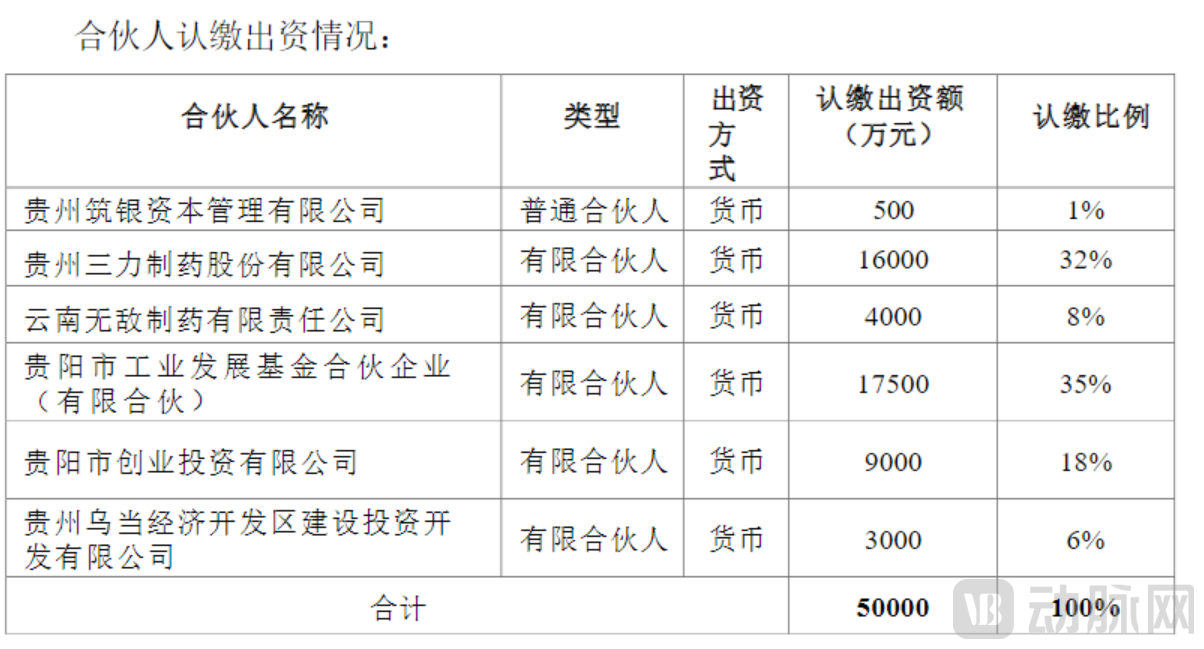
According to the announcement, the total subscribed capital contribution of the fund amounts to RMB 500 million, all in cash. The limited partners (LPs) collectively subscribe to RMB 450 million, accounting for 99.00% of the total contributions. Among them, Guizhou Sanli Pharmaceutical Joint Stock (limited) Company subscribes RMB 160 million with its own funds, representing a 32.00% stake; its controlled subsidiary, Yunnan Wudi Pharmaceutical Co., Ltd. (hereinafter referred to as “Wudi Pharmaceutical”), subscribes RMB 40 million with its own funds, representing an 8.00% stake. Zhuyin Capital, as the general partner (GP), subscribes RMB 5 million, accounting for 1.00% of the total contributions.
In its announcement, Guizhou Sanli Pharmaceutical Joint Stock (Limited) Company also stated that its participation in the establishment of the venture capital fund aims to further expand the company’s investment layout in the pharmaceutical sector by leveraging the professional expertise and resource advantages of specialized investment institutions, while simultaneously enhancing the utilization efficiency of the company’s proprietary funds.
Earlier, a number of listed companies—including Botanee, Hengrui Medicine, Yongxin Medical, Anxu Biology, Hybribio, Intco Medical, Baicheng Medicine, Baiyang Pharmaceutical, Baihua Medicine, and Dongya Pharmaceutical—had already provided capital support as limited partners (LPs) to venture capital and private equity funds seeking funding during the downturn in the capital markets. Since the beginning of this year, traditional Chinese medicine giants Pien Tze Huang and Yunnan Baiyao have also successively announced their entry as LPs, making investment arrangements focused on the traditional Chinese medicine industry, biopharmaceuticals, and related fields.
Guizhou Sanli Amidst Mergers, Acquisitions, and Integration
Guizhou Sanli Pharmaceutical Joint Stock (Limited) Company, established in 1995, is a modern traditional Chinese medicine (TCM) pharmaceutical enterprise integrating research and development, production, and sales. The company primarily focuses on the fields of pediatrics, respiratory medicine, cardiovascular and cerebrovascular diseases, and gastroenterology. Its flagship products include Kaihoujian Spray (Pediatric Formulation), Kaihoujian Spray, and Qiangli Tianma Duzhong Capsules. Notably, its core products, Kaihoujian Spray (Pediatric Formulation) and Kaihoujian Spray, are both nationally patented products. They hold a significant market share in the TCM spray market for throat disorders and have established considerable brand recognition in the areas of throat disease treatment and pediatric TCM medications.
Since its listing on the A-share market in 2020, Guizhou Sanli Pharmaceutical Joint Stock (Limited) Company has frequently engaged in mergers and acquisitions (M&A) and capital injections, achieving continuous performance growth through effective integration of acquired resources. In July of that year, the company announced plans to inject cash into Hanfang Pharmaceutical and Dechangxiang Pharmaceutical to acquire no more than 51% equity stakes in both entities. However, due to the unsatisfactory operational performance of Hanfang Pharmaceutical and Dechangxiang Pharmaceutical at the time, and to ensure the company’s normal operations, Guizhou Sanli ultimately terminated this restructuring in late October 2020.
However, Guizhou Sanli did not give up. To avoid missing out on business opportunities, less than a month after the termination of the aforementioned restructuring, Guizhou Sanli finalized a new investment plan, under which it and Sheng Yongjian, a director of the company and a shareholder holding more than 5% of its shares, jointly participated in the capital increase of Hanfang Pharmaceutical. Specifically, Guizhou Sanli contributed RMB 112 million to acquire a 25.64% equity stake in Hanfang Pharmaceutical, while Sheng Yongjian made a cash contribution of RMB 50 million to obtain an 11.46% equity stake.
Subsequently, Guizhou Sanli Pharmaceutical Joint Stock (limited) Company first acquired the bankrupt Guiyang Dechangxiang Pharmaceutical Co., Ltd. (hereinafter referred to as “Dechangxiang Pharmaceutical”), then indirectly gained control of Wudi Pharmaceutical by investing in and holding a controlling stake in Guizhou Haosite Biotechnology Co., Ltd., and included Hanfang Pharmaceutical in its consolidated financial statements in November 2023. Together with Dechangxiang Pharmaceutical, which it had invested in and taken control of in 2022, these moves unlocked the synergies of investment and M&A, achieving expansion of its product portfolio.
Earlier this month, Guizhou Sanli Pharmaceutical Joint Stock(limited)Company acquired a 22.9111% equity stake in Hanfang Pharmaceutical, a long-established pharmaceutical company in Guizhou Province, for RMB 170 million. Upon completion of this equity transfer, Guizhou Sanli will hold a 98.8039% stake in Hanfang Pharmaceutical.
The reason for such “persistence” in Hanfang Pharmaceutical lies in the traditional Chinese medicine (TCM) resources it holds. As a long-established pharmaceutical enterprise in Guizhou Province, Hanfang Pharmaceutical currently operates 10 GMP-compliant production lines and holds over 80 drug approval numbers, including 13 exclusive varieties and 13 products listed in the National Reimbursement Drug List.
From this perspective, the diversified product portfolio of Guizhou Sanli Pharmaceutical Joint Stock (Limited) Company and its controlled subsidiaries—Dechangxiang, Hanfang Pharmaceutical, and Wudi Pharmaceutical—is achieving volume growth through synergies, thereby exerting a positive impact on Guizhou Sanli’s revenue and profits.
The financial report shows that the total operating revenue from 2020 to 2023 was RMB 630 million, RMB 939 million, RMB 1.201 billion, and RMB 1.635 billion, respectively, while the net profit attributable to shareholders of the parent company reached RMB 93.9528 million, RMB 152 million, RMB 201 million, and RMB 293 million, respectively.
According to the financial report, Guizhou Sanli Pharmaceutical Joint Stock (Limited) Company recorded a total operating revenue of RMB 1.447 billion in the first three quarters of 2024, representing a year-on-year increase of 49.26%; its net profit attributable to shareholders of the parent company was RMB 194 million, up 22.89% year on year. The third-quarter financial report shows that the company’s total assets amounted to RMB 3.059 billion, an increase of 53.82% compared with the same period last year, with cash and cash equivalents totaling RMB 537 million. As of the end of the reporting period (the first three quarters), the net cash flow from operating activities was RMB 88.9617 million, a year-on-year decrease of 51.10%.
Trends in External M&A in the Traditional Chinese Medicine Industry
Amid the current wave of mergers and acquisitions in the traditional Chinese medicine (TCM) industry, a dominant trend is increasingly emerging: companies are not only focusing on strategic alliances between leading players and resource optimization within the proprietary Chinese medicine sector but are also diversifying their portfolios through various forms of cross-sector expansion into the field of biochemical innovative drugs. Guizhou Sanli Pharmaceutical Joint Stock (Limited) Company is a typical representative of this trend, while earlier entrants include TCM giants such as Pien Tze Huang and Yunnan Baiyao.
As early as 2015, Pien Tze Huang partnered with Industrial Capital, a wholly-owned subsidiary of Industrial Securities, to establish Industrial Pien Tze Huang Capital Management Co., Ltd. The registered capital was RMB 10 million, with Pien Tze Huang planning to contribute RMB 4.9 million, accounting for a 49% stake. Industrial Pien Tze Huang Capital Management Co., Ltd. planned to initiate the establishment of the Industrial Pien Tze Huang Healthcare Equity Investment Fund (Limited Partnership), with a fund size of RMB 500 million, primarily targeting investments in promising companies within the healthcare sector. As a limited partner in the fund, Pien Tze Huang planned to subscribe for RMB 85.1 million, with an initial contribution of 50%.
In March 2023, Zhangzhou Pien Tze Huang Investment Management Co., Ltd., together with Yinke Capital and Jiangxi Jiangtou Private Equity Fund, jointly initiated the establishment of the “Pien Tze Huang Yinke Life and Health Industry Fund.” The fund is planned to have a scale of RMB 1 billion, primarily making direct or indirect equity investments in projects within the traditional Chinese medicine industry, biopharmaceuticals, medical devices, healthcare services, and related sectors.
In September this year, Pien Tze Huang announced that its wholly-owned subsidiary, Pien Tze Huang Investment, jointly established the Zhangzhou Yuanshan Big Health Industry Investment Fund Partnership (Limited Partnership) (hereinafter referred to as the "Yuanshan Fund") with Zhangzhou Zhanxin Venture Capital Fund Management Co., Ltd., Zhangzhou Pien Tze Huang Asset Management Co., Ltd., Zhangzhou Industrial Equity Investment Co., Ltd., and Zhangzhou Tourism Investment Group Co., Ltd. Among them, Pien Tze Huang Investment subscribed for a capital contribution of RMB 200 million using its own funds, accounting for 20% of the fund.
Another pharmaceutical giant, Yunnan Baiyao, is also making significant moves. At the end of last month, Yunnan Baiyao announced its plan to jointly establish an industrial fund with BOC International Investment Co., Ltd. (hereinafter referred to as "BOC International Investment"). The total target committed capital will be RMB 7 billion, with the company contributing RMB 5 billion and BOC International Investment contributing RMB 2 billion. The fund will focus on strategic investments in the traditional Chinese medicine industry through a model combining direct investments and sub-funds.
These moves to establish investment funds are also regarded by the industry as a precursor to mergers and acquisitions. According to 21st Century Business Herald, industry insiders point out that listed companies hope to use external investment funds as an extension of their outward growth strategy; if the invested enterprises perform well, they may ultimately become acquisition targets for the listed companies.
This year, the trend of external mergers and acquisitions in the traditional Chinese medicine (TCM) industry has become more pronounced. Kangyuan Pharmaceutical and Lingrui Pharmaceutical have successively announced acquisitions of biopharmaceutical and chemical pharmaceutical companies, marking their entry into the innovative drug sector; meanwhile, China Resources Sanjiu has taken control of the TCM enterprise Tasly with a RMB 6.2 billion investment.
Reference Article:
1. Guizhou Sanli’s M&A “Expansion Strategy.” Beijing Business Today
2. Intelligent Manufacturing Empowers Guizhou Sanli’s “Legacy Drugs” to Rejuvenate with New Vitality. Shanghai Securities News
3. Intense M&A Activity in the Traditional Chinese Medicine Industry: Multiple Companies Expand into Biochemical Innovative Drugs Through Cross-Sector Diversification – 21st Century Business Herald