

Wuhan Yangsen Announces Breakthrough Clinical Data for Its Novel Polycarbonate Polyurethane Artificial Blood Vessel, Achieving Global Leadership
Recently, preliminary clinical study data from Dr. Ouyang Chenxi, Chief Physician at the Vascular Center of Fuwai Hospital, Chinese Academy of Medical Sciences, and his team demonstrated that large-diameter synthetic vascular grafts made from novel composite polycarbonate polyurethane outperformed traditional synthetic grafts in multiple dimensions, including mechanical properties, hemocompatibility, and anti-permeability to blood, during the First-in-Human (FIM) clinical trial conducted at Fuwai Hospital. This study was published in a renowned international journal《Journal of Endovascular Therapy》 HomepageAbove, the paper is titled “Perioperative Outcomes: Polycarbonate Polyurethane Artificial Blood Vessel Versus Polyester Artificial Blood Vessel”.
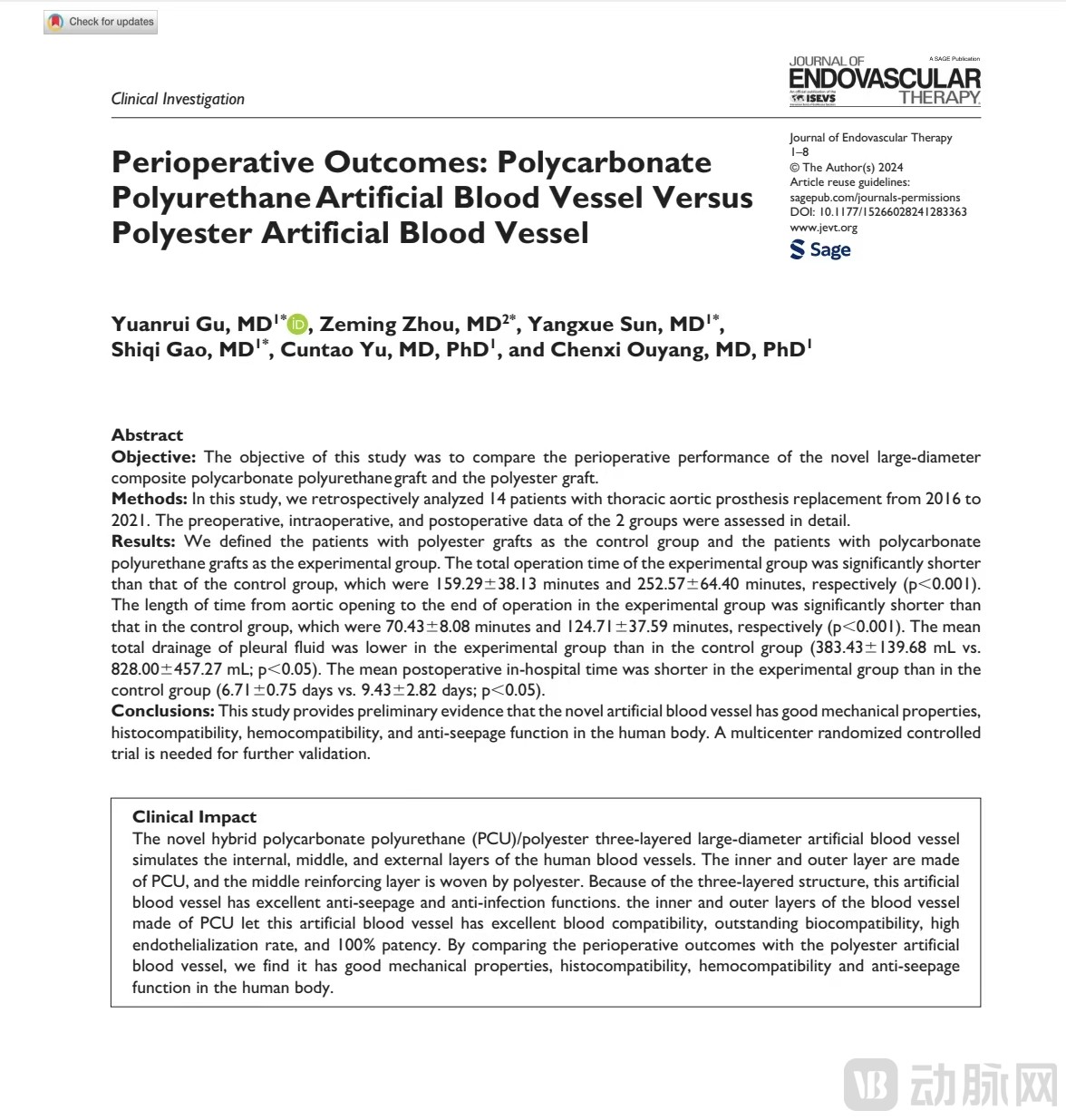
Screenshot of the paper (provided by the interviewee)
It is worth mentioning that,This large-diameter artificial blood vessel, made from the world’s first novel polyurethane material, was independently developed by Wuhan Yangsen Biotechnology Co., Ltd. (hereinafter referred to as “Wuhan Yangsen”), founded by Ouyang Chenxi.In 2008, Professor Ouyang, then practicing as a vascular surgeon, developed the world’s first polyurethane composite “three-layer biomimetic structured artificial graft.” This innovation broke the sixty-year global monopoly held by artificial vascular products primarily made of polyester and expanded polytetrafluoroethylene (ePTFE), and earned him the Second Prize of the National Technology Invention Award in the same year.
Subsequently, in 2009, Professor Ouyang founded Wuhan Janssen, a company dedicated to the research and development of artificial blood vessels. After nearly 15 years of arduous entrepreneurship, the company finally gained recognition from international experts, backed by a solid research foundation and comprehensive clinical data. The disclosure of these achievements has also attracted the attention of the Beijing municipal government, which has extended an olive branch. VCBeat has learned from the company thatWuhan Janssen also has plans to relocate its headquarters to Beijing in the near future., they hope to leverage Beijing’s resources and advantages as a national center for scientific and technological innovation to further advance the development of the high-end medical device sector.
Excellent Clinical Performance of Novel Artificial Blood Vessels
Since Wuhan Janssen successfully patented the “three-layer biomimetic artificial blood vessel” in 2006, it has developed large-diameter artificial blood vessels—including straight, curved, and sinus-type grafts—to address clinical challenges, as well as a small-diameter artificial blood vessel specifically designed for coronary artery bypass grafting.
This trial, however, utilized a therapy targeting aortic vascular diseases.Large-Diameter Artificial Blood Vessels. The team conducted a retrospective analysis of the clinical data from 14 patients who underwent thoracic aortic prosthetic graft replacement at Fuwai Hospital between 2016 and 2021, and drew conclusions by thoroughly evaluating the preoperative, intraoperative, and postoperative data of two groups of patients who received different types of prosthetic grafts.
First,The total operative time for cardiac and great vessel surgery using novel polyurethane vascular grafts was significantly shorter than that in the control group using imported Dacron vascular grafts.(P<0.01). The average operative time for traditional polyester vascular grafts is 4 hours, whereas the novel domestically produced polyurethane artificial vascular graft requires only 2.5 hours. This not only significantly improves surgical efficiency and reduces costs, but also mitigates surgical trauma to patients. Additionally,The mean postoperative hospital stay was also reduced by 3 days compared with the control group.(P < 0.05). Meanwhile, inThe mean total drainage volume of pleural effusion in the novel artificial blood vessel group was only one-third of that in the control group.
Results from the FIM study demonstrate that the novel polyurethane vascular graft exhibits in the human bodyExcellent mechanical properties, histocompatibility, hemocompatibility, and anti-hemorrhagic properties. However, further validation through multicenter randomized controlled trials is still required.
From the perspective of clinical practice, novel artificial blood vessels will bring significant benefits to both physicians and patients. First, the substantial reduction in operative time not only lowers medical costs but also effectively minimizes surgical trauma, thereby facilitating postoperative recovery. In aortic surgery, extracorporeal circulation is an essential component. Compared with traditional artificial blood vessels, novel artificial blood vessels can reduce the duration of extracorporeal circulation from an average of 4 hours to less than 2.5 hours, effectively alleviating the physiological burden on patients.
Secondly, the superior anti-permeability of novel artificial blood vessels can reduce the learning curve for aortic surgery and increase the adoption rate of cardiovascular procedures. According to Frost & Sullivan, only 57,300 cardiovascular surgeries were performed in China in 2022, while the potential patient population reached as high as 347,600 (calculated based on the total number of patients with Type A and Type B aortic dissection and aortic aneurysm). This discrepancy is primarily due to the technical complexity of cardiovascular surgery, which poses significant challenges in hemostasis, making it difficult for some primary-care hospitals and junior surgeons to master the procedure. Material innovations in novel artificial blood vessels have effectively reduced intraoperative bleeding, lowered surgical difficulty, and enhanced safety, thereby facilitating the broader adoption of these surgical techniques and enabling more patients to benefit from advances in medical technology.
Finally, from the patient’s perspective, the use of novel artificial vascular grafts can reduce the average length of hospital stay by approximately three days. According to Professor Ouyang’s estimates, this could save patients nearly 30,000 yuan in medical expenses, significantly alleviating their financial burden. It also further improves hospital admission rates, helping to mitigate the difficulty of accessing medical care.
Professor Ouyang stated, “Since the first clinical trial in 2020, the novel artificial blood vessel has received favorable feedback,”No adverse cases have been reported to date.. In the future, Wuhan Janssen will continue to advance clinical trials, with the aim of bringing the novel artificial blood vessels to market as soon as possible.”
Three-Layer Structural Artificial Vascular Graft Technology Empowers Cardiovascular Products
The exceptional clinical performance of novel artificial blood vessels is primarily attributed to innovations in their materials.
Prior to Wuhan Janssen’s proposal of polyurethane composite materials in 2008, large-diameter artificial blood vessels had always been made usingPolyesterMaterials. Polyester exhibits strong mechanical properties and biocompatibility, enabling it to withstand pulsatile blood pressure and ensure the long-term safe use of artificial blood vessels. Additionally, its favorable heat resistance and corrosion resistance, along with ease of suturing and handling, have consistently established it as the optimal material for artificial blood vessels.
However, in nearly six decades of practice, clinicians have found thatPolyester materials exhibit poor resistance to blood seepage., which not only makes intraoperative hemostasis difficult but may also lead to thrombosis in severe cases, posing potential risks to patient health. More critically, polyester fails to undergo rapid endothelialization after implantation, which may result in vascular stenosis and embolism, thereby compromising the long-term patency and safety of small-diameter vascular grafts.
For various reasons, the field of artificial blood vessels urgently needs a new material to break this impasse. With the continuous iteration of biomaterials,Polyurethaneentering the public eye. Although polyurethane exhibits good resistance to blood seepage, it also has relatively obvious drawbacks,such as poor mechanical properties and poor processing flowability, making it unsuitable for long-term use. Therefore, although many believe from a theoretical standpoint that polyurethane will become the new material for future artificial blood vessels, no team has yet succeeded in practical application.
In response to this issue, Wuhan Janssen boldly proposed“"Three-Layer Biomimetic Structure Artificial Blood Vessel". Human native blood vessels are divided into the intima, media, and adventitia layers. Following this anatomical structure, Wuhan Janssen has designed a three-layered artificial vascular graft, with an inner layer made of polyurethane for improved hemocompatibility, a middle layer composed of polyester fabric to enhance mechanical properties, and an outer layer also made of polyurethane.
The three-layer material combines the strengths of each component,It ensures mechanical support and flexibility, while also demonstrating characteristics such as prevention of needle-hole bleeding, excellent anticoagulant properties, and non-adhesion to surrounding tissues.
Triple-layer vascular grafts have demonstrated significant advantages in the field of artificial blood vessels. Professor Ouyang further emphasized, “The technology of triple-layer biomimetic structured artificial blood vessels is not limited to this domain; it holds broad application prospects and heralds greater potential for future innovation.”
withArtificial Heartas an example. Currently, artificial hearts still use polyester as the vascular material. Although this material has excellent suturing properties, it still suffers from blood leakage issues, which may cause the artificial vessel to be compressed by exuded proteins, ultimately leading to artificial heart failure. In addition, blood leakage also poses a risk of infection in the artificial vessel, resulting in serious postoperative complications and other sequelae, thereby affecting the performance of the artificial heart.
By employing a “three-layer biomimetic artificial blood vessel,” the artificial heart can effectively mitigate excessive bleeding, reduce the complexity of implantation and the likelihood of postoperative complications, thereby offering patients a superior therapeutic solution.
Furthermore,Covered StentThe same issues persist. Traditional covered stents utilize polyester (Dacron) membranes; however, this material is prone to collapse under increased intraluminal pressure and exhibits relatively high leakage rates. These drawbacks can lead to complications such as catheter malfunction, catheter-related infections, and central venous stenosis. Furthermore, the insufficient fatigue resistance of polyester may result in weakening or rupture of the graft covering during long-term use, potentially causing in-stent restenosis due to neointimal hyperplasia or aneurysm formation, thereby endangering patient safety. The adoption of novel artificial vascular technology can effectively address these critical challenges.
Therefore, in Professor Ouyang’s view, the “three-layer biomimetic structure artificial blood vessel” technology is poised to bring about revolutionary changes in enhancing the performance and safety of artificial hearts and stent grafts.
Landing in Beijing, Wuhan Janssen Sets Sail Overseas
Currently, Wuhan Janssen is actively advancing clinical trials for multiple artificial blood vessel pipelines, with the aim of bringing its products to market as early as possible. In the future, the team will continue to develop innovative products based on its three-layer artificial blood vessel technology, such as valve products with integrated artificial blood vessels, to reduce the complexity of aortic valve surgery and improve healthcare accessibility.
In 2024, Beijing introduced a series of favorable policies to support medical innovation, implementing sweeping reforms in areas such as optimization of approval processes, promotion of clinical application, review and approval, and manufacturing. For companies dedicated to medical innovation, such as Wuhan Janssen, this sends a clear positive signal: Beijing is creating a more conducive policy environment to foster the development and application of medical innovations.
Moreover, as a hub for talent and an open platform for collaboration, Beijing’s inherent advantages have provided fertile ground for medical innovation.For various reasons, Wuhan Janssen has decided to relocate its headquarters to Beijing., to accelerate the Company’s R&D and commercialization of high-end medical devices, particularly in the field of artificial vascular technology. Leveraging Beijing’s favorable policy environment, scientific research resources, and market potential, Wuhan Janssen remains committed to medical innovation with the aim of achieving greater breakthroughs. Furthermore, by establishing a presence in Beijing, Wuhan Janssen can strengthen collaborations with research institutions and universities, thereby promoting industrial upgrading and economic growth, and injecting new momentum into Beijing’s medical innovation and industry development.
While expanding its presence in the Chinese market, Wuhan Janssen has also keenly focused onOverseas Marketsdemand. In recent years, the rising prevalence of cardiovascular diseases in the United States has fueled the growth of the artificial blood vessel market. Market analysis estimates that the global market size for artificial blood vessel replacement was $513 million in 2023 and is projected to reach $1.078 billion by 2032. Wuhan Janssen’s artificial blood vessel products are characterized by their forward-looking design and technological leadership, instilling confidence in the company regarding overseas markets. Currently, Wuhan Janssen is preparing to simultaneously apply for FDA and CE certifications, with plans to establish a presence in Europe and the United States by 2028, allowing more patients to benefit from the dividends of Chinese innovation.