

iFLYTEK Health Becomes the First Medical Large Model Company Listed in Hong Kong

Xunfei Healthcare
Developer of Intelligent Medical Service Platforms
On December 30, 2024, IFLY TEK, the first listed company specializing in large medical AI models, began trading on the Hong Kong Stock Exchange, becoming the only enterprise this year to complete its spin-off from an A-share listing and list in Hong Kong after filing with the China Securities Regulatory Commission.
As of press time, iFlytek Healthcare’s share price stood at HK$94.8, up 14.49%, with its real-time market capitalization exceeding HK$11.46 billion.
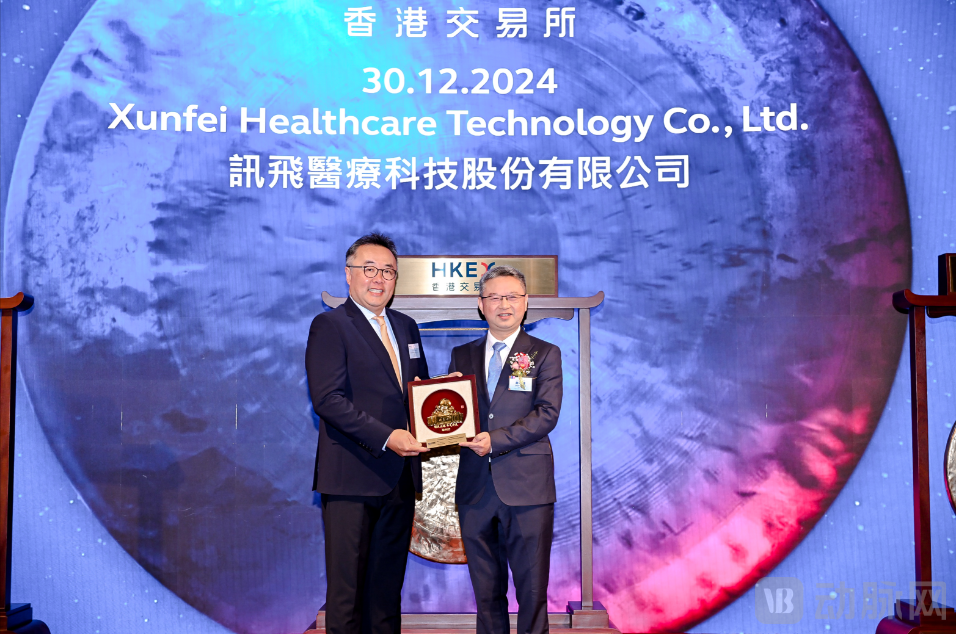
Dr. Wu Xiaoru, President of iFLYTEK, and Tao Xiaodong, General Manager of IFLY TEK and Executive Director, jointly rang the opening bell
After eight years of dedicated development, IFLY TEK has built a full-stack smart healthcare ecosystem based on large language models, comprising four major modules: services for primary healthcare institutions, hospital services, patient services, and regional management platform solutions. This ecosystem not only digitally empowers every aspect of medical operations and management but also provides patients with intelligent services throughout the entire diagnosis and treatment process.
In terms of commercialization, IFLY TEK has successively established mature payment relationships with hospitals, patients, health commissions, and medical insurance bureaus, thereby completing the construction of a diversified business model. In 2021, 2022, 2023, and the first six months of 2024, IFLY TEK generated revenues of RMB 372 million, RMB 472 million, and RMB 556 million, respectively, with annual growth rates of 26.88%, 18.80%, and 19.80%. Despite the economic downturn, the company has maintained a growth rate far exceeding the industry average.
Frost & Sullivan data shows that between 2022 and 2023, IFLY TEK’s revenue scale ranked first consecutively in China’s medical artificial intelligence industry, successfully defending its top position.
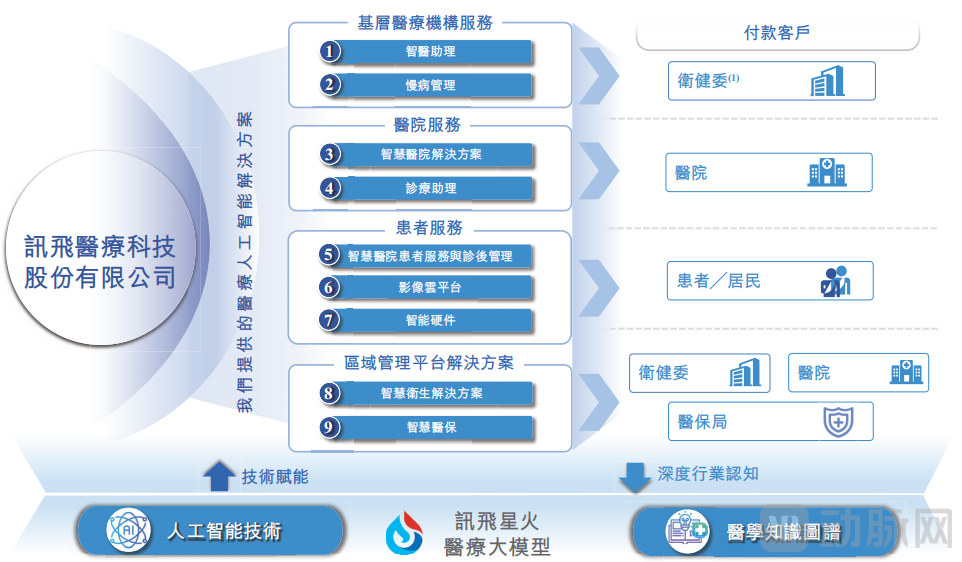
Schematic Diagram of IFLY TEK Healthcare Service System
IFLY TEK’s consistent top-tier performance in the fiercely competitive arena of medical AI is driven not only by its technology and solutions, but also by its keen insight into industry trends and transformation.
IFLY TEK was established in 2016. At that time, concepts such as the coordinated reform of medical care, health insurance, and pharmaceuticals (“three-medical linkage”) and tiered diagnosis and treatment had been proposed for many years, yet the situation remained unchanged: large hospitals were overcrowded, while small clinics saw few patients.
The underlying cause is that the inadequate infrastructure of primary healthcare facilities is the main factor limiting policy implementation. On one hand, physicians in these institutions are limited in number and competence, making it difficult to establish trust with patients. On the other hand, the lagging level of informatization in primary care prevents information interoperability with tertiary hospitals. When patients are referred from primary care institutions to tertiary hospitals, they incur additional medical costs due to duplicate testing and procedures, while also consuming significant amounts of time, thereby negatively impacting their healthcare experience.
Addressing this critical pain point, IFLY TEK initially leveraged Clinical Decision Support Systems (CDSS) as a strategic entry point to develop an AI-powered next-generation general practice CDSS. This system creates a virtual assistant equipped with comprehensive general medical knowledge to support primary care physicians in diagnosis and treatment. Subsequently, through collaborations with regional health commissions across multiple areas, IFLY TEK helped establish standards for electronic medical records in primary care, thereby facilitating the regional rollout of its general practice CDSS solution, “Intelligent Medical Assistant.”
In this way, IFLY TEK has not only addressed the challenges of medical quality faced by numerous primary healthcare institutions and facilitated interoperability between primary care providers and higher-level medical institutions, but also identified a practical foothold for the commercialization of medical artificial intelligence, thereby promoting the healthy development of the industry.
As of December 2024, iFLYTEK Healthcare’s primary care medical service products had been deployed in 610 districts and counties across more than 30 provinces, with its intelligent solutions adopted by over 60,000 primary healthcare institutions. In terms of revenue, iFLYTEK Healthcare ranked first in China’s Clinical Decision Support System (CDSS) market for primary healthcare institutions in 2023, capturing a 61.5% market share.
Although the optimal application scenario for artificial intelligence lies in primary healthcare, the most viable payers remain tertiary hospitals. Therefore, after refining its products and achieving initial market penetration, IFLY TEK swiftly adjusted its strategy to incorporate smart hospital enablement into its product portfolio.
Based on the data provided in the prospectus, IFLY TEK’s hospital-centric layout can be divided into two segments: hospital services and patient services. Both segments are closely aligned with national policies on patient services and imaging interoperability.
Hospital services consist of two modules: the Smart Hospital Solution and the Clinical Diagnosis and Treatment Assistant. The former is patient-centric, providing an intelligent triage system and a medical history collection system during the pre-consultation phase to enhance patients' efficiency and convenience in seeking medical care. The latter is tailored for physicians, featuring a voice-based EMR generation tool for use during consultations, along with general practice and specialty-specific Clinical Decision Support System (CDSS) tools, and an AI-powered comprehensive case quality control system. These features aim to improve both physicians' work efficiency and the quality of medical services.
In contrast, the elements of patient services are more diversified, covering three modules: smart hospital patient services and post-diagnosis management (including the IFLY TEK Xiaoyi App and mini-programs), the imaging cloud platform, and medical devices, with a focus on patient empowerment. Taking post-diagnosis management as an example, patients can use the intelligent platform developed by IFLY TEK to communicate with doctors in real time, upload medical records after discharge, receive medication reminders, and conduct self-assessments. Meanwhile, this platform also facilitates doctors in collecting and analyzing data related to patient recovery or changes in condition, allowing for timely adjustments to treatment plans and achieving truly personalized therapy.
From the breakdown of revenue, IFLY TEK’s transformation strategy has proven highly successful, with businesses targeting tiered hospitals in the areas of hospital services and patient services gradually becoming the main drivers of revenue over the past two years. Notably, in the first six months of 2024, year-on-year growth rates for hospital services and patient services reached 160% and 138%, respectively, both surpassing the revenue generated from primary healthcare services.
A set of data in the prospectus may more intuitively demonstrate the current implementation status of IFLY TEK Healthcare: As of December 2024, IFLY TEK Healthcare had cumulatively provided over 877 million AI-assisted diagnostic suggestions, standardized 340 million medical records, and corrected diagnoses in more than 1.5 million valuable medical records following alerts from its Intelligent Doctor Assistant system. Furthermore, IFLY TEK Healthcare’s hospital services have covered more than 500 tiered hospitals in China, with nearly half of the top 100 hospitals in the country having deployed IFLY TEK Healthcare’s intelligent products.
In the era of large language models, iFlytek Healthcare’s competitive advantage is expanding further.
As the sole enterprise involved in formulating the “Technical Evaluation System and Standard Specifications for Large Medical Models,” the iFlytek Spark Medical Large Model is applied to over 300 medical scenarios, capable of deeply understanding various medical knowledge and providing rapid and accurate diagnostic and treatment recommendations based on medical inquiries.
Following multiple rounds of iteration, the iFlytek Spark Medical Large Model has been updated to version 2.0. Its understanding of medicine has been further deepened, and its scope of empowerment has expanded from patient services to clinical departments, achieving a new round of upgrades in both model capabilities and application scenarios. According to third-party testing data from CTTL (part of CAICT), the iFlytek Spark Medical Large Model has undergone rigorous evaluation and surpassed GPT-4 Turbo in six medical-related NLP task dimensions: expert-level medical knowledge graph question answering, clinical language understanding, medical document generation, disease diagnosis and treatment recommendations, multi-turn medical dialogue generation, and multimodal interaction.
The value of the new model is evident through its practical applications in the field of smart imaging.
As China’s leading imaging cloud platform in terms of application scale, the Anhui Provincial Imaging Cloud Platform serves over 1,970 medical institutions and more than 3,200 registered experts, having delivered nearly 8.4 million remote consultation services and recorded over 112 million data upload service transactions.
After integrating the Xinghuo Medical Large Model into Anhui Province’s Provincial Imaging Cloud Platform, it empowers all scenarios of imaging diagnosis and treatment. In the intelligent quality control phase, it assists imaging technologists in rapidly assessing image quality and promptly correcting examination issues. In the intelligent diagnosis phase, it helps radiologists quickly generate diagnostic reports, providing explanatory traceability and multi-phase comparisons. In the intelligent image interpretation phase, it incorporates a medical imaging large model to assist clinicians in formulating diagnosis and treatment plans through interactive Q&A, thereby comprehensively enhancing the quality and efficiency of medical care across Anhui Province.
Furthermore, IFLY TEK, in collaboration with the Health Commission of Anhui Province and the State Key Laboratory of Cognitive Intelligence, has launched an open cooperation initiative for a full-spectrum, multi-modal large medical imaging model. This initiative aims to bring together the world’s leading AI research teams in medical imaging for co-development and innovation, ultimately achieving end-to-end coverage from data platforms and algorithm platforms to research projects and application commercialization, thereby accelerating the realization of the applied value of large medical imaging models.
Over the past decade, digital health technologies have focused on “enhancing quality and improving efficiency,” aiming to disrupt traditional healthcare workflows. In practice, however, many companies offer product portfolios with limited breadth and depth; while they have managed to improve quality to some extent, they have fallen short in boosting efficiency, failing to become an indispensable “must-have” for which healthcare providers are willing to pay.
Today, IFLY TEK leverages its large language models and related smart applications to not only optimize diagnostic and treatment efficiency in primary care settings and tiered hospitals, but also effectively enhance physician productivity, reduce medical errors, and lower the additional costs associated with such errors, thereby delivering tangible benefits to healthcare institutions.
IFLY TEK has vast untapped potential, particularly at the clinical level, where numerous medical departments and workflows remain to be empowered and optimized by large language models to enhance quality and efficiency.
Now entering the secondary market, we may see IFLY TEK accelerate its R&D with ample financial support, enabling more medical scenarios to rapidly enter the era of large language models and allowing more patients to benefit from advancements in digital technology.